Who really created the Son of God?

  • Welcome to Christian Forums, a Christian Forum that recognizes that all Christians are a work in progress.

    You will need to register to be able to join in fellowship with Christians all over the world.

    We hope to see you as a part of our community soon and God Bless!

Status
Not open for further replies.

JustMe

Well-Known Member
May 6, 2025
1,172
1,333
113
US
Faith
Christian
Country
United States
Gender
Male
Here's a quick subject summary/ commentary, one of many apparently that someone deliberately determined I neglected to respond to in a timely way, in one of their posts.

The tune is called or about ' Jesus is worshipped by angels.' So now the sky must fall and everything changes. Not at all. It's just a case of ignorance and laziness of those not wanting to really understand the subject, especially if their core belief system depends upon it.

Let me play it...

The worship of Yeshua by the angels​

The amazing and yet self-inflicted difficultly in understanding the word ‘worship’ as used in the Bible.

Many have found scripture that says we worship God and even Yeshua, his Son, and therefore the son is at least divine if not God aswell. They hang their hats on the English translated word from Hebrew and Greek words for ‘worship’ considered exclusive acts only for God and Yeshua.

The association with the word worship for both God and his Son creates unnecessary faulty logic, that this word worship is the link to Yeshua’s divinity and being God.

  • The Hebrew word shachah and the Greek word proskuneo account for more than 80% of the appearances of the word “worship” in most English versions of the Bible, so these two words are at the center of attention.
  • Both of these words mean ‘to bow down” and similar meaning words, of a few.
  • For the Hebrew word shachah, it means ‘bowing down’ or’ prostrating oneself’ usually before a human superior or God.
  • For the Greek word proskuneo, ‘pros’ means towards and ‘kuneo’ means to kiss. It means to literally kiss the hand towards someone as a token of reverence.
  • Examples: Lot worshipped the strangers who came to Sodom. He spread out to the ground to show his respect for them.(Gen 19:1). Moses worshipped his father-in-law whom he respected and honored (Ex 18:7). There are many more examples where all mean to honor another person, he would bow down or fall down (worship) before them. That was the custom, that was the culture. And this custom of common worship of this visible outward act between other people revealed the inner heart of respect and honor.
  • So why do we use the English word ‘worship’ at all in the Bible? The English origin of the word means worthiness for the word ‘weorthscipe.’ They are worthy to be worshipped.
  • As the background has now been set, now here’s why there’s poison in this soup. There are many variations of these Hebrew and Geek words when translated in English text of the bible. Translators have created their own logic. Many translators in many versions of the Bible, when associated between one person to another, translate the words consistently as “bow down” or of similar language. And when these two words of the Hebrew and Greek are used before God or his Son, they, nearly all prefer using these words as ‘worship.’ So then many misunderstand the word ‘worship’ today. They then say that Yeshua must be God because he is worshipped as God. And yet when God alone is the subject of worship, and his Son truly worships his Father, the translators were careful not to use the word ‘worship.’ They uses a phrase of ‘bowing down’ as if the Son was the same God as his Father (Matt 26:39).
  • Now it is obvious that not only God or Jesus are worshipped, but many men are also worshipped as well. People worshipping Jesus does not make him God any more than Abraham bowing down before the Hittites makes them God.
  • The translators need to be consistent within all scripture and where the Greek and Hebrew is used: either all translated as 'worship' or all translated into English as 'bowing down' or something of the same effect.
  • Anyone worthy or deserving honor and respect and also obedience, given by a sincere heart should be worshipped.

And then it is appropriate for Yeshua to also be worshipped, as God provided commanded it to all his creation for his Son, for he is worthy. and ultimately for his Father's own glory.

And this study shows again that Yeshua, being worshipped (and many today do not even bow down or collapse to the ground either), really means showing honor and respect and obedience as to a King, or Son of God, or a man worthy of such an act.

And it still does not make Yeshua divine or God either..as an appropriate chorus line.
 
Last edited:
  • Love
Reactions: Wrangler

shepherdsword

Encounter Team - Eagle
Staff member
Encounter Team
Feb 12, 2009
2,034
1,631
113
Millington
Faith
Christian
Country
United States
Gender
Male
JLB, I would like to leave you with more on the history of 1 Timothy 3:16 as @dak already pointed to, in his post. Keep it for future reference. I generated this years ago and improved upon it a bit. I really hope you can understand it, even after a few reads.

Thanks

-----------------------------------------------------

1 Timothy 3:16​

This verse is set as a creed as a hymn in poetic language.

The controversy centers around the use of the word ‘God’ or ‘who’ or ‘which, or ‘He.’ Now the message of the verse really does not alter by using any of the choices, although some will take the opportunity if the word is ‘God’ as the more acceptable word, as proof that Yeshua, the Son of God is also God the Son. And fail to realize the point of the verse is about Yahshua's’ life of godliness, shown in segments.

If God is used it surely does NOT mean God the Son is revealed in the flesh. It can mean that since God was in his Son, then his Father who is God was revealed through his Son, who was born human person. And if one of the other three choice of words was the best fit, then it would clearly reveal Yeshua the human being as part of the theme of godliness. And thus indicating his natural and yet unique method of creation.

Now from the start it must be said that the use of the word 'God' was a later insertion into the verse.

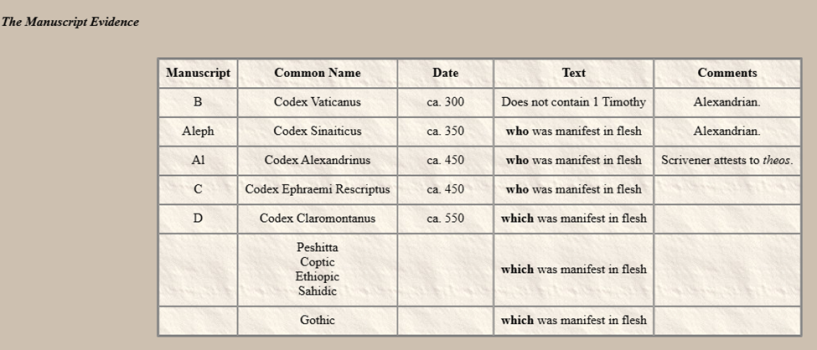
The majority of modern critical editions of the Greek New Testament, such as the Nestle-Aland and United Bible Societies' texts, favor the reading "He who was manifested in the flesh" or "Who was manifested in the flesh" based on the earliest extant manuscripts, including Codex Sinaiticus, Codex Alexandrinus, and others.

“God was manifested in flesh” is what we still have in the Textus Receptus but they who follow the Westcott & Hort / Nestle text do not have it.

In An Historical Account of Two Notable Corruptions of Scripture (posthumously published in 1754), Isaac Newton argues that a small change to early Greek versions of this verse effectively changed "which" (referring to godliness) was changed to "God". This change increases textual support for trinitarianism, a doctrine to which Newton did not subscribe. There is evidence that the original Greek read 'ος' but was modified by the addition of a strikethrough to become 'θς' (see the excerpt from the Codex Sinaiticus, above). 'θς' was then assumed to be a contraction of 'θεος.' The biblical scholar Metzger explains, "no uncial (in the first hand) earlier than the eighth or ninth century (Ψ) supports θεος; all ancient versions presuppose ὃς or ὃ; and no patristic writer prior to the last third of the fourth century testifies to the reading of θεος."[24] In other words, Bible manuscripts closest to the original said 'who' and not 'God' in verse 16.

[ Source for paragraph above : First Epistle to Timothy - Wikipedia ]

The difference between these two readings has nothing to do with anyone wanting to "weaken the relationship between Father and Son"; it is simply a statement of fact consistent with the textual philosophy of the particular version being used. More specifically:

  1. If we accept that earlier manuscripts are more likely to have the original text, then we essentially arrive at the UBS5/NA28 text. In 1 Tim 3:16 this gives "he/who" uniformly for all early MSS
  2. If we accept the much later Byzantine text, then we essentially arrive at the Robinson-Pierpoint text (quite different from the TR but similar to the majority text). In 1 Tim 3:16 this gives "God".
The evidence from a number of Greek texts and textual authorities clearly indicates that the word “God” (theos in the Greek) was not originally in this verse. The King James Version was translated from the Stephens Greek text; and the Stephens Greek text does have in this verse the word theos, from which “God” was accurately translated. However, in Jesus Christ Is Not God, page 33, Dr. Victor Paul Wierwille reveals that in all the critical Greek texts other than Stephens, the masculine relative pronoun hos appears, instead of the word theos. These critical texts are documented in a note at the bottom of page 543 in The Interlinear KJV Parallel New Testament in Greek and English by George Ricker Berry. As noted in place of theos, these texts all have hos, meaning “who.”
The Companion Bible adds the understanding that it’s probable that an earlier reading was the neuter pronoun ho (which), to agree with mustērion, the Greek word translated “mystery,” which is also neuter. This agrees with the Syriac Version and all the Latin Versions….[1]

1 Timothy 3:16 in Codex Alexandrinus​

Reproduced below is the text of 1 Timothy 3:16–4:3 from Codex A, as presented in the photographic facsimile volume published by the British Museum in 1879. Of particular interest here is the reading in 3:16, where it may be seen that the manuscript reads ΘC "God was manifested in the flesh," employing the usual abbreviation ΘC for ΘEOC, with a stroke over the letters to indicate an abbreviation. However, textual critics believe that the ink in the center of the Θ and the stroke above were added by a corrector in modern times. Reasons for this belief are the color of the ink, and the fact that a "dot" has been placed in the Θ instead of a line. Tregelles writes, "The ink in which this has been done in A is sufficiently modern and black to declare its recent application" (An Account of the Printed Text of the Greek New Testament, London, 1854). Without these marks, the manuscript originally read ΟC "He who was manifested in the flesh." In the photograph below the ΘC in 3:16 is circled. Further down, in verse 4:3, there is another ΘC circled for comparison. Click on the circled areas for a larger view.[2]

View attachment 74828


View attachment 74829

[1] (Way, 2021)
[2] (1 Timothy 3:16 in Codex Alexandrinus)
Didymus the Blind (313–398 AD) and later fathers like Gregory of Nyssa and John Chrysostom did quote 1Tim 3:16 with the reading "God" (Theos)
This is in perfect harmony with John 1:1, John 1:14, and Titus 2:13, to establish the Word's divinity.
 
Last edited:

JustMe

Well-Known Member
May 6, 2025
1,172
1,333
113
US
Faith
Christian
Country
United States
Gender
Male
Didymus the Blind (313–398 AD) and later fathers like Gregory of Nyssa and John Chrysostom did quote 1Tim 3:16 with the reading "God" (Theos)
This is in perfect harmony with John 1:1, John 1:14, and Titus 2:13, to establish the Word's divinity.
Lovely, another desperate soul trying to force any verses he can find to force them into an unnatural relationship, and with 1 Tim 3:16

Yes, I would not be surprised that all these persons you mentioned used theos instead of a pronoun for Christ in 1 Timothy 3:16. The Trinity was firmly in place by force in the later 4th Century. Just because they quoted theos from whatever source does not make it accurate or correct, especially after 398 AD.

Here's some more data. I would check it out for yourself.

----More Manuscripts that reveal no theos present in 1 Timothy 3:16----

1767319179129.png


This verse word of theos is known to be a forgery, although consideration should be taken as many scholars do, that this alteration from a pronoun for Yeshua, to theos (God) might be a scribal error. And that’s why contemporary Trinitarian Greek scholars, who have access to numerous manuscripts, have not been able to perpetuate this error any longer into English translations, despite the passions of some who desire the word "God" to appear in this verse at the expense of truth. Let us look at some of the major translations of this passage and note how Trinitarian Greek scholars themselves acknowledged the scribal error:

"He appeared in a body" (NIV)

"He who was manifested in the flesh" (ASV)

"He who was revealed in the flesh" (NASB)

"He was manifested in the flesh" (RSV)

"Which was manifested in the flesh" (Douey-Rheims)

"Who was manifested in the flesh" (NAB)"

Quite plainly, Trinitarian translation scholars are admitting this version of the verse is not authentic. One then wonders why Trinitarians so often continue to appeal to it.


Even the Ante-Nicene and Arian scholars did not Quote 1 Timothy :3:16 with theos until the late 4th century.

1767319040216.png

And so what are really trying to accomplish here?

You have no clue what the 'word' is, although it is divine.
 

GRACE ambassador

Well-Known Member
Mar 1, 2021
2,819
2,029
113
73
Midwest
Faith
Christian
Country
United States
Gender
Male
This is in perfect harmony with John 1:1, John 1:14, and Titus 2:13, to establish the Word's divinity.
Amen! And Also 'in Perfect Harmony' with A Vast Multitude ( about 500 ) Of Plain And Clear Passages,
Leaving No
doubt [ for Diligent students ] About The Central Person Of The Entire Bible!:

The Complete Case For The Triune GodHead!

Amen.

And, precious friend, Please Be Very Richly Encouraged and Edified
In The Lord Jesus Christ and In His Precious Word Of Truth, Rightly
Divided:


The Bible: The BIG Picture
 

JustMe

Well-Known Member
May 6, 2025
1,172
1,333
113
US
Faith
Christian
Country
United States
Gender
Male
Amen! And Also 'in Perfect Harmony' with A Vast Multitude ( about 500 ) Of Plain And Clear Passages,
Leaving No
doubt [ for Diligent students ] About The Central Person Of The Entire Bible!:

The Complete Case For The Triune GodHead!

Amen.

And, precious friend, Please Be Very Richly Encouraged and Edified
In The Lord Jesus Christ and In His Precious Word Of Truth, Rightly
Divided:


The Bible: The BIG Picture
GRACE A: a couple of things to ponder upon.

1. You have to admit that John 1:1 does not mention Yeshua, let alone him being divine.

The word logos as John used it, uniquely, is drawn from his Hebraic roots of the OT and his current understanding of its Greek usage. One, wisdom as used in the OT is personified and the other is not personified, for the Greek term 'logos.' In other words the latter is never a person; as the same in all other places in the NT.

So when combined, the meaning of logos then becomes the dynamic power of expression and plans of God himself, who is only the Father, the only creator. Normally, logos is used as in all other places of the NT to be a neutered gender, a thing, an 'it' pronoun. When it becomes personified with 'wisdom,' it can become a type of person for its understanding, although is does not actually mean it stands for a person. It stands for the godlike or divine quality attribute of God's dynamic power of expression to causes things to be created etc. as you noitce in the next verses.

2. The verse 14, using John 1:1 for the basis that Yeshua 'is' the word is not correct. This cannot be the basis for it.
When you view the local context from where verse 14 is located with the meaning that Yeshua is '=' God's word, it causes a huge problem.

Look at a couple of verses preceding verse 14. The context is about one who believes in Christ can become a child of God. And in order for this to occur, God the Father's word as in verse 1, MUST possess or enter into the spirit of his Son, Yeshua. This is the context, not that suddenly John is defining the Son as the Father's word. It makes no logical or scriptural sense whatsoever.

And to understand this even further as the truth, in the earliest text, there were one or two words deleted from the beginning of verse 14. It was prefixes with the word 'So' or 'therefore' or because of this'...it directly connected verse 13 with verse 14.

Well, I hope this becomes of some importance to you in the future.
 
  • Like
Reactions: Wrangler

Button

Well-Known Member
Jan 6, 2026
1,348
1,073
113
USA America is Great & Blessed
www.cambridge.org
Faith
Christian
Country
United States
Gender
Female
Clearly, you haven't taken the time to read the original post to make such absurd claims that seem more fitting for an angry crowd. You simply dropped a bombshell here and then disappeared back into the shadows.

However, this does not change the undeniable truth I present.

You are welcome to reveal yourself and emerge from hiding if you choose. I would genuinely be interested in hearing your thoughts on my original post. The real question is, are you able to, and will you?
"Undeniable truth"?

This,from your OP, isn't that:
"...Considering the involvement of Father God in the conception and birth of His own son, does this imply that His son is the same God as His Father? Is God engaged in the creation of little human hybrid god-sons or Els-Elyon, as His own divine offspring in a form resembling humans? Or did He simply create a typical human being (Son of Man), a human person without any inherent divine nature? He did not impart His own divine spirit or God DNA ‘essence’ into Mary's ovum. Instead, He generated pure HUMAN genes for Mary's ovum for the purpose of conception. This resulted in a human nature, untainted and sinless, forming a male human with no inclination to sin or of a sinless essence."

The undeniable truth of the origin of the Son of God,Son of Man, is in the New Testament.
And the Old.


I agree with a brothers earlier observation.
Your playing games.
Only God knows why.
 

Wrangler

Well-Known Member
Feb 14, 2021
20,732
8,987
113
57
Shining City on a Hill
Faith
Christian
Country
United States
Gender
Male
1. You have to admit that John 1:1 does not mention Yeshua, let alone him being divine.
Trinitarians cannot seem to admit this. They connect v1 directly to v14 rather than v45. They also cannot admit v14 does not mention that God became incarnate or flesh. In addition, they ignore what Moses wrote about referenced in v45 is a prophecy, not of God incarnate, but how God will pick a man among the people of Israel to put his words in that man's mouth.

Neither can they admit the Gospel of John is the only Gospel to have an explicit purpose statement. 20:31 does not read "God in the flesh." (No verse states this.) It reads "these are written that you may believe that Jesus is the Messiah, the Son of God, and that by believing you may have life in his name."

Finally, they cannot admit that "the Son of God" is a title, which applied to other beings in Scripture (and eventually to us. Galatians 3:26) and is not a statement of biology, "essence" or nature. This last part is patently absurd because Jesus has a body, God does not. Jesus died. God did not and cannot. These are different natures. To overcome this, they invoke dualism, a philosophy invented precisely for the purpose to overcome logic.

Dualism denies proof by contradiction. If Jesus is IN the house, it means he is not OUT of the house. In dualism, you can have your cake and eat it too. The many verses that explicitly state Jesus is a man does not convince a dualist that it is true and that truth is exclusive to his nature. Let alone admitting the many verses than imply that Jesus is a man, only and just a man. For instance, 1 Corinthians 15:20 says that Jesus is the "first fruits" of the resurrection, which means like to follow. This means that Jesus is like us mortals.

So, either way the trinity is destroyed by implication: either we all have dual natures, which means God is more than 3 in 1; Or Jesus is a man - and only and just a man, which means "God" does not include Jesus. That Jesus is a man and only and just a man is again implied in the very next verse where God re-establishes life through a man. "For since death came through a man, also the resurrection of the dead has come through a man." One might also say trinitarians have to admit this verse does not say resurrection of the dead has come through God.

One might ask why Paul emphatically explained how the resurrection came through a man and not a man-God since death did not come through a man-God with the whole point of the verse being balance (divine justice) of death and restored life through mortal men. This verse would be troubling for one who embraces logic. Fortunately, dualism to the rescue.

It is an dualistic article of faith for trinitarians to directly contradict 1 Corinthians 15:21;
  • they hold that the resurrection can only occur by God and through God (only God can pay for the sins of the world).
  • We logically know God paying for the sins of the world is impossible because the wages of sin is death and God cannot die.
  • So, God created another way. Jesus, a man through whom resurrection of the dead came.
 

JustMe

Well-Known Member
May 6, 2025
1,172
1,333
113
US
Faith
Christian
Country
United States
Gender
Male
Trinitarians cannot seem to admit this. They connect v1 directly to v14 rather than v45. They also cannot admit v14 does not mention that God became incarnate or flesh. In addition, they ignore what Moses wrote about referenced in v45 is a prophecy, not of God incarnate, but how God will pick a man among the people of Israel to put his words in that man's mouth.

Neither can they admit the Gospel of John is the only Gospel to have an explicit purpose statement. 20:31 does not read "God in the flesh." (No verse states this.) It reads "these are written that you may believe that Jesus is the Messiah, the Son of God, and that by believing you may have life in his name."

Finally, they cannot admit that "the Son of God" is a title, which applied to other beings in Scripture (and eventually to us. Galatians 3:26) and is not a statement of biology, "essence" or nature. This last part is patently absurd because Jesus has a body, God does not. Jesus died. God did not and cannot. These are different natures. To overcome this, they invoke dualism, a philosophy invented precisely for the purpose to overcome logic.

Dualism denies proof by contradiction. If Jesus is IN the house, it means he is not OUT of the house. In dualism, you can have your cake and eat it too. The many verses that explicitly state Jesus is a man does not convince a dualist that it is true and that truth is exclusive to his nature. Let alone admitting the many verses than imply that Jesus is a man, only and just a man. For instance, 1 Corinthians 15:20 says that Jesus is the "first fruits" of the resurrection, which means like to follow. This means that Jesus is like us mortals.

So, either way the trinity is destroyed by implication: either we all have dual natures, which means God is more than 3 in 1; Or Jesus is a man - and only and just a man, which means "God" does not include Jesus. That Jesus is a man and only and just a man is again implied in the very next verse where God re-establishes life through a man. "For since death came through a man, also the resurrection of the dead has come through a man." One might also say trinitarians have to admit this verse does not say resurrection of the dead has come through God.

One might ask why Paul emphatically explained how the resurrection came through a man and not a man-God since death did not come through a man-God with the whole point of the verse being balance (divine justice) of death and restored life through mortal men. This verse would be troubling for one who embraces logic. Fortunately, dualism to the rescue.

It is an dualistic article of faith for trinitarians to directly contradict 1 Corinthians 15:21;
  • they hold that the resurrection can only occur by God and through God (only God can pay for the sins of the world).
  • We logically know God paying for the sins of the world is impossible because the wages of sin is death and God cannot die.
  • So, God created another way. Jesus, a man through whom resurrection of the dead came.
Well said, and the concept of dualism is very appropriate in this discussion. Thank you
 

JustMe

Well-Known Member
May 6, 2025
1,172
1,333
113
US
Faith
Christian
Country
United States
Gender
Male
"Undeniable truth"?

This,from your OP, isn't that:
"...Considering the involvement of Father God in the conception and birth of His own son, does this imply that His son is the same God as His Father? Is God engaged in the creation of little human hybrid god-sons or Els-Elyon, as His own divine offspring in a form resembling humans? Or did He simply create a typical human being (Son of Man), a human person without any inherent divine nature? He did not impart His own divine spirit or God DNA ‘essence’ into Mary's ovum. Instead, He generated pure HUMAN genes for Mary's ovum for the purpose of conception. This resulted in a human nature, untainted and sinless, forming a male human with no inclination to sin or of a sinless essence."

The undeniable truth of the origin of the Son of God,Son of Man, is in the New Testament.
And the Old.


I agree with a brothers earlier observation.
Your playing games.
Only God knows why.
Well, can you explain where are coming from? I do not understand your post at all. What is this nonsense that you have kept hidden and just couched as " I agree with a brothers earlier observation." And what are the so-called 'games' I'm playing here. This is a serious subject. Did I hit a nerve and you are now upset with my postings?

If you cannot clearly explain yourself then later dude, and have a great day.
 

Wrangler

Well-Known Member
Feb 14, 2021
20,732
8,987
113
57
Shining City on a Hill
Faith
Christian
Country
United States
Gender
Male
Well said, and the concept of dualism is very appropriate in this discussion. Thank you
You're welcome. I believe @Aunty Jane has written a couple dozen paragraphs on the origins of dualism is Greek philosophy and not Hebrew theologians. This explains how the doctrine morphed upon Christianity spreading from the Holy Land into Greece.
 
  • Like
Reactions: Aunty Jane

JustMe

Well-Known Member
May 6, 2025
1,172
1,333
113
US
Faith
Christian
Country
United States
Gender
Male
@HealthyShape I've noticed that some threads were closed, likely due to a few people using provocative and intense language.

However, neither you nor anyone else needs to get upset over a comment I intended to share. I wanted to provide you with additional information since I saw that you seemed quite certain about your viewpoint. This one concerns John 1:18, which you can review at your convenience and keep for reference. I don't expect a response unless you wish to reply.

--------------------John 1:18 commentary---------------

John 1:18 - the only begotten Son​

There are some translations of the last 40 years or so that have suddenly taken liberties with the rendering of the Son in this subject verse. It is not new for this verse and it’s very deceptive and apparently a desperate attempt to force the Son to be also God. It is a fruitless idea.

The NIV and NASB represent theologians who believe that the original text read “ho monogenes theos” = “the unique, or only begotten God,” while the KJV is representative of theologians who believe that the original text was “ho monogenes huios” = “the only begotten Son.”

Here’s one example of it.

The Literal Standard Version (LSV) of recent years.

(LSV) No one has ever seen God; the only begotten God who is on the bosom of the Father—He has expounded Him.

Now does this make any sense at all. Do we find ‘God’ or another ‘God’ inside another we know as God, the Father?!

Another reason for favoring and keeping the “Son” over “God” is that the verse is about God being revealed by Jesus (John 1:17), because the verse started with the phrase, that no one had ever seen “God.” To call Jesus in that context “the only begotten God” (or the “unique God”) would set up an inherent contradiction. If you cannot see God, how could you see “the unique God?” The simple answer in the verse is that the Son is not God, and so while we cannot see God, we can see the only begotten Son who has made God known to us.[1]

It is difficult to conceive of what “only begotten God” would have meant in the Jewish culture. There is no use of the phrase anywhere else in the Bible. In contrast, the phrase “only begotten Son” is used three other times by John (John 3:16, 18; 1 John 4:9 – KJV). To a Jew, or Judahite, any reference to a “unique God” would have usually referred to the Father. Although the Jews of John’s day would have had a problem with “only begotten God,” Christians of the second century and beyond, with their increasingly paradoxical understanding of Christology and the nature of God, would have been much more easily able to accept such a doctrine.[2]

The reason that the text was likely changed from “Son” to “God” was to provide “extra evidence” for the existence of the Trinity. By the second century, an intense debate about whether or not Jesus was God raged in Alexandria, Egypt, the place where all the texts that read “God” originated. The stakes were high in these debates, and excommunication, banishment or worse could be the lot of the “loser.” Changing a text or two to in order to “help” in a debate was a tactic proven to have occurred. An examination of all the evidence shows that it is probable that “the only begotten son” is the original reading of John 1:18. [3]

Even if the original text reads “God” and not “Son,” that still does not prove the 3-in-1 Trinity. The word “God” has a wider application in Hebrew, Aramaic and Greek than it does in English. It can be used of men who have divine authority (See John 10:33 and Heb. 1:8). There is no “Trinitarian Formula” in this verse that forces a Trinitarian interpretation.

The King James Version (KJV)

(KJV) No man hath seen God at any time; the only begotten Son, which is in the bosom of the Father, he hath declared him.

This KJV is much closer to the translation of its original conception.

Fortunately, there are only about 10 percent of the translations of this verse that are skewed and altered with a mean bias toward a religious-mythological Yeshua.

The standing question is why do some force the Son of God to be a hybrid God-man when the overwhelming scriptural evidence says he is not, and infers it’s an impossibly?


[1] (John 1:18, 2025)
[2] (John 1:18, 2025)
[3] (John 1:18, 2025)

----------------------------
written in love to educate and not insult anyone...thank you
 

Justified

Active Member
Mar 11, 2025
405
168
43
Canada
Faith
Christian
Country
Canada
Trinitarians cannot seem to admit this. They connect v1 directly to v14 rather than v45.
That “John 1:1 does not mention Yeshua,” is irrelevant. The entire point of John1:1-18 is to introduce us to who the Son of God is. Everything that follows in the entire book is predicated on John’s prelude. You can’t simply ignore it and go directly to v. 45.

They also cannot admit v14 does not mention that God became incarnate or flesh.
This is fallaciously begging the question. You’ve made assumptions about “what” the Word is.

In addition, they ignore what Moses wrote about referenced in v45 is a prophecy, not of God incarnate, but how God will pick a man among the people of Israel to put his words in that man's mouth.
This is fallacious for at least two reasons. First, Trinitarians acknowledge that Jesus was fully and truly human. That does not preclude him from also being truly and fully God. Second, the Bible uses progressive revelation—what we learn in the NT reveals additional understanding of many things in the OT.

Neither can they admit the Gospel of John is the only Gospel to have an explicit purpose statement. 20:31 does not read "God in the flesh." (No verse states this.) It reads "these are written that you may believe that Jesus is the Messiah, the Son of God, and that by believing you may have life in his name."
Again, begging the question. You’re assuming that “Son of God” doesn’t mean that Jesus wasn’t also truly God. Yet, we see that at least once John says it does (John 5:18) and one other time the Jews understood it as well John 10:33, 36).

Finally, they cannot admit that "the Son of God" is a title, which applied to other beings in Scripture (and eventually to us. Galatians 3:26) and is not a statement of biology, "essence" or nature.
This is just poor exegesis based on proof-texting. John says in 1:14, 18 that Jesus is the one and only Son of God. Jesus himself says he is the only Son in 3:16.

We are only sons and daughters of God by adoption (Rom. 8:15, 33; Gal. 4:5; Eph. 1:5).

Language used of Jesus doesn’t necessarily have the same meaning when applied to humans. I’ve pointed that out to you before.

This last part is patently absurd because Jesus has a body, God does not. Jesus died. God did not and cannot. These are different natures.
This is very poor reasoning. You limit God in ways the Bible does not.

To overcome this, they invoke dualism, a philosophy invented precisely for the purpose to overcome logic.
Phil. 2:5-8.

The many verses that explicitly state Jesus is a man does not convince a dualist that it is true and that truth is exclusive to his nature. Let alone admitting the many verses than imply that Jesus is a man, only and just a man. For instance, 1 Corinthians 15:20 says that Jesus is the "first fruits" of the resurrection, which means like to follow. This means that Jesus is like us mortals.
Again, fallaciously begging the question. Yes, there are many verses that clearly state Jesus was truly and fully human, but there are many that explicitly or implicitly state that he is also truly and fully God. All has to be taken into account without those of his humanity overriding those of his deity or vice versa. That is why Trinitarianism makes the most sense.

So, either way the trinity is destroyed by implication: either we all have dual natures, which means God is more than 3 in 1; Or Jesus is a man - and only and just a man, which means "God" does not include Jesus. That Jesus is a man and only and just a man is again implied in the very next verse where God re-establishes life through a man. "For since death came through a man, also the resurrection of the dead has come through a man." One might also say trinitarians have to admit this verse does not say resurrection of the dead has come through God.

One might ask why Paul emphatically explained how the resurrection came through a man and not a man-God since death did not come through a man-God with the whole point of the verse being balance (divine justice) of death and restored life through mortal men. This verse would be troubling for one who embraces logic. Fortunately, dualism to the rescue.

It is an dualistic article of faith for trinitarians to directly contradict 1 Corinthians 15:21;
  • they hold that the resurrection can only occur by God and through God (only God can pay for the sins of the world).
  • We logically know God paying for the sins of the world is impossible because the wages of sin is death and God cannot die.
  • So, God created another way. Jesus, a man through whom resurrection of the dead came.
Except that you’re ignoring a lot of context of Paul. That is what happens with proof-texting. Try Rom. 10:9-13, 1 Cor. 8:6, Phil. 2:5-8, and Col. 1:16-17.
 

Justified

Active Member
Mar 11, 2025
405
168
43
Canada
Faith
Christian
Country
Canada
The standing question is why do some force the Son of God to be a hybrid God-man when the overwhelming scriptural evidence says he is not, and infers it’s an impossibly?
What “overwhelming scriptural evidence”? What is just one verse that “infers it’s an impossibility”?
 

Justified

Active Member
Mar 11, 2025
405
168
43
Canada
Faith
Christian
Country
Canada
LOL. Humor us. Admit v1 does not mention Yeshua.
Try reading my statement again.

Projecting. Humor us! Admit v14 does not mention that God became incarnate or flesh.
But it does; that's John's whole point. You're not following the flow of John's thoughts and reasoning, but instead taking things piecemeal, which will almost always lead to error. Read John 1:1-18 closely, and as a whole. Again, those verses are the foundation of everything else in John's Gospel, culminating in Thomas's declaration that Jesus was both his Lord and his God.
 

HealthyShape

Well-Known Member
Aug 29, 2025
1,827
673
113
Northeast
Faith
Christian
Country
United States
@HealthyShape I've noticed that some threads were closed, likely due to a few people using provocative and intense language.

However, neither you nor anyone else needs to get upset over a comment I intended to share. I wanted to provide you with additional information since I saw that you seemed quite certain about your viewpoint. This one concerns John 1:18, which you can review at your convenience and keep for reference. I don't expect a response unless you wish to reply.

--------------------John 1:18 commentary---------------

John 1:18 - the only begotten Son​

There are some translations of the last 40 years or so that have suddenly taken liberties with the rendering of the Son in this subject verse. It is not new for this verse and it’s very deceptive and apparently a desperate attempt to force the Son to be also God. It is a fruitless idea.

The NIV and NASB represent theologians who believe that the original text read “ho monogenes theos” = “the unique, or only begotten God,” while the KJV is representative of theologians who believe that the original text was “ho monogenes huios” = “the only begotten Son.”

Here’s one example of it.

The Literal Standard Version (LSV) of recent years.

(LSV) No one has ever seen God; the only begotten God who is on the bosom of the Father—He has expounded Him.

Now does this make any sense at all. Do we find ‘God’ or another ‘God’ inside another we know as God, the Father?!

Another reason for favoring and keeping the “Son” over “God” is that the verse is about God being revealed by Jesus (John 1:17), because the verse started with the phrase, that no one had ever seen “God.” To call Jesus in that context “the only begotten God” (or the “unique God”) would set up an inherent contradiction. If you cannot see God, how could you see “the unique God?” The simple answer in the verse is that the Son is not God, and so while we cannot see God, we can see the only begotten Son who has made God known to us.[1]

It is difficult to conceive of what “only begotten God” would have meant in the Jewish culture. There is no use of the phrase anywhere else in the Bible. In contrast, the phrase “only begotten Son” is used three other times by John (John 3:16, 18; 1 John 4:9 – KJV). To a Jew, or Judahite, any reference to a “unique God” would have usually referred to the Father. Although the Jews of John’s day would have had a problem with “only begotten God,” Christians of the second century and beyond, with their increasingly paradoxical understanding of Christology and the nature of God, would have been much more easily able to accept such a doctrine.[2]

The reason that the text was likely changed from “Son” to “God” was to provide “extra evidence” for the existence of the Trinity. By the second century, an intense debate about whether or not Jesus was God raged in Alexandria, Egypt, the place where all the texts that read “God” originated. The stakes were high in these debates, and excommunication, banishment or worse could be the lot of the “loser.” Changing a text or two to in order to “help” in a debate was a tactic proven to have occurred. An examination of all the evidence shows that it is probable that “the only begotten son” is the original reading of John 1:18. [3]

Even if the original text reads “God” and not “Son,” that still does not prove the 3-in-1 Trinity. The word “God” has a wider application in Hebrew, Aramaic and Greek than it does in English. It can be used of men who have divine authority (See John 10:33 and Heb. 1:8). There is no “Trinitarian Formula” in this verse that forces a Trinitarian interpretation.

The King James Version (KJV)

(KJV) No man hath seen God at any time; the only begotten Son, which is in the bosom of the Father, he hath declared him.

This KJV is much closer to the translation of its original conception.

Fortunately, there are only about 10 percent of the translations of this verse that are skewed and altered with a mean bias toward a religious-mythological Yeshua.

The standing question is why do some force the Son of God to be a hybrid God-man when the overwhelming scriptural evidence says he is not, and infers it’s an impossibly?


[1] (John 1:18, 2025)
[2] (John 1:18, 2025)
[3] (John 1:18, 2025)

----------------------------
written in love to educate and not insult anyone...thank you
1. You say "written in love to educate and not insult anyone", but you then go on and use loaded language from the beginning - "deceptive", "desperate attempt"...

2. Your text is just some kind of your opinion or speculation, but this is now how it works. The verse is not based upon "what the theologians believe".
In reality, translators just translate what is in the standard critical edition of the Greek New Testament. The KJV translators in the 17th century did not have so many and so old Greek manuscripts as we have today. Today, we know that the original text was "ho monogenes theos" - "the only begotten God", it is in the oldest and best Greek manuscripts from independent geographical locations and even in early translations. It is not about wishes or theology or beliefs, it is about objective, factual textual criticism. If the text were "Son", Bibles would just say "Son" like the KJV, the deity of Christ is not relying on this specific one verse. It is just one of many.

3. Reasoning "what would that mean in the Jewish culture" is quite irrelevant. It is like saying what would J 1:1 about the Logos being in the beginning and God mean in the Jewish culture or what would the Logos becoming flesh mean in the Jewish culture etc. Jewish culture is not the standard through which we judge what was in the text. In fact, if any, then the Hellenistic culture should be the view to read the text through (study what the Logos meant in the Hellenistic Judaism, here: Philo - Wikipedia)

4. It is compatible with the prologue of J 1 and with the rest of the gospel of John who focuses on Jesus being God throughout the text. So it does make sense in the context of the Gospel.

5. Instead of some conspiracy theories (the church changed it in all first manuscripts and translations in all various independent geographical locations to deceive Christians), it is much more probable that some tired copyist around the 5th century overlooked the correct word and when he saw "begotten", he automatically wrote "Son" instead of "God", because it is an easier, sub-conscious, automatic reading of the sentence and so created that error which you can find in later medieval manuscripts and in medieval and post-medieval translations like the Latin Vulgate or in the KJV.

====

The verse is one of the most certain and best proven verses in the New Testament. Attack it and you can dismiss basically all the verses in the Bible as unreliable and the textual criticism as completely irrelevant and postulate that the medieval versions are some kind of inspired standard we must uncritically follow and never look deeper. Which would be a fanaticism similar to the KJV-Onlyism or Flat-earthism, a fringe view acceptable just for some minor cults or sects.
 
Last edited:

Wrangler

Well-Known Member
Feb 14, 2021
20,732
8,987
113
57
Shining City on a Hill
Faith
Christian
Country
United States
Gender
Male
Try reading my statement again.
Try admitting v1 does not mention that God became incarnate or flesh.
But it does; that's John's Trinitarian eisegesis whole point.
That's the whole point; it doesn't mention that God became flesh. Trinitarians are reading that into the text.
 
  • Like
Reactions: JustMe

JustMe

Well-Known Member
May 6, 2025
1,172
1,333
113
US
Faith
Christian
Country
United States
Gender
Male
1. You say "written in love to educate and not insult anyone", but you then go on and use loaded language from the beginning - "deceptive", "desperate attempt"...

2. Your text is just some kind of your opinion or speculation, but this is now how it works. The verse is not based upon "what the theologians believe".
In reality, translators just translate what is in the standard critical edition of the Greek New Testament. The KJV translators in the 17th century did not have so many and so old Greek manuscripts as we have today. Today, we know that the original text was "ho monogenes theos" - "the only begotten God", it is in the oldest and best Greek manuscripts from independent geographical locations and even in early translations. It is not about wishes or theology or beliefs, it is about objective, factual textual criticism. If the text were "Son", Bibles would just say "Son" like the KJV, the deity of Christ is not relying on this specific one verse. It is just one of many.

3. Reasoning "what would that mean in the Jewish culture" is quite irrelevant. It is like saying what would J 1:1 about the Logos being in the beginning and God mean in the Jewish culture or what would the Logos becoming flesh mean in the Jewish culture etc. Jewish culture is not the standard through which we judge what was in the text. In fact, if any, then the Hellenistic culture should be the view to read the text through (study what the Logos meant in the Hellenistic Judaism, here: Philo - Wikipedia)

4. It is compatible with the prologue of J 1 and with the rest of the gospel of John who focuses on Jesus being God throughout the text. So it does make sense in the context of the Gospel.

5. Instead of some conspiracy theories (the church changed it in all first manuscripts and translations in all various independent geographical locations to deceive Christians), it is much more probable that some tired copyist around the 5th century overlooked the correct word and when he saw "begotten", he automatically wrote "Son" instead of "God", because it is an easier, sub-conscious, automatic reading of the sentence and so created that error which you can find in later medieval manuscripts and in medieval and post-medieval translations like the Latin Vulgate or in the KJV.

====

The verse is one of the most certain and best proven verses in the New Testament. Attack it and you can dismiss basically all the verses in the Bible as unreliable and the textual criticism as completely irrelevant and postulate that the medieval versions are some kind of inspired standard we must uncritically follow and never look deeper. Which would be a fanaticism similar to the KJV-Onlyism or Flat-earthism, a fringe view acceptable just for some minor cults or sects.
Thank you for your comments as I see you have a different perspective. I'm glad you read my post.
 
  • Like
Reactions: Wrangler
Status
Not open for further replies.