- Jan 14, 2014
- 6,595
- 580
- 113
- Faith
- Christian
- Country
- South Africa
- Gender
- Male
https://www.youtube.com/watch?v=DFX_jJqPL6M
Transcript:
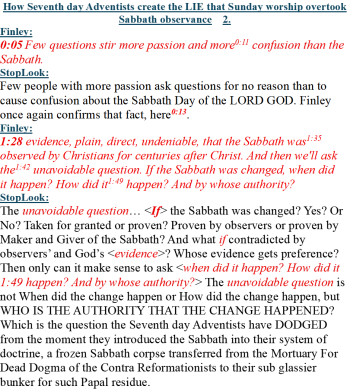
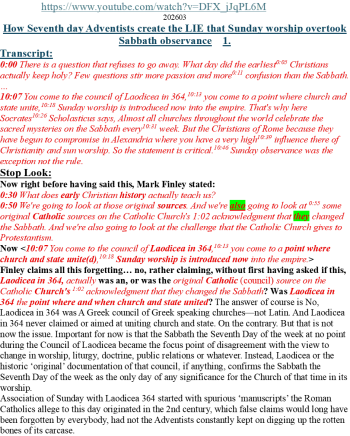
0:00 There is a question that refuses to go away. What day did the earliest0:05 Christians actually keep holy? Few questions stir more passion and more0:11 confusion than the Sabbath. …
10:07 You come to the council of Laodicea in 364,10:13 you come to a point where church and state unite,10:18 Sunday worship is introduced now into the empire. That's why here Socrates10:26 Scholasticus says, Almost all churches throughout the world celebrate the sacred mysteries on the Sabbath every10:31 week. But the Christians of Rome because they have begun to compromise in Alexandria where you have a very high10:39 influence there of Christianity and sun worship. So the statement is critical.10:46 Sunday observance was the exception not the rule.
Stop Look:
Now right before having said this, Mark Finley stated:
0:30 What does early Christian history actually teach us?
0:50 We're going to look at those original sources. And we're also going to look at 0:55 some original Catholic sources on the Catholic Church's 1:02 acknowledgment that they changed the Sabbath. And we're also going to look at the challenge that the Catholic Church gives to Protestantism.
Stop Look:
Now <10:07 You come to the council of Laodicea in 364,10:13 you come to a point where church and state unite(d),10:18 Sunday worship is introduced now into the empire.>
Finley claims all this forgetting… no, rather claiming, without first having asked if this, Laodicea in 364, actually was an, or was the original Catholic (council) source on the Catholic Church's 1:02 acknowledgment that they changed the Sabbath? Was Laodicea in 364 the point where and when church and state united? The answer of course is No, Laodicea in 364 was A Greek council of Greek speaking churches—not Latin. And Laodicea in 364 never claimed or aimed at uniting church and state. On the contrary. But that is not now the issue. Important for now is that the Sabbath the Seventh Day of the week at no point during the Council of Laodicea became the focus point of disagreement with the view to change in worship, liturgy, doctrine, public relations or whatever. Instead, Laodicea or the historic ‘original’ documentation of that council, if anything, confirms the Sabbath the Seventh Day of the week as the only day of any significance for the Church of that time in its worship.
Association of Sunday with Laodicea 364 started with spurious ‘manuscripts’ the Roman Catholics allege to this day originated in the 2nd century, which false claims would long have been forgotten by everybody, had not the Adventists constantly kept on digging up the rotten bones of its carcase.
202603
How Seventh day Adventists create the LIE that Sunday worship overtook Sabbath observance 1.
How Seventh day Adventists create the LIE that Sunday worship overtook Sabbath observance 1.
Transcript:
0:00 There is a question that refuses to go away. What day did the earliest0:05 Christians actually keep holy? Few questions stir more passion and more0:11 confusion than the Sabbath. …
10:07 You come to the council of Laodicea in 364,10:13 you come to a point where church and state unite,10:18 Sunday worship is introduced now into the empire. That's why here Socrates10:26 Scholasticus says, Almost all churches throughout the world celebrate the sacred mysteries on the Sabbath every10:31 week. But the Christians of Rome because they have begun to compromise in Alexandria where you have a very high10:39 influence there of Christianity and sun worship. So the statement is critical.10:46 Sunday observance was the exception not the rule.
Stop Look:
Now right before having said this, Mark Finley stated:
0:30 What does early Christian history actually teach us?
0:50 We're going to look at those original sources. And we're also going to look at 0:55 some original Catholic sources on the Catholic Church's 1:02 acknowledgment that they changed the Sabbath. And we're also going to look at the challenge that the Catholic Church gives to Protestantism.
Stop Look:
Now <10:07 You come to the council of Laodicea in 364,10:13 you come to a point where church and state unite(d),10:18 Sunday worship is introduced now into the empire.>
Finley claims all this forgetting… no, rather claiming, without first having asked if this, Laodicea in 364, actually was an, or was the original Catholic (council) source on the Catholic Church's 1:02 acknowledgment that they changed the Sabbath? Was Laodicea in 364 the point where and when church and state united? The answer of course is No, Laodicea in 364 was A Greek council of Greek speaking churches—not Latin. And Laodicea in 364 never claimed or aimed at uniting church and state. On the contrary. But that is not now the issue. Important for now is that the Sabbath the Seventh Day of the week at no point during the Council of Laodicea became the focus point of disagreement with the view to change in worship, liturgy, doctrine, public relations or whatever. Instead, Laodicea or the historic ‘original’ documentation of that council, if anything, confirms the Sabbath the Seventh Day of the week as the only day of any significance for the Church of that time in its worship.
Association of Sunday with Laodicea 364 started with spurious ‘manuscripts’ the Roman Catholics allege to this day originated in the 2nd century, which false claims would long have been forgotten by everybody, had not the Adventists constantly kept on digging up the rotten bones of its carcase.
Attachments
Last edited: