the beast with seven heads and ten horns - the Roman Empire

  • Welcome to Christian Forums, a Christian Forum that recognizes that all Christians are a work in progress.

    You will need to register to be able to join in fellowship with Christians all over the world.

    We hope to see you as a part of our community soon and God Bless!

Douggg

Well-Known Member
Nov 26, 2020
5,490
439
83
77
Memphis
Faith
Christian
Country
United States
Gender
Male
Micah 5:5 speaks of the Assyrian coming into Israel. There are six such countries prophesied to take such control of Israel:
1. Egypt
2. Assyria
3. Babylon
4. Persia
5. Greece
6. Rome
Today this is all history, it's done.

Ancient Babylon was never conquered by another city, rather it faded away. Saddam Hussein had lots of money, and restored some of ancient Babylon. This ceased when the U.S. forces killed him.

I suppose the beast to come is Middle Eastern. He brokers a peace agreement in the Middle East, and supports rebuilding the Jewish temple. Then he takes a seat in it, processing himself to be God (2Thessalonians 2:4).
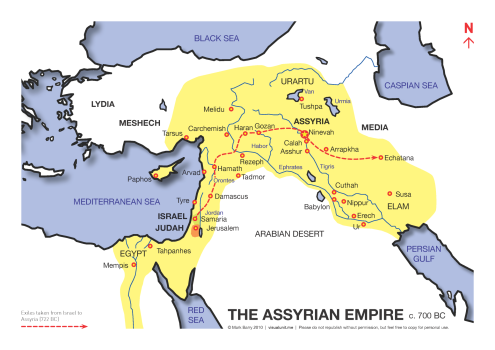
The Assyrian in Micah 5:5 is an end times person. Here is a map of the ancient Assyrian empire, I copied and pasted. The Assyrian will likely be a major figure in the Gog/Magog attack on Israel in the end times.

In Micah 5:2 is a reference to Jesus who was born in Bethlehem and will rule over Israel when He returns.

Let's look and see what it says in Micah 5:5-6. My comment in brackets.

It appears that the seven shepherds and eight principal men will be political and military leaders of Israel who will launch a counter attack against the Assyrian and his homeland. That is kinda what is going on right now between Israel and Iran.

5 And this man [Jesus] shall be the peace, when the Assyrian shall come into our land: and when he shall tread in our palaces, then shall we raise against him seven shepherds, and eight principal men.

6 And they shall waste the land of Assyria with the sword, and the land of Nimrod in the entrances thereof: thus shall he deliver us from the Assyrian, when he cometh into our land, and when he treadeth within our borders.


1777752395758.png
 
Last edited:

Trekson

Well-Known Member
Jul 24, 2012
2,679
311
83
70
Kentucky
Faith
Christian
Country
United States
Gender
Male
The seven kings are kings, not kingdoms. It does not say seven kingdoms in Revelation 17:10, but kings.

Also, the ten horns are ten kings, Revelation 17:12. Ten kings who will give their kingdom to beast in Revelation 17:17.

The ten kings will be ten EU leaders. Their kingdom the EU. The EU is the Roman Empire manifested in the end times. The EU will be the kingdom of the beast.

The woman is the Vatican, located in Rome, and the RCC worldwide, Revelation 17:15. Which in Revelation 17:16, the ten kings aligned with the beast king will burn the Vatican to the ground.

The ten kings will rule with the beast for one hour (metaphoric for the 42 months in Revelation 13:5 that the beast will be in power),
Kings rule over kingdoms. One would think that would be obvious. However, prophetically, the EU is insignificant. Presently there are 27 nations, not 10. Rome is pretty insignificant to.
 

Douggg

Well-Known Member
Nov 26, 2020
5,490
439
83
77
Memphis
Faith
Christian
Country
United States
Gender
Male
Kings rule over kingdoms. One would think that would be obvious. However, prophetically, the EU is insignificant. Presently there are 27 nations, not 10. Rome is pretty insignificant to.
The Vatican and RCC is significant because of its persecution during the time that Christians wanted to separate from the Vatican's rule and authority during the Protestant Reformation.

There are 1.4 billion Catholics worldwide. I copied and pasted this.

  • Catholic Church: 1.345–1.422 billion
  • Protestantism (Total): 800 million–1 billion
      • Pentecostalism: 200–280 million
      • Anglicanism: 85–110 million
      • Baptist Churches: 51–110 million
      • Lutheranism: 70–90 million
      • Calvinism/Reformed: 60–100 million
      • Methodism: 46–80 million
 

Trekson

Well-Known Member
Jul 24, 2012
2,679
311
83
70
Kentucky
Faith
Christian
Country
United States
Gender
Male
The Vatican and RCC is significant because of its persecution during the time that Christians wanted to separate from the Vatican's rule and authority during the Protestant Reformation.

There are 1.4 billion Catholics worldwide. I copied and pasted this.

  • Catholic Church: 1.345–1.422 billion
  • Protestantism (Total):800 million–1 billion
      • Pentecostalism: 200–280 million
      • Anglicanism: 85–110 million
      • Baptist Churches: 51–110 million
      • Lutheranism: 70–90 million
      • Calvinism/Reformed: 60–100 million
      • Methodism: 46–80 million
As I said, Rev. is a book of prophecy not history and there are about two dozen or more protestant denominations, not including the thousands of non-denominational churches. So much so that added together, Protestants out number catholics close to 3 to 1.
 

Douggg

Well-Known Member
Nov 26, 2020
5,490
439
83
77
Memphis
Faith
Christian
Country
United States
Gender
Male
As I said, Rev. is a book of prophecy not history and there are about two dozen or more protestant denominations, not including the thousands of non-denominational churches. So much so that added together, Protestants out number catholics close to 3 to 1.
But those Protestant churches do not have their headquarters in Rome. The city of the seven mountains of Revelation 17:9 where the woman sits.
 

CTK

Well-Known Member
Aug 13, 2024
1,515
315
83
72
Albuquerque
Faith
Christian
Country
United States
Nah... that above idea is NEVER plausible as an interpretation of the Daniel 9:27 verse.


1. Lord Jesus NEVER made any 7 year covenant. The New Covenant is an EVERLASTING COVENANT.

2. The symbolic "one week" of Dan.9:27 is for the LATTER DAYS, not the time of Jesus' 1st coming.

3. Jesus was 'cut off' at His cross at the END of the 69th symbolic week of Dan.9, leaving the final 70th "one week" remaining still today.

4. The event of the "abomination of desolation" which Dan.9:27 reveals was WARNED of by Lord Jesus in His Olivet discourse within the SIGNS of the future time of "great tribulation", which ONLY happens at the very END of this world (Matt.24:15 forward). Jesus was thus pointing to the coming Antichrist at the end of this world placing an IDOL abomination at JERUSALEM for the end of this world. Therefore, those who claim Jesus was behind the events of Daniel 9:27 MOCK Lord Jesus Christ because Jesus instead warned the Church about the coming false one who will fulfill the placing of that IDOL abomination.

It is very, very, very obvious, that the FALSE JEWS who HATE Jesus of Nazareth are behind the FALSE interpretation of Daniel 9:27 with wrongly trying to apply that to Lord Jesus Christ's Ministry at His 1st coming. That idea couldn't be further from the Truth of Bible Scripture, and only a servant of the devil would ever come up with such a vain idea against Christ Jesus!
Here is a partial narrative on 9:27...

Daniel 9:27

27And he shall confirm the covenant with many for one week: and in the midst of the week he shall cause the sacrifice and the oblation to cease, and for the overspreading of abominations he shall make it desolate, even until the consummation, and that determined shall be poured upon the desolate.

The book of Daniel is not merely a historical record of successive world empires—it is prophetic revelation, and at its center stands the Messiah and God’s plan of salvation. He is not a distant figure in the backdrop; He is the focal point toward whom the prophecy moves. Daniel’s visions are not ultimately about human kingdoms rising and falling, but about God bringing His covenant purposes to completion through His Anointed One. From beginning to end, Christ is present in every chapter—visible to those who desire to see Him. But as with all spiritual truth, He can be missed… if one chooses to.

Daniel 9:24–27 is among the clearest messianic passages in the Tanakh. In four tightly packed verses, God reveals the timing and purpose of the Messiah’s coming, the completion of covenant objectives, and the consequences that follow rejection. These verses form the destructive counterpart to the restorative promises of verses 24 and 25: restoration is decreed, fulfillment arrives, rejection occurs, and judgment follows. Within this short prophecy, several key actors appear:

The Messiah — the Anointed One who arrives as “Messiah the Prince,” is “cut off,” and fulfills the redemptive objectives listed in verse 24.

The Jews (“your people”) — the covenant people to whom the seventy weeks are first appointed.​
The people of the prince who is to come — those connected to pagan Rome, who would destroy the city and sanctuary.​
The many — those who receive the covenant blessings the Messiah confirms.​

A critical turning point in understanding the passage is properly identifying the pronoun in Daniel 9:27a:

And he shall confirm the covenant with many for one week…”

The immediate context strongly supports the conclusion that this “He” is the Messiah:

He is “Messiah the Prince” of verse 25, who appears after the sixty-nine weeks.​
He is the One “cut off, but not for Himself” in verse 26—language that naturally points to the Messiah’s sacrificial death.​
And He is the One who “confirms the covenant” in verse 27—fulfilling what Jeremiah foretold: a covenant written on the heart (Jeremiah 31:31–34), not merely maintained through external ceremony.​

In this same final week, the Messiah brings the sacrificial system to its appointed goal—not by abolishing it through violence, but by fulfilling what it always pointed toward. The offerings cease in meaning because the true Offering has been given. The shadow reaches its substance.

Daniel’s prophecy therefore moves forward as a seamless sequence. It does not require a prophetic pause inserted between verses 26 and 27. The seventy weeks are presented as a unified, continuous decree that culminates in the Messiah’s ministry, His being “cut off,” and the immediate aftermath that follows. For this reason, as we enter verse 27, we will treat the text with care and restraint—avoiding additions or speculative frameworks that pull the passage away from its central subject. Daniel 9 is not a prophecy designed to relocate attention to a distant future figure; it is God’s blueprint of redemption centered on the Messiah and the covenant He confirms.

So as we begin the individual narratives in verse 27—starting with “He and the covenant”—the foundation is set:

The “He” is the Messiah.​
The covenant confirmed is God’s covenant promise brought to completion in Christ.​
The final week belongs to His mission, His sacrifice, and His fulfillment.​

He and the Covenant

The verses in Daniel 9 are a direct response to Daniel’s prayer—a prayer grounded in covenant faithfulness, confession, and longing for restoration. And the divine answer he receives is nothing less than a prophetic blueprint for salvation, culminating in the coming of the Messiah, the Anointed One. Daniel’s focus is not a distant end-time figure inserted from outside the text; it is the Messiah Himself. The “He” of Daniel 9:27a refers to the Messiah.

This Messiah is the One who “confirms the covenant with many” during the final week. He is the same “Messiah the Prince” of verse 25, who arrives after the sixty-nine weeks, and who is then “cut off, but not for Himself” in verse 26. The covenant He confirms is not new in God’s heart or God’s purpose—it is the covenant promise God has been unfolding from Abraham onward—but now brought to its appointed completion through the Messiah. What was once administered through shadows—priests, offerings, and ritual blood—is now ratified by the true sacrifice: His own blood.

As Hebrews explains, the former covenantal system could not accomplish what it continually pointed toward. Its sacrifices testified to sin, but could not remove it (Hebrews 10:1–4). Christ enters not with the blood of bulls and goats, but with His own blood (Hebrews 9:12). He is the surety of a better covenant (Hebrews 7:22), established on better promises (Hebrews 8:6)—because it is grounded in a better Priest and a final, sufficient offering.

Under the old administration, God’s people were marked by physical circumcision; under the new, God marks His people by circumcision of the heart (Philippians 3:3). This is the covenant promised in Jeremiah 31:31–34—a covenant written not on tablets of stone, but inwardly, on the hearts of those who receive it. It is personal, permanent, and unalterable—not dependent on external ritual or human mediators, but sealed by the Holy Spirit.

They shall all know Me… for I will forgive their iniquity, and I will remember their sin no more.” (Jeremiah 31:34)

The Messiah’s blood inaugurates this covenant (Matthew 26:28), making reconciliation possible for both Jew and Gentile. The “one week” of Daniel 9:27 is the final week of the seventy-weeks prophecy—a literal seven-year period. In the middle of the week, after three and a half years of ministry, Jesus is crucified—confirming the covenant not with ritual repetition, but with His own blood. He fulfills every sacrificial shadow. The daily offerings, the Day of Atonement, the blood at the mercy seat—each was a signpost pointing forward to Him. As Paul writes:

“But now in Christ Jesus you who once were far off have been brought near by the blood of Christ… so as to create in Himself one new man from the two, thus making peace… that He might reconcile them both to God in one body through the cross.” (Ephesians 2:13–16)

In Christ, the dividing wall falls. The veil is torn. Jew and Gentile are reconciled into one spiritual body—not through a future political arrangement, but through the cross.

 
  • Like
Reactions: covenantee

Trekson

Well-Known Member
Jul 24, 2012
2,679
311
83
70
Kentucky
Faith
Christian
Country
United States
Gender
Male
But those Protestant churches do not have their headquarters in Rome. The city of the seven mountains of Revelation 17:9 where the woman sits.
There are no mountains in Rome, there are only hills and the word for 'hills" would have been used if he was speaking of Rome and if it was Rome do you really think it would need a mind of wisdom to figure that out. Rome isn't ruling the world's economy, and it's not a large importer on the world's goods. Rome doesn't match the description given in Rev. 17:15 but we know a country that does.
 

Trekson

Well-Known Member
Jul 24, 2012
2,679
311
83
70
Kentucky
Faith
Christian
Country
United States
Gender
Male
Here is a partial narrative on 9:27...

Daniel 9:27

27And he shall confirm the covenant with many for one week: and in the midst of the week he shall cause the sacrifice and the oblation to cease, and for the overspreading of abominations he shall make it desolate, even until the consummation, and that determined shall be poured upon the desolate.

The book of Daniel is not merely a historical record of successive world empires—it is prophetic revelation, and at its center stands the Messiah and God’s plan of salvation. He is not a distant figure in the backdrop; He is the focal point toward whom the prophecy moves. Daniel’s visions are not ultimately about human kingdoms rising and falling, but about God bringing His covenant purposes to completion through His Anointed One. From beginning to end, Christ is present in every chapter—visible to those who desire to see Him. But as with all spiritual truth, He can be missed… if one chooses to.

Daniel 9:24–27 is among the clearest messianic passages in the Tanakh. In four tightly packed verses, God reveals the timing and purpose of the Messiah’s coming, the completion of covenant objectives, and the consequences that follow rejection. These verses form the destructive counterpart to the restorative promises of verses 24 and 25: restoration is decreed, fulfillment arrives, rejection occurs, and judgment follows. Within this short prophecy, several key actors appear:

The Messiah — the Anointed One who arrives as “Messiah the Prince,” is “cut off,” and fulfills the redemptive objectives listed in verse 24.

The Jews (“your people”) — the covenant people to whom the seventy weeks are first appointed.​
The people of the prince who is to come — those connected to pagan Rome, who would destroy the city and sanctuary.​
The many — those who receive the covenant blessings the Messiah confirms.​

A critical turning point in understanding the passage is properly identifying the pronoun in Daniel 9:27a:

And he shall confirm the covenant with many for one week…”

The immediate context strongly supports the conclusion that this “He” is the Messiah:

He is “Messiah the Prince” of verse 25, who appears after the sixty-nine weeks.​
He is the One “cut off, but not for Himself” in verse 26—language that naturally points to the Messiah’s sacrificial death.​
And He is the One who “confirms the covenant” in verse 27—fulfilling what Jeremiah foretold: a covenant written on the heart (Jeremiah 31:31–34), not merely maintained through external ceremony.​

In this same final week, the Messiah brings the sacrificial system to its appointed goal—not by abolishing it through violence, but by fulfilling what it always pointed toward. The offerings cease in meaning because the true Offering has been given. The shadow reaches its substance.

Daniel’s prophecy therefore moves forward as a seamless sequence. It does not require a prophetic pause inserted between verses 26 and 27. The seventy weeks are presented as a unified, continuous decree that culminates in the Messiah’s ministry, His being “cut off,” and the immediate aftermath that follows. For this reason, as we enter verse 27, we will treat the text with care and restraint—avoiding additions or speculative frameworks that pull the passage away from its central subject. Daniel 9 is not a prophecy designed to relocate attention to a distant future figure; it is God’s blueprint of redemption centered on the Messiah and the covenant He confirms.

So as we begin the individual narratives in verse 27—starting with “He and the covenant”—the foundation is set:

The “He” is the Messiah.​
The covenant confirmed is God’s covenant promise brought to completion in Christ.​
The final week belongs to His mission, His sacrifice, and His fulfillment.​

He and the Covenant

The verses in Daniel 9 are a direct response to Daniel’s prayer—a prayer grounded in covenant faithfulness, confession, and longing for restoration. And the divine answer he receives is nothing less than a prophetic blueprint for salvation, culminating in the coming of the Messiah, the Anointed One. Daniel’s focus is not a distant end-time figure inserted from outside the text; it is the Messiah Himself. The “He” of Daniel 9:27a refers to the Messiah.

This Messiah is the One who “confirms the covenant with many” during the final week. He is the same “Messiah the Prince” of verse 25, who arrives after the sixty-nine weeks, and who is then “cut off, but not for Himself” in verse 26. The covenant He confirms is not new in God’s heart or God’s purpose—it is the covenant promise God has been unfolding from Abraham onward—but now brought to its appointed completion through the Messiah. What was once administered through shadows—priests, offerings, and ritual blood—is now ratified by the true sacrifice: His own blood.

As Hebrews explains, the former covenantal system could not accomplish what it continually pointed toward. Its sacrifices testified to sin, but could not remove it (Hebrews 10:1–4). Christ enters not with the blood of bulls and goats, but with His own blood (Hebrews 9:12). He is the surety of a better covenant (Hebrews 7:22), established on better promises (Hebrews 8:6)—because it is grounded in a better Priest and a final, sufficient offering.

Under the old administration, God’s people were marked by physical circumcision; under the new, God marks His people by circumcision of the heart (Philippians 3:3). This is the covenant promised in Jeremiah 31:31–34—a covenant written not on tablets of stone, but inwardly, on the hearts of those who receive it. It is personal, permanent, and unalterable—not dependent on external ritual or human mediators, but sealed by the Holy Spirit.

They shall all know Me… for I will forgive their iniquity, and I will remember their sin no more.” (Jeremiah 31:34)

The Messiah’s blood inaugurates this covenant (Matthew 26:28), making reconciliation possible for both Jew and Gentile. The “one week” of Daniel 9:27 is the final week of the seventy-weeks prophecy—a literal seven-year period. In the middle of the week, after three and a half years of ministry, Jesus is crucified—confirming the covenant not with ritual repetition, but with His own blood. He fulfills every sacrificial shadow. The daily offerings, the Day of Atonement, the blood at the mercy seat—each was a signpost pointing forward to Him. As Paul writes:

“But now in Christ Jesus you who once were far off have been brought near by the blood of Christ… so as to create in Himself one new man from the two, thus making peace… that He might reconcile them both to God in one body through the cross.” (Ephesians 2:13–16)

In Christ, the dividing wall falls. The veil is torn. Jew and Gentile are reconciled into one spiritual body—not through a future political arrangement, but through the cross.

Sorry, but Dan. 9:24-27 is 'not" a Messianic prophecy. It's about a prophecy for Israel. For those who actually care about the truth read Dan. 11:22-23, it is speaking of the same prince of 9:27.
 

CTK

Well-Known Member
Aug 13, 2024
1,515
315
83
72
Albuquerque
Faith
Christian
Country
United States
Nah... that above idea is NEVER plausible as an interpretation of the Daniel 9:27 verse.


1. Lord Jesus NEVER made any 7 year covenant. The New Covenant is an EVERLASTING COVENANT.

2. The symbolic "one week" of Dan.9:27 is for the LATTER DAYS, not the time of Jesus' 1st coming.

3. Jesus was 'cut off' at His cross at the END of the 69th symbolic week of Dan.9, leaving the final 70th "one week" remaining still today.
Here is another partial narrative for 9:27...

In the Middle of the Week, He Shall Bring an End to Sacrifice and Offering…

The seventieth week of Daniel’s prophecy is the culminating chapter in God’s redemptive timeline—a seven-year window deliberately set aside for the Messiah to fulfill the work of salvation. Every phrase in Daniel 9:27b is packed with meaning and purpose, and three components are especially critical:

“In the middle of the week”​
The identity of “He”​
“Shall bring an end to sacrifice and offering”​
In the Middle of the Week​

The "week" refers to the final seven-year period of the seventy-weeks-of-years prophecy (490 literal years), and “the middle” of this week falls at 3.5 years. It is precisely at this halfway point that Jesus, the Messiah, is “cut off”—crucified as foretold in Daniel 9:26. This is not an approximation or symbolic midpoint. Jesus was crucified at the close of His fourth Passover, after 3.5 years of ministry, in the spring of 30/1 AD. The timing is exact. This moment marked the end of the Old Covenant’s sacrificial system and the beginning of the New Covenant, not by abolishment through rebellion, but by fulfillment through obedience and love.

He Shall Bring an End

The “He” in this passage is not some future antichrist. It is Jesus Christ, the same “Anointed One” mentioned in verse 25. He is the One who confirms the covenant (v.27a), is cut off (v.26), and brings a final end to the Levitical system through the sacrifice of Himself. This is the Messiah, foretold and promised, not some malevolent figure inserted into prophecy by human reinterpretation centuries later. When He cried out on the cross, “It is finished” (John 19:30), it was not a cry of defeat but a proclamation of completion. His mission—defined by the six divine tasks in Daniel 9:24—was accomplished in full.

To Sacrifice and Offering

The phrase “He shall bring an end to sacrifice and offering” directly addresses the Levitical system that had operated for over 1,500 years since Mt. Sinai. Through His death on the cross, Jesus fulfilled every symbol and shadow represented in the sanctuary—every lamb, every sin offering, every annual atonement ceremony. All pointed to Him. At the very moment of His death:

The Temple veil was torn from top to bottom (Matthew 27:51), signifying the end of the earthly priesthood and the removal of the barrier between God and man.​
The sacrifices were rendered obsolete, not by temple destruction or enemy invasion, but by the perfect sacrifice—the Lamb of God slain for the sin of the world.​
The new covenant was confirmed—not abandoned, not replaced, but fulfilled in accordance with Jeremiah 31:31–34, where God promised to write His law upon our hearts.​

This was not symbolic theology or poetic vision. It was real, historical, and spiritual fulfillment. Within 3.5 years, Jesus had perfectly kept and fulfilled the Law, revealed the heart of the Father, and offered Himself as the final, once-for-all sacrifice (Hebrews 10:10–14). This singular moment in Daniel 9:27b also resonates with the broader scope of prophecy—especially the 2,300 evenings and mornings (Daniel 8:14). The “cleansing of the sanctuary” began not with a third Temple or a future antichrist, but with Jesus entering the heavenly sanctuary as High Priest after His resurrection (Hebrews 9:11–14). The earthly temple had served its purpose. It was no longer the center of worship—heaven was. The events of the cross were not isolated—they were deeply embedded in a divine timeline that included:

The seventy-week prophecy (Daniel 9)​
The 2,300-day vision (Daniel 8)​
The Passover fulfillment​
And the complete and permanent abolition of the Levitical system as they relate to the Spring Festivals.​


Everything aligned. Every symbol found its substance. Every shadow met its light. Jesus was not a casualty of human betrayal—He was the architect and finisher of salvation’s plan. The seventy weeks were never random. They were designed to lead us to this very moment: the cross. This is the centerpiece of time.

It divides covenants, fulfills prophecy, and makes reconciliation possible.​
By the middle of the final week, Jesus did exactly what Daniel foretold.​
He brought an end to sacrifice and offering.​
He fulfilled the covenant.​
He opened the way to eternal life.​
No future “week” is necessary. No future temple needs to be rebuilt.​

It is finished.​


4. The event of the "abomination of desolation" which Dan.9:27 reveals was WARNED of by Lord Jesus in His Olivet discourse within the SIGNS of the future time of "great tribulation", which ONLY happens at the very END of this world (Matt.24:15 forward). Jesus was thus pointing to the coming Antichrist at the end of this world placing an IDOL abomination at JERUSALEM for the end of this world. Therefore, those who claim Jesus was behind the events of Daniel 9:27 MOCK Lord Jesus Christ because Jesus instead warned the Church about the coming false one who will fulfill the placing of that IDOL abomination.

It is very, very, very obvious, that the FALSE JEWS who HATE Jesus of Nazareth are behind the FALSE interpretation of Daniel 9:27 with wrongly trying to apply that to Lord Jesus Christ's Ministry at His 1st coming. That idea couldn't be further from the Truth of Bible Scripture, and only a servant of the devil would ever come up with such a vain idea against Christ Jesus!
 
  • Like
Reactions: covenantee

CTK

Well-Known Member
Aug 13, 2024
1,515
315
83
72
Albuquerque
Faith
Christian
Country
United States
Nah... that above idea is NEVER plausible as an interpretation of the Daniel 9:27 verse.


1. Lord Jesus NEVER made any 7 year covenant. The New Covenant is an EVERLASTING COVENANT.

2. The symbolic "one week" of Dan.9:27 is for the LATTER DAYS, not the time of Jesus' 1st coming.

One Week

The phrase “one week” in Daniel 9:27 stands at the center of longstanding interpretive debate. Some theological systems separate this final week from the preceding sixty-nine and project it into the distant future, constructing a seven-year tribulation governed by a future antichrist figure. This approach—first articulated during the Counter-Reformation and later developed within modern dispensationalism—introduces a chronological gap between the sixty-ninth and seventieth weeks. Yet the text itself gives no indication of such a pause.

Daniel presents the seventy weeks as a unified prophetic period—seventy sevens, or 490 years—decreed upon Daniel’s people and holy city (Daniel 9:24). The progression is sequential and uninterrupted: decree, rebuilding, Messiah’s arrival after sixty-nine weeks, Messiah cut off, covenant confirmed. The seventieth week is not detached from the sixty-nine; it is their culmination. The Hebrew construction reinforces this continuity. The text simply reads:

“And he shall confirm the covenant with many — one week.”

There is no explicit preposition before “one week.” Hebrew frequently expresses duration without inserting a word equivalent to the English “for.” As a result, the phrase may be translated “for one week,” “during one week,” or “within one week.” The emphasis is temporal—it identifies the span in which the covenant is strengthened. It does not describe a negotiated treaty lasting seven years, but a covenant confirmed within the final segment of the prophetic timeline.

This grammatical observation aligns naturally with the structure already established in the chapter. The final week is the last division of the seventy. It does not stand apart from them; it completes them. Within this final week:

The Messiah appears and begins His public ministry (27 AD).​
In the midst of the week—after three and a half years—He is “cut off” (30/31 AD), bringing sacrifice and offering to their appointed fulfillment (Daniel 9:27; Hebrews 10:10–12).​
The remaining three and a half years extend to 34 AD, completing the seventy weeks, during which the gospel is proclaimed primarily to Israel before the stoning of Stephen (Acts 7–8).​

The week is therefore not a suspended future event awaiting fulfillment. It is the climactic moment of redemptive history—the divinely appointed window in which the Messiah arrives, ministers, is cut off, and confirms the covenant. To remove the seventieth week from the seventy fractures the very structure the prophecy carefully builds. Daniel does not suggest a parenthesis. He reveals a completion. And this final week was no ordinary span of years. It was a week set apart for the Messiah Himself. It was the sacred interval in which He would fulfill the six redemptive objectives of Daniel 9:24—to finish transgression, make an end of sins, make reconciliation for iniquity, bring in everlasting righteousness, seal vision and prophecy, and anoint the Most Holy.

In the sanctuary pattern woven throughout Scripture, this week represents the restoration of what had long been missing—the true Ark of the Covenant. Not a wooden chest overlaid with gold, but the living presence of God in the Son. In Christ, mercy and law meet again. The covenant is no longer carried in a chamber; it is embodied in the Messiah who stands at the center of history. The seventieth week is not merely chronological. It is covenantal. It is the appointed moment when God restores His dwelling among His people through the One who is Himself the mercy seat.

The Strengthened Covenant

Even more significant than the phrase “one week” is the verb that governs the clause. Daniel 9:27 states that “he shall confirm the covenant with many.” The Hebrew verb used here is וְהִגְבִּיר (vehegbīr)—derived from gābar, meaning “to make strong,” “to cause to prevail,” or “to strengthen.” It does not ordinarily describe the initiation of a brand-new covenant, nor the signing of a political treaty. Rather, it conveys the idea of reinforcing, upholding, or causing something already established to prevail. This is critical.

The text does not say the “he” makes a new covenant. It says he makes strong the covenant. The definite structure implies continuity, not innovation. The covenant already exists in God’s redemptive plan—promised to Abraham, administered under Moses, foretold by the prophets—and in the final week it reaches its decisive confirmation.

Within the seventy-weeks framework, this makes perfect sense. The Messiah does not arrive to invent a new political arrangement; He arrives to bring the covenant promises to their fulfillment.

By His ministry and ultimately by His blood, He causes the covenant to prevail—establishing it in its intended, completed form. This reading aligns naturally with the broader testimony of Scripture. At the Last Supper, Jesus does not speak of drafting a treaty; He speaks of confirming covenant reality: “This is My blood of the covenant” (Matthew 26:28). In Hebrews, Christ is not portrayed as negotiating, but as inaugurating what had long been promised (Hebrews 8–10). Thus the force of Daniel 9:27 rests not on the duration of a supposed treaty, but on the strengthening of God’s covenant within the final week of the seventy. The grammatical structure reinforces what the timeline already demonstrates: the focus is redemptive, not political.


3. Jesus was 'cut off' at His cross at the END of the 69th symbolic week of Dan.9, leaving the final 70th "one week" remaining still today.

4. The event of the "abomination of desolation" which Dan.9:27 reveals was WARNED of by Lord Jesus in His Olivet discourse within the SIGNS of the future time of "great tribulation", which ONLY happens at the very END of this world (Matt.24:15 forward). Jesus was thus pointing to the coming Antichrist at the end of this world placing an IDOL abomination at JERUSALEM for the end of this world. Therefore, those who claim Jesus was behind the events of Daniel 9:27 MOCK Lord Jesus Christ because Jesus instead warned the Church about the coming false one who will fulfill the placing of that IDOL abomination.

It is very, very, very obvious, that the FALSE JEWS who HATE Jesus of Nazareth are behind the FALSE interpretation of Daniel 9:27 with wrongly trying to apply that to Lord Jesus Christ's Ministry at His 1st coming. That idea couldn't be further from the Truth of Bible Scripture, and only a servant of the devil would ever come up with such a vain idea against Christ Jesus!
 
  • Like
Reactions: covenantee

Douggg

Well-Known Member
Nov 26, 2020
5,490
439
83
77
Memphis
Faith
Christian
Country
United States
Gender
Male
There are no mountains in Rome, there are only hills and the word for 'hills" would have been used if he was speaking of Rome and if it was Rome do you really think it would need a mind of wisdom to figure that out. Rome isn't ruling the world's economy, and it's not a large importer on the world's goods. Rome doesn't match the description given in Rev. 17:15 but we know a country that does.

The place where the woman sits, also has the seven kings associated with it. And the sixth king was ruling at the time - Nero. Nero was an emperor of Rome. The seven mountains of Revelation 17:9 implies the seven hills of Rome. Seven is the key.

Rome does not rule the world's economy. I don't know why that would be a factor to being where the woman sits.
 

Douggg

Well-Known Member
Nov 26, 2020
5,490
439
83
77
Memphis
Faith
Christian
Country
United States
Gender
Male
The phrase “one week” in Daniel 9:27 stands at the center of longstanding interpretive debate.
Just go to Ezekiel 39. The 7 years of Ezekiel 39:9 are the same 7 years of Daniel 9:27.
 

covenantee

Well-Known Member
Feb 22, 2022
7,773
3,438
113
75
Canada
Faith
Christian
Country
Canada
Gender
Male
Sorry, but Dan. 9:24-27 is 'not" a Messianic prophecy. It's about a prophecy for Israel. For those who actually care about the truth read Dan. 11:22-23, it is speaking of the same prince of 9:27.
Sorry, but you've been debunked. :laughing:

For those who actually care about recognizing, honoring, and glorifying Messiah the Christ of Calvary, read:

Luke 24
25 Then he said unto them, O fools, and slow of heart to believe all that the prophets have spoken:
26 Ought not Christ to have suffered these things, and to enter into his glory?
27 And beginning at Moses and all the prophets, he expounded unto them in all the scriptures the things concerning himself.
44 And he said unto them, These are the words which I spake unto you, while I was yet with you, that all things must be fulfilled, which were written in the law of Moses, and in the prophets, and in the psalms, concerning me.
45 Then opened he their understanding, that they might understand the scriptures,

Daniel was a prophet. Therefore, there were things concerning Jesus, written by Daniel the prophet, which Jesus had fulfilled.
What things do you think those were?
Hint: Try Daniel 9:24.

You've said "He only fulfilled the prophecies regarding "himself". Lk. 24:44."

You're absolutely correct, because Daniel 9:24 is all about Himself, and no one else.

Only He could fulfill it.

And He did.

Luke 24:44.
 
Last edited:
  • Like
Reactions: CTK

covenantee

Well-Known Member
Feb 22, 2022
7,773
3,438
113
75
Canada
Faith
Christian
Country
Canada
Gender
Male
Just go to Ezekiel 39. The 7 years of Ezekiel 39:9 are the same 7 years of Daniel 9:27.
Daniel 9:27 began in 27 AD with the beginning of Jesus' earthly ministry.

Ezekiel 39:9 didn't. :laughing:
 
  • Like
Reactions: CTK
Apr 7, 2026
372
50
28
74
Lexington KY
Faith
Christian
Country
United States
Gender
Male
The woman is the RCC, headquartered in Rome, and under the Vatican's rule.
[/QUOTE]
OF THE EARTH.

The woman herself is not Babylon the Great, just like people who take the name of the beast on their forehead are not the beast themselves.

Mystery Babylon the Great is referring to the mystical kingdom of Satan and his angels. They will have an impact regarding the actions and activity of the woman.

---------------------------------------------------------------------------------------------------

Your wrote.... "2. "Many waters" refers to the Euphrates River, near Babylon.."

The many water is defined in verse 15...

15 And he saith unto me, The waters which thou sawest, where the whore sitteth, are peopl NJes, and multitudes, and nations, and tongues.

So the woman has a presence in the nations around the world. The size of the RCC is 1.4 billion worldwide.

The woman is the RCC, headquartered in Rome, and under the Vatican's rule.
[/QUOTE]
Sorry, but Dan. 9:24-27 is 'not" a Messianic prophecy. It's about a prophecy for Israel. For those who actually care about the truth read Dan. 11:22-23, it is speaking of the same prince of 9:27.
 
Apr 7, 2026
372
50
28
74
Lexington KY
Faith
Christian
Country
United States
Gender
Male
Search internet: "City of many waters Babylon."

Babylon was known as "city on many waters." Water supply was an issue in Biblical times, and Babylon had an ingenious canal system, hence "many waters" (17:1). This drew many people, since water is somewhat limited in the Middle East.
 
Last edited:

Trekson

Well-Known Member
Jul 24, 2012
2,679
311
83
70
Kentucky
Faith
Christian
Country
United States
Gender
Male
The woman is the RCC, headquartered in Rome, and under the Vatican's rule.
OF THE EARTH.

The woman herself is not Babylon the Great, just like people who take the name of the beast on their forehead are not the beast themselves.

Mystery Babylon the Great is referring to the mystical kingdom of Satan and his angels. They will have an impact regarding the actions and activity of the woman.

---------------------------------------------------------------------------------------------------

Your wrote.... "2. "Many waters" refers to the Euphrates River, near Babylon.."

The many water is defined in verse 15...

15 And he saith unto me, The waters which thou sawest, where the whore sitteth, are peopl NJes, and multitudes, and nations, and tongues.

So the woman has a presence in the nations around the world. The size of the RCC is 1.4 billion worldwide.

The woman is the RCC, headquartered in Rome, and under the Vatican's rule.
[/QUOTE]
[/QUOTE]
The description given in vs. 15 is not describing a "presence", it's describing a nation, as historically nations were known by their cities. Babylon was a city of Chaldea. Rome was a city of Italia. Why it seems like what they're describing could be called the "melting pot" of civilization.
 
Apr 7, 2026
372
50
28
74
Lexington KY
Faith
Christian
Country
United States
Gender
Male
IMO:
Revelation 17:9 is Greek ορη, which would typically be translated "hill," not "mountain."

I am not aware that Satan has a kingdom. He tried to establish one in heaven, lost the fight, and was thrown down to earth (Ezekiel 28:14), along with his angels.

"Many waters" apparently occurs 386 times in the Bible. Here IMO it indicates the Euphrates River, adjacent to Babylon.

This is apocalyptic literature and it needs to be interpreted accordingly.
 
Last edited:

Davy

Well-Known Member
Feb 11, 2018
15,973
3,379
113
Southeastern U.S.
Faith
Christian
Country
United States
Gender
Male
Sorry, but you've been debunked. :laughing:

For those who actually care about recognizing, honoring, and glorifying Messiah the Christ of Calvary, read:

Luke 24
25 Then he said unto them, O fools, and slow of heart to believe all that the prophets have spoken:
26 Ought not Christ to have suffered these things, and to enter into his glory?
27 And beginning at Moses and all the prophets, he expounded unto them in all the scriptures the things concerning himself.
44 And he said unto them, These are the words which I spake unto you, while I was yet with you, that all things must be fulfilled, which were written in the law of Moses, and in the prophets, and in the psalms, concerning me.
45 Then opened he their understanding, that they might understand the scriptures,

Daniel was a prophet. Therefore, there were things concerning Jesus, written by Daniel the prophet, which Jesus had fulfilled.
What things do you think those were?
Hint: Try Daniel 9:24.

You've said "He only fulfilled the prophecies regarding "himself". Lk. 24:44."

You're absolutely correct, because Daniel 9:24 is all about Himself, and no one else.

Only He could fulfill it.

And He did.

Luke 24:44.


Afraid not. Only 69 weeks of the symbolic 70 weeks of Daniel 9:24-26 have been fulfilled. And you cannot just try and isolate... the Daniel 9:24 verse by itself like you are attempting to do, because details about verse 24 are given in the next 25-27 verses, and in the Daniel Chapters following.
 

covenantee

Well-Known Member
Feb 22, 2022
7,773
3,438
113
75
Canada
Faith
Christian
Country
Canada
Gender
Male
Afraid not. Only 69 weeks of the symbolic 70 weeks of Daniel 9:24-26 have been fulfilled. And you cannot just try and isolate... the Daniel 9:24 verse by itself like you are attempting to do, because details about verse 24 are given in the next 25-27 verses, and in the Daniel Chapters following.
Whom to believe?

1. Daniel, the Holy Spirit who inspired him, and Messiah the Covenant Confirming Prince of Whom he wrote.
2. You

Need a hint? :laughing: