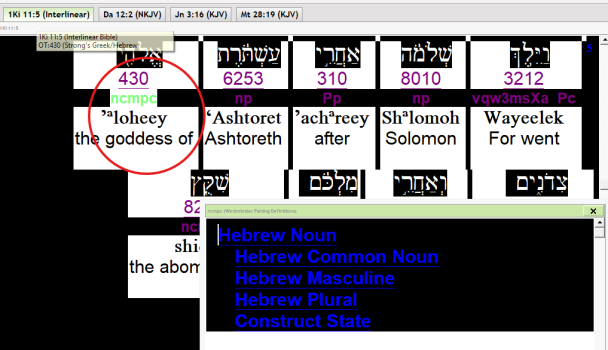
Those types of words are not in question even though gender could be indicated by following pronouns. For instance, I can indicate a feminine gender for car by calling it "her". Even though car itself has no gender the following pronoun does. However, the real danger is when this happens:But (s I understand it, (and I don't claim to know biblical Greek or Hebrew) "Elohim" is not just grammatically masculine. Its meaning is masculine too - it refers to a male Being. By "grammatical gender" I meant Hebrew words like "erets" which although grammatically feminine, means "land", which is neither male nor female. Similarly "yam" ("sea") is grammatically masculine, but the sea is neither male nor female. Because English doesn't have grammatical genders, there is no way a translator from Hebrew to English can show in their translation that the Hebrew word for "land" was grammatically feminine, or the word for "sea" was grammatically masculine. I would emphasise again, that I am not talking about words such as "man," "girl", "king", "widow," etc. where the actually meaning of the word refers specifically either to a male or to a female person.
- The Holy Bible Feminine Translation Version (FTV): A literal, word-for-word translation based on the 1901 American Standard Version that explicitly highlights the feminine attributes of God.
- The Inclusive Bible (2007): A radical translation designed to remove gender-specific language for the divine, often using gender-neutral or inclusive phrasing, though sometimes employing feminine imagery.
- The Divine Feminine Version (DFV) New Testament: A translation that specifically replaces masculine pronouns for God with feminine ones to challenge traditional patriarchal language.
- The Women's Lectionary (Wilda Gafny): While a lectionary rather than a full bible translation, this resource frequently uses feminine pronouns for the Divine. [1, 2, 3]
- Hebrew Language: The Hebrew word for Spirit (\(ruach\)) is grammatically feminine.
- Scriptural Imagery: Many translations (NRSV, NIV, etc.) include passages describing God using maternal metaphors, such as a mother hen (Matthew 23:37), a woman in labor (Isaiah 42:14), or a nursing mother (Isaiah
Last edited: