A BLATANT ERROR IN THE NEW BIBLES

  • Welcome to Christian Forums, a Christian Forum that recognizes that all Christians are a work in progress.

    You will need to register to be able to join in fellowship with Christians all over the world.

    We hope to see you as a part of our community soon and God Bless!

shepherdsword

Encounter Team - Eagle
Staff member
Encounter Team
Feb 12, 2009
2,034
1,631
113
Millington
Faith
Christian
Country
United States
Gender
Male
But (s I understand it, (and I don't claim to know biblical Greek or Hebrew) "Elohim" is not just grammatically masculine. Its meaning is masculine too - it refers to a male Being. By "grammatical gender" I meant Hebrew words like "erets" which although grammatically feminine, means "land", which is neither male nor female. Similarly "yam" ("sea") is grammatically masculine, but the sea is neither male nor female. Because English doesn't have grammatical genders, there is no way a translator from Hebrew to English can show in their translation that the Hebrew word for "land" was grammatically feminine, or the word for "sea" was grammatically masculine. I would emphasise again, that I am not talking about words such as "man," "girl", "king", "widow," etc. where the actually meaning of the word refers specifically either to a male or to a female person.
Those types of words are not in question even though gender could be indicated by following pronouns. For instance, I can indicate a feminine gender for car by calling it "her". Even though car itself has no gender the following pronoun does. However, the real danger is when this happens:

  • The Holy Bible Feminine Translation Version (FTV): A literal, word-for-word translation based on the 1901 American Standard Version that explicitly highlights the feminine attributes of God.
  • The Inclusive Bible (2007): A radical translation designed to remove gender-specific language for the divine, often using gender-neutral or inclusive phrasing, though sometimes employing feminine imagery.
  • The Divine Feminine Version (DFV) New Testament: A translation that specifically replaces masculine pronouns for God with feminine ones to challenge traditional patriarchal language.
  • The Women's Lectionary (Wilda Gafny): While a lectionary rather than a full bible translation, this resource frequently uses feminine pronouns for the Divine. [1, 2, 3]
Context for Feminine Imagery:
  • Hebrew Language: The Hebrew word for Spirit (\(ruach\)) is grammatically feminine.
  • Scriptural Imagery: Many translations (NRSV, NIV, etc.) include passages describing God using maternal metaphors, such as a mother hen (Matthew 23:37), a woman in labor (Isaiah 42:14), or a nursing mother (Isaiah
 
Last edited:

David Lamb

Well-Known Member
Feb 21, 2025
826
499
63
77
Paignton
Faith
Christian
Country
United Kingdom
Those types of words are not in question. The danger is when this happens:

  • The Holy Bible Feminine Translation Version (FTV): A literal, word-for-word translation based on the 1901 American Standard Version that explicitly highlights the feminine attributes of God.
  • The Inclusive Bible (2007): A radical translation designed to remove gender-specific language for the divine, often using gender-neutral or inclusive phrasing, though sometimes employing feminine imagery.
  • The Divine Feminine Version (DFV) New Testament: A translation that specifically replaces masculine pronouns for God with feminine ones to challenge traditional patriarchal language.
  • The Women's Lectionary (Wilda Gafny): While a lectionary rather than a full bible translation, this resource frequently uses feminine pronouns for the Divine. [1, 2, 3]
Context for Feminine Imagery:
  • Hebrew Language: The Hebrew word for Spirit (\(ruach\)) is grammatically feminine.
  • Scriptural Imagery: Many translations (NRSV, NIV, etc.) include passages describing God using maternal metaphors, such as a mother hen (Matthew 23:37), a woman in labor (Isaiah 42:14), or a nursing mother (Isaiah
I agree that is wrong to use inclusive language when the original Hebrew or Greek word means specifically either male or female, but that is not the same thing as grammatical gender.

You wrote: "Many translations (NRSV, NIV, etc.) include passages describing God using maternal metaphors, such as a mother hen (Matthew 23:37), a woman in labor (Isaiah 42:14), or a nursing mother (Isaiah"

The KJV translation of Matthew 23:37 is:

(Mat 23:37 KJV) O Jerusalem, Jerusalem, thou that killest the prophets, and stonest them which are sent unto thee, how often would I have gathered thy children together, even as a hen gathereth her chickens under her wings, and ye would not!

Also the KJV translates Isaiah 42:14:

(Isa 42:14 KJV) I have long time holden my peace; I have been still, and refrained myself: now will I cry like a travailing woman; I will destroy and devour at once.

So it is not an error by modern translators.
 

shepherdsword

Encounter Team - Eagle
Staff member
Encounter Team
Feb 12, 2009
2,034
1,631
113
Millington
Faith
Christian
Country
United States
Gender
Male
I agree that is wrong to use inclusive language when the original Hebrew or Greek word means specifically either male or female, but that is not the same thing as grammatical gender.
It doesn't matter if the gender is "grammatical" if it is translated in some inclusive way to deceive people. or even if the correct gender is used to emphasize an errant point.(case in point, gender of the Holy Spirit)
 

David Lamb

Well-Known Member
Feb 21, 2025
826
499
63
77
Paignton
Faith
Christian
Country
United Kingdom
It doesn't matter if the gender is "grammatical" if it is translated in some inclusive way to deceive people. or even if the correct gender is used to emphasize an errant point.(case in point, gender of the Holy Spirit)
I will say this once more and then leave it. Some languages have grammatical gender, with every noun being either masculine, feminine, or neuter. This grammatical gender does not refer to the actual gender of thing referred to by the noun. For example, in French, "voiture" (car) and "table" (table) are grammatically feminine nouns, but that doesn't mean that French speakers imagine tat tables and cars are female.
 
Last edited:

shepherdsword

Encounter Team - Eagle
Staff member
Encounter Team
Feb 12, 2009
2,034
1,631
113
Millington
Faith
Christian
Country
United States
Gender
Male
I will say this once more and then eave it. Some languages have grammatical gender, with every noun being either masculine, feminine, or neuter. This grammatical gender does not refer to the actual gender of thing referred to by the noun. For example, in French, "voiture" (car) and "table" (table) are grammatically feminine nouns, but that doesn't mean that French speakers imagine tat tables and cars are female.
English nouns without, what you label as "grammatical" gender can have the gender indicated by following pronouns. example, Saying of my car "She's a beauty" or of a ship "She's the best in the fleet"
 

David Lamb

Well-Known Member
Feb 21, 2025
826
499
63
77
Paignton
Faith
Christian
Country
United Kingdom
English nouns without, what you label as "grammatical" gender can have the gender indicated by following pronouns. example, Saying of my car "She's a beauty" or of a ship "She's the best in the fleet"
They are exceptions, and they are not grammatical genders anyway. Also, we are not really saying that our cars or ships are female. What about all the other nouns in English, "nail", "dinner", "money", "cloud," for example? In some languages, they, like all nouns, have a grammatical gender, but not in English. I really will leave it now as I am becoming repetitive - sorry!
 
Last edited:
Apr 7, 2026
371
50
28
74
Lexington KY
Faith
Christian
Country
United States
Gender
Male
<"Elohim" is not just grammatically masculine. Its meaning is masculine too - it refers to a male Being.>

o Hebrew El (אל) = "god/mighty one."

o. Hebrew Elohim (אלים) = "gods/mighty ones."

o The gender of El is indeed masculine.
 

Pierac

Well-Known Member
Nov 15, 2021
1,007
288
83
63
Phoenix
Faith
Christian
Country
United States
Gender
Male
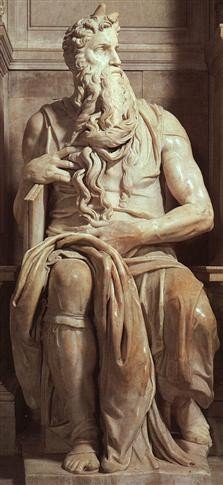
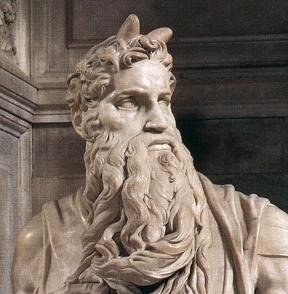
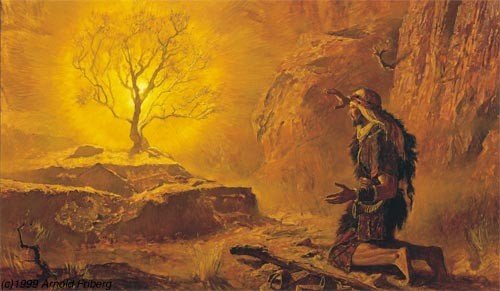
What happens when you get a translator who mistranslates scripture? How about a translation that is the only accepted version allowed to be used? And what if that translation was the only Bible used for over 1000 years. Could one simple mistranslation alter our view on scripture for over 1000 years? You bet your horny Moses!

Medieval artwork sometimes portrays Moses with horns. This depiction derives from Jerome's mistranslation of verses in Exodus 34. Verse 29: "he knew not that his face was horned from the conversation of the Lord." Verse 30: "And Aaron and the children of Israel seeing the face of Moses horned, were afraid to come near." Verse 35: "And they saw that the face of Moses when he came our was horned." Rather than being "horned" Moses face "shone," as in the Old Latin and the Septuagint read.

1)(Qal) send out rays
2) (Hiphil) display (grow) horns (be fully developed).

Qaran is derived from H7161, which is a noun meaning "horn." Jerome took the basic meaning of the word and neglected its derived meaning of "to emit rays." Many times in Hebrew one must assign the meaning of a word based on its context. In Psalm 69:31 qaran is used to describe an ox or young bull. There the translation as "horn" is appropriate. But in Exodus 34:29 qaran is used in conjunction with the phrase "skin of his face." From the context of following versus the meaning as "horns" is not supported. The Apostle Paul understood this to mean "shone" and not "grew horns" as can be seen from 2 Corinthians 3:7-13.


Jerome translated the Latin Vulgate, which was the official bible of the Catholic Church for well over 1000 years.


Take a look at Michelangelo's Moses at the Cistene Chapel


Attachments

  • Moses1.jpg
    Moses1.jpg
    32.2 KB · Views: 1
  • moses2.jpg
    moses2.jpg
    26.2 KB · Views: 1
  • moses3.jpg
    moses3.jpg
    29.3 KB · Views: 1
  • moses4.jpg
    moses4.jpg
    43 KB · Views: 1
  • Wow
Reactions: Lambano

David Lamb

Well-Known Member
Feb 21, 2025
826
499
63
77
Paignton
Faith
Christian
Country
United Kingdom
<"Elohim" is not just grammatically masculine. Its meaning is masculine too - it refers to a male Being.>

o Hebrew El (אל) = "god/mighty one."

o. Hebrew Elohim (אלים) = "gods/mighty ones."

o The gender of El is indeed masculine.
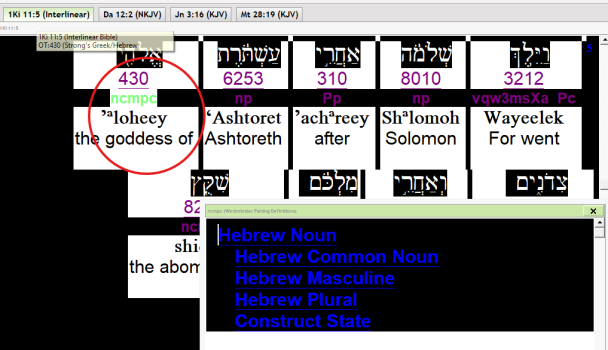
Just asking, not being argumentative, why is the same Hebrew word "Elohim" used when referring to the false goddess Ashtoreth:

(1Ki 11:5) For Solomon went after Ashtoreth the goddess of the Sidonians, and after Milcom the abomination of the Ammonites.
 

shepherdsword

Encounter Team - Eagle
Staff member
Encounter Team
Feb 12, 2009
2,034
1,631
113
Millington
Faith
Christian
Country
United States
Gender
Male
Just asking, not being argumentative, why is the same Hebrew word "Elohim" used when referring to the false goddess Ashtoreth:

(1Ki 11:5) For Solomon went after Ashtoreth the goddess of the Sidonians, and after Milcom the abomination of the Ammonites.
A good question, the gender is definitely masculine.
1778999983440.png
Probably for the same reason a woman who is female can be part of mankind which is masculine. It does beg the question...is there even a feminine version of Elohim?
 

MatthewG

Well-Known Member
Apr 21, 2021
18,967
5,786
113
35
Alabama
Faith
Christian
Country
United States
Gender
Male
Elohim could describe Gods perfect masculine and feminine traits. God made male and female in his image. You see the masculine side of God greatly in the Old testament and the softer side through his Word (Jesus) when showing up in the New testament which is a wrapping up of the prior age and economy (the heaven and earth the people in that day knew.)
 

David Lamb

Well-Known Member
Feb 21, 2025
826
499
63
77
Paignton
Faith
Christian
Country
United Kingdom
A good question, the gender is definitely masculine.
View attachment 84197
Probably for the same reason a woman who is female can be part of mankind which is masculine. It does beg the question...is there even a feminine version of Elohim?
So if the word can be used to mean a female "god," its gender must be grammatical, rather than connected with the meaning of the word. I notice that the New Testament uses a Greek word that actually means "goddess" (in the passage about Diana of the Ephesians). The Old Testament uses exactly the same Hebrew word for God, god, and goddess.
 

shepherdsword

Encounter Team - Eagle
Staff member
Encounter Team
Feb 12, 2009
2,034
1,631
113
Millington
Faith
Christian
Country
United States
Gender
Male
So if the word can be used to mean a female "god," its gender must be grammatical, rather than connected with the meaning of the word. I notice that the New Testament uses a Greek word that actually means "goddess" (in the passage about Diana of the Ephesians). The Old Testament uses exactly the same Hebrew word for God, god, and goddess.
or hebrew has no concept of a feminine god while the greeks do
 

David Lamb

Well-Known Member
Feb 21, 2025
826
499
63
77
Paignton
Faith
Christian
Country
United Kingdom
or hebrew has no concept of a feminine god while the greeks do
That may be so, but Hebrew does have a word for "female", as in:

(Gen 1:27) So God created man in His own image; in the image of God He created him; male and female He created them.

So if there was not word in Hebrew for a female "god", wouldn't the divinely-inspired authors have added the word for "female?"

I won't go any further with this because I don't know Hebrew, so I'll leave it to somebody who dows know the language.
 

shepherdsword

Encounter Team - Eagle
Staff member
Encounter Team
Feb 12, 2009
2,034
1,631
113
Millington
Faith
Christian
Country
United States
Gender
Male
That may be so, but Hebrew does have a word for "female", as in:

(Gen 1:27) So God created man in His own image; in the image of God He created him; male and female He created them.

So if there was not word in Hebrew for a female "god", wouldn't the divinely-inspired authors have added the word for "female?"

I won't go any further with this because I don't know Hebrew, so I'll leave it to somebody who dows know the language.
Of course it has a word for female. You can even make "EL" feminine by rendering it as "Elah" but it isn't found in the scriptures. However all of that is irrelevant to the issue. When a translation translate "God" as feminine for some woke inclusive agenda, that is error. There are translations that do this and I suspect such errors will become more and more frequent as we hurdle towards the fullness of iniquity.
 
Last edited:

David Lamb

Well-Known Member
Feb 21, 2025
826
499
63
77
Paignton
Faith
Christian
Country
United Kingdom
Of course it has a word for female. You can even make "EL" feminine by rendering it as "Elah" but it isn't found in the scriptures. However all of that is irrelevant to the issue. When a translation translate "God" as feminine for some woke inclusive agenda that is error. There are translations that do this and I suspect such errors will become more and more frequent as we hurdle towards the fullness of iniquity.
I must immediately assure you that I certainly don't agree with translating the Hebrew word for "God" as feminine for any woke agenda. I hope you didn't imagine that I was arguing for such a thing. I wasn't.
 
  • Like
Reactions: shepherdsword

shepherdsword

Encounter Team - Eagle
Staff member
Encounter Team
Feb 12, 2009
2,034
1,631
113
Millington
Faith
Christian
Country
United States
Gender
Male
I must immediately assure you that I certainly don't agree with translating the Hebrew word for "God" as feminine for any woke agenda. I hope you didn't imagine that I was arguing for such a thing. I wasn't.
of course not brother. I have read many of your posts and agree with almost all of them. I see you as a voice of sanity amidst many kooky characters....lol.
 
  • Like
Reactions: David Lamb
Apr 7, 2026
371
50
28
74
Lexington KY
Faith
Christian
Country
United States
Gender
Male
<Just asking, not being argumentative, why is the same Hebrew word "Elohim" used when referring to the false goddess Ashtoreth:>

Hebrew El = "lord, master ruler, etc.". It is not specific to Yahweh.

Elohim is the Hebrew plural of El. We call this a "plural of majesty" when used to denote a single god/ruler.
 
Apr 7, 2026
371
50
28
74
Lexington KY
Faith
Christian
Country
United States
Gender
Male
[Mark 1:2 KJV] "As it is written in the prophets, Behold, I send my messenger before thy face, which shall prepare thy way before thee."

[Mark 1:2 NIV] "as it is written in Isaiah the prophet: "I will send my messenger ahead of you, who will prepare your way"--"

The new Bibles not only remove words and verses they are in error.

In the KJV Mark 1:2 reads "as it is written in the PROPHETS", prophets Plural!
In the NIV it reads "as it is written in ISAIAH"
This is a blatant error!
Mark 1:2 is from Malachi NOT Isaiah ********* [Malachi 3:1 KJV] "Behold, I will send my messenger, and he shall prepare the way before me: and the Lord, whom ye seek, shall suddenly come to his temple, even the messenger of the covenant, whom ye delight in: behold, he shall come, saith the LORD of hosts."

[Mark 1:3 KJV] "The voice of one crying in the wilderness, Prepare ye the way of the Lord, make his paths straight." ********** Mark 1:3 is from Isaiah *********[Isaiah 40:3 KJV] "The voice of him that crieth in the wilderness, Prepare ye the way of the LORD, make straight in the desert a highway for our God."

The KJV is correct in saying "as it is written in the prophets" because Mark 1:2 is taken from Malachi and Mark 1:3 from Isaiah.