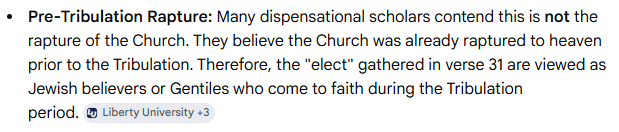
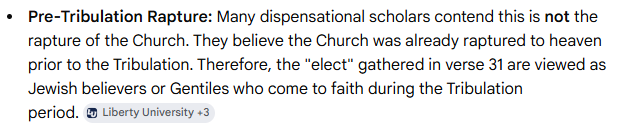
Yes thanks it’s really that easy I can’t explain it anymore to them and I can’t understand why they can’t grasp what I’m saying
It’s not really “that easy,” though. Saying people simply “can’t grasp it” assumes the interpretation is already settled and self-evident, when in reality that’s exactly what’s being debated.
The issue isn’t comprehension—it’s whether your conclusion actually follows from the text. I understand what you’re trying to argue, but understanding the claim isn’t the same as accepting it as biblically correct. I knew the doctrine of preterism very well that I have determined it is unbiblical!
As for Si's another false assumption. You need to ask SI where in Scripture is it stated that God gave “40 years of probation” specifically to the Jews regarding temple sacrifices before judging them in AD 70? LOL!!!
That’s not exegesis—that’s a timeline being read into the text after the fact. The New Testament NEVER frames the destruction of the temple as a countdown of delayed tolerance for continued sacrifices, nor does it define a fixed “grace period” tied to the calendar between the cross and AD 70. No where do we read that in Scripture! That is his
wishful thinking to support your false doctrine. Both of you.
By the same logic, are we supposed to conclude that if enough Jews had stopped sacrifices earlier—or if they had repented differently—the temple would have remained standing, humm? That would make the destruction contingent on human response rather than on God’s sovereign prophetic plan, which undermines the very argument being made.
And that’s the core issue: You and SI are assuming AD 70 is the fulfillment of Matthew 24:1–2, then building a moral explanation around it, and then using that explanation as proof of the interpretation. That’s circular reasoning, not biblical proof. Sad!
Continuing to offer sacrifices AFTER the cross may seems like a theologically significant to both of you, but it does not automatically establish the claim that Matthew 24 is primarily about AD 70, nor that the temple’s destruction was simply God “running out of patience.” That is an assumption layered onto the text—not drawn from it. Do better, SI.
@rwb