The Conundrum of Zechariah Ch. 14

  • Welcome to Christian Forums, a Christian Forum that recognizes that all Christians are a work in progress.

    You will need to register to be able to join in fellowship with Christians all over the world.

    We hope to see you as a part of our community soon and God Bless!

Spiritual Israelite

Well-Known Member
Apr 13, 2022
17,267
6,975
113
Midwest
Faith
Christian
Country
United States
Gender
Male
He was talking about a literal physical city and temple. Your obsessive spiritualizing away of reality has produced heresy. You deny the reality of Satan, demons and angels. Do you believe Jesus is real?
You have to wonder at this point. He tries to say that the Judea that Jesus mentions in the Olivet Discourse is spiritual or heavenly Judea. But, nowhere does scripture ever refer to a spiritual or heavenly Judea.
 

Marty fox

Well-Known Member
Jun 1, 2021
3,541
1,293
113
56
Vancouver
Faith
Christian
Country
Canada
Gender
Male
When that happens repeatedly, you have to wonder if it's on purpose or not rather than it just being a case where he's not reading what you're saying carefully or that he just lacks basic reading comprehension skills. As for me, I'm having no trouble understanding what you're saying at all. I, of course, don't agree with everything you're saying since I'm not a partial preterist, but I do understand what you're saying and can actually address what you're saying instead of misrepresenting what you're saying.


Yes, you have. Very plainly. Yet, he somehow missed all of those times you've said that? How?

After post #695 I actually think that his purpose is only to frustrate and play games.

He answerEd my direct question with an waste of time question like he’s just playing a game and trying to frustrate me and probably laughed about it.

He has constantly avoided direct questions he’s not interested is any real dialogue
 

ewq1938

Mod
Staff member
Jul 11, 2015
8,554
1,704
113
Faith
Christian
Country
United States
Gender
Male


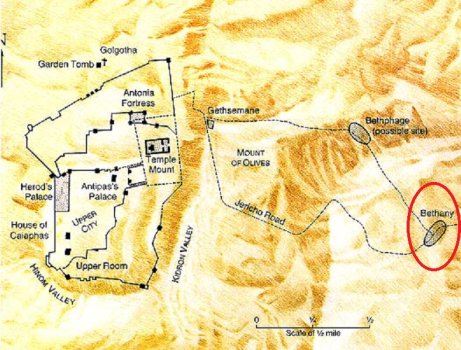
Jesus ascended from the town of Bethany, near the MT of Olives but not on it.

Luk 24:50 And he led them out as far as to Bethany, and he lifted up his hands, and blessed them.
Luk 24:51 And it came to pass, while he blessed them, he was parted from them, and carried up into heaven.

Bethany Mt of olives map.jpg
 

TribulationSigns

Well-Known Member
May 1, 2023
2,747
970
113
56
Somewhere west of Mississippi River
Faith
Christian
Country
United States
You have to wonder at this point. He tries to say that the Judea that Jesus mentions in the Olivet Discourse is spiritual or heavenly Judea. But, nowhere does scripture ever refer to a spiritual or heavenly Judea.

Here you go again...Of course you are in denial because you do not have spiritual discernment. Period.

The assumption that “Judea” in Matthew 24 must only refer to a physical, geographic region is not actually proven by the text itself. Scripture often uses geographic and temple-related language in a covenantal or symbolic way, especially in prophetic and apocalyptic contexts. Christ was talking about Judea with His Church in mind.

For example, in Matthew 24 Jesus speaks of “wars, famines, earthquakes, and pestilences” as “birth pains,” yet these are not isolated literal events tied only to one location—they describe covenantal judgment patterns right prior to the Judgment of the unfaithful congregation and the Second Coming. Likewise, “abomination of desolation standing in the holy place” cannot be reduced to a simple physical temple reading without first dealing with how the New Testament redefines the “holy temple” as God’s congregation (cf. 1 Corinthians 3:16, Ephesians 2:21).

The same passage includes highly symbolic language such as housetops, garments, winter, and Sabbath in connection with prophetic urgency. These details are not random—they are covenant-era imagery used to communicate spiritual realities and imminent judgment themes.

Even the warnings about “false christs and false prophets” showing signs and wonders did not take place in the first century. You do not even understand what the desert and secret chambers signifies when people are telling us that they have Christ there. Does this sounds like first century to you, chuckle!
 
Last edited:
  • Haha
Reactions: WPM

PeterAndroz

Active Member
May 15, 2026
667
159
43
42
Mt Compass Adelaide
Faith
Christian
Country
Australia
Gender
Male
Jesus ascended from the town of Bethany, near the MT of Olives but not on it.

Luk 24:50 And he led them out as far as to Bethany, and he lifted up his hands, and blessed them.
Luk 24:51 And it came to pass, while he blessed them, he was parted from them, and carried up into heaven.

View attachment 85956

"""Jesus ascended from the town of Bethany, near the MT of Olives but not on it.
Yet doesn't Acts 1:11-12 state/imply otherwise ?
11Which also said, Ye men of Galilee, why stand ye gazing up into heaven? this same Jesus, which is taken up from you into heaven, shall so come in like manner as ye have seen him go into heaven.
12Then returned they unto Jerusalem from the mount called Olivet, which is from Jerusalem a sabbath day's journey.
 

ewq1938

Mod
Staff member
Jul 11, 2015
8,554
1,704
113
Faith
Christian
Country
United States
Gender
Male

Spiritual Israelite

Well-Known Member
Apr 13, 2022
17,267
6,975
113
Midwest
Faith
Christian
Country
United States
Gender
Male
Here you go again.
No, here you go again.

..Of course you are in denial because you do not have spiritual discernment. Period.
Says the guy with zero spiritual discernment who has been deceived by the spirit beings Satan and demons to think that they don't exist.

The assumption that “Judea” in Matthew 24 must only refer to a physical, geographic region is not actually proven by the text itself. Scripture often uses geographic and temple-related language in a covenantal or symbolic way, especially in prophetic and apocalyptic contexts. Christ was talking about Judea with His Church in mind.
There are no references in scripture anywhere to a spiritual or heavenly Judea. A heavenly Jerusalem, yes, but not a spiritual or heavenly Judea. You are required to make that up in order to keep your interpretation of the text afloat.

For example, in Matthew 24 Jesus speaks of “wars, famines, earthquakes, and pestilences” as “birth pains,” yet these are not isolated literal events tied only to one location—they describe covenantal judgment patterns right prior to the Judgment of the unfaithful congregation and the Second Coming.
He was referring to literal wars, famines, earthquakes and pestilences that would occur "in various places" in the world. People would tend to think that those things are an indication that Christ's second coming and the end of the age are near, but He indicated otherwise. He said those things are only the beginning of birth pains and not an indication that the end is near. Instead, it is things like increased deception, wickedness and apostasy that indicate that His second coming and the end of the age are near.

Likewise, “abomination of desolation standing in the holy place” cannot be reduced to a simple physical temple reading without first dealing with how the New Testament redefines the “holy temple” as God’s congregation (cf. 1 Corinthians 3:16, Ephesians 2:21).
There is no indication whatsoever that Jesus is doing anything but speaking literally up to verse 15, so why would He suddenly switch to speaking figuratively at that point?

The same passage includes highly symbolic language such as housetops, garments, winter, and Sabbath in connection with prophetic urgency.
LOL. Ridiculous. He said that it would be particularly difficult for certain people in Judea to physically flee to the mountains and particularly difficult under certain conditions because that would obviously be true for nursing mothers and pregnant women and would also obviously be true during the winter and on the Sabbath when there were travel restrictions put in place. Jesus was warning believers of their need to flee to the mountains before the Roman armies came to destroy the city and the temple. Just as we should expect He would have done. What happened then was God's wrath against unbelieving Jews, so, obviously, He would not want believers to have been caught up in that.

These details are not random—they are covenant-era imagery used to communicate spiritual realities and imminent judgment themes.
Wrong. That's only in your imagination.

Even the warnings about “false christs and false prophets” showing signs and wonders did not take place in the first century.
I agree with that. I relate that to what Paul talked about in 2 Thessalonians 2:3-12 which relates to a time period before Christ's future return and not to a time period long ago. Do you not understand that I'm not a preterist? Think about who you're talking to and address what I believe instead of what preterists believe. I believe only Matthew 24:15-21 relates to 70 AD and the rest of the Olivet Discourse relates to things that occur before and up to the future second coming of Christ at the end of this temporal age.
 
Last edited:
  • Love
Reactions: WPM

Spiritual Israelite

Well-Known Member
Apr 13, 2022
17,267
6,975
113
Midwest
Faith
Christian
Country
United States
Gender
Male
You misunderstood the question. What he was asking you is if you have any New Testament scripture to support your belief that Zechariah 14 relates to the second coming of Christ.

How do you interpret this passage:

2 Peter 3:10 But the day of the Lord will come as a thief in the night, in which the heavens will pass away with a great noise, and the elements will melt with fervent heat; both the earth and the works that are in it will be burned up. 11 Therefore, since all these things will be dissolved, what manner of persons ought you to be in holy conduct and godliness, 12 looking for and hastening the coming of the day of God, because of which the heavens will be dissolved, being on fire, and the elements will melt with fervent heat?
 

WPM

Well-Known Member
May 10, 2022
11,111
5,925
113
USA
Faith
Christian
Country
United States
Gender
Male
Here you go again...Of course you are in denial because you do not have spiritual discernment. Period.

The assumption that “Judea” in Matthew 24 must only refer to a physical, geographic region is not actually proven by the text itself. Scripture often uses geographic and temple-related language in a covenantal or symbolic way, especially in prophetic and apocalyptic contexts. Christ was talking about Judea with His Church in mind.

For example, in Matthew 24 Jesus speaks of “wars, famines, earthquakes, and pestilences” as “birth pains,” yet these are not isolated literal events tied only to one location—they describe covenantal judgment patterns right prior to the Judgment of the unfaithful congregation and the Second Coming. Likewise, “abomination of desolation standing in the holy place” cannot be reduced to a simple physical temple reading without first dealing with how the New Testament redefines the “holy temple” as God’s congregation (cf. 1 Corinthians 3:16, Ephesians 2:21).

The same passage includes highly symbolic language such as housetops, garments, winter, and Sabbath in connection with prophetic urgency. These details are not random—they are covenant-era imagery used to communicate spiritual realities and imminent judgment themes.

Even the warnings about “false christs and false prophets” showing signs and wonders did not take place in the first century. You do not even understand what the desert and secret chambers signifies when people are telling us that they have Christ there. Does this sounds like first century to you, chuckle!
Anything goes with you guys. Is Jesus real? Why will you guys not answer that fundamental question?
 
  • Like
Reactions: Spiritual Israelite

PeterAndroz

Active Member
May 15, 2026
667
159
43
42
Mt Compass Adelaide
Faith
Christian
Country
Australia
Gender
Male
Says who? Chat GPT? Google?
Here's more
..


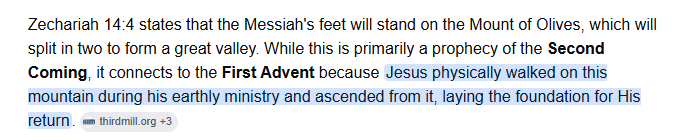
Zechariah 14:4 predicts, “On that day his feet will stand on the Mount of Olives, east of Jerusalem, and the Mount of Olives will be split in two from east to west, forming a great valley, with half of the Mount moving north and half moving south.” “That day” is a reference to the Day of the Lord, and the One who stands on the mountain is the Lord Himself. So, yes, this passage predicts the second coming of Christ.

The opening of Zechariah 14 speaks of a future day when Jerusalem will be plundered by its enemies. Verse 2 prophesies that all nations will gather against Jerusalem and capture and ransack the city. Half of the citizens of Jerusalem will flee the devastation, but the other half will remain. This will be one half of the one third of the Jewish population still alive in Jerusalem after the Tribulation (13:8). Then, Zechariah says, the Lord Himself will go forth and engage these opponents in battle (14:3). Verse 4 speaks of the Messiah standing on the Mount of Olives, a hill near Jerusalem on the east. The mountain will split, creating an enormous valley. Since none of this has taken place yet, the prophecy points to a future time.

A parallel passage tells of the Battle of Armageddon (Revelation 19:11-21). Revelation 16:18-21 predicts horrible events at the end of the Tribulation when the seventh bowl is poured out:

“Then there came flashes of lightning, rumblings, peals of thunder and a severe earthquake. No earthquake like it has ever occurred since man has been on earth, so tremendous was the quake. The great city split into three parts, and the cities of the nations collapsed. . . . Every island fled away and the mountains could not be found. From the sky huge hailstones of about a hundred pounds each fell upon men. And they cursed God on account of the plague of hail, because the plague was so terrible.”

The earthquake in Revelation could very well speak of the event described in Zechariah when the Mount of Olives splits in two. Jesus the Messiah will cause an earthquake at His second coming that will serve as part of the destruction of God’s enemies. The outcome of this battle is never in doubt: Christ will be the victor, Israel’s enemies will be destroyed, and the beast (Antichrist) and false prophet will be thrown into the lake of fire (Revelation 19:11-21).
 

PeterAndroz

Active Member
May 15, 2026
667
159
43
42
Mt Compass Adelaide
Faith
Christian
Country
Australia
Gender
Male
Have you any NT support to corroborate your opinion?

Zechariah 14:4 predicts, “On that day his feet will stand on the Mount of Olives, east of Jerusalem, and the Mount of Olives will be split in two from east to west, forming a great valley, with half of the Mount moving north and half moving south.” “That day” is a reference to the Day of the Lord, and the One who stands on the mountain is the Lord Himself. So, yes, this passage predicts the second coming of Christ.

The opening of Zechariah 14 speaks of a future day when Jerusalem will be plundered by its enemies. Verse 2 prophesies that all nations will gather against Jerusalem and capture and ransack the city. Half of the citizens of Jerusalem will flee the devastation, but the other half will remain. This will be one half of the one third of the Jewish population still alive in Jerusalem after the Tribulation (13:8). Then, Zechariah says, the Lord Himself will go forth and engage these opponents in battle (14:3). Verse 4 speaks of the Messiah standing on the Mount of Olives, a hill near Jerusalem on the east. The mountain will split, creating an enormous valley. Since none of this has taken place yet, the prophecy points to a future time.

A parallel passage tells of the Battle of Armageddon (Revelation 19:11-21). Revelation 16:18-21 predicts horrible events at the end of the Tribulation when the seventh bowl is poured out:

“Then there came flashes of lightning, rumblings, peals of thunder and a severe earthquake. No earthquake like it has ever occurred since man has been on earth, so tremendous was the quake. The great city split into three parts, and the cities of the nations collapsed. . . . Every island fled away and the mountains could not be found. From the sky huge hailstones of about a hundred pounds each fell upon men. And they cursed God on account of the plague of hail, because the plague was so terrible.”

The earthquake in Revelation could very well speak of the event described in Zechariah when the Mount of Olives splits in two. Jesus the Messiah will cause an earthquake at His second coming that will serve as part of the destruction of God’s enemies. The outcome of this battle is never in doubt: Christ will be the victor, Israel’s enemies will be destroyed, and the beast (Antichrist) and false prophet will be thrown into the lake of fire (Revelation 19:11-21).
 

WPM

Well-Known Member
May 10, 2022
11,111
5,925
113
USA
Faith
Christian
Country
United States
Gender
Male

Zechariah 14:4 predicts, “On that day his feet will stand on the Mount of Olives, east of Jerusalem, and the Mount of Olives will be split in two from east to west, forming a great valley, with half of the Mount moving north and half moving south.” “That day” is a reference to the Day of the Lord, and the One who stands on the mountain is the Lord Himself. So, yes, this passage predicts the second coming of Christ.

The opening of Zechariah 14 speaks of a future day when Jerusalem will be plundered by its enemies. Verse 2 prophesies that all nations will gather against Jerusalem and capture and ransack the city. Half of the citizens of Jerusalem will flee the devastation, but the other half will remain. This will be one half of the one third of the Jewish population still alive in Jerusalem after the Tribulation (13:8). Then, Zechariah says, the Lord Himself will go forth and engage these opponents in battle (14:3). Verse 4 speaks of the Messiah standing on the Mount of Olives, a hill near Jerusalem on the east. The mountain will split, creating an enormous valley. Since none of this has taken place yet, the prophecy points to a future time.

A parallel passage tells of the Battle of Armageddon (Revelation 19:11-21). Revelation 16:18-21 predicts horrible events at the end of the Tribulation when the seventh bowl is poured out:

“Then there came flashes of lightning, rumblings, peals of thunder and a severe earthquake. No earthquake like it has ever occurred since man has been on earth, so tremendous was the quake. The great city split into three parts, and the cities of the nations collapsed. . . . Every island fled away and the mountains could not be found. From the sky huge hailstones of about a hundred pounds each fell upon men. And they cursed God on account of the plague of hail, because the plague was so terrible.”

The earthquake in Revelation could very well speak of the event described in Zechariah when the Mount of Olives splits in two. Jesus the Messiah will cause an earthquake at His second coming that will serve as part of the destruction of God’s enemies. The outcome of this battle is never in doubt: Christ will be the victor, Israel’s enemies will be destroyed, and the beast (Antichrist) and false prophet will be thrown into the lake of fire (Revelation 19:11-21).
What? None of these NT passages correlate with Zech 14. You are twisting them to support what you have been taught.
 

WPM

Well-Known Member
May 10, 2022
11,111
5,925
113
USA
Faith
Christian
Country
United States
Gender
Male

Zechariah 14:4 predicts, “On that day his feet will stand on the Mount of Olives, east of Jerusalem, and the Mount of Olives will be split in two from east to west, forming a great valley, with half of the Mount moving north and half moving south.” “That day” is a reference to the Day of the Lord, and the One who stands on the mountain is the Lord Himself. So, yes, this passage predicts the second coming of Christ.

The opening of Zechariah 14 speaks of a future day when Jerusalem will be plundered by its enemies. Verse 2 prophesies that all nations will gather against Jerusalem and capture and ransack the city. Half of the citizens of Jerusalem will flee the devastation, but the other half will remain. This will be one half of the one third of the Jewish population still alive in Jerusalem after the Tribulation (13:8). Then, Zechariah says, the Lord Himself will go forth and engage these opponents in battle (14:3). Verse 4 speaks of the Messiah standing on the Mount of Olives, a hill near Jerusalem on the east. The mountain will split, creating an enormous valley. Since none of this has taken place yet, the prophecy points to a future time.

A parallel passage tells of the Battle of Armageddon (Revelation 19:11-21). Revelation 16:18-21 predicts horrible events at the end of the Tribulation when the seventh bowl is poured out:

“Then there came flashes of lightning, rumblings, peals of thunder and a severe earthquake. No earthquake like it has ever occurred since man has been on earth, so tremendous was the quake. The great city split into three parts, and the cities of the nations collapsed. . . . Every island fled away and the mountains could not be found. From the sky huge hailstones of about a hundred pounds each fell upon men. And they cursed God on account of the plague of hail, because the plague was so terrible.”

The earthquake in Revelation could very well speak of the event described in Zechariah when the Mount of Olives splits in two. Jesus the Messiah will cause an earthquake at His second coming that will serve as part of the destruction of God’s enemies. The outcome of this battle is never in doubt: Christ will be the victor, Israel’s enemies will be destroyed, and the beast (Antichrist) and false prophet will be thrown into the lake of fire (Revelation 19:11-21).
First of all, Zechariah 14 makes absolutely no allusion to a future 1,000 years after the second coming, or does Zechariah 14 compare with any of the detail outlined in Revelation 20 (start, middle or finish). The detail occurring at the end of Revelation 20 only compares with the many passages relating to Christ’s one final future all-consummating Second Advent – there we see the destruction of every enemy of Christ and righteousness.

A helpful pointer that should aid the open-minded reader dissect the book of Zechariah is the phrase “in that day.” It connects the whole book together. It is mentioned 20 times in this Old Testament prophecy. It is extremely notable that reference after reference to “in that day” actually refers to the 1st Advent. Zechariah 14 also describes AD 70 and the spread of the Gospel to the darkened nations.

AD 70 is referenced in Zechariah 13 and 14 but generally it is a symbolic looking at Christ's ministry. There are a mixture of events relating to the life and ministry of Christ, Jerusalem's judgment (AD 70), the going out of the Gospel to the Gentiles. Notwithstanding, these are all tied together in Christ – and cannot be divorced one from another. Jerusalem was destroyed because of their rejection of Christ. The Gentiles came against the city, but the Gospel in turn went out among the Gentiles with great success.

Second, as you study the New Testament you see that the wicked are all destroyed when Jesus comes, this disallows the placing of this after the second coming. There will be no mortals or no sinners to populate the new earth, what is more, they are prohibited from inheriting it (Matthew 25:34 &25:46, 1 Corinthians 6:9, and 1 Corinthians 15:50).

Thirdly, the keeping of the Judaic sacrificial system has been eternally abolished (see Galatians 4:9-10, Colossians 2:14, 16, 20-22 ). Many of the place names in Jerusalem don't exist anymore. Localized worship in a brick temple in Jerusalem has gone forever. We now "worship" God "in spirit and in truth" (John 4:21).

Fourthly, while the prophet Zechariah uses Old Testament vernacular, he seems to be looking forward to a brighter and better day. He is anticipating the coming Messiah, a new order and a final sacrifice for sin. He is looking to a day where the nations will experience the favor of God.

It is difficult to decipher because it is written in a type of apocalyptic form, which contains a mixture of literal and cryptic language. and must be understood in the symbolic way in which it is written.
 
  • Like
Reactions: Spiritual Israelite

Spiritual Israelite

Well-Known Member
Apr 13, 2022
17,267
6,975
113
Midwest
Faith
Christian
Country
United States
Gender
Male
Really? He doesn't believe that they exist
Yes. He also doesn't believe in spirit beings called angels. He believes that references to angels in scripture are references to human messengers. He believes that Satan refers to the fallen spirit of man or mankind. We've debated him about that at length. WPM even created a thread about it.

You can check it out here: Satan and his demons are real beings/entities (with personalities) not abstract evil within unregenerate man
 

Marty fox

Well-Known Member
Jun 1, 2021
3,541
1,293
113
56
Vancouver
Faith
Christian
Country
Canada
Gender
Male
Yes Marty, I agree whosoever among mankind experiences suffering and affliction it is tribulation to them. OTOH great tribulation that Christ said His disciples must endure comes from faithfulness to proclaim the Gospel of the Kingdom of God through Christ. Christ tells us all these things are the beginning of sorrows for His faithful disciples in this world as we preach the Kingdom of God.

Matthew 24:9-13 (KJV) Then shall they deliver you up to be afflicted, and shall kill you: and ye shall be hated of all nations for my name's sake. And then shall many be offended, and shall betray one another, and shall hate one another. And many false prophets shall rise, and shall deceive many. And because iniquity shall abound, the love of many shall wax cold. But he that shall endure unto the end, the same shall be saved.
Yes of course haven't disputed that
 

Marty fox

Well-Known Member
Jun 1, 2021
3,541
1,293
113
56
Vancouver
Faith
Christian
Country
Canada
Gender
Male
Yes. He also doesn't believe in spirit beings called angels. He believes that references to angels in scripture are references to human messengers. He believes that Satan refers to the fallen spirit of man or mankind. We've debated him about that at length. WPM even created a thread about it.

You can check it out here: Satan and his demons are real beings/entities (with personalities) not abstract evil within unregenerate man
So he thinks Daniel chapter 10 is people not angles? Wow