The Coherent Causality Argument

  • Welcome to Christian Forums, a Christian Forum that recognizes that all Christians are a work in progress.

    You will need to register to be able to join in fellowship with Christians all over the world.

    We hope to see you as a part of our community soon and God Bless!

Jun 12, 2026
146
15
18
63
Timaru
Faith
Agnostic
Country
New Zealand
Gender
Male

How can there be life after death?​

How is such a thing possible? In order for the soul to leave the body upon death, it must break the laws of the universe. It is a supernatural event. But supernatural events do not happen in this universe precisely because they would break the laws of physics, and that's not possible.

My view is, once the brain dies, the person creases to exist because we are our brains. A great example of this is people who have suffered an extensive brain injury. They often experience significant changes in their personality because of the physical changes to their brains.

We still don't understand consciousness, it's true. It's possible that conciuousness is something that happens outside our brains and its interpreted in real time by the brain. However, I think that's unlikely given that it would require an insane amount of compute power from an outside source, and that the brain acting as a receiver would require an immense amount of power from the brain itself to interpret and render 3D reality in real time.

Therefore I conclude that it is very likely that there is nothing beyond the physical death of the brain. We return to the state we were in before we were born.
{SOURCE}
Here is the analysis of that post through the CCA framework:


Through the CCA Lens

1. The Argument Summarized


The soul cannot leave the body at death because that would violate the laws of physics.
Therefore, death is the end of consciousness - we are our brains.
Brain injury changes personality, supporting the claim that consciousness is brain-dependent.
Consciousness outside the brain is unlikely due to the immense computing power required.

2. Coherence Assessment

The argument is internally coherent: it assumes physicalism, rejects supernatural events, and concludes that consciousness ends at death.
However, it relies on an unstated assumption: that the laws of physics are complete and closed to mindful influence. This is an assumption, not a demonstrated fact.

3. Lawfulness

The argument appeals to the laws of physics. The CCA does not deny physics - it includes physics as part of formation.
But the CCA does not assume that physics is the only lawful framework. The Source's expression is lawful, and that lawfulness may extend beyond current physics.

4. Understandability in Principle

The argument presents a clear, testable hypothesis (consciousness = brain function).
It is understandable in principle - we can investigate brain states and consciousness.
However, the CCA would ask: what grounds the physical laws themselves? The argument does not address that.

5. Strong vs. Weak Supernaturalism/Strong Naturalism

The argument rejects strong supernaturalism - the idea that a soul (as a separate, non-physical substance) leaves the body at death, violating physical law. The CCA agrees: strong supernaturalism is incoherent.

But the CCA does not require physicalism as the only alternative. In the CCA, consciousness is not a separate substance that "leaves." Consciousness is what the Source is. The body is a formation of the Source. When the body dies, the formation changes. The Source does not "leave" - the Source is, and remains, expressed as whatever formation occurs.

The physicalist's assumption — that physical law is closed and that consciousness must be brain-generated - is a metaphysical stance, not a demonstrated fact. The CCA offers a third option: the Source expressing as both brain and consciousness, without violation of physical law, and without dualism.

6. Relation to the CCA’s Source

The CCA’s Source is not a supernatural soul. The Source is wilful matter - consciousness intrinsic to formation.
Consciousness is not an emergent property of the brain. It is the Source expressing as the brain’s formation. When the brain dies, the formation changes, but the Source does not cease. The personality grown, as that particular formation, is no longer expressed through the human experience.

7. The Kingdom Lens

The Kingdom is not about escaping death or proving an afterlife.
It is about recognizing that you are an expression of The Source, appearing as this formation - and that the Source does not begin or end with the formation.

Conclusion
The argument is coherent within its own physicalist assumptions, but it does not account for the grounding of physics itself, nor does it address the possibility of a broader natural reality (strong naturalism) beyond current physics. The CCA accepts the lawful nature of physics but does not reduce consciousness to brain function. The Kingdom is not just about surviving death - it is about recognizing what you are before, during and after any formation.
 

PeterAndroz

Active Member
May 15, 2026
661
166
43
42
Mt Compass Adelaide
Faith
Christian
Country
Australia
Gender
Male
Here is the analysis of that post through the CCA framework:


Through the CCA Lens

1. The Argument Summarized


The soul cannot leave the body at death because that would violate the laws of physics.
Therefore, death is the end of consciousness - we are our brains.
Brain injury changes personality, supporting the claim that consciousness is brain-dependent.
Consciousness outside the brain is unlikely due to the immense computing power required.

2. Coherence Assessment

The argument is internally coherent: it assumes physicalism, rejects supernatural events, and concludes that consciousness ends at death.
However, it relies on an unstated assumption: that the laws of physics are complete and closed to mindful influence. This is an assumption, not a demonstrated fact.

3. Lawfulness

The argument appeals to the laws of physics. The CCA does not deny physics - it includes physics as part of formation.
But the CCA does not assume that physics is the only lawful framework. The Source's expression is lawful, and that lawfulness may extend beyond current physics.

4. Understandability in Principle

The argument presents a clear, testable hypothesis (consciousness = brain function).
It is understandable in principle - we can investigate brain states and consciousness.
However, the CCA would ask: what grounds the physical laws themselves? The argument does not address that.

5. Strong vs. Weak Supernaturalism/Strong Naturalism

The argument rejects strong supernaturalism - the idea that a soul (as a separate, non-physical substance) leaves the body at death, violating physical law. The CCA agrees: strong supernaturalism is incoherent.

But the CCA does not require physicalism as the only alternative. In the CCA, consciousness is not a separate substance that "leaves." Consciousness is what the Source is. The body is a formation of the Source. When the body dies, the formation changes. The Source does not "leave" - the Source is, and remains, expressed as whatever formation occurs.

The physicalist's assumption — that physical law is closed and that consciousness must be brain-generated - is a metaphysical stance, not a demonstrated fact. The CCA offers a third option: the Source expressing as both brain and consciousness, without violation of physical law, and without dualism.

6. Relation to the CCA’s Source

The CCA’s Source is not a supernatural soul. The Source is wilful matter - consciousness intrinsic to formation.
Consciousness is not an emergent property of the brain. It is the Source expressing as the brain’s formation. When the brain dies, the formation changes, but the Source does not cease. The personality grown, as that particular formation, is no longer expressed through the human experience.

7. The Kingdom Lens

The Kingdom is not about escaping death or proving an afterlife.
It is about recognizing that you are an expression of The Source, appearing as this formation - and that the Source does not begin or end with the formation.

Conclusion
The argument is coherent within its own physicalist assumptions, but it does not account for the grounding of physics itself, nor does it address the possibility of a broader natural reality (strong naturalism) beyond current physics. The CCA accepts the lawful nature of physics but does not reduce consciousness to brain function. The Kingdom is not just about surviving death - it is about recognizing what you are before, during and after any formation.
Are you desperately trying to disprove what science is unable to do ?
That is disprove the existence of GOD ?
 
  • Like
Reactions: Anchorite
Jun 12, 2026
146
15
18
63
Timaru
Faith
Agnostic
Country
New Zealand
Gender
Male
PeterAndroz, the CCA does not try to disprove God. It argues for a conscious, physical Source -GOD, if you prefer that word - that is coherent with physical law and does not rely on supernatural gaps. I am not trying to disprove anything. Desperately or otherwise. I am offering a coherent explanation. If for any reason you think the CCA is wrong, please point to a specific premise you reject and explain why.
Also, science is not about disproving we exist within a created thing.
 

PeterAndroz

Active Member
May 15, 2026
661
166
43
42
Mt Compass Adelaide
Faith
Christian
Country
Australia
Gender
Male
PeterAndroz, the CCA does not try to disprove God. It argues for a conscious, physical Source -GOD, if you prefer that word - that is coherent with physical law and does not rely on supernatural gaps. I am not trying to disprove anything. Desperately or otherwise. I am offering a coherent explanation. If for any reason you think the CCA is wrong, please point to a specific premise you reject and explain why.
Also, science is not about disproving we exist within a created thing.
"""It argues for a conscious, physical Source -GOD
The GOD that through His Holy men wrote the Bible that we have today that teaches how anyone today enters Heaven tomorrow
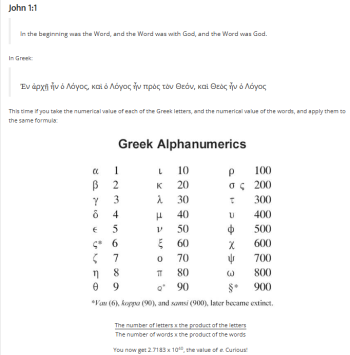
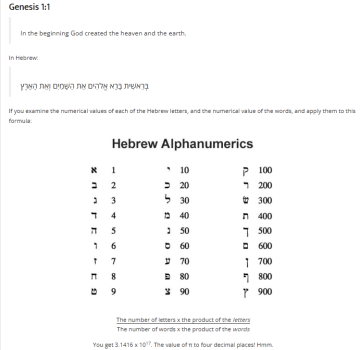
That same GOD through His Bible embedded Maths Pi RATIO into Gen 1:1, & Maths e RATIO into John 1:1
Do you know of an equivalent like for like occurence anywhere else ?
If so, please list it.
.

1781666560628.png

1781666593304.png
 
Jun 12, 2026
146
15
18
63
Timaru
Faith
Agnostic
Country
New Zealand
Gender
Male
"""It argues for a conscious, physical Source -GOD
The GOD that through His Holy men wrote the Bible that we have today that teaches how anyone today enters Heaven tomorrow
That same GOD through His Bible embedded Maths Pi RATIO into Gen 1:1, & Maths e RATIO into John 1:1
I personally don't give much credence to belief claims that the Bible is the word of GOD - that everything in it is dictated by GOD or that the book itself is the only source of recorded inspiration from GOD.

As to the data in the link you provided...
... It argues that the mathematical constants π (pi) and e appear encoded in the Hebrew of Genesis 1:1 and the Greek of John 1:1, respectively, when applying a specific numerical formula. The author presents this as an intriguing "coincidence" or possible remez (hint), but does not claim a definitive meaning. It is a classic example of Bible code or numerology - finding patterns in texts by applying arbitrary mathematical operations.

If the whole Bible was like those two verses, then certainly there would be something extraordinary which would support the belief.

(My own understanding of the Bible can be read here.)
Do you know of an equivalent like for like occurence anywhere else ?
There are similar discoveries which hint that we exits within a created thing.
Adinkras and Superstring Theory: Physicist S. James Gates discovered that the equations describing supersymmetric particles (the fundamental building blocks of nature) contain geometric symbols called Adinkras. When mapped out, these equations reveal the exact same strings of 1s and 0s (specifically, Shannon or error-correcting codes) used to compress data and detect transmission errors in digital communications.

Individuals under the influence of DMT (N,N-Dimethyltryptamine) observe a diffracted 650nm red laser to see visual symbols resembling source code, numbers, or Japanese Katakana characters. [1]
The Discovery: Amateur researcher Danny Goler popularized this phenomenon in 2020 after shining a 650nm laser through adiffraction grating (creating a grid or cross pattern) while in an altered state induced by DMT. [1, 2]
What is Seen: Instead of just scattered light dots, observers describe seeing intricate, floating, coherent symbols that resemble digital or mythological writing. Many report the symbols looking like 0-5 numbers and Katakana characters. [1, 2]
Consistency: According to the DMT Code Project, a high percentage of participants independently describe seeing similar structures, sparking discussions in the r/SimulationTheory community about whether this is a "glitch" in reality or an underlying layer of a simulation. [1, 3]

(Skeptics and neuroscientists suggest the visual effect is primarily the result of the brain's pattern-hunting system—known as pareidolia and apophenia—overdrive while under the influence of hallucinogens. [1, 2])
____________
My own research with the English language has me suspecting that language is mathematically based and this adds support that we exist within a created thing. Since I haven't studied the phenomena with other human languages, I suspect that similar results would occur. If not, then this would signify that the English language is unique in that regard.

To example...
Based on the simplest coding (A=1...Z=26) one can compile lists of same-value words, and word strings (sentences, paragraphs et al.)TO
Using the simple code, the sentence "In the beginning God" has the number value of 163 (= 163) which also a correlation with another word string to do with the subject currently being discussed "Computer Coding" = 163

There are other examples, such as serendipitous and synchronistic events which add support to the theory of intelligent design.
 

ScottA

Well-Known Member
Feb 24, 2011
15,812
7,097
113
www.FinishingTheMystery.com
Faith
Christian
Country
United States
2. The Gap in Simulation Theory
  • It fails as an ultimate explanation because it does not ground the programmers, their hardware, or their broader reality.
  • The CCA's Source is the ground of all formations - including any possible simulators and their "base reality."
Your Conclusion below of the loaves and fishes fails your Gap Theory above: In the beginning God was not physical and did not create the heavens and the earth from his physical self.

What you have shown--in your own words--is that your so-called "Source" is not God.

Conclusion:
The loaves and fishes are coherent with the CCA framework. They do not require ex nihilo, lawlessness, or strong supernaturalism. They are a sign of the Source's nature: physical consciousness, present, abundant, and able to transform physical reality according to Its will. The miracle is not a violation of nature. It is an expression of the Source's mastery over nature. The Kingdom is revealed in the feeding of the hungry. The Source is the bread. The Source is the fish. The Source is the hands that break and the mouths that eat. All is Source. All is physical. All is love.
 
  • Like
Reactions: Anchorite
Jun 12, 2026
146
15
18
63
Timaru
Faith
Agnostic
Country
New Zealand
Gender
Male
Your Conclusion below of the loaves and fishes fails your Gap Theory above: In the beginning God was not physical and did not create the heavens and the earth from his physical self.
To be clear - those additions you made are what has that effect on any conclusions one might draw.
What you have shown--in your own words--is that your so-called "Source" is not God.
Only if we accept you additions to the script. (was not physical and did not create the heavens and the earth from his physical self.)

The question then can be posed "How can the Source be physical if it existed before physical reality?"

The CCA covers this because it does not differentiate re material between things which are created (have a beginning) from that which was not created and had no beginning.
That which is created (has a beginning) is simply the material being used to form things. That is what "Wilful Material" denotes. Consciousness is What the Creator is and consciousness is physical, which in turn answers the question "How can the Source create physical reality from itself if it is physical?" by showing that the question is nonsensical.

Rather, the real question to be asking is "How can the Source create physical reality if It is non- physical?" and that is one of the main points the CCA investigates and concludes that to answer such a question one has to resort to Supernaturalism which in turn creates the Gap that the CCA bridges effectively.
 

ScottA

Well-Known Member
Feb 24, 2011
15,812
7,097
113
www.FinishingTheMystery.com
Faith
Christian
Country
United States
To be clear - those additions you made are what has that effect on any conclusions one might draw.

Only if we accept you additions to the script. (was not physical and did not create the heavens and the earth from his physical self.)

The question then can be posed "How can the Source be physical if it existed before physical reality?"

The CCA covers this because it does not differentiate re material between things which are created (have a beginning) from that which was not created and had no beginning.
That which is created (has a beginning) is simply the material being used to form things. That is what "Wilful Material" denotes. Consciousness is What the Creator is and consciousness is physical, which in turn answers the question "How can the Source create physical reality from itself if it is physical?" by showing that the question is nonsensical.

Rather, the real question to be asking is "How can the Source create physical reality if It is non- physical?" and that is one of the main points the CCA investigates and concludes that to answer such a question one has to resort to Supernaturalism which in turn creates the Gap that the CCA bridges effectively.
You haven't shown anything except that you're hypothesizing, which you are doing against established reality. In other words, the God you say are additions (to reality) that I made--I did not make at all, but have more than observed (I was shown by God) is confirmed by an innumerable amount of witnesses, which science is slowly making its way back to also.

To the contrary, you are only, either sharing your own limited niche hypothesis, or one you have found agreeable.

Are you actually trying to convince or enlighten others that your hypothesis is more correct and the one to believe in? Or is it actually just an argument? If not/if so, why don't you just say this is your own idea, what you believe is true, that seems to have merit...instead of arrogantly making claims you can't really support?
 
Last edited:
  • Like
Reactions: Anchorite
Jun 12, 2026
146
15
18
63
Timaru
Faith
Agnostic
Country
New Zealand
Gender
Male
You haven't shown anything except that your hypothesizing, which you are doing against established reality.

What "established reality" is that? The belief that God is somehow supernatural? That has never been established.

Supernaturalism is not established reality - it is an assumption. It is a claim that something exists beyond natural laws, understanding, and evidence. That is not established; it is asserted.

The CCA, by contrast, is grounded in what we know: physical reality, consciousness, and causation.
In other words, the God you say are additions (to reality) that I made--I did not make at all, but have more than observed (I was shown by God)

What did God look like to you? What were you shown?

Was it visual? Auditory? Sensory?
Did you perceive it through some form of awareness?
If you perceived it, then it was physical in the broad sense – real, coherent, and causally efficacious.
Why do you think what you experienced was immaterial?

If you had any perception at all - any sensory or quasi-sensory experience - then it was physical in the CCA's sense. Calling it "supernatural" is an interpretation, not a description.
The CCA is not a "limited niche hypothesis." It is a comprehensive framework that can account for:

The origin of the universe.
The nature of consciousness.
The ground of physical law.
Miracles and spiritual experiences.

It does not diminish your witness. It gives it a coherency which supernaturalism does not.
is confirmed by an innumerable amount of witnesses, which science is slowly making its way back to also.
If science can confirm anything, then that anything must be natural. Calling it "supernatural" is merely to throw an "invisible" cloak over it in an attempt to make it "disappear" into something it is not.
I have provided adequate examples throughout this thread in support of the coherency of the argument and instead of fully engaging with those, you appear to prefer ad hominem personal attack on my character and motives.
To the contrary, you are only, either sharing your own limited niche hypothesis, or one you have found agreeable.
The CCA does not deny your experience. It offers a more coherent interpretation of it: you experienced a deeper, purer physical reality - one that is coherent, lawful, and understandable in principle.
The CCA does not diminish your witness. It gives it a coherency which supernaturalism does not.
Are you actually trying to convince or enlighten others that your hypothesis is more correct and the one to believe in?
More coherent = better. That is not the same as "more true" in a dogmatic sense – but it is the best standard we have for evaluating explanations.

I offer the CCA as a means of bridging between extremes:

Between strong supernaturalism (lawless, beyond understanding) and weak materialism (which cannot account for consciousness).
Between faith and reason.
Between science and spirituality.

If you don't like it simply because it challenges traditional beliefs, then show why traditional belief is coherent:

Explain why the gaps are necessary.
Explain why supernaturalism should be believed in.
Explain how a non-physical spirit produces physical effects.

I am open to being shown a better explanation. Are you?

Or is it actually just an argument?
It is both an argument and a framework.

It is an argument in the sense that it has premises and conclusions that can be examined logically.

It is a framework in the sense that other theories and hypotheses can be lensed through it - as I have already demonstrated in this thread.

This includes your own hypothesis, which I evaluated through the CCA lens.


If not/if so, why don't you just say this is your own idea, what you believe is true, that seems to have merit...instead of arrogantly making claims you can't really support?

What exactly is your problem with the way I have presented the argument and shown how well it works when other arguments are placed through its framework?

The CCA is largely my own project and is a work in progress.
I am open to refinements and tweaks.
I acknowledge valid critiques and revise my argument accordingly.
That is not arrogance. That is intellectual honesty.

If you have a specific objection to the CCA, I welcome it.
If you do not, then your criticisms are not philosophical - they are personal.
 

ScottA

Well-Known Member
Feb 24, 2011
15,812
7,097
113
www.FinishingTheMystery.com
Faith
Christian
Country
United States
What "established reality" is that? The belief that God is somehow supernatural? That has never been established.

Supernaturalism is not established reality - it is an assumption. It is a claim that something exists beyond natural laws, understanding, and evidence. That is not established; it is asserted.

The CCA, by contrast, is grounded in what we know: physical reality, consciousness, and causation.
You contrast what you and the closed-circuit knowledge of those knowing nothing beyond this universe know, against what others know, and yes, by a longstanding record of eyewitnesses, it is established. Which is not limited except by those who do not know more, or those who self-limit short of what historically is even immensely greater than modern theory.

Personally, I can tell you that what I "know" of God cannot even be defined as mere "belief." I have been outside the limit you have considered the limit to reality. Which you do not have the privilege of setting for all humanity, as your position and knowledge as you have just defined as "physical reality, consciousness, and causation", is the lesser.

You don't have to believe in anything more than you do, but your declaration is little more than limited knowledge not unlike many throughout history who thought they knew better but were eventually proven wrong. Which I suspect will be your comeback, repeating the statements of those who were proven wrong in history, saying, "Where is your proof? Show us your proof!"

To the contrary, that is not my position--I am not challenging you, I'm telling you there is something more--way more.

As for proof--because you are repeating what many have done before you--with the next actually level of understanding, unlike the free for all that exists within this realm of natural laws, it's personal, and not available by design to those who choose another path...you know, kind of like certain levels of higher education or vocation even here. Like many things in this world--that is why such limits exist here--so that we come to learn and understand that it is reasonable and to be accepted. That actual next level, though not "natural", has its limits too--the limit is within you.
 
Jun 12, 2026
146
15
18
63
Timaru
Faith
Agnostic
Country
New Zealand
Gender
Male
Either answer the questions put to you – did you see God, what did you experience, and why do you think it was supernatural – and explain why you think what you experienced was supernatural, or remain aloof as you have been and continue to talk down at me with personal comments aimed at me.

If you decide to continue with the latter, I will ignore your replies herein.

The CCA does not deny your experience. It offers a coherent interpretation of it. If you believe your experience was supernatural, explain why – without resorting to personal attacks.

The choice is yours.
 
Last edited:

Anchorite

Well-Known Member
May 1, 2026
567
503
93
68
Peoria
Faith
Christian
Country
United States
Gender
Male
I have been working on this idea for a while now. It is still a Work in Progress which means it is open to additions, tweaks et al.
I share it here because it is clear that some members want to get to know me - how I think etc...
In Love
Eternal Entity

Definitions (Oxford Languages):

Supernatural: (of a manifestation or event) attributed to some force beyond scientific understanding or the laws of nature.

Premises:
P1: Everything that begins to exist has a natural cause.

P2: It is generally accepted in modern cosmology that this universe (our spacetime reality) had a beginning.

C1: Therefore, this universe has a natural cause.

P3: A "natural cause" means a cause that operates within some framework of consistent laws, is potentially understandable in principle, and is part of a broader causal reality.

P4: A supernatural cause, by definition, is beyond natural laws, understanding, and evidence, thus it cannot function as a causal explanation.

C2: Therefore, the cause of the universe is not supernatural - it is part of a broader natural reality (a "Source Reality").
P5: This Source Reality must be eternal - uncreated, but still natural in the sense of being coherent, consistent, and conceptually describable.

C3: Since an infinite regress of contingent causes provides no ultimate explanation, the Source Reality must be eternal (and necessary).

P6: A non-physical substance cannot produce physical effects without an explanatory gap (from P4 and the rejection of strong supernaturalism).

P7: The Source produces physical effects (the universe, matter, formations).

C4: Therefore, the Source is physical.

P8: The Source, being physical, either is conscious or is not.

P9: If the Source is not conscious, consciousness must emerge from non-conscious physical reality. This is the hard problem of consciousness - an unexplained gap equivalent to strong supernaturalism.

P10: Consciousness is not a separate substance, nor is it an emergent property. Consciousness is a physical reality. The Source does not have consciousness; the Source is consciousness.

C5: Therefore, the Source is conscious.

C4 established that the Source is physical. Consciousness is not an attribute the Source has; the Source is consciousness. Therefore, the Source is physical consciousness - wilful matter.

Overall Conclusion:
The universe was caused by an eternal, physical, conscious Source - not by a supernatural one. Consciousness is not an add-on or a possibility; it is the nature of the Source itself. This avoids the explanatory dead-end of supernaturalism while also resolving the hard problem of consciousness by grounding subjective experience in the fundamental nature of any reality experienced.
Yawn. Just more carnal, materialist philosophy which has been done already by much sharper minds, yet is still bankrupt.

No evidence or scripture supports any of these meandering musings.

So many errors, it is too time consuming to list them all. Your premises are unfounded presumptions.

Reject the supernatural causation if that makes you feel better. But your denial of God’s Word will result in consequences.

Why are you polluting this Christian forum with your pagan ideas?
 

ScottA

Well-Known Member
Feb 24, 2011
15,812
7,097
113
www.FinishingTheMystery.com
Faith
Christian
Country
United States
What did God look like to you? What were you shown?

Was it visual? Auditory? Sensory?
Did you perceive it through some form of awareness?
If you perceived it, then it was physical in the broad sense – real, coherent, and causally efficacious.
Why do you think what you experienced was immaterial?

If you had any perception at all - any sensory or quasi-sensory experience - then it was physical in the CCA's sense. Calling it "supernatural" is an interpretation, not a description.
The CCA is not a "limited niche hypothesis." It is a comprehensive framework that can account for:

The origin of the universe.
The nature of consciousness.
The ground of physical law.
Miracles and spiritual experiences.

It does not diminish your witness. It gives it a coherency which supernaturalism does not.
You keep going back to supernaturalism...which was something you brought up, not me. You asked a question. I answered, saying that "supernatural" was not incorrect, as God does by definition "exist outside the known laws of nature."

If you are not happy with that definition, it's not my definition, and I am not here to help you with that. However, I have stated what is actually true.

As for my my experience with God, I have written books on it. But it was spiritual, as God is spirit. Not physical. You are wrong about the physical, and the so-called source. Which is to say, what is spiritual is not limited as that which is physical is limited, but infinitely exceeds the physical realm limits. So, yes, what you have described is indeed "a limited niche hypothesis." As a "framework", you have given its limit as being physical. Which, no, does not account for "the nature of consciousness" or "spiritual experiences", it puts them in a box--a worldly box.

You are in no position to say what does and does not diminish my witness.
 
  • Like
Reactions: Anchorite

ScottA

Well-Known Member
Feb 24, 2011
15,812
7,097
113
www.FinishingTheMystery.com
Faith
Christian
Country
United States
Either answer the questions put to you – did you see God, what did you experience, and why do you think it was supernatural – and explain why you think what you experienced was supernatural, or remain aloof as you have been and continue to talk down at me with personal comments aimed at me.

If you decide to continue with the latter, I will ignore your replies herein.

The CCA does not deny your experience. It offers a coherent interpretation of it. If you believe your experience was supernatural, explain why – without resorting to personal attacks.

The choice is yours.
You didn't use the "Reply" feature, so I missed this one.

Again, "supernatural" is a term you brought up, not me.
As for me talking down at you--you dug a hole and have placed yourself in a pit. Lower. You did that. Not me. Which I actually jumped into with you to start with (I even complimented you)--but only to explain that your digging was not helping your position.

But, what, you think that my jumping in to help you...was an attack? Wow!

Well, your being ungrateful and not perceiving what I was doing, does not change what is true. It just makes it more obvious how deep in you are.
 
  • Like
Reactions: Anchorite
Jun 12, 2026
146
15
18
63
Timaru
Faith
Agnostic
Country
New Zealand
Gender
Male
Yawn. Just more carnal, materialist philosophy which has been done already by much sharper minds, yet is still bankrupt.
You have dismissed the CCA as "carnal" and "materialist." But I would gently point out that the CCA is not materialism - it is a framework that grounds consciousness in the nature of the Source itself. It is neither reductive nor dismissive of spiritual experience.

If you have a specific objection to the argument, I am open to it. But dismissing it with labels is not a refutation.
No evidence or scripture supports any of these meandering musings.
The CCA is a philosophical argument, not a theological one. It does not rely on scripture as its authority - it relies on reason, logic, and evidence.

However, I would note that the CCA does not contradict scripture. It offers a coherent interpretation of the Source that is consistent with the biblical witness: the Source is eternal, conscious, and the ground of all reality.

If you believe the CCA contradicts scripture, please show me where. If you cannot, then your objection is not a refutation - it is a dismissal.
So many errors, it is too time consuming to list them all. Your premises are unfounded presumptions.
Please list just one.

Which premise is false?
Which conclusion does not follow?
What is the specific logical error?
If you cannot list even one, then your objection is not a philosophical critique - it is a personal opinion.
Reject the supernatural causation if that makes you feel better. But your denial of God’s Word will result in consequences.
I am not denying Jesus. I am offering a philosophical argument about the nature of the Source. If you believe that argument is wrong, I am open to hearing why.

But vague threats are not arguments. They are attempts to control through fear - and they have no place in a philosophical discussion.
Why are you polluting this Christian forum with your pagan ideas?
I would respectfully remind you that this thread is in the section reserved for non-Christians. It is a space for philosophical discussion, not for evangelism or theological debate.

I am here to offer a philosophical argument - the Coherent Causality Argument - and to discuss it with anyone who is willing to engage on philosophical grounds.

If you are not interested in philosophical discussion, you are free to ignore this thread. But I am not "polluting" anything - I am participating in a space that is specifically designated for this kind of discussion.
 
Jun 12, 2026
146
15
18
63
Timaru
Faith
Agnostic
Country
New Zealand
Gender
Male

LLS: Here is an analysis of this video transcript through the CCA framework.

1. Coherence Assessment
The argument is internally coherent. It builds a case from neuroscience (the brain constructs reality from signals), physics (quantum non-locality, observer effect), and philosophy (the hard problem of consciousness) to a conclusion: that consciousness is fundamental, not emergent, and that a single field of awareness underlies all individual experiences. It does not invoke lawless or inexplicable forces; it appeals to scientific findings and logical parsimony. This aligns with the CCA's requirement for coherence: the argument is understandable, and its premises are connected in a lawful manner.

2. Lawfulness
The argument operates within a framework of consistent principles: perception as construction, quantum observation as collapse, and consciousness as the unifying field. It does not appeal to miracles or supernatural interventions. It describes a lawful, intelligible process — even if that process challenges the conventional materialist view. This fits the CCA's broad natural category: the "something" that coordinates all private hallucinations is not lawless; it is the ground of lawfulness itself.

3. Understandability in Principle
The argument is presented as a scientific and philosophical inquiry. It invites investigation — through neuroscience, quantum physics, and personal experience. It is not a closed, unverifiable assertion. It offers a model (consciousness as a single field) that can be tested, refined, or falsified. The CCA requires that a cause be potentially understandable in principle; this argument meets that criterion.

4. Strong vs. Weak Supernaturalism
This argument does not invoke strong supernaturalism. It does not appeal to a lawless, beyond-understanding realm. It uses physics and neuroscience to argue for a reality that is deeper than the materialist model, but still coherent and lawful. It is closer to weak supernaturalism or preternatural — something currently unexplained but potentially understandable. The CCA does not exclude such proposals.

5. Relation to the CCA’s Source
The transcript’s conclusion — that a single consciousness is looking through all of us — is functionally similar to the CCA’s Source. The Source is not a supernatural soul; it is the ground of all formation. The transcript describes that ground as a field of awareness, from which all individual experiences arise. This aligns with the CCA: consciousness is not produced by the brain; it is the Source expressing through the brain’s formation. The brain is the receiver, not the generator.

Conclusion
The argument is coherent, lawful, and understandable in principle. It does not rely on strong supernaturalism. It points to a ground of reality that is consciousness — which fits the CCA’s concept of the Source. The transcript offers a scientific and philosophical case for the idea that we are not separate selves, but expressions of a single awareness. The CCA can accommodate this view as a coherent formation within the broader natural reality.
 

Anchorite

Well-Known Member
May 1, 2026
567
503
93
68
Peoria
Faith
Christian
Country
United States
Gender
Male
This is just a secular, materialist, anti-supernatural philosophy. It’s full of errors and not worth discussing. The OP thinks he’s clever and provocative, but to me, this is just silly and boring.
 
Jun 12, 2026
146
15
18
63
Timaru
Faith
Agnostic
Country
New Zealand
Gender
Male
This is just a secular, materialist, anti-supernatural philosophy. It’s full of errors and not worth discussing. The OP thinks he’s clever and provocative, but to me, this is just silly and boring.
Puerility