So Joseph married Mary but didn’t have sex?

  • Welcome to Christian Forums, a Christian Forum that recognizes that all Christians are a work in progress.

    You will need to register to be able to join in fellowship with Christians all over the world.

    We hope to see you as a part of our community soon and God Bless!

Moonwood

Member
Aug 24, 2026
100
38
28
Pacific Northwest
Faith
Christian
Country
United States
Gender
Female
Inherent implication isn't the point. How do people fluent in a language use it to communicate?

If heos does not inherently imply resumed normal behavior after the terminus, neither does it imply the continuance of the exceptional behavior afterwards. If you are going to rigidly follow dictionary meanings and grammatical rules, then you have to say, "We don't know whether or not Mary and Joseph enjoyed normal marital relations."

Matthew isn’t indicating Joseph and Mary had marital relations after Jesus’s birth but the status of Jesus’s origin and Joseph’s role. Heos marks the period before the birth because that is where the paternity issue is relevant. As you’ve acknowledged, heos does not inherently imply either reversal or continuation, which means Matthew 1:25 does not speak to what happened afterward. Any conclusion about later intercourse is supplied by the reader, not by the Greek text.
 

Lambano

Well-Known Member
Jul 13, 2021
10,567
13,223
113
Island of Misfit Toys
Faith
Christian
Country
United States
Gender
Male
As you’ve acknowledged, heos does not inherently imply either reversal or continuation, which means Matthew 1:25 does not speak to what happened afterward. Any conclusion about later intercourse is supplied by the reader, not by the Greek text.
Then with any communication channel, when you have uncertainty in the message, you have to apply probabilistic methods.
 

Moonwood

Member
Aug 24, 2026
100
38
28
Pacific Northwest
Faith
Christian
Country
United States
Gender
Female
Then with any communication channel, when you have uncertainty in the message, you have to apply probabilistic methods.

Matthew isn’t indicating Joseph and Mary had marital relations after Jesus’s birth but the status of Jesus’s origin and Joseph’s role. Heos marks the period before the birth because that is where the paternity issue is relevant. As you’ve acknowledged, heos does not inherently imply either reversal or continuation, which means Matthew 1:25 does not speak to what happened afterward. Probabilistic inference isn’t a substitute for what the text actually says. Any conclusion about later intercourse is supplied by the reader, not by the Greek text.
 
Last edited:

Lambano

Well-Known Member
Jul 13, 2021
10,567
13,223
113
Island of Misfit Toys
Faith
Christian
Country
United States
Gender
Male
Probabilistic inference isn’t a substitute for what the text actually says.
Probabilistic inference is necessary when certainty is not possible.

In this case, the largest denomination in Christendom has established a major doctrine that cannot be supported by "what the text actually says".

If you argue that the doctrine of Mary's perpetual virginity is supported by the testimony of the Early Church Fathers, then I'll have to echo your phrase, "the testimony of the Early Church Fathers isn't a substitute for what the Biblical text actually says".
 

Moonwood

Member
Aug 24, 2026
100
38
28
Pacific Northwest
Faith
Christian
Country
United States
Gender
Female
Probabilistic inference is necessary when certainty is not possible.

In this case, the largest denomination in Christendom has established a major doctrine that cannot be supported by "what the text actually says".

If you argue that the doctrine of Mary's perpetual virginity is supported by the testimony of the Early Church Fathers, then I'll have to echo your phrase, "the testimony of the Early Church Fathers isn't a substitute for what the Biblical text actually says".

Probabilistic inference isn’t relevant here because Matthew isn’t communicating uncertainty. He isn’t indicating anything about Joseph and Mary’s later relations; he’s underlining Jesus’s origin and Joseph’s role. Heos marks the period before the birth because that is where the paternity issue is relevant. As you’ve acknowledged, heos does not inherently imply either reversal or continuation, which means Matthew 1:25 is not indicating that they did or did not have intercourse afterward. Any conclusion about later intercourse is supplied by the reader, not by the Greek text.
 

Lambano

Well-Known Member
Jul 13, 2021
10,567
13,223
113
Island of Misfit Toys
Faith
Christian
Country
United States
Gender
Male
He isn’t indicating anything about Joseph and Mary’s later relations; he’s underlining Jesus’s origin and Joseph’s role.
He may or may not be indicating something about Joseph and Mary's later relations. You have already conceded that you cannot state that he is not with certainty for the very reasons that you say I cannot state with certainty that he is. Either way, the form would be the same in Greek.
 
Last edited:

Moonwood

Member
Aug 24, 2026
100
38
28
Pacific Northwest
Faith
Christian
Country
United States
Gender
Female
He may or may not be indicating something about Joseph and Mary's later relations. You have already conceded that you cannot state that he is not with certainty for the very reasons that you say I cannot state with certainty that he is. Either way, the form would be the same in Greek.

The Greek form is the same precisely because Matthew isn’t indicating either outcome. Heos marks the period before the birth because that is where Jesus’s origin and Joseph’s role are relevant. Matthew 1:25 is not signaling that they did or did not have intercourse afterward; it is simply not addressing that question. Silence in the text isn’t uncertainty to be filled with probability. It’s silence because Matthew is not talking about that. Any conclusion about later relations comes from the reader, not from the Greek.
 

Armour of God

Well-Known Member
Mar 6, 2026
1,694
1,118
113
47
Adelaide
Faith
Christian
Country
Australia
Gender
Male
The Greek word for "brothers" and "sisters" (adelphous and adelphai) can also refer to cousins, so that isn't definitive.

Yea that's what the Catholics say to protect their perpetual virginity dogma. But what they don't tell you is that there is another word for cousin in classical Greek, anepsios, and it appears elsewhere in the new testement

I'm not 100% sure but I tend to believe that they would of used that word if they meant to say cousin, that Jesus did have siblings and that Mary did love her husband and allowed him to love her.

But no one knows for sure I guess
 
  • Like
Reactions: Lambano

Lambano

Well-Known Member
Jul 13, 2021
10,567
13,223
113
Island of Misfit Toys
Faith
Christian
Country
United States
Gender
Male
The Greek form is the same precisely because Matthew isn’t indicating either outcome. Heos marks the period before the birth because that is where Jesus’s origin and Joseph’s role are relevant. Matthew 1:25 is not signaling that they did or did not have intercourse afterward; it is simply not addressing that question.
You cannot state with certainty that he is or is not signaling whether or not Mary and Joseph had normal marital relations.

I stand by my assessment that it is highly probable that Matthew knows that that they did and has no issue with implying such. It would not affect his main point anyway.
 
Last edited:

Armour of God

Well-Known Member
Mar 6, 2026
1,694
1,118
113
47
Adelaide
Faith
Christian
Country
Australia
Gender
Male
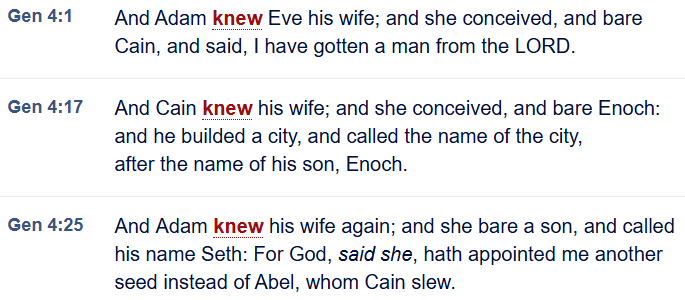
I don't see any confusion.
We all know what KNEW does :)

View attachment 89922
View attachment 89923

That's a good point Pete
Thanks for sharing

Matthew 1:25 NIV says
But he did not consummate their marriage until she gave birth to a son. And he gave him the name Jesus.

In ERV it's says
But Joseph did not have sexual relations with her until her son was born. And he named him Jesus.

What do you think of this @Lambano ?
Brother Pete makes a good point.
It looks pretty certain to me now.
 

Moonwood

Member
Aug 24, 2026
100
38
28
Pacific Northwest
Faith
Christian
Country
United States
Gender
Female
You cannot state with certainty that he is or is not signaling whether or not Mary and Joseph had normal marital relations.

I stand by my assessment that it is highly probable that Matthew knows that that they did and has no issue with implying such. It would not affect his main point anyway.

Matthew’s silence on Joseph and Mary’s later relations is not a signal; it’s simply silence because Matthew is not addressing that topic. Heos marks the period before the birth because that is where Jesus’s origin and Joseph’s role are relevant. As you’ve acknowledged, heos does not inherently imply either reversal or continuation, which means Matthew 1:25 is not indicating that they did or did not have intercourse afterward. Treating narrative silence as probabilistic evidence is not exegesis; it’s supplying a conclusion the Greek text does not provide.
 

Armour of God

Well-Known Member
Mar 6, 2026
1,694
1,118
113
47
Adelaide
Faith
Christian
Country
Australia
Gender
Male
Matthew’s silence on Joseph and Mary’s later relations is not a signal; it’s simply silence because Matthew is not addressing that topic. Heos marks the period before the birth because that is where Jesus’s origin and Joseph’s role are relevant. As you’ve acknowledged, heos does not inherently imply either reversal or continuation, which means Matthew 1:25 is not indicating that they did or did not have intercourse afterward. Treating narrative silence as probabilistic evidence is not exegesis; it’s supplying a conclusion the Greek text does not provide.

But Joseph did not have sexual relations with her until her son was born. And he named him Jesus. - Matthew 1:25 ERV

Looks pretty clear to me.
Also refer to Peter's post above