


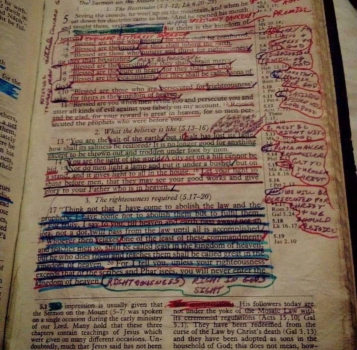
This is an example of someone (not me) writing in their Bible. How common is it for people to write in their Bibles? Do you write in yours?
I own dozens of Bibles. I only write in Bibles that I use to teach and preach from.
Welcome to Christian Forums, a Christian Forum that recognizes that all Christians are a work in progress.
You will need to register to be able to join in fellowship with Christians all over the world.
We hope to see you as a part of our community soon and God Bless!

This is an example of someone (not me) writing in their Bible. How common is it for people to write in their Bibles? Do you write in yours?
I own dozens of Bibles. I only write in Bibles that I use to teach and preach from.

These days I'm mostly using on-line bibles, and Blue Letter Bible's site owner won't authorize me to write on their site, darn it.This is an example of someone (not me) writing in their Bible. How common is it for people to write in their Bibles? Do you write in yours?
I own dozens of Bibles. I only write in Bibles that I use to teach and preach from.
Even at church services I see people using Blue Letter Bible on their phones ... I guess I'm just an old fuddy-duddy but it doesn't feel like a real Bible to meThese days I'm mostly using on-line bibles, and Blue Letter Bible's site owner won't authorize me to write on their site, darn it.


As young people we were encouraged to write in our Bibles. Many of us had Oxford Wide Margin Bibles. One exercise given to us was to mark where Isaiah was quoted in the NT, referencing both the OT and NT passages. We were given a thorough list but there is also a more useful list in Barnes OT Commentary accessed via Bible Hub. I also marked the relevant verses in the Psalms. Some of our members have very thorough Bible marking, and most of these are much more tidy than the example that you gave. I made extensive notes on Galatians, but the writing is very small and now difficult to read.This is an example of someone (not me) writing in their Bible. How common is it for people to write in their Bibles? Do you write in yours?

I have recently received an interesting addition to my library which in some respects resembles a fully marked up Wide Margin Bible. It was a gift from a US speaker who stayed with my brother-in-law when he visited and spoke in Sydney. It is Dake's Annotated Reference Bible with Concordance and Index 1961. It has two columns of KJV text and two columns of notes and reference material on either side. There is not much room for personal notes except for a small amount at the bottom of the page. Possibly good for reference, but I will continue to use my RV/KJV Interlinear Bible. In a way Dake's Bible is not much different to Ethelbert W Bullinger;s Companion Bible or my NASB Study Bible which comes with some Notes on each page, a Strong's Concordance and a limited Lexicon of important words.This is an example of someone (not me) writing in their Bible. How common is it for people to write in their Bibles? Do you write in yours?

^^^^ Do you write in your bible?
The problem is that I have not yet written "my bible."
Do you write in the Bible you have?

My problem is that the contextual accuracy of the translations that have been produced by the "scholars" through the "committees" process leaves a lot to be desired.
What I have been working on slowly is to produce my own paraphrased translation of the original text.
The problem I have is that people will trust a translation compiled by a committee rather than by a single person based on the premise that a committee is less likely to make "mistakes" in the committee generated process, however I have come to accept that a committee can generate just as many mistakes as a single person makes in their understanding of the "original" scriptural texts.
People also hate change and so it is a very slow process to produce new translations that will readily sell to the general public at large. An example of this is the KJV which many "Christians" still prefer over better crafted versions today.
Now, the re-paraphrased biblical text that I have generated for myself have only corrected the contextual errors that I have found/discovered within the translations that exist today.
One example of this is found in Genesis 2:17 which I have rephrased to read in this manner.
View attachment 91466
However, many scholars suggest that the concept of the "Second Death" has been revealed to us slowly in the scriptures, whereas it is my contention that the "Second Death" was introduced to Adam before he entered the Garden of Eden and that it was a distant future event which would be decided at the end of the Seventh Age when all of mankind will be judged for their righteousness.
In Ezekiel 18, the prophet tells us that the consequences of being a candidate to be dispatched into the Lake of Fire, i.e. the second death, can be overturned if we, that is anyone who will humble themselves and repent of their sins against God and will be called righteous at the time of the Judgement at the end of the seventh age. Ezekiel 18 also tells us that if a righteous man sins and will not humble themselves and repent of their sins against God that they will not gain everlasting life at the time of the final judgement but that they will also be cast into the Lake of Fire, i.e. the Second Death.
In the inserted image of what my corrected contextual translation looks like it is easy for other readers to see the contextual translated text that I perceive is in error and my inserted text which I believe corrects this error.
Simply writing in "my Bible" to correct these contextual errors is not workable because when I have to replace my printed Bible because it is falling apart because of its age, I lose the work that I have done and the new Bible is once more just a blank sheet with none of my previous learned/revealed understanding of the Bible within its fresh pages.
Instead, I use a computer "Writing Program" to store my revelations in.
Shalom
None of the Bibles you own have been written in by you?


