I ran this through chatgpt, taking a screen shot of the image of that photo and asking it to explain, to make this potentially understandable for you. Here's what it spit out.
- - -
This is a fascinating photograph because it demonstrates just how far human vision can extend under the right conditions. The mountains in your picture are between 420 and 493 kilometers (261–306 miles) away.
The explanation involves three things working together:
- The elevation of the photographer.
- The elevation of the distant mountain peaks.
- The bending of light as it travels through Earth's atmosphere (atmospheric refraction).
Let's break that down.
1. Both ends of the line of sight are elevated
Richard Jezik was photographing from a mountain in the Karagöl area of northeastern Turkey.
- His observation point was approximately 3,107 meters (10,194 feet) above sea level.
- Mount Shkhara, the most distant mountain in the photograph, is approximately 5,193 meters (17,037 feet) high.
This is important because the Earth curves away below both the photographer and the distant mountain.
Think of it this way: the photographer doesn't have to see around the Earth from sea level. He is looking from one elevated mountain toward another elevated mountain.
2. Each mountain has its own horizon
Here is the interesting mathematics.
On a spherical Earth, the approximate distance to the horizon, without atmospheric refraction, is:
\[ D=3.57\sqrt{h} \]
Where:
- D is the distance in kilometers.
- h is the height in meters.
For Jezik's position:
\[ 3.57\sqrt{3107}=199\text{ km} \]
For the top of Mount Shkhara:
\[ 3.57\sqrt{5193}=257\text{ km} \]
Add those together:
\[ 199+257=456\text{ km} \]
Important result
Even without atmospheric refraction, the two elevated positions have a combined geometric horizon distance of approximately 456 kilometers.
That is why the elevation of both mountains matters so much.
3. Atmospheric refraction extends the distance
This is the part that makes the photograph especially interesting.
Light does not travel in a perfectly straight line through Earth's atmosphere.
Air near the surface is generally denser than air higher up. As light travels through these layers, its path bends slightly downward, following the curvature of the Earth.
This phenomenon is called atmospheric refraction.
Under ordinary atmospheric conditions, refraction can extend the geometric viewing distance by as much as approximately 9%.
DOI.org+1
Let's apply that to the photograph:
The viewing distance to Mount Shkhara
Geometric horizon distance
456 km
With 8.1% additional reach
493 km
493 km
Approximately 306 miles
That is remarkably close to the actual Guinness record distance of 493.07 kilometers.
4. Why was the photograph taken at sunrise?
The atmospheric conditions were particularly important.
According to Guinness, Jezik:
- Climbed for approximately 10 hours to reach his observation point.
- Set up his equipment during the night.
- Experienced temperatures around -12°C (10°F).
- Waited until sunrise to capture the photograph.
There were two advantages:
Atmospheric conditions: Temperature differences between atmospheric layers affect how much light bends. Certain stable conditions and temperature inversions can extend visibility considerably.
Visual contrast: The distant mountains appear as dark silhouettes against the brighter sky around sunrise. This makes otherwise nearly invisible mountain peaks much easier to photograph.
Guinness World Records+1
5. What does this photograph actually demonstrate?
There is an important distinction worth making.
The photograph demonstrates that an elevated observer can see extremely distant elevated objects, even when the distance exceeds the combined geometric horizon distances calculated without refraction.
It does not mean that the entire distant mountain range is visible. The visible portions are primarily the elevated peaks.
And it does not mean atmospheric refraction is imaginary or an arbitrary explanation. It is a measurable optical phenomenon that scientists account for in surveying, astronomy, and long-distance visibility calculations.
My takeaway: The remarkable thing about this photograph is that the combination of two high elevations, Earth's atmosphere, and exceptionally favorable weather makes it possible to photograph a mountain more than 300 miles away while standing on another mountain.
- - -
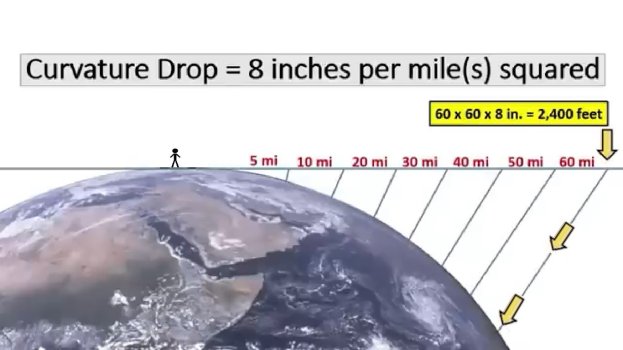
Then I asked it to make an image illustrating how this works. Here's what it gave me.
View attachment 93089
But....but....conspiracy! (probably chatgpt is part of that conspiracy!)