Debunking the big bang theory

  • Welcome to Christian Forums, a Christian Forum that recognizes that all Christians are a work in progress.

    You will need to register to be able to join in fellowship with Christians all over the world.

    We hope to see you as a part of our community soon and God Bless!

Armour of God

Well-Known Member
Mar 6, 2026
1,573
1,035
113
47
Adelaide
Faith
Christian
Country
Australia
Gender
Male
The big bang theory was invented about a hundred years ago and is taught today in schools as if it's was an undeniable fact.

But the materialistic view has always had some big questions that it couldn't answer.
What caused the big bang?
Where did all the matter (stars, planets, moons, galaxies, etc) come from?

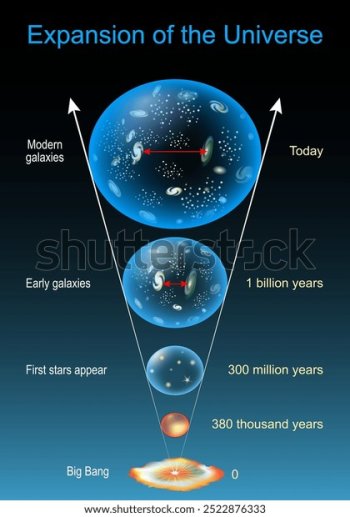
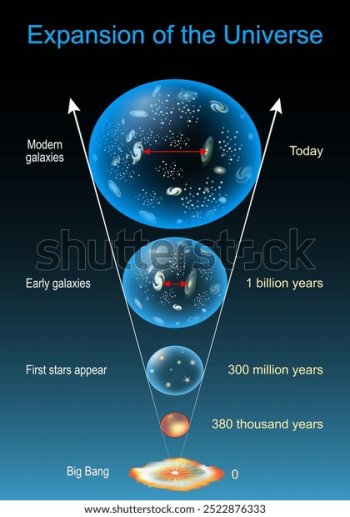
The big bang theory says that the universe is expanding. It says that shortly after the big bang there wasn't much matter, only some young stars. Then over time galaxies formed. This image illustrates that.
evolution-universe-expansion-cosmic-timeline-600w-2522876333.jpg

They think the universe is 13.8 billion years old.

In 2021 they launched a new telescope into orbit, the James Webb Space Telescope, JWST. It is much more powerful than the Hubble telescope that they had been using for decades. The JWST can look much further out into space. And seeing that light takes time to travel it can essentially look back in time.

The big bang theory says that the further back we look the less matter we should see but the JWST has torn that hypothesis to shreds. Instead of seeing less matter it is seeing more matter. Big galaxies and many of them in a time where they said there should be hardly anything there.

This short video explains


Many scientists are admitting that the big bang theory was wrong but many stiff necked scientists are refusing to accept the findings and are scrambling to make excuses, others are just flat out ignoring or dismissing the findings.

In this short video a scientist explains how science is secular. It views everything in a materialistic way and will never accept God.


Of course we know that the materialistic explanation for the universe is wrong. There must of been a creator. And that creator has an intelligence far far greater than any human or super computer.

Praise be to God
 

Stumpmaster

Well-Known Member
Apr 5, 2009
2,838
1,857
113
71
Hamilton, New Zealand
Faith
Christian
Country
New Zealand
Gender
Male
The big bang theory was invented about a hundred years ago and is taught today in schools as if it's was an undeniable fact.

But the materialistic view has always had some big questions that it couldn't answer.
What caused the big bang?
Where did all the matter (stars, planets, moons, galaxies, etc) come from?

The big bang theory says that the universe is expanding. It says that shortly after the big bang there wasn't much matter, only some young stars. Then over time galaxies formed. This image illustrates that.

View attachment 89158

They think the universe is 13.8 billion years old.

In 2021 they launched a new telescope into orbit, the James Webb Space Telescope, JWST. It is much more powerful than the Hubble telescope that they had been using for decades. The JWST can look much further out into space. And seeing that light takes time to travel it can essentially look back in time.

The big bang theory says that the further back we look the less matter we should see but the JWST has torn that hypothesis to shreds. Instead of seeing less matter it is seeing more matter. Big galaxies and many of them in a time where they said there should be hardly anything there.

This short video explains


Many scientists are admitting that the big bang theory was wrong but many stiff necked scientists are refusing to accept the findings and are scrambling to make excuses, others are just flat out ignoring or dismissing the findings.

In this short video a scientist explains how science is secular. It views everything in a materialistic way and will never accept God.


Of course we know that the materialistic explanation for the universe is wrong. There must of been a creator. And that creator has an intelligence far far greater than any human or super computer.

Praise be to God
The latest telescope launched into space is the Nancy Grace Roman Space Telescope, which lifted off on 30 August 2026 aboard a SpaceX Falcon Heavy from NASA’s Kennedy Space Center.

What the Roman Telescope Is​

  • A next‑generation infrared space telescope designed to survey hundreds of millions of stars and billions of galaxies.
  • Originally known as WFIRST, renamed to honor Nancy Grace Roman, NASA’s first chief astronomer and a key figure behind Hubble.

Mission & Scientific Goals​

  • Dark energy & dark matter: Roman will probe the universe’s expansion and help decode its most mysterious components.
  • Exoplanets: Expected to uncover 100,000+ planets around other stars.
  • Cosmic mapping: Its wide-field instrument surveys the sky 1,000× faster than Hubble, producing 1.4 TB of data per day.
  • Complement to Webb & Hubble: Roman offers a panoramic “wide-angle lens” compared to Webb’s zoom-like precision.

️ Flight & Deployment​

  • Reached space minutes after launch; separated from the rocket at 31 minutes.
  • Now traveling to Lagrange Point L2, about 1 million miles from Earth, where Webb also operates.
  • First images expected in early 2027 after commissioning.

⭐ Why It Matters​

Roman is poised to become a household name in astronomy, offering unprecedented wide-field views of the universe and enabling discoveries across cosmology, galaxy evolution, and planetary science.
 
  • Like
Reactions: Armour of God

Armour of God

Well-Known Member
Mar 6, 2026
1,573
1,035
113
47
Adelaide
Faith
Christian
Country
Australia
Gender
Male
The latest telescope launched into space is the Nancy Grace Roman Space Telescope, which lifted off on 30 August 2026 aboard a SpaceX Falcon Heavy from NASA’s Kennedy Space Center.

What the Roman Telescope Is​

  • A next‑generation infrared space telescope designed to survey hundreds of millions of stars and billions of galaxies.
  • Originally known as WFIRST, renamed to honor Nancy Grace Roman, NASA’s first chief astronomer and a key figure behind Hubble.

Mission & Scientific Goals​

  • Dark energy & dark matter: Roman will probe the universe’s expansion and help decode its most mysterious components.
  • Exoplanets: Expected to uncover 100,000+ planets around other stars.
  • Cosmic mapping: Its wide-field instrument surveys the sky 1,000× faster than Hubble, producing 1.4 TB of data per day.
  • Complement to Webb & Hubble: Roman offers a panoramic “wide-angle lens” compared to Webb’s zoom-like precision.

️ Flight & Deployment​

  • Reached space minutes after launch; separated from the rocket at 31 minutes.
  • Now traveling to Lagrange Point L2, about 1 million miles from Earth, where Webb also operates.
  • First images expected in early 2027 after commissioning.

⭐ Why It Matters​

Roman is poised to become a household name in astronomy, offering unprecedented wide-field views of the universe and enabling discoveries across cosmology, galaxy evolution, and planetary science.

I didn't know that.
Thanks for sharing.
I'll look into it further.

I wonder why the universe exists.
Why did God create such a vast universe with so many planets, stars and galaxies further than the human eye can see.
 

Armour of God

Well-Known Member
Mar 6, 2026
1,573
1,035
113
47
Adelaide
Faith
Christian
Country
Australia
Gender
Male
The latest telescope launched into space is the Nancy Grace Roman Space Telescope, which lifted off on 30 August 2026 aboard a SpaceX Falcon Heavy from NASA’s Kennedy Space Center.

What the Roman Telescope Is​

  • A next‑generation infrared space telescope designed to survey hundreds of millions of stars and billions of galaxies.
  • Originally known as WFIRST, renamed to honor Nancy Grace Roman, NASA’s first chief astronomer and a key figure behind Hubble.

Mission & Scientific Goals​

  • Dark energy & dark matter: Roman will probe the universe’s expansion and help decode its most mysterious components.
  • Exoplanets: Expected to uncover 100,000+ planets around other stars.
  • Cosmic mapping: Its wide-field instrument surveys the sky 1,000× faster than Hubble, producing 1.4 TB of data per day.
  • Complement to Webb & Hubble: Roman offers a panoramic “wide-angle lens” compared to Webb’s zoom-like precision.

️ Flight & Deployment​

  • Reached space minutes after launch; separated from the rocket at 31 minutes.
  • Now traveling to Lagrange Point L2, about 1 million miles from Earth, where Webb also operates.
  • First images expected in early 2027 after commissioning.

⭐ Why It Matters​

Roman is poised to become a household name in astronomy, offering unprecedented wide-field views of the universe and enabling discoveries across cosmology, galaxy evolution, and planetary science.

Your information is accurate.
I'm interested to see if they learn anything about dark matter and dark energy because at the moment they don't know very much about it at all.

Here is a short video explaining the difference between the Webb and Roman telescopes


They say the universe is 13.8 billion years old. Thats when they say the big bang occured. I hope one day they can build a telescope that can look that deep to see if their right about it or not
 
  • Like
Reactions: Stumpmaster

Stumpmaster

Well-Known Member
Apr 5, 2009
2,838
1,857
113
71
Hamilton, New Zealand
Faith
Christian
Country
New Zealand
Gender
Male
Your information is accurate.
I'm interested to see if they learn anything about dark matter and dark energy because at the moment they don't know very much about it at all.

Here is a short video explaining the difference between the Webb and Roman telescopes


They say the universe is 13.8 billion years old. Thats when they say the big bang occured. I hope one day they can build a telescope that can look that deep to see if their right about it or not
The various theories of distant starlight give me much to ponder.
 
  • Like
Reactions: Armour of God

Debp

Mod - Encounter Team
Staff member
Encounter Team
Jul 5, 2020
14,056
16,930
113
California
Faith
Christian
Country
United States
Gender
Female
Everything is so complex, even a cell in our bodies. The cells must work in certain ways in order for everything to function. So this all points to the Creator. I read an article about it at Institute for Creation Research. They have many articles about science backing up Creation.


Armour of God

Well-Known Member
Mar 6, 2026
1,573
1,035
113
47
Adelaide
Faith
Christian
Country
Australia
Gender
Male
Everything is so complex, even a cell in our bodies. The cells must work in certain ways in order for everything to function. So this all points to the Creator. I read an article about it at Institute for Creation Research. They have many articles about science backing up Creation.


Cells are extremely complex. It's like a little city in there with little machines doing all kinds of tasks. The more they learn about it the more improbable it becomes that this randomly came about from materialistic functions and the more improbable it becomes for them to replicate such a thing. And remember there are 40 trillion cells in a human body.

This video is only 3 minutes and is an animation of what they see in a cell under a microscope.


Gods intelligence is far far greater than any human or super computer.
 
  • Like
Reactions: Debp

Grailhunter

Well-Known Member
Jun 19, 2019
15,054
6,352
113
69
FARMINGTON
Faith
Christian
Country
United States
Gender
Male
The big bang theory was invented about a hundred years ago and is taught today in schools as if it's was an undeniable fact.

But the materialistic view has always had some big questions that it couldn't answer.
What caused the big bang?
Where did all the matter (stars, planets, moons, galaxies, etc) come from?

The big bang theory says that the universe is expanding. It says that shortly after the big bang there wasn't much matter, only some young stars. Then over time galaxies formed. This image illustrates that.

View attachment 89158

They think the universe is 13.8 billion years old.

In 2021 they launched a new telescope into orbit, the James Webb Space Telescope, JWST. It is much more powerful than the Hubble telescope that they had been using for decades. The JWST can look much further out into space. And seeing that light takes time to travel it can essentially look back in time.

The big bang theory says that the further back we look the less matter we should see but the JWST has torn that hypothesis to shreds. Instead of seeing less matter it is seeing more matter. Big galaxies and many of them in a time where they said there should be hardly anything there.

This short video explains


Many scientists are admitting that the big bang theory was wrong but many stiff necked scientists are refusing to accept the findings and are scrambling to make excuses, others are just flat out ignoring or dismissing the findings.

In this short video a scientist explains how science is secular. It views everything in a materialistic way and will never accept God.


Of course we know that the materialistic explanation for the universe is wrong. There must of been a creator. And that creator has an intelligence far far greater than any human or super computer.

Praise be to God

You are mixing science with the biblical perspective and never will they match. The earth is not flat nor is it just 6,000 years old.
And the Big Bang theory does not say that the further back we look the less matter we should see.
Presumably, the Big Bang was caused by gravity collecting a lot of matter and compressing it until it exploded at which point the matter was converted to energy travelling at the speed light and as it reached out to the further parts of space, slowed down and returned to matter. Changing matter to energy is another discussion.
Now the biggest unanswered question is, where did all that matter come from to begin with. Those that believe in intelligent design or creation believe that God created the matter and set things in motion.
 

Armour of God

Well-Known Member
Mar 6, 2026
1,573
1,035
113
47
Adelaide
Faith
Christian
Country
Australia
Gender
Male
You are mixing science with the biblical perspective and never will they match

I never mentioned biblical perspective at all.

The earth is not flat nor is it just 6,000 years old.

I never made those claims.

And the Big Bang theory does not say that the further back we look the less matter we should see.

Yes it does. Look at this diagram of the expanding universe. There is hardly nothing after the big bang. The first stars begin to appear 300 million years after and early galaxies start to appear 1 billion years after. This is the big bang model. Matter accumulated over time they believed.

The first video I posted only goes for 1 minute and explains it. It's worth watching

evolution-universe-expansion-cosmic-timeline-600w-2522876333.jpg
 

Armour of God

Well-Known Member
Mar 6, 2026
1,573
1,035
113
47
Adelaide
Faith
Christian
Country
Australia
Gender
Male
You are mixing science with the biblical perspective and never will they match. The earth is not flat nor is it just 6,000 years old.
And the Big Bang theory does not say that the further back we look the less matter we should see.
Presumably, the Big Bang was caused by gravity collecting a lot of matter and compressing it until it exploded at which point the matter was converted to energy travelling at the speed light and as it reached out to the further parts of space, slowed down and returned to matter. Changing matter to energy is another discussion.
Now the biggest unanswered question is, where did all that matter come from to begin with. Those that believe in intelligent design or creation believe that God created the matter and set things in motion.

Google also confirms it

Screenshot_20260901-175310_Samsung Internet.jpg
 

Grailhunter

Well-Known Member
Jun 19, 2019
15,054
6,352
113
69
FARMINGTON
Faith
Christian
Country
United States
Gender
Male
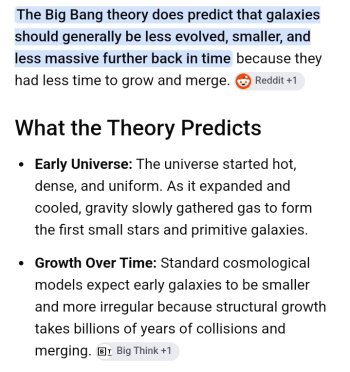
Google also confirms it

View attachment 89198

Why the Big Bang Theory Predicts Less Matter at Earlier Times​

The Big Bang theory does not say that the universe contained less matter the farther back we look — in fact, the opposite is true. According to the model, the universe began in an extremely hot, dense state and has been expanding and cooling ever since cosmichorizons.org cosmichorizons.org.

How the theory works:

  • The Big Bang describes the expansion of space itself, not an explosion into pre-existing space. This expansion means that as we look back in time, we see the universe in a smaller, hotter, and denser state Science Mission Directorate Science Mission Directorate.
  • The Friedmann–Lemaître–Robertson–Walker (FLRW) metric from general relativity models this expansion, showing that earlier times correspond to higher densities and temperatures Wikipedia Wikipedia.
  • The cosmic microwave background (CMB), detected 380,000 years after the Big Bang, is the “afterglow” of that hot, dense phase — it fills the entire sky and is uniform, proving the universe was once much hotter and denser cosmichorizons.org cosmichorizons.org+1.
Why the idea of “less matter” is a misconception:

  • The Big Bang theory predicts that matter density increases as we go back in time toward the initial hot, dense state.
  • The “less matter” idea might come from confusion with the observable universe — as we look farther back, we see more distant objects, but the observable universe’s size is limited by the speed of light and the expansion rate. This is a separate effect from the total matter content of the universe.
  • The horizon problem and flatness problem in early cosmology were resolved by the inflationary epoch, which smoothed and expanded the universe to its current large-scale structure Wikipedia Wikipedia.
In summary:
The Big Bang theory says that the farther back we look, the hotter and denser the universe was — meaning more matter per unit volume, not less. The “less matter” idea is a misunderstanding of how the expansion of space and the limits of observation work.
 

Armour of God

Well-Known Member
Mar 6, 2026
1,573
1,035
113
47
Adelaide
Faith
Christian
Country
Australia
Gender
Male

Why the Big Bang Theory Predicts Less Matter at Earlier Times​

The Big Bang theory does not say that the universe contained less matter the farther back we look — in fact, the opposite is true. According to the model, the universe began in an extremely hot, dense state and has been expanding and cooling ever since cosmichorizons.org cosmichorizons.org.

How the theory works:

  • The Big Bang describes the expansion of space itself, not an explosion into pre-existing space. This expansion means that as we look back in time, we see the universe in a smaller, hotter, and denser state Science Mission Directorate Science Mission Directorate.
  • The Friedmann–Lemaître–Robertson–Walker (FLRW) metric from general relativity models this expansion, showing that earlier times correspond to higher densities and temperatures Wikipedia Wikipedia.
  • The cosmic microwave background (CMB), detected 380,000 years after the Big Bang, is the “afterglow” of that hot, dense phase — it fills the entire sky and is uniform, proving the universe was once much hotter and denser cosmichorizons.org cosmichorizons.org+1.
Why the idea of “less matter” is a misconception:

  • The Big Bang theory predicts that matter density increases as we go back in time toward the initial hot, dense state.
  • The “less matter” idea might come from confusion with the observable universe — as we look farther back, we see more distant objects, but the observable universe’s size is limited by the speed of light and the expansion rate. This is a separate effect from the total matter content of the universe.
  • The horizon problem and flatness problem in early cosmology were resolved by the inflationary epoch, which smoothed and expanded the universe to its current large-scale structure Wikipedia Wikipedia.
In summary:
The Big Bang theory says that the farther back we look, the hotter and denser the universe was — meaning more matter per unit volume, not less. The “less matter” idea is a misunderstanding of how the expansion of space and the limits of observation work.

Yea these are the excuses they are coming up with now after the JW telescope made its findings. Their trying to change the theory to suit.

See when that article was written.
Earlier this year

The fact is they used to think there was less matter the further back we looked. I provided 3 lines of evidence for this. A youtube video, a Google explanation and a big bang diagram
 
Last edited:

Grailhunter

Well-Known Member
Jun 19, 2019
15,054
6,352
113
69
FARMINGTON
Faith
Christian
Country
United States
Gender
Male
Yea these are the excuses they are coming up with now after the JW telescope made its findings. Their trying to change the theory to suit.

See when that article was written.
Earlier this year

The fact is they used to think there was less matter the further back we looked. I provided 3 lines of evidence for this. A youtube video, a Google explanation and a big bang diagram

They have always theorized that a great amount of matter accumulated and gravity compressed them, heated them up and exploded. But you are right in that the Big Bang theory has been an evolving theory as more facts are established.
 

Armour of God

Well-Known Member
Mar 6, 2026
1,573
1,035
113
47
Adelaide
Faith
Christian
Country
Australia
Gender
Male
They have always theorized that a great amount of matter accumulated and gravity compressed them, heated them up and exploded. But you are right in that the Big Bang theory has been an evolving theory as more facts are established.

That article you linked was written a few months ago. Well after the observations of the JWST.

Before the JWST they thought there was less matter after the big bang and that stars and galaxies accumulated over time. Google explains this.

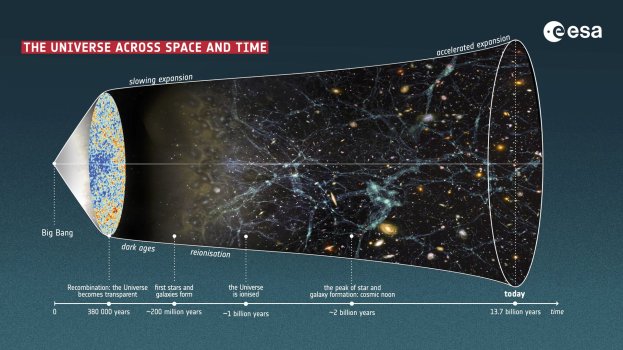
Look here is another diagram. The period after the big bang was known as the dark ages with very little matter. Stars and galaxies start forming after.

The_Universe_across_space_and_time_pillars.jpg

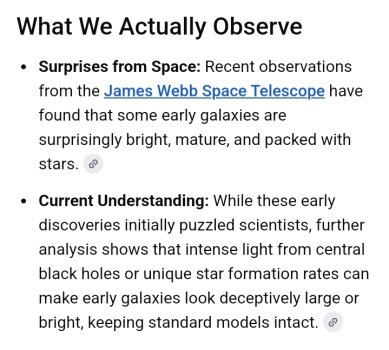
And here Google explains that it was a surprise for them to find this and then offers another explanation for it, holding firm to their initial models.

Screenshot_20260901-184154_Samsung Internet.jpg

There have been several explanations after the findings of the JWST. The two main ones are about black holes as stated above and the one you produced which basically says all the matter was there straight after the big bang
 
Last edited:

Grailhunter

Well-Known Member
Jun 19, 2019
15,054
6,352
113
69
FARMINGTON
Faith
Christian
Country
United States
Gender
Male
Before the JWST they thought there was less matter after the big bang and that stars and galaxies accumulated over time. Google explains this.

Well stars and galaxies did develop after the Big Bang, nothing new with that. Matter as hard objects and matter as gases, it looks like there is a theory that particles exploded and turned to energy and gas as matter and anti-matter came into contact with each other. So depending on what matter you are talking about it could be less hard matter. Right now the most abundant substance in space is hydrogen making up 92% of all atoms. Matter did not disappear it was converted. You have matter, anti-matter, dark matter, and gases....subatomic particles. Now the volume of all categories of matter, hard to know.

Why There Was Less Matter After the Big Bang​

After the Big Bang, the universe was initially an extremely hot, dense state where matter and energy were in perfect balance. However, most of the matter and antimatter annihilated each other, leaving behind only a tiny excess of matter — about one part in a billion — to form everything we see today CompleteEra CompleteEra.

1. Matter–Antimatter Symmetry and Annihilation​

In the first fractions of a second, particle–antiparticle pairs (quarks–antiquarks, electrons–positrons) were constantly created from energy and then annihilated back into energy. This process kept matter and antimatter in equilibrium. For the universe to have any matter left, a baryogenesis event must have produced a small asymmetry: slightly more matter than antimatter. This asymmetry is still not fully explained by current physics sentinelmission.org sentinelmission.org.

2. Cooling and Particle Formation​

As the universe expanded and cooled, the energy density dropped. Around 1 second old, quarks and gluons combined into protons and neutrons. By about 1 minute old, protons and neutrons had fused into light atomic nuclei during Big Bang Nucleosynthesis, producing roughly 75% hydrogen and 25% helium by mass, with trace amounts of lithium CompleteEra CompleteEra. At this stage, matter made up only about 0.000001% of the total energy density — the rest was radiation CompleteEra CompleteEra.

3. Inflation’s Role​

Before the hot Big Bang phase, a period of cosmic inflation stretched the universe so rapidly that any initial matter was diluted to near-imperceptible levels. Inflation also smoothed out density fluctuations, setting the stage for later structure formation Wikipedia Wikipedia+1.

4. Recombination and the Cosmic Microwave Background​

About 380,000 years after the Big Bang, the universe cooled enough for electrons to combine with protons, forming neutral hydrogen. This “recombination” released the cosmic microwave background (CMB) radiation, which still fills the universe today. At this point, most of the remaining matter was in the form of neutral atoms, not free particles CompleteEra CompleteEra.

5. Today’s Matter Budget​

By now, ordinary (baryonic) matter makes up only about 4.9% of the universe’s total energy content, with the rest being dark matter (~26.8%) and dark energy (~68.3%) CompleteEra CompleteEra. The small fraction of matter left after the Big Bang is all that has ever existed in the form of stars, planets, gas, and life.
In summary: After the Big Bang, there was far less matter because most of it annihilated with antimatter, and the tiny excess that survived was diluted by cosmic expansion and inflation. The matter we see today is a remnant of that minuscule surplus, forged in the first minutes and preserved through cosmic history.
 
Last edited:

Grailhunter

Well-Known Member
Jun 19, 2019
15,054
6,352
113
69
FARMINGTON
Faith
Christian
Country
United States
Gender
Male
That article you linked was written a few months ago. Well after the observations of the JWST.

Before the JWST they thought there was less matter after the big bang and that stars and galaxies accumulated over time. Google explains this.

Look here is another diagram. The period after the big bang was known as the dark ages with very little matter. Stars and galaxies start forming after.

View attachment 89199

And here Google explains that it was a surprise for them to find this and then offers another explanation for it, holding firm to their initial models.

View attachment 89200

There have been several explanations after the findings of the JWST. The two main ones are about black holes as stated above and the one you produced which basically says all the matter was there straight after the big bang

Well stars and galaxies did develop after the Big Bang, nothing new with that. Matter as hard objects and matter as gases, it looks like there is a theory that particles exploded and turned to energy and gas as matter and anti-matter came into contact with each other. So depending on what matter you are talking about it could be less hard matter. Right now the most abundant substance in space is hydrogen making up 92% of all atoms. Matter did not disappear it was converted. You have matter, anti-matter, dark matter, and gases....subatomic particles. Now the volume of all categories of matter, hard to know.

How the James Webb Space Telescope Reveals Matter in Space​

The James Webb Space Telescope (JWST) is revolutionizing our understanding of matter in the universe by detecting and mapping both visible matter and the invisible dark matter that shapes it.

Mapping Dark Matter
In 2026, JWST produced the most detailed high‑resolution map of dark matter ever made, showing how this invisible substance — which does not emit, reflect, absorb, or block light — overlaps and intertwines with ordinary matter NASA NASA+1. By measuring the gravitational lensing effect of dark matter on light from distant galaxies, scientists overlaid a blue map onto Webb’s deep‑field images, revealing a cosmic web of dense dark matter clusters connected by filaments NASA NASA+1. This “scaffolding” guided the formation of galaxies, stars, and even planets like Earth.

How It Works
JWST’s large infrared‑sensitive mirror and advanced instruments can penetrate dust clouds and detect light from the earliest galaxies, allowing astronomers to trace the distribution of both dark and visible matter across millions of light‑years Science Mission Directorate Science Mission Directorate. Its infrared capability is key because visible light is blocked by dust, while infrared can reveal hidden structures.

Impact on Understanding Matter

  • Dark Matter’s Role: Early in the universe, dark matter clumped first, pulling in ordinary matter to form dense regions where stars and galaxies could form ScienceDaily ScienceDaily.
  • Ordinary Matter Distribution: Galaxies and stars tend to align with the underlying dark matter structure, confirming the “scaffolding” model of cosmic evolution NASA NASA+1.
  • Planetary Formation: By enabling earlier galaxy and star formation, dark matter indirectly helped create the conditions for planets and life‑forming elements ScienceDaily ScienceDaily.
Broader Science Goals
Beyond dark matter, JWST studies the formation of stars and planets, the assembly of galaxies over time, and the chemical composition of planetary systems, including our own Science Mission Directorate Science Mission Directorate+1. These investigations help us understand how matter cycles through the universe — from birth in stellar nurseries to dispersal in supernovae and re‑accretion into new systems.

In short, JWST is not only revealing the visible matter in space but also uncovering the invisible framework that governs its distribution, evolution, and ultimate fate.
 
Last edited:

Grailhunter

Well-Known Member
Jun 19, 2019
15,054
6,352
113
69
FARMINGTON
Faith
Christian
Country
United States
Gender
Male
Scientists that believe in Creation...three minute video.

The Navy schooled me in Quantum Mechanics and Astrophysics so I could be a liaison between the scientists and the defense contractors.....Skunk works and such so I spent time at Los Alamos and Oak Ridge National Laboratories.

And you are right more and more scientists are believing in creationism, sort of. I spent time with people that were certified geniuses. Back in the 50's and 60's science thought it had it all sewed up but then they looked deeper....
DNA is more or less a biological computer program. Its complexities and construction are so vast that they know it could not happen by accident. And it all has to be right or it does not live.

Gravity...if gravity was a little stronger nothing would orbit....it would all collapse and collide, no life. If gravity was a little less strong planets and suns would just wander around, no life.

Without some origination of the cosmos it would look like a train wreck.

So some believe in God and some believe in intelligent design....not naming the God.
 
  • Like
Reactions: Debp