As I said earlier, we see Daniel so differently and that is not a bad thing.. but is a thing to discuss. There is no question that either one of us can shout out loud our respective interpretations, but neither would be either heard or deemed right. It definitely is as you say, "we should take each chapter or vision or verse at a time and try to learn how the other sees and interprets them." That is the good thing.
I think that sharing scripture for the reasons to believe is important to rightly divide the Word of Truth. To that end, I've found that getting into the details is very important for that. You seem to have a more wholistic view of Daniel as one where it's all related.
I've tried to begin at the most focused point of the individual visions and the grammar and words used and identities defined before stretching across all books of Daniel. That isn't to say I think each vision is unrelated, I would hope that I've made it clear that they often intersect, but at the same time there are different scopes for time and subject focus in each vision as laid out below.
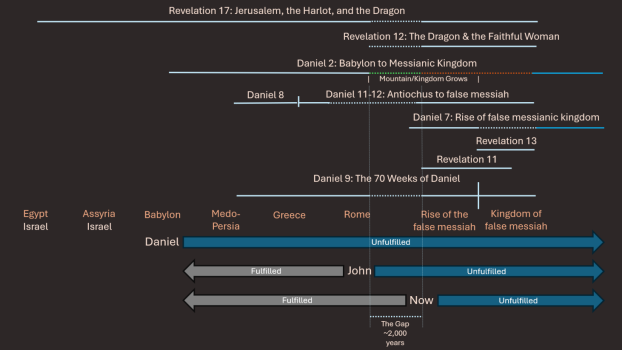
So, If you really want to do this I am willing and of course, I would suggest beginning with the most important fundamental verses in Daniel - if we get this wrong, EVERYTHING in Daniel will be wrong. That is a tremendous claim but it is so, so true. Forgive me for saying this but "today's accepted interpretations" are largely all the same and arise from interpreting Daniel using a historical approach. Meaning, they have sat at their desk with Daniel on the left side with their historical records on the right and they go back and forth trying to match the two books together.
Yes, many bad interpretations have come from trying to cram history and modern events into prophecy. The words of the prophecies themselves interpreted for us should be the only sure foundation to connect history to the prophecy. The scope of the visions given can inform as to whether more history or future is in view.
God is indeed not writing a history book and this is why when those scholars and theoglogians apply this method of interpretation and they cannot "match" the actors or events in Daniel to their history books, they ASSUME it must mean that those events have yet to take place and they throw them some 2000 years in the future and try to predict when and how they will manifest themselves...
What is history but a record of events past? What is scripture but a record of events past and future? This seems to me to be a record of events centered around mankind, Israel, God, and the Savior who brings them all together in His timing. In eternity, the Bible will definitely be a history book of recorded events, though now it's a mix.
Well, almost 90 % of Daniel takes place from 606 BC to the time of the cross. Then, we have the entire chapter 11 which picks up after the cross. Why, because the book of Daniel is all about the coming of the Messiah -not kingdoms, kings, conflicts, etc.
God is not writing another history book. We have to look at Daniel as a series of prophecies that focus on HIM and His first coming.... a completely different way of looking at Daniel.
Given He comes twice there are debates as to the percentages for the first and second, but much of Daniel is history to us I agree. The context defines what is in view.
Now, if we were to go through each chapter it would not make any sense should we just try and compare your historical interpretations to mine... apples and oranges. But if you would like to look into Daniel using a messianic or spiritual lens, then it wo2uld be interesting. If so, I would suggest we begin to focus on the most important verses in chapter 2 - 2:31-35. Again, if we get these wrong, there is absolutely no reason to move forward because EVERYTHING is driven from these 5 verses. Please let me know....
Sure, how would you see this in a Messianic/spiritual lens?
Daniel 2:31-35 – "Thou, O king, sawest, and behold a great image. This great image, whose brightness [was] excellent, stood before thee; and the form thereof [was] terrible. This image's head [was] of fine gold, his breast and his arms of silver, his belly and his thighs of brass, His legs of iron, his feet part of iron and part of clay. Thou sawest till that
a stone was cut out without hands, which smote the image upon his feet [that were] of iron and clay, and brake them to pieces. Then was the iron, the clay, the brass, the silver, and the gold, broken to pieces together, and became like the chaff of the summer threshingfloors; and the wind carried them away, that no place was found for them: and
the stone that smote the image became a great mountain, and filled the whole earth."
Yeshua's kingdom stands forever and so the head of gold, breast and arms of silver, belly and thighs of brass, legs of iron, and feet and toes of iron and clay would be unrelated to the Messiah.
The stone cut without hands is seen in the requirement of unhewn stone for the altar whereby communion and relationship with God was to take place. The word used was perfect, complete, whole and further defined as untouched by human hands. This was using a direct creation of God without man's intervention.
Joshua 8:31 – "As Moses the servant of the LORD commanded the children of Israel, as it is written in the book of the law of Moses,
an altar of whole[H8003 salem] stones, over which no man hath lift up [any] iron: and they offered thereon burnt offerings unto the LORD, and sacrificed peace offerings."
Exodus 3:4-6 – "And when the LORD saw that he turned aside to see, God called unto him out of the midst of the bush, and said, Moses, Moses. And he said, Here [am] I. And he said, Draw not nigh hither:
put off thy shoes from off thy feet, for the place whereon thou standest [is] holy ground. Moreover he said, I [am] the God of thy father, the God of Abraham, the God of Isaac, and the God of Jacob. And Moses hid his face; for he was afraid to look upon God."
We also saw this idea with Moses and the burning bush, pointing to the idea that in relationship with God we are to come as we were made.
So this idea of the stone cut without hands points to an identity not created by man as all other men are created through procreation. Rather the stone is a direct creation of God, a virgin birth.
This stone strikes not the toes, but the feet. The image has progressed kingdom after kingdom from the head to the toes. This points to the stone arriving to strike the image on the feet before its very end as the last toe breaks apart and blows away with no place found for it.
The overarching narrative seen and, I believe, the point of the vision is that the kingdoms of men in their various forms are contrasted with the kingdom of God and will all be broken and blown away with no place left for their power because the kingdom of God will come and the stone will rule the whole earth from His holy mountain and His kingdom will never end.