
A Textual Challenge to the “Mary and Joseph Had Later Relations” Position

  • Welcome to Christian Forums, a Christian Forum that recognizes that all Christians are a work in progress.

    You will need to register to be able to join in fellowship with Christians all over the world.

    We hope to see you as a part of our community soon and God Bless!

Crazy Ivan

Active Member
Jun 23, 2026
400
120
43
56
Connecticut
Faith
Christian
Country
United States
Gender
Male
You absolutely have.

False.

- You’ve claimed that I haven’t presented ANY evidence.
- You claimed that the Protoevangelium tells us that “these tales were believed by some people at that time.”

I made it VERY clear that I wasn't saying that the Proto *says that in its text* but rather it's mere existence shows us that people believed some of this at the time. That you can't accept that that's what I meant - even after I've clarified it numerous times - is YOUR problem, not mine.

These are baldface LIES . . .

No – you completely back-pedaled on this because I exposed your LIE.


WRONG.


As I’ve educated you on MANY occasions – Kecharitomene indicates a PAST action with a PERMANENT result.

Mary was ALREADY considered Kecharitomene when the Angel came because he addressed her as that. He didn’t say, “Hail Mary. From THIS point you will be called Kecharitomene.”
He said, “
Hail Kecharitomene” . . .

Wanna try again?

And thank YOU for proving MY pont that YOU don’t have a CLUE about languages other than English.

What have I repeatedly explained to you about this word?
When used for Mary in Luke 1:28 – it was used in the perfect past participle. Which changes the meaning. For example, you might find a language that has a word for “Swim” – but uses it for every occasion, past present or future.

In English, we have -
Swim
Swam
Swum
Swimming


- The word used ion Eph, 1:6 to describe the saints is “charis”.
- The word used In Luke 1:28 “Kecharitomene”.
SAME
root word (charis) – different participle . . .

It’s that simple . . .

Yes, Mary was given a special blessing - to be the mother of the Savior. That implies NOTHING about whether she was "perfect".
 

Crazy Ivan

Active Member
Jun 23, 2026
400
120
43
56
Connecticut
Faith
Christian
Country
United States
Gender
Male
You're right, because I didn't say I use AI for formatting, did I? I actually said:

"I use AI to format,

So yes, yes you did. You literally quoted yourself. That there's more to the quote doesn't mean you didn't also say that you use AI for formatting.

grammar correct, etc, my own thoughts/words and/or quickly research preexisting information."

That's what online editing/research tools are there for. Even if I didn't use an editing/research tool, my arguments would remain the same—and in reality, truth doesn't depend on what word processor, lexicon, or editing assistant helped organize the sentences; an argument stands or falls strictly on the Scripture, Greek, and historical evidence itself. Now, I'm confident, able, and willing to address your arguments—no matter how many times they come up, and whether you use AI or not.

Look at what you actually did instead of refuting a single word of my explanation of erusin and nissuin: you simply said "these timeline markers are significant, though of course you try to explain them away." That isn't an argument when I just showed you from Jewish marriage law why Joseph had to bring Mary into his home (nissuin, Matthew 1:20, 24) to protect Her and the child from the public charge of adultery (Deuteronomy 22:23–24), regardless of consummation.

Even your own Strong's Concordance quote proves my point, not yours: "conjugal cohabitation" literally means living together as husband and wife in the same household (co-habitare), which is the exact nissuin stage I just described. If synerchomai in verse 18 already meant sexual intercourse, Matthew wouldn't have switched to the actual Greek verb for sexual relations (ginōskō, "he knew her not") seven verses later in Matthew 1:25.

Meanwhile, look at everything you just skipped completely in post #711:
  1. My entire grammatical breakdown of heōs ("until") in Matthew 1:25 (2 Samuel 6:23, Matthew 28:20, Psalm 110:1, Calvin, Keener, Koester, and Allison).
  2. Every single point in Point 3—Augustine’s On Holy Virginity 4.4, Luther, Calvin, and Zwingli, Jeremiah 16:2, Luke 2:36–37, 1 Corinthians 7, and why a marriage set apart for the Incarnation has zero "normal" benchmark.
  3. And brushing off Judges 13:3 with "different stories" still misses how a counterexample works: it disproves your universal rule that a sudden angelic visit plus "You will conceive and bear a son" automatically implies "soon."

Lay off the AI cutting and pasting and we can talk again.
 

markalan

Well-Known Member
May 31, 2021
755
511
93
81
Perth
Faith
Christian
Country
Australia
Gender
Male
As if people never leave their kids under the care of other family members while they travel.....
I've noticed that those who try to promote Mary as the Queen of Heaven often make arguments based on silence.
 

Crazy Ivan

Active Member
Jun 23, 2026
400
120
43
56
Connecticut
Faith
Christian
Country
United States
Gender
Male
I've noticed that those who try to promote Mary as the Queen of Heaven often make arguments based on silence.

"The Bible doesn't say that Mary was born immaculately, but couldn't God do that if He wanted?"

LOL, uh yeah, I suppose. Too bad the Bible doesn't remotely teach that He DID do that, but ok, if that's the basis for the argument, then we can kinda make up whatever we want using that line of reasoning.
 

markalan

Well-Known Member
May 31, 2021
755
511
93
81
Perth
Faith
Christian
Country
Australia
Gender
Male
"The Bible doesn't say that Mary was born immaculately, but couldn't God do that if He wanted?"

LOL, uh yeah, I suppose. Too bad the Bible doesn't remotely teach that He DID do that, but ok, if that's the basis for the argument, then we can kinda make up whatever we want using that line of reasoning.

I believe Mary was righteous before God ... just as Zacharias & Elisabeth were:
"And they were both righteous before God, walking in all the commandments and ordinances of the Lord blameless." (Luke 1:36)
 

beechan

Member
Oct 28, 2026
404
32
28
Zion
Faith
Christian
Country
Greenland
Gender
Male
I know he's claimed that. But I literally gave the word from Strong's concordance, and it is applied to every believer in the only other place in the New Testament where it's used (Eph 1:6).

That word is used TWICE in all the New Testament. Luke 1:28 and Eph 1:6. One applied to Mary and the other applied to every believer.

So he's right in the unique structure of this particular use of the word, but wrong insofar as the root word is applied to all believers.
We are not wrong. YOU are wrong!!!
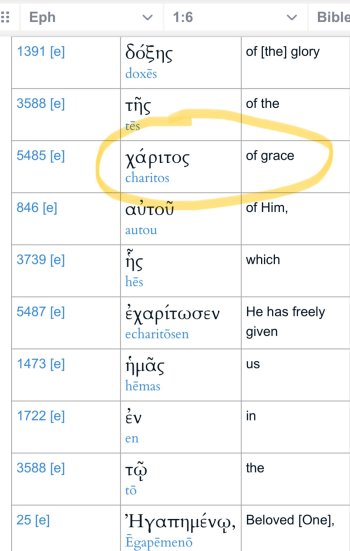
IMG_0651.jpeg
see what word is used in Ep 1:6 in Greek text!
So, the exact word kecharitomene is used once.

the Protestant pastor who told you this must be a cheap Bible scholar,not academically qualified.
 
Last edited:

Crazy Ivan

Active Member
Jun 23, 2026
400
120
43
56
Connecticut
Faith
Christian
Country
United States
Gender
Male
We are not wrong. YOU are wrong!!!
View attachment 93878
see what word is used in Ep 1:6 in Greek text!

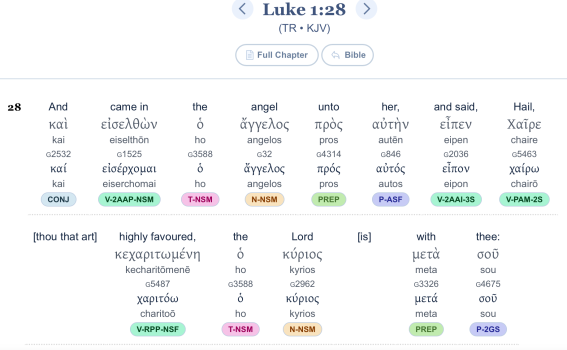
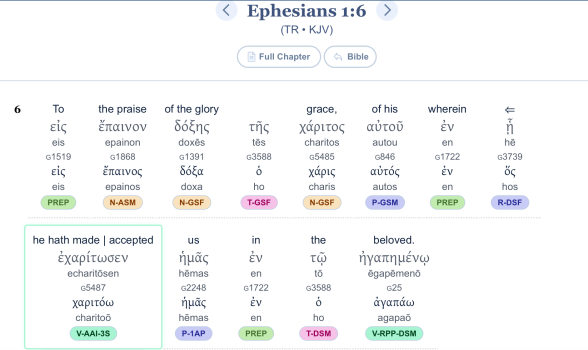
I have already talked about this. It's a different form of the same root word. So he's right in that this is a unique form of this word, but this is also a unique root word that has been used only twice in all Scripture. Once it's applied to Mary specifically, and the other time it's applied to all believers. It's very different from the normal word for grace, which is "charis", which is used 156 times in the New Testament (including also in Eph 1:6). Here's a comparison of the words found in Luke 1:28 and Eph 1:6:

Screenshot 2026-11-25 at 6.16.16 AM.png

Screenshot 2026-11-25 at 6.15.33 AM.png

Both come from the root χαριτόω, which means:

  1. to make graceful
    1. charming, lovely, agreeable
  2. to persue with grace, compass with favour
  3. to honour with blessings

It's distinct from the normal "charis" that is used so often in Scripture.

Moreover, the word in Luke 1:28 is in the passive voice, indicating that this is something bestowed upon Mary, not something she earned or deserved. If she was perfect, this kind of blessing would be something that would be her birthright. But it's not. It's God showing incredible favor on a person who did not deserve it. That's the nature of grace.
 

beechan

Member
Oct 28, 2026
404
32
28
Zion
Faith
Christian
Country
Greenland
Gender
Male
As if people never leave their kids under the care of other family members while they travel.....
then Joseph would be an abnormal father. He brought a non-biological son to Jerusalem for pilgri, and left his biological sons and daughters home alone.

Put some logic and common sense in your argument please.
 

Crazy Ivan

Active Member
Jun 23, 2026
400
120
43
56
Connecticut
Faith
Christian
Country
United States
Gender
Male
then Joseph would be an abnormal father. He brought a non-biological son to Jerusalem for pilgri, and left his biological sons and daughters home alone.

Pot some logic and common sense in your argument please.

Perhaps. Or perhaps the larger family all came with them to Jerusalem and they stayed in a hotel while Mary and Joseph had something special in store for Jesus. Since, you know, they knew He was the MESSIAH. Easily explainable.

I mean, you guys have been spending two weeks reminding me that this entire situation is so special, so unique, so one-of-a-kind, that it allows for all kinds of crazy exceptions in the case of Mary, but God forbid it would mean an exception to who is babysitting the other kids when they're taking Jesus to the temple.
 

markalan

Well-Known Member
May 31, 2021
755
511
93
81
Perth
Faith
Christian
Country
Australia
Gender
Male
We are not wrong. YOU are wrong!!!
View attachment 93878
see what word is used in Ep 1:6 in Greek text!
So, the exact word kecharitomene is used once.

the Protestant pastor who told you this must be a cheap Bible scholar,not academically qualified.

In Greek grammar, kecharitomene is a perfect passive participle built from three distinct parts:
• Prefix (ke-). Formed by duplicating the initial consonant of the root word - this signals the perfect tense, meaning the action is fully finished and its effects continue indefinitely.
• Root (charitoo). Derived from charis (grace or favor), this verb means "to bestow grace" or "to show favor".
• Suffix (-mene). This ending marks the feminine passive participle, indicating that the action was performed on the subject by someone else.

There is nothing in the word kecharitomene to indicate the so called 'immaculate conception' of Mary ... that is just human invention.

Mary was righteous & blameless before God just as Zacharias & Elisabeth were:
"And they were both righteous before God, walking in all the commandments and ordinances of the Lord blameless." (Luke 1:36)
 

beechan

Member
Oct 28, 2026
404
32
28
Zion
Faith
Christian
Country
Greenland
Gender
Male
Perhaps. Or perhaps the larger family all came with them to Jerusalem and they stayed in a hotel while Mary and Joseph had something special in store for Jesus.
Sola scriptura!!!
’where in bible says…..’ the things you put up here?
if you do’t find a verse clearly said so,, you must be speaking crappy stuff.
 

beechan

Member
Oct 28, 2026
404
32
28
Zion
Faith
Christian
Country
Greenland
Gender
Male
In Greek grammar, kecharitomene is a perfect passive participle built from three distinct parts:
• Prefix (ke-). Formed by duplicating the initial consonant of the root word - this signals the perfect tense, meaning the action is fully finished and its effects continue indefinitely.
• Root (charitoo). Derived from charis (grace or favor), this verb means "to bestow grace" or "to show favor".
• Suffix (-mene). This ending marks the feminine passive participle, indicating that the action was performed on the subject by someone else.

There is nothing in the word kecharitomene to indicate the so called 'immaculate conception' of Mary ... that is just human invention.

Mary was righteous & blameless before God just as Zacharias & Elisabeth were:
"And they were both righteous before God, walking in all the commandments and ordinances of the Lord blameless." (Luke 1:36)
@Crazy Ivan

In English, awful and awesome have common root.
Awful now means very bad; awesome means very impressive or excellent.

so ‘common root ‘ argument for ‘grace’ in Greek would have same meaning holds no ground.

use of word ‘kecharitomene’ is like calling someone a ‘trillionaire’ instead of ‘rich’.
 
Last edited:

markalan

Well-Known Member
May 31, 2021
755
511
93
81
Perth
Faith
Christian
Country
Australia
Gender
Male
then Joseph would be an abnormal father. He brought a non-biological son to Jerusalem for pilgri, and left his biological sons and daughters home alone.

Put some logic and common sense in your argument please.

We know Jesus was 12 (approaching religious maturity) and the other children would be younger, so more likely to be left at home on such a long journey.

OTOH, the younger children may have accompanied Joseph & Mary but Luke is focused on telling Jesus' story.

You cannot make an argument from silence.
 

Crazy Ivan

Active Member
Jun 23, 2026
400
120
43
56
Connecticut
Faith
Christian
Country
United States
Gender
Male
Sola scriptura!!!
’where in bible says…..’ the things you put up here?
if you do’t find a verse clearly said so,, you must be speaking crappy stuff.

LOLOL doesn't say either way - both you and I are left to wonder. My hypothesis is every bit as good as yours is.
 

Crazy Ivan

Active Member
Jun 23, 2026
400
120
43
56
Connecticut
Faith
Christian
Country
United States
Gender
Male
@Crazy Ivan

In English, awful and awesome have common root.
Awful now means very bad; awesome means very impressive or excellent.

so ‘common root ‘ argument for ‘grace’ in Greek would have same meaning holds no ground.

From Strong's concordance: The root word for favor or grace in Luke 1:28 and Ephesians 1:6 is the same:

χαριτόω:
  1. to make graceful
    1. charming, lovely, agreeable
  2. to persue with grace, compass with favour
  3. to honour with blessings

In Luke 1:28 the form of the word is κεχαριτωμένη, which is:
Perfect Passive Participle
Nominative Singular Feminine

This describes a single feminine subject that is the grammatical subject of a clause and is in a completed state resulting from a passive action.

In Eph 1:6 the form of the word is ἐχαρίτωσεν, which is:
Aorist Active Indicative
3rd Person Singular

It is a verb form referring to one person or thing (3rd person singular) performing an action (active voice) stated as a fact (indicative mood), usually in past time and viewed as a single, completed whole (aorist aspect).

Mary gets the feminine because - gasp! - she's the subject and is female. Luke 1:28 indicates a completed state due to something that has happened TO the subject. Eph 1:6 is an action that is completed.

So you are trying to make the Luke 1:28 form of the word seem SO unique that it elevates Mary to moral perfection (holier than holiness, as Pope Pius IX put it), when that same idea is expressed of believers in Ephesians 1:6.
 
  • Like
Reactions: markalan

Crazy Ivan

Active Member
Jun 23, 2026
400
120
43
56
Connecticut
Faith
Christian
Country
United States
Gender
Male
Don’t masturbate with your own words and then get high.

Oh boy. I've immediately thought of a dozen different ways to respond to this - including some crass ones, but I'll just let your own deplorable words sit there for all to see, on the permanent record. Goodness.