

The future is going to be INCREDIBLE!The entities people refer to as "aliens" are not kind to people. God wouldn't leave this information out. His Word would specifically inform us of aliens from outer space if that's what they were. Why would He not tell us about these entities who come and harm people? Well, HE HAS .....Jesus said that there would be a return to th days of Noah. The sons of God (angels) came in unto the daughters of men and bare them children. Those children were the "men if renowned"(giants, nephilim). These days are the days of Noah.
"Aliens" aren't from other planets. You can't find that in Scripture.
Aliens
- Thread starter PossibleThrowawayAccount
- Start date
-
Welcome to Christian Forums, a Christian Forum that recognizes that all Christians are a work in progress.
You will need to register to be able to join in fellowship with Christians all over the world.
We hope to see you as a part of our community soon and God Bless!
You are using an out of date browser. It may not display this or other websites correctly.
You should upgrade or use an alternative browser.
You should upgrade or use an alternative browser.


The point is, it doesn't say in Genesis that the dinosaurs, or whatever word you'd like to use, were created before humans, and then went extinct.There are creatures mentioned in scripture that would fit into the description of what today is labeled "dinosaur."

The historical version of "dinosaurs" that we have been sold is a psyop. Here is one of several who have exposed this hoax.There were many things left out of the bible. The dinosaurs and their extinction went unannounced.
Indeed.There are creatures mentioned in scripture that would fit into the description of what today is labeled "dinosaur."
The historical version of "dinosaurs" that we have been sold is a psyop. Here is one of several who have exposed this hoax.


The Gospel of Christ
Well-Known Member
The claim that Genesis “left out” enormous ancient reptilian or monster-like creatures is false. The modern scientific term dinosaur wasn't coined until 1842, but the creature-category absolutely existed in the Bible.
Genesis 1:21 says God created the “great tannînîm”
Tannîn is the ancient Hebrew word used elsewhere for a dragon, great serpent, or sea monster.
So claiming Genesis never mentions giant creatures of that general class simply because it doesn't use a scientific term coined in the nineteenth century is anachronistic and wrong.
Genesis 1:21 places them on Day Five, with the creatures of the waters and the birds.
Humans are then created on Day Six in Genesis 1:26–27.
Genesis 1:21 says God created the “great tannînîm”
Tannîn is the ancient Hebrew word used elsewhere for a dragon, great serpent, or sea monster.
So claiming Genesis never mentions giant creatures of that general class simply because it doesn't use a scientific term coined in the nineteenth century is anachronistic and wrong.
Genesis 1:21 places them on Day Five, with the creatures of the waters and the birds.
Humans are then created on Day Six in Genesis 1:26–27.
Last edited:
Just looked up Genesis 1:21 and it doesn't say that. Beyond that, if humans were created a day after the dinosaurs, then why didn't we go extinct alongside the dinosaurs?The claim that Genesis “left out” enormous ancient reptilian or monster-like creatures is false. The modern scientific term dinosaur wasn't coined until 1842, but the creature-category absolutely existed in the Bible.
Genesis 1:21 says God created the “great tannînîm”
Tannîn is the ancient Hebrew word used elsewhere for a dragon, great serpent, or sea monster.
So claiming Genesis never mentions giant creatures of that general class simply because it doesn't use a scientific term coined in the nineteenth century is anachronistic and wrong.
Genesis 1:21 places them on Day Five, with the creatures of the waters and the birds.
Humans are then created on Day Six in Genesis 1:26–27.
.
whale = H8577 = tannîn
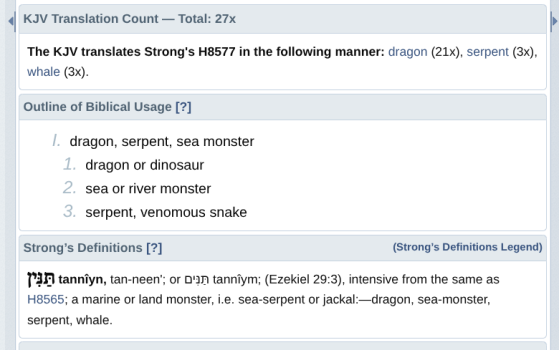
- source: Blue Letter Bible
.
andGenesis 1:21 says God created the “great tannînîm”
And God created great whales [H8577], and every living creature that moveth, which the waters brought forth abundantly, after their kind, and every winged fowl after his kind: and God saw that it was good. (Genesis 1:21)Just looked up Genesis 1:21 and it doesn't say that.
whale = H8577 = tannîn
- source: Blue Letter Bible
...because the version of "the dinosaurs" (and "extinction") that we have been programmed to accept is a lie....why didn't we go extinct alongside the dinosaurs?
.
Last edited:
The Gospel of Christ
Well-Known Member
Just looked up Genesis 1:21 and it doesn't say that. Beyond that, if humans were created a day after the dinosaurs, then why didn't we go extinct alongside the dinosaurs?
It absolutely does, you just looked up an English translation.
I’m talking about the actual Hebrew text.
Genesis 1:21 contains:
הַתַּנִּינִם הַגְּדֹלִים — hattannînîm haggĕdolîm
“the great tannînîm.”
Tannîn is the ancient Hebrew word used elsewhere for a dragon, great serpent, or sea monster.
What killed them then? They're clearly dead, and they're bones are fossilized in the ground. If we lived alongside dinosaurs, like some Christians believe, then why are we still here and the dinosaurs are not?...because the version of "the dinosaurs" (and "extinction") that we have been programmed to accept is a lie.
.
The Dinosaur HOAX
.
Virtually no one questions the premise; rather, they question the means to achieve it. IOW, they presume that "the dinosaurs" are a reality and then set out to prove the falsity. A classic psyop. One can't kill what never existed. Read the article:What killed them then? They're clearly dead, and they're bones are fossilized in the ground. If we lived alongside dinosaurs, like some Christians believe, then why are we still here and the dinosaurs are not?
The Dinosaur HOAX
.
I think it's ridiculous to suggest that it's a psyop. Dinosaur bones are found all over the world, not just in North America.Virtually no one questions the premise; rather, they question the means to achieve it. IOW, they presume that "the dinosaurs" are a reality and then set out to prove the falsity. A classic psyop. One can't kill what never existed.
Doesn't matter what we "think." Rather, what do the facts reveal? Read The Dinosaur HOAX and let's talk turkey.I think it's ridiculous to suggest that it's a psyop. Dinosaur bones are found all over the world, not just in North America.
This is the equivalent of trying to argue that gravity isn't real. Sorry, but science has established that dinosaur bones are real. I'm not going to read some random person's substack that's full of baseless conjecture.Doesn't matter what we "think." Rather, what do the facts reveal? Read The Dinosaur HOAX and let's talk turkey.
If you want to believe it's all a psyop, I'm cool with that. Flat eathers also refer me to random substack articles to support their theory. It's quite telling.
The Gospel of Christ
Well-Known Member
There's no way to derive the actual duration of the Genesis creation “days” from the text with any certainty. Treating them as automatically equivalent to modern 24-hour calendar days goes beyond what the Hebrew alone can prove. The earliest Christians were not locked into the assumption that every Genesis “day” had to be interpreted as a 24-hour period; early Christian writers interpreted the days in different ways. The Epistle of Barnabas and Irenaeus, for example, explicitly applied a thousand-years-per-day significance to the six-day creation pattern. And Irenaeus was a disciple of Polycarp, who had personally known apostles and others who had seen Christ.
So presenting a rigid 24-hour chronology as though God Himself dictated that interpretation is theological overconfidence masquerading as biblical certainty.
No one knows the exact time frame but if it's between Irenaeus and somebody kissing rattle snakes in Appalachia saying it was a 24 hour day; I would probably stick with Irenaues here, at least.
And Christ never said, ‘Each day in Genesis 1 was exactly 24 hours.’ If God intended the exact duration to be a required doctrine, Scripture had every opportunity to say so.
Personally, I believe neither interpretation is necessarily correct, and the exact duration remains a mystery. At this point in our knowledge and technology, the Genesis “days” were most likely vast epochs of time. And saying, “Well, God wouldn’t have needed to take that long,” is an extremely human assumption. You’re anthropomorphizing God by projecting human ideas of speed, efficiency, and necessity onto Him, then treating those assumptions as though they define how God must create. Who are we to tell Him how long creation should take?
You assume creation should have been fast because you’re measuring God by fallen human impatience and our obsession with speed and efficiency.
So presenting a rigid 24-hour chronology as though God Himself dictated that interpretation is theological overconfidence masquerading as biblical certainty.
No one knows the exact time frame but if it's between Irenaeus and somebody kissing rattle snakes in Appalachia saying it was a 24 hour day; I would probably stick with Irenaues here, at least.
And Christ never said, ‘Each day in Genesis 1 was exactly 24 hours.’ If God intended the exact duration to be a required doctrine, Scripture had every opportunity to say so.
Personally, I believe neither interpretation is necessarily correct, and the exact duration remains a mystery. At this point in our knowledge and technology, the Genesis “days” were most likely vast epochs of time. And saying, “Well, God wouldn’t have needed to take that long,” is an extremely human assumption. You’re anthropomorphizing God by projecting human ideas of speed, efficiency, and necessity onto Him, then treating those assumptions as though they define how God must create. Who are we to tell Him how long creation should take?
You assume creation should have been fast because you’re measuring God by fallen human impatience and our obsession with speed and efficiency.

I have no reason to assume that a day in Genesis was any longer than a day in 2026. I would need to see it in scripture.
On the other hand, God created Adam and Eve with adult bodies. So, it was as if they had lived some years ...maybe 30 or 40 years ...when in fact, they had just been created.
As far as dinosaur bones, those may be relics left behind from the pre-Adamic earth.
On the other hand, God created Adam and Eve with adult bodies. So, it was as if they had lived some years ...maybe 30 or 40 years ...when in fact, they had just been created.
As far as dinosaur bones, those may be relics left behind from the pre-Adamic earth.
The Gospel of Christ
Well-Known Member
I have no reason to assume that a day in Genesis was any longer than a day in 2026. I would need to see it in scripture.
You do and it does.
Genesis 1:21 places great sea creatures, sea monsters and dragons on Day Five.
Humans are then created on Day Six in Genesis 1:26–27.
The sun isn't even appointed to govern the day until Day Four. So insisting that Days 1–3 must already be rigid 24-hour solar days is not “just reading the text”; its importing a modern clock into the passage and then pretending Genesis put it there.
Genesis does not force yôm (“day”) to mean exactly 24 hours.
Genesis 2:4 uses the same word much more broadly: “in the day that the LORD God made the earth and the heavens”
There, yôm summarizes the whole creation event itself, not one literal 24-hour period (day). So the same Hebrew word used for the creation “days” can also mean a broader span of time within Genesis itself. Context determines the meaning; the word alone doesn't prove a 24-hour period.
Even Irenaeus, a student of Polycarp who had known apostles who broke bread with Christ didn't treat the creation days as having only a simple 24-hour significance; he gave the six-day creation pattern a thousand-years-per-day typological meaning.
Genesis 3:1 calls the serpent - nāḥāš - “more subtle/crafty than any beast of the field.” It (which was created before humans) reasons, speaks, persuades, and deliberately deceives Eve.
So the biblical text itself gives you great tannînîm in creation and then afterward, an extraordinarily crafty, speaking serpent in Eden.
And ancient biblical and neighboring traditions repeatedly portray serpent, dragon, and sea-monster figures as more than mindless reptiles; sometimes crafty, sometimes supernatural, and sometimes conscious enemies of God or divine order.
So Scripture itself places the great tannînîm before mankind and then introduces a nāḥāš capable of reasoning, speech, persuasion and deception. Whatever modern categories we impose upon those descriptions, the ancient text is plainly stranger than a world containing nothing but the unintelligent reptiles familiar to us today.
And this is where the pattern becomes extraordinarily difficult simply to wave away. The Hebrews were not remotely alone. Across enormous distances and radically different civilizations, culture after culture preserved traditions of immense serpent-like or dragon-like beings associated with intelligence, supernatural power, the waters or heavens, and interaction with mankind.
Ancient Hebrews / Israelites
Sumerians
Akkadians
Babylonians
Ancient Egyptians
Canaanites / Ugaritic peoples
Ancient Persians / Iranians
Ancient Indians
Hindu traditions
Buddhist South Asian traditions
Tibetans / Himalayan peoples
Khmer / Cambodians
Thai peoples
Lao peoples
Balinese / Javanese / Indonesian peoples
Chinese
Japanese
Koreans
Vietnamese
Filipino peoples
Ancient Greeks
Romans
Norse peoples
Germanic peoples
Slavic peoples
Balkan peoples
Welsh / Celtic peoples
Teotihuacanos
Mexica / Aztecs
Maya
Andean peoples
Cherokee
Muscogee / Creek
Pueblo peoples
Hopi
Australian Aboriginal peoples
Māori
Fon / Dahomey peoples
Other West African serpent-tradition cultures
Genesis places the animals before humanity in the creation sequence, and then Genesis 3 presents a nonhuman serpent capable of understanding God’s command, reasoning about it, contradicting it, persuading Eve, and successfully deceiving her.
So stripped down to the rudiments:
nonhuman creatures existed first → the serpent was among the creatures → the serpent displayed intelligence sufficient to deceive a human who was made afterwards.
You can argue about what the serpent was, what animated it, or how literally to understand its form. What you can't honestly argue is that Genesis presents the earliest world of mankind as containing nothing but mindless animal life.
Genesis does not read like a modern biology textbook. It reads like an ancient account of a world in which humans appear into a creation that already contains powers, creatures, and intelligences they don't fully understand.
I'm not saying God didn't create all these things. OF COURSE, He did! But what I am saying is that He said He did each of these in increments of days. He said "the evening and the morning were the first day" ...and so on and so forth. I'm not going to place my carnal interpretation on what a day looked like then, compared to now.You do and it does.
Similar threads

- Replies
- 0
- Views
- 122
- Replies
- 31
- Views
- 1K


- Replies
- 49
- Views
- 2K

- Replies
- 19
- Views
- 785
- Replies
- 0
- Views
- 35