Contending with the devil

  • Welcome to Christian Forums, a Christian Forum that recognizes that all Christians are a work in progress.

    You will need to register to be able to join in fellowship with Christians all over the world.

    We hope to see you as a part of our community soon and God Bless!

Hiddenthings

Well-Known Member
May 19, 2025
3,777
415
83
Leeton NSW
Faith
Christian
Country
Australia
Lol, so you now want to drag me into this one too?
Oh, you're back, huh? Thought you bailed on the last thread because you couldn't provide evidence and now you think you can just jump into this one and do the same?
The statement from Jude 1:9 is a quote from Zechariah 3:2.

Zechariah 3:1-9 KJV
1 And he shewed me Joshua the high priest standing before the angel of the LORD, and Satan standing at his right hand to resist him.
2 And the LORD said unto Satan, [by mouth of the Angel of the LORD] The LORD rebuke thee, O Satan; even the LORD that hath chosen Jerusalem rebuke thee: is not this a brand plucked out of the fire?
I'm interested to see you identify the adversary dak. What does it represent, and can you use the Word to discern its identity?

Do you hold the view that "the body of Moses" refers to Joshua the High Priest during the time of Ezra and Zechariah, and that "the devil" represents the group of disaffected (human) priests who were barred from serving in the priesthood?

That "Satan" in Zech 3:1 could refer to the adversaries of Judah mentioned in Ezra 4:1. The passage in Zechariah is grounded in historical events it reflects the context recorded in the book of Ezra.

Now when the adversaries of Judah and Benjamin heard that the returned exiles were building a temple to the Lord, the God of Israel Ezra 4:1

The challenge for everyone in this thread is to demonstrate using context that both Jude and Zechariah are referring to a fallen angel. The burden of proof is on proving that claim from the text itself.
 

dak

Well-Known Member
Feb 9, 2013
1,457
188
63
Messianica
sites.google.com
Faith
Other Faith
Country
United States
Gender
Male
Oh, you're back, huh? Thought you bailed on the last thread because you couldn't provide evidence and now you think you can just jump into this one and do the same?

I'm interested to see you identify the adversary dak. What does it represent, and can you use the Word to discern its identity?

Do you hold the view that "the body of Moses" refers to Joshua the High Priest during the time of Ezra and Zechariah, and that "the devil" represents the group of disaffected (human) priests who were barred from serving in the priesthood?

That "Satan" in Zech 3:1 could refer to the adversaries of Judah mentioned in Ezra 4:1. The passage in Zechariah is grounded in historical events it reflects the context recorded in the book of Ezra.

Now when the adversaries of Judah and Benjamin heard that the returned exiles were building a temple to the Lord, the God of Israel Ezra 4:1

The challenge for everyone in this thread is to demonstrate using context that both Jude and Zechariah are referring to a fallen angel. The burden of proof is on proving that claim from the text itself.

Sorry, you do not make the rules for what I believe, and I've already shown you what I believe Jude 9 concerns in what I already posted. It appears you are not able to fully comprehend what was stated and shown because you are now asking questions about it which have already been answered in the post.
 

Hiddenthings

Well-Known Member
May 19, 2025
3,777
415
83
Leeton NSW
Faith
Christian
Country
Australia
Sorry, you do not make the rules for what I believe, and I've already shown you what I believe Jude 9 concerns in what I already posted. It appears you are not able to fully comprehend what was stated and shown because you are now asking questions about it which have already been answered in the post.
I’m still waiting for you to identify the adversary, do that first, then you can run.
 

Matthias

Well-Known Member
May 3, 2022
32,138
24,090
113
Kentucky
Faith
Other Faith
Country
United States
Gender
Male
“Dialogue works when participants care for truth while respecting one another.”

(Clark H. Pinnock, A Wideness in God’s Mercy, p. 136)

There isn’t much dialogue taking place in this thread (and others), nor is there much respect for one another being exhibited.

Debate and disrespect harden hearts.

The fruits of the spirit are on display, and much of the fruit on display in this thread (and in others) is rotten.
 

Hiddenthings

Well-Known Member
May 19, 2025
3,777
415
83
Leeton NSW
Faith
Christian
Country
Australia
“Dialogue works when participants care for truth while respecting one another.”

(Clark H. Pinnock, A Wideness in God’s Mercy, p. 136)

There isn’t much dialogue taking place in this thread (and others), nor is there much respect for one another being exhibited.

Debate and disrespect hardens hearts.
Thanks for your contribution, Matthias, perhaps you could also add something constructive to your OP?
 

Hiddenthings

Well-Known Member
May 19, 2025
3,777
415
83
Leeton NSW
Faith
Christian
Country
Australia
Returning to Jude 9, there is compelling evidence that the “devil” mentioned here refers to a human adversary rather than a supernatural being. Notably, the strong literary parallels between Jude and 2 Peter suggest this interpretation, Jude 8–9 appears to expand on 2 Peter 2:10–12. Since Peter’s passage clearly describes human individuals, it logically follows that Jude is referring to the same group. (See also Jude verses 16 and 19 for further support.)

Can Jude 9 be used to prove that the devil is a personal superhuman being?

The evidence suggests not.

If we list the context of Jude 9 onwards, we see the following evidence:

Corrupt people within the early Christian community - these are compared to infamous biblical rebels (humans):
  • Cain (murderous and jealous)
  • Balaam (greedy prophet for hire)
  • Korah (who rebelled against God’s appointed leadership, Moses)
What @Matthias needs to produce is a New Testament passage where the context clearly involves divine angels, along with an origin story of a heavenly rebellion, which, as we all know, simply doesn’t exist in the text.
 

Rockerduck

Well-Known Member
Nov 7, 2022
4,251
3,391
113
71
Marietta, Georgia.
Faith
Christian
Country
United States
Gender
Male
I do too.

Why do you think Satan encourages people not to believe that he exists?
Satan spreads rumors that he doesn't exists. Not believing in God lets Satan have sway over them. Just like not believing and looking for evidence they can't see, therefore it can't exist.
 
  • Like
Reactions: Matthias

Wick Stick

Well-Known Member
Sep 21, 2023
2,424
1,486
113
46
Phoenix
Faith
Christian
Country
United States
The real issue here is identifying the adversary Jesus was referring to and understanding how the context points to something very different from a literal angel falling from heaven.

You can determine the adversary if you are a willing to study the context.
Well, I'm all for looking at the text. Shall we? Luke 10:

17 And the seventy returned again with joy, saying, Lord, even the devils are subject unto us through thy name. 18 And he said unto them, I beheld Satan as lightning fall from heaven. 19 Behold, I give unto you power to tread on serpents and scorpions, and over all the power of the enemy: and nothing shall by any means hurt you. 20 Notwithstanding in this rejoice not, that the spirits are subject unto you; but rather rejoice, because your names are written in heaven.

Observations
(1) v.18 Satan is actually "the Satan" in Greek - someone specific is in mind rather than something general
(2) v.17 mention of "devils" suggests that v.18 "Satan" is numbered among the devils
(3) v.19 makes "the enemy" the same as "the Satan"
(4) v.20 makes "the spirits" the same group as "the devils" from v.17

If (2) is accepted as a premise, then we can syllogize with (4) to conclude that "the Satan" here is a spirit.

Your turn; what've you got out of the text?
 

Hiddenthings

Well-Known Member
May 19, 2025
3,777
415
83
Leeton NSW
Faith
Christian
Country
Australia
Well, I'm all for looking at the text. Shall we? Luke 10:

17 And the seventy returned again with joy, saying, Lord, even the devils are subject unto us through thy name. 18 And he said unto them, I beheld Satan as lightning fall from heaven. 19 Behold, I give unto you power to tread on serpents and scorpions, and over all the power of the enemy: and nothing shall by any means hurt you. 20 Notwithstanding in this rejoice not, that the spirits are subject unto you; but rather rejoice, because your names are written in heaven.

Observations
(1) v.18 Satan is actually "the Satan" in Greek - someone specific is in mind rather than something general
(2) v.17 mention of "devils" suggests that v.18 "Satan" is numbered among the devils
(3) v.19 makes "the enemy" the same as "the Satan"
(4) v.20 makes "the spirits" the same group as "the devils" from v.17

If (2) is accepted as a premise, then we can syllogize with (4) to conclude that "the Satan" here is a spirit.

Your turn; what've you got out of the text?
Can you see the issue with using a simile? Do you know what a simile is?

What is the context?
What was the adversary in mind?
Who did Jesus call serpents and scorpians?

I'm sure if you read the entire context you will get it.
 

Hiddenthings

Well-Known Member
May 19, 2025
3,777
415
83
Leeton NSW
Faith
Christian
Country
Australia
Satan spreads rumors that he doesn't exists. Not believing in God lets Satan have sway over them. Just like not believing and looking for evidence they can't see, therefore it can't exist.
These kinds of personal opinions carry little weight with those who genuinely seek the truth. More often than not, they reflect the mindset of a complacent disciple relying on shallow, unsupported views. What I've come to observe with @Matthias is that he quotes Scripture but offers no real explanation or interpretation. Unfortunately, he seems unable to open the Word in a way that brings light or understanding.
 

Wick Stick

Well-Known Member
Sep 21, 2023
2,424
1,486
113
46
Phoenix
Faith
Christian
Country
United States
Can you see the issue with using a simile? Do you know what a simile is?
That's a bit insulting... I suppose you don't know me, and there are plenty of people for which it's necessary to dumb things down. I'm not a novice. Let's speak to each other as equals, okay?
What is the context?
What was the adversary in mind?
Who did Jesus call serpents and scorpions?

I'm sure if you read the entire context you will get it.
Within the context of the chapter (yes I read the whole chapter) there are references to several cities who did NOT receive the seventy that were sent out. Jesus compares them to Tyre and Sidon of old. I did consider these as candidates for being "the enemy" and "the satan" here, particularly given the affinity between Tyre of old and the same (cf Eze 28).

That's a plausible identification, but not completely without problems. To wit, the most immediate context suggests that "the enemy" here is a spirit - the syllogism I pointed out in my previous post. Capernaum and Bethsaida are not spirits; they're cities. If that's the enemy we're identifying, then some reconciliation is needed.

If that isn't what you were thinking of, then please leave off the guessing games and just give your interpretation.
 

Hiddenthings

Well-Known Member
May 19, 2025
3,777
415
83
Leeton NSW
Faith
Christian
Country
Australia
That's a bit insulting... I suppose you don't know me, and there are plenty of people for which it's necessary to dumb things down. I'm not a novice. Let's speak to each other as equals, okay?
It was a genuine question - do you know what a simile is and how they are used? Many do not.
Within the context of the chapter (yes I read the whole chapter) there are references to several cities who did NOT receive the seventy that were sent out. Jesus compares them to Tyre and Sidon of old. I did consider these as candidates for being "the enemy" and "the satan" here, particularly given the affinity between Tyre of old and the same (cf Eze 28).

That's a plausible identification, but not completely without problems. To wit, the most immediate context suggests that "the enemy" here is a spirit - the syllogism I pointed out in my previous post. Capernaum and Bethsaida are not spirits; they're cities. If that's the enemy we're identifying, then some reconciliation is needed.

If that isn't what you were thinking of, then please leave off the guessing games and just give your interpretation.
The term Satan (Greek: adversary) is used by Jesus to describe the binding power of sin, particularly as it manifests through disease. Several passages highlight this idea:
  • Luke 11:14–23: Jesus heals a mute man, with the condition attributed to demon possession (v. 14), as was common language at the time. Jesus links the affliction to the "house" of Satan (vv. 17–18), and the healing itself is described as evidence that the kingdom of God had come upon them, demonstrating the presence and power of the King (vv. 20–22).
  • Luke 13:10–17: Jesus heals a woman crippled for eighteen years, described as having "a spirit of infirmity" (v. 11). Yet Jesus interprets her condition as having been bound by Satan for those eighteen years (v. 16), reinforcing the idea of Satan as a symbol of sin's oppressive effects.
So, when the seventy disciples returned rejoicing over their ability to cast out demons, Jesus interpreted their success as the fall of Satan—a symbolic overthrow of the adversary's influence. Their victories over illness and affliction were so powerful and immediate that Jesus likened them to lightning falling from heaven (Luke 10:18). Still, He reminded them to rejoice not in their authority over spirits, but in the greater reality that their names were written in heaven (Luke 10:20).

Wick, as you can see, Christians have often used this verse to support the idea of an angel’s fall from Heaven, but it’s clear there is no contextual basis for that interpretation.

I appreciate the effort you’re putting into seeking the truth, others here would do well to follow your example.
 
  • Like
Reactions: Wick Stick

Stumpmaster

Well-Known Member
Apr 5, 2009
2,747
1,783
113
71
Hamilton, New Zealand
Faith
Christian
Country
New Zealand
Gender
Male
Thanks, Stumpmaster... this observation will definitely come to light as we delve deeper into the true meaning of this section of Scripture.

Matthias will likely lean on the idea of a fallen angel, which isn’t explicitly mentioned, nor is the false accuser clearly defined, this is a huge issue for him.

More to come!
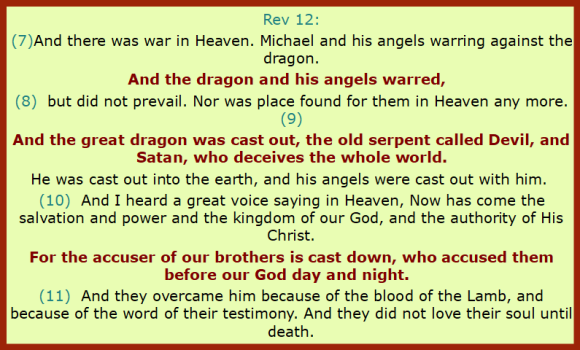
Good on Matthais for trusting Scripture regarding Satan and his angels.

1753662119239.png