Does Daniel 11 Describe King Herod and His Dynasty?

  • Welcome to Christian Forums, a Christian Forum that recognizes that all Christians are a work in progress.

    You will need to register to be able to join in fellowship with Christians all over the world.

    We hope to see you as a part of our community soon and God Bless!

Douggg

Well-Known Member
Nov 26, 2020
5,494
440
83
77
Memphis
Faith
Christian
Country
United States
Gender
Male
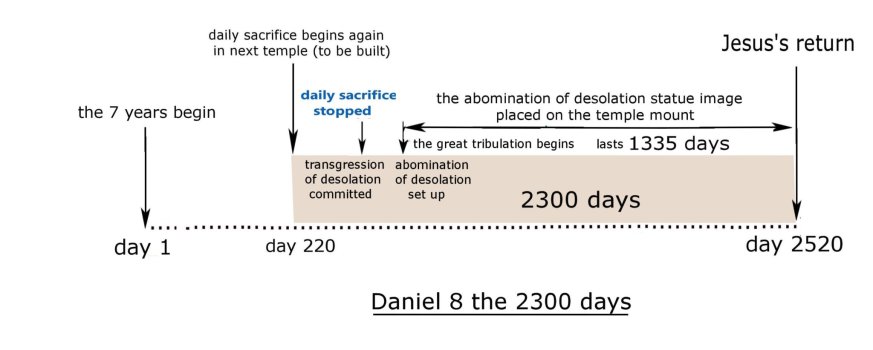
And this is why God gave us the “mareh” vision in Daniel 8. Most know this as the 2300 evenings and mornings vision.
The 2300 days of Daniel 8:14 are associated with the little horn person. Not Jesus.

2300 days 3.jpg
 

Exegesis

Member
Jun 22, 2025
417
92
28
62
Salt Lake
Faith
Christian
Country
United States
Gender
Male
Regarding my post, here are more specifics from Wikipedia....

In 168 BC, a Roman Consul named Gaius Popillius Laenas drew a circular line in the sand around King Antiochus IV of the Seleucid Empire, then said, "Before you cross this circle I want you to give me a reply for the Roman Senate" – implying that Rome would declare war if the King stepped out of the circle without committing to leave Egypt immediately. Weighing his options, Antiochus wisely decided to withdraw. Only then did Popillius agree to shake hands with him.

I believe this event happened at Daniel 11:18:

Daniel 11:18 - "After this shall he turn his face unto the isles, and shall take many: but a prince for his own behalf shall cause the reproach offered by him to cease; without his own reproach he shall cause it to turn upon him."

Antiochus IV Epiphanes captured Cyprus (an island) and other areas. He kept going, but the 'reproach' was stopped by Laenas.

The next verse is when Antiochus IV Epiphanes falls off his chariot and dies:

Daniel 11:19 - "Then he shall turn his face toward the fort of his own land: but he shall stumble and fall, and not be found."

The timeline offered by the mainstream "scholars" are all messed up. They are trying to associate the above verses with Antiochus III the Great. That is why they often say things like 'this explanation makes no sense' when you read their commentaries. clfh
 

Exegesis

Member
Jun 22, 2025
417
92
28
62
Salt Lake
Faith
Christian
Country
United States
Gender
Male
I am getting closer to concluding my Daniel 11 study. When it's finished, I will make a new thread and post my commentaries for every verse.

Basically, my conclusion will demonstrate that Daniel 11 is all past history. Moreover, it will prove that it foretold Jesus and the Crucifixion, something that most folks can't do with their interpretations.

The videos I posted in the OP are very close to being spot-on. Verse 20 is where Rome picks up as the new King of the North after the Medo-Persian Empire fizzled out.

I was looking into the 'Ships of Chittim' as being pirates, but the Battle of Actium turns out to be a much better fit:

Daniel 11:30 - "For the ships of Chittim shall come against him: therefore he shall be grieved, and return, and have indignation against the holy covenant: so shall he do; he shall even return, and have intelligence with them that forsake the holy covenant."

This is great romantic stuff with Cleopatra, Mark Antony, Julius Caesar, Octavian Augustus and Pompey. It's Just like the movie:


It's absolutely epic history that everyone here seems to want to erase from Scripture.

Daniel 11:30 alludes to King Herod being installed, who forsakes the Holy Covenant and tries to kill Jesus after he is born.

Daniel 11:31 is a prophecy about King Herod:

Daniel 11:31 - "And arms shall stand on his part, and they shall pollute the sanctuary of strength, and shall take away the daily sacrifice, and they shall place the abomination that maketh desolate."

It continues from there. Christians have no idea what they are reading.
 

Exegesis

Member
Jun 22, 2025
417
92
28
62
Salt Lake
Faith
Christian
Country
United States
Gender
Male
Put these two verses together:

Daniel 8:25 - "And through his policy also he shall cause craft to prosper in his hand; and he shall magnify himself in his heart, and by peace shall destroy many: he shall also stand up against the Prince of princes; but he shall be broken without hand."

Daniel 11:36 - "And the king shall do according to his will; and he shall exalt himself, and magnify himself above every god, and shall speak marvellous things against the God of gods, and shall prosper till the indignation be accomplished: for that that is determined shall be done."

The verses are about the Roman Caesars, and King Herod and his dynasty. The 'Prince of Princes' is Jesus of course. The 'indignation' is the Crucifixion.

King Herod was infamous for craft to prosper as he built all kinds of things. Heck, even the final Temple is called 'Herod's Temple'.
 

Exegesis

Member
Jun 22, 2025
417
92
28
62
Salt Lake
Faith
Christian
Country
United States
Gender
Male
Here is it again:

Daniel 8:19 - "And he said, Behold, I will make thee know what shall be in the last end of the indignation: for at the time appointed the end shall be."

The 'indignation' is the Crucifixion. The 'end' that shall be is the end of the 70 week prophecy.

So simple a caveman can figure it out. :p
 

Wish-it

Member
Apr 14, 2025
350
32
28
Wellington
Faith
Christian
Country
New Zealand
Gender
Male
I am getting closer to concluding my Daniel 11 study. When it's finished, I will make a new thread and post my commentaries for every verse.

Basically, my conclusion will demonstrate that Daniel 11 is all past history. Moreover, it will prove that it foretold Jesus and the Crucifixion, something that most folks can't do with their interpretations.

The videos I posted in the OP are very close to being spot-on. Verse 20 is where Rome picks up as the new King of the North after the Medo-Persian Empire fizzled out.

I was looking into the 'Ships of Chittim' as being pirates, but the Battle of Actium turns out to be a much better fit:


This is great romantic stuff with Cleopatra, Mark Antony, Julius Caesar, Octavian Augustus and Pompey. It's Just like the movie:


It's absolutely epic history that everyone here seems to want to erase from Scripture.

Daniel 11:30 alludes to King Herod being installed, who forsakes the Holy Covenant and tries to kill Jesus after he is born.

Daniel 11:31 is a prophecy about King Herod:


It continues from there. Christians have no idea what they are reading.
If it's all history what's the significance of Dan 8.17,19,26, Dan 11.36, Dan 12.1,4,9,13 which mentions "the time of the end, the time of wrath, time of distress".
Maybe Dan 11 is all prophecy for the future "time of the end", where God is providing clues as to what will proceed prior to His coming.
 

Exegesis

Member
Jun 22, 2025
417
92
28
62
Salt Lake
Faith
Christian
Country
United States
Gender
Male
Hi @Wish-it . Let's see what you got.

If it's all history what's the significance of Dan 8.17...

Here is the verse:

Daniel 8:17 - "So he came near where I stood: and when he came, I was afraid, and fell upon my face: but he said unto me, Understand, O son of man: for at the time of the end shall be the vision."

The phrase 'time of the end' in Daniel 8:17 is referring to the end of Daniels 70 week prophecy, not the end of the world. It covers a span of time ranging from the beginning of the Fourth Kingdom, with the reign of Julius Caesar, to Titus and destruction of Jerusalem in 70 AD.


Here is the verse:

Daniel 8:19 - "And he said, Behold, I will make thee know what shall be in the last end of the indignation: for at the time appointed the end shall be."

Daniel 8:19 is a little more specific. The 'indignation' is still the same time period, but the 'end of the indignation' is the Crucifixion itself with the destruction of Jerusalem coming a few decades later. The Crucifixion happens at an appointed time that was foretold in many verses in Daniel.

The Battle of Actium, in 11:30, is when the indignation time period begins:

Daniel 11:30 - "For the ships of Chittim shall come against him: therefore he shall be grieved, and return, and have indignation against the holy covenant: so shall he do; he shall even return, and have intelligence with them that forsake the holy covenant."

It is around that time that King Herod is set up in Judea. That is who is being alluded to as 'forsaking the holy covenant'. In fact, King Herod and his dynasty is referred to in the very next verse:

Daniel 11:31 - "And arms shall stand on his part, and they shall pollute the sanctuary of strength, and shall take away the daily sacrifice, and they shall place the abomination that maketh desolate."

Forces, i.e. King Herod, came from Octavian Augustus and Mark Antony. Herod's dynasty would go on to eventually pollute the Sanctuary of God, in other words crucify Jesus. The 'abomination that maketh desolate' was the Crucifixion. The daily sacrifice was no longer accepted after that point. Everything lines up perfectly.

Dan 11.36...

Daniel 11:36 - And the king shall do according to his will; and he shall exalt himself, and magnify himself above every god, and shall speak marvellous things against the God of gods, and shall prosper till the indignation be accomplished: for that that is determined shall be done.

The king in Daniel 11:36 is King Herod. His dynasty would prosper until the end of the indignation, i.e., until the Crucifixion and the 70AD siege.


Daniel 12:1 - "And at that time shall Michael stand up, the great prince which standeth for the children of thy people: and there shall be a time of trouble, such as never was since there was a nation even to that same time: and at that time thy people shall be delivered, every one that shall be found written in the book."

I used to believe Daniel 12:1 was future, however I now believe it is just a continuation of chapter 11.
  • Michael stand's up: He is always standing up in the Book of Daniel and ready to do battle. There is nothing unique about that.
  • A time of trouble: Jacob's Trouble (Jeremiah 30:7).
  • People shall be delivered: The finished work of the cross is just that. It is finished.
  • Everyone written in the book: The book was written before the world began.
Next verse:

Daniel 12:2 - "And many of them that sleep in the dust of the earth shall awake, some to everlasting life, and some to shame and everlasting contempt."

Daniel 12:2 is just referring to the small sample of people that were resurrected after Jesus died:

Matthew 27:50-53 - "Jesus, when he had cried again with a loud voice, yielded up the ghost. And, behold, the veil of the temple was rent in twain from the top to the bottom; and the earth did quake, and the rocks rent; And the graves were opened; and many bodies of the saints which slept arose, And came out of the graves after his resurrection, and went into the holy city, and appeared unto many."

It is basically a 'preview' of the final two resurrections in our future.


Daniel 12:4 - "But thou, O Daniel, shut up the words, and seal the book, even to the time of the end: many shall run to and fro, and knowledge shall be increased."

Daniel 12:4 is about the end of the Old Testament and the words being 'sealed' as in no more words are going to be added. Daniel was one of the books of the OT. 'Knowledge increased' is about *THE* knowledge of the Old Testament and its prophecies, teachings, etc.

'The knowledge', as opposed to knowledge in general.

...which mentions "the time of the end, the time of wrath, time of distress".

Yep, the end of Jerusalem and the Temple and the people of God who lived there at the time.

Maybe Dan 11 is all prophecy for the future "time of the end", where God is providing clues as to what will proceed prior to His coming.

If we interpret Daniel 11 in that manner, then God basically flushed the Israelites and the Jews down the toilet centuries before Jesus even showed up. It does not make sense from a ton of standpoints and perspectives. Moreover, it is incredibly disrespectful to those who God considered a Holy Nation and Holy People at the time.

 

Wish-it

Member
Apr 14, 2025
350
32
28
Wellington
Faith
Christian
Country
New Zealand
Gender
Male
Thanks for your analysis, but as with many commentators on these passages, there seems to be an emphasis on historical fulfillment rather than future fulfillment. My considerations are more for future fulfillment. By placing prophecy in the historical past, reduces many from seeing what He is saying TODAY, to us now, and as a result dont see His plan. All I can suggest is to read it both ways to be sure the correct interpretation is applied for both then and now. NOW, seems pretty important, in my opinion.
Note. The expression ," the time of the end" could be broken down into differing periods, but we should also read the passages as if they are all discussing the same period of time, and that they could all be prophecy advice, not historical memoirs.