mailmandan
Well-Known Member
If they were talking about two different types of works, then you would have James promoting salvation by works in James 2:24. I have heard numerous folks over the years say Paul and James are talking about two different types of works then afterwards conclude that James is teaching "justified by works" in James 2:24 = "saved by works," which is in contradiction to Romans 4:2-6. Abraham was before the law and obeying God by setting out to sacrifice Isaac in Genesis 22 was not an attempt of the flesh to seek justification. Paul clearly said, if Abraham was justified (accounted as righteous) by works something to boast about, but not before God. For what does the Scripture say? “Abraham believed God, and it (faith, not works) was accounted to him for righteousness.” God imputes righteousness apart from works.They are talking about two different types of works. However, you conclusion as to those that do mean that they believe "saved by works" is in error. IF they are talking about the same type of works you have put them into contradiction with each other.
The harmony of Romans 4:2-3 and James 2:24 is seen in the differing ways that Paul and James use the term "justified." Paul, when he uses the term, refers to the legal (judicial) act of God by which He accounts the sinner as righteous. James, however, is using the term to describe those who would show the genuineness of their faith by the works that they do -- Agree or disagree?
Jesus Christ saves us through faith based on the merits of His finished work of redemption "alone" and not based on the merits of our works. (Romans 3:24-28; 4:5-6; Ephesians 2:8,9; Titus 3:5; 2 Timothy 1:9) Hence, faith (rightly understood in Jesus Christ) alone. It is through faith "in Jesus Christ alone" (and not based on the merits of our works) that we are justified on account of Christ (Romans 4:5-6; 5:1; 5:9); yet the faith that justifies does not remain alone (unfruitful, barren) if it is genuine. (James 2:14-24) *Perfect Harmony* -- Agree or disagree?
I already thoroughly covered James 2:20-24 in post #111.Evidently it wasn't clear enough for James because he wrote:
Jas 2:20-24 But wilt thou know, O vain man, that faith without works is dead? Was not Abraham our father justified by works, when he had offered Isaac his son upon the altar? Seest thou how faith wrought with his works, and by works was faith made perfect? And the scripture was fulfilled which saith, Abraham believed God, and it was imputed unto him for righteousness: and he was called the Friend of God. Ye see then how that by works a man is justified, and not by faith only.
Faith alone
Hello Sheri, I noticed that you are a new member so I thought that I should say, welcome to CB.com :ntmetu Also, thank you for posting the passage from James that is so vtial to understand whenever the topic of sola fide is being discussed :thumbsupx1 God bless you!! --Papa Smurf p.s. - you...
 www.christianityboard.com
If you can't see that James is not using the term "justified" in James 2:24 to mean "accounted as righteous" but is shown to be righteous and that James is discussing the evidence of faith (says-claims to have faith but has no works/I will show you my faith by my works - James 2:14-18) and not the initial act of being accounted as righteous with God (Romans 4:2-3) then you are left with "justified by works" = "saved by works" in contradiction to Romans 4:2-3.
James 2:14-24 has nothing to do with OSAS vs. NOSAS but has everything to do with genuine faith vs. an empty profession of faith/dead faith.And here comes your OSAS dogma: No fruit would imply they failed to abide in the vine:
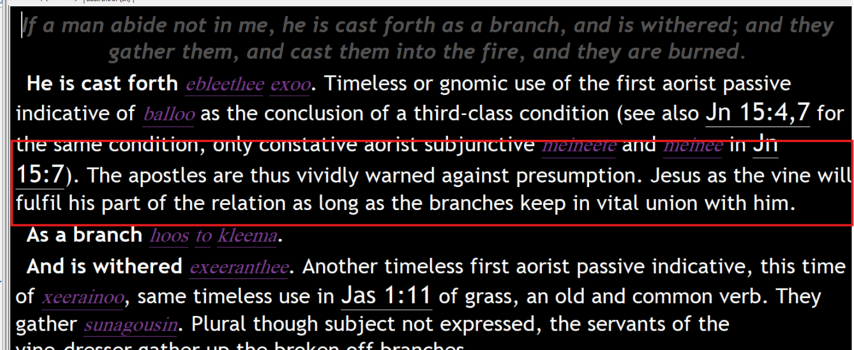
I agree with AT Robertson - In me (εν εμο). Two kinds of connexion with Christ as the vine (the merely cosmic which bears no fruit, the spiritual and vital which bears fruit). The fruitless (not bearing fruit, μη φερον καρπον) the vine-dresser "takes away" (αιρε) or prunes away. Probably (Bernard) Jesus here refers to Judas. *Judas did not abide because Judas was unclean. (John 13:10-11)Jn 15:1-6 I am the true vine, and my Father is the husbandman. Every branch in me that beareth not fruit he taketh away: and every branch that beareth fruit, he purgeth it, that it may bring forth more fruit. Now ye are clean through the word which I have spoken unto you. Abide in me, and I in you. As the branch cannot bear fruit of itself, except it abide in the vine; no more can ye, except ye abide in me.
I am the vine, ye are the branches: He that abideth in me, and I in him, the same bringeth forth much fruit: for without me ye can do nothing. If a man abide not in me, he is cast forth as a branch, and is withered; and men gather them, and cast them into the fire, and they are burned.

John 15 - Robertson's Word Pictures in the New Testament - Bible Commentaries - StudyLight.org
John 15, Robertson's Word Pictures in the New Testament, Robertson's Word Pictures of the New Testament is a rich resource for understanding Scripture, delving into original language and cultural nuances.
 www.studylight.org