Otherwise know as address every point ad nauseum in order to wear someone out. Prepare to have your position destroyed
If you don't understand that Elohim is plural and claiming to be one(echad) then the reason for your misunderstanding is obvious.
The purpose of their Unity pertains to creation and redemption
Yes...it is. It is showing their unity in creation (Let US make made in OUR image) and redeemption
It represents a multiplicity in the Godhead that is declared to be "echad"
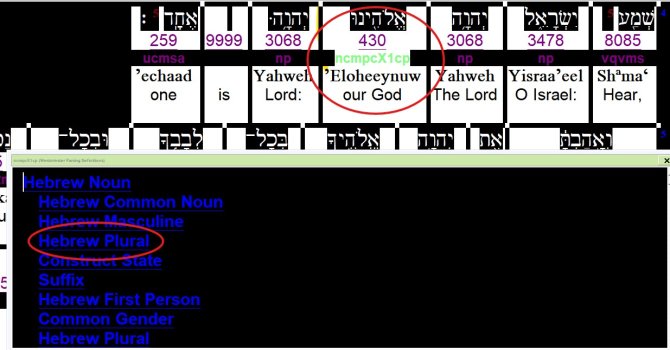
Do I need to post this again? It shows that Elohim(plural) is one "echad" YHWH. Look at it carefully:
View attachment 77187
It is stating that they are one in the purpose of creation and redemption and require the love and obedience of Israel.
SW, Elohim is not exactly plural, it is not, it is YHWH actively in the present time, expressing a/his own majestic plurality (plural of majesty) (like when the Queen might say, "we are not amused." She is one person, although she speaks as being many people/persons because of her position and power and influence. When she speaks people listen. What you have been taught is categorically false. Most scholars believe as I do, Trinitarian or not that Elohim is one person and not a plurality of people.
Even if it were so and it's not, a plurality means more than one of something.. 2,3,4........n, not just 3! I hope you can understand this simple point. You have been taught to believe that generally anything that whistles or sounds like being plural, especially remotely associated with God, it automatically means only 3.
And therefore Elohim is not a collective noun either, if you already considered to travel to this dead end. So you cannot forge a fictious relation with the noun Elohim and echad.
(Gen 1:26) God said, Let us make man in our image, after our likeness: and let them have dominion over the fish of the sea, and over the birds of the sky, and over the livestock, and over all the earth, and over every creeping thing that creeps on the earth.
(Gen 1:27) God created man in His own image. In God’s image He created him; male and female He created them.
Let me give you some points to remember regarding God - Elohim. It took me some time assemble and I gladly give them to you.
The
Hebrew language and its 'Elohim' usage in scripture: The Hebrew language is a bit complex, and the Greek and especially the English have a hard time translating the Hebrew language into their respective languages.
1. The word Elohim for the one true God YHWH is in a plural form of the noun. It has been used in the OT about 2,570 times.
2. When Elohim is used in a complete sentence, and a verb, an adjective and a pronoun is used to represent it, the subject only, the pronoun, adjective and verb are always singular. Even though any pronoun can be singular or plural.
3. Elohim has more than one definition as a plural or singular noun.
4. In a plural sense, Elohim can mean gods, those in authority. In a singular sense it means God Almighty or a god.
5. Hebrew lexicons give preference to the term Elohim in the plural sense as being rulers and judges as divine representatives or indicating divine majesty and powers. They have superhuman abilities, for angels, heavenly beings and gods, and for people doing divine work.
6. Not one definition of Elohim in Hebrew mentions a plurality within a plurality of beings or undefinable persons. Not one time! gods are individual gods, not composed internally of a plurality of beings or personalities within each.
7. Elohim in the singular sense is the one God, a god, a judge and never any hint of a plurality or a compound of different or same entities with the single Elohim God, god or judge. Even Moses was called a god or Elohim - Exodus 7:1. Pagan gods were called Elohim over 200 times.
8. The Encyclopedia Britannica says Elohim means the 'plural of majesty' the God of Israel. It also says, ‘... When referring to Yahweh, elohim very often is accompanied by the article ha-, to mean, in combination, “the God,” and sometimes with a further identification Elohim ḥayyim, meaning “the living God.”
And further, it states, 'Thus, in Genesis the words, “In the beginning God (Elohim) created the heavens and the earth,” Elohim is monotheistic in connotation, though its grammatical structure
seems polytheistic. The Israelites probably borrowed the Canaanite plural noun Elohim and made it singular in meaning in their cultic practices and theological reflections.'
[1]
9. Another source: '...It was general practice among the Hebrew people to pluralize nouns
when they desired to express greatness or majesty. It is then
not a numerical plural. For example: Moses is also called elohim, for God made Moses very great in the land of Egypt (Exo 7:1; 11:3) ...' And further it says, ‘...dictionaries define elohim as a plural of majesty. For example, the Theological Wordbook of the Old Testament says that “the plural ending is usually described as a plural of majesty and not intended as a true plural when used of God.”
[2]
Moses was made 'larger' and more powerful that he was capable of being, because the one true God empowered and drove him, like his Son, Yeshua.
10. Deuteronomy 6:4 ...'Hear, O Israel: The Lord our God is one... (Lord (LORD or YHWH)).'
Exodus 7:1 ...'And the Lord said unto Moses, See, I have made thee a god [ELOHIM] to Pharaoh: and Aaron thy brother shall be thy prophet.'
Did God tell Moses that He was going to make him a 'trinity' to Pharaoh? Of course not. God is telling Moses that He was going to make him 'GREAT' in the eyes of Pharaoh. Which is what the word Elohim really means ... 'greatness' and 'majesty'. Look at how this is revealed in 1 Chronicles 29.
1 Chronicles 29:10-11 ...'Wherefore David blessed the Lord before all the congregation: and David said, Blessed be thou, Lord God [Elohim] of Israel our father, for ever and ever. Thine, O Lord is the greatness, and the power, and the glory, and the victory, and the majesty: for all that is in the heaven and in the earth is thine; thine is the kingdom, O Lord, and thou art exalted as head above all.'
This is the 'plurality' of Elohim. It is a 'plurality of majesty', just as David confirmed above. And it belongs to God the Father, as 'head above all' - even the head of Christ (1 Corinthians 11:3)
11. Look at the following interesting quote concerning Elohim and the Trinity:
Review and Herald"... it is certain that the synagogue (their church) held to no such doctrine. Says Mr. Summerbell, 'A friend of mine who was present in a New York synagogue, asked the Rabbi for an explanation of the word 'Elohim'. A Trinitarian clergyman who stood by, replied, 'Why, that has reference to the three persons in the Trinity,' when a Jew stepped forward and said he must not mention that word again, or they would have to compel him to leave the house; for it was not permitted to mention the name of any strange god in the synagogue." (Discussion between Summerbell and Flood on Trinity, p. 38) Milman says the idea of the Trident is fabulous. (Hist. Christianity, p. 34)
[3]
12. Scripture contains no reproof (no condemnation) for those who do not believe in a “Triune God.” Those who do not believe in God are called “fools” (Ps. 14:1). Those who reject Christ are condemned (John 3:18). Scripture testifies that it is for “doctrine, reproof, and correction” (2 Tim. 3:16 – KJV), and there are many verses that reprove believers for all kinds of erroneous beliefs and practices. Conspicuous in its absence is any kind of reproof for not believing in the Trinity.
[1] (Britannia.com 2010)
[2] (Niekerk 2022)
[3] (Loughborough n.d.)
And the verse 1:26 in Genesis, it the same thing I already wrote about concerning Elohim, concerning the majestic plurality applied in creating man, with two plural pronouns in the verse.
Try reading the next verse to confirm it, to be sure and intellectually honest. Suddenly in the next verse, Elohim becomes one person as he was in verse 26, and using singular verbs.
(Gen 1:27) God created man in His own image. In God’s image He created him; male and female He created them.
In verse 27 this is a record of what the single person Elohim did, created man in his own image.
Verse 26 is the active present voice or expression of God when he actually created man in his own image, making himself known in a majestic and a greater sense that being just one God of himself.
Here's something else I will add in for you as a bonus.
This is a list of how Echad is used in the Torah" Keep it for future reference...
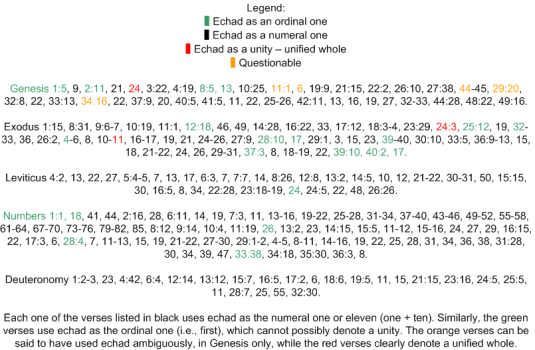
To end with two verses to remind who is God as he is an echad of one, numerically...not a unity in any plurality.

The YHWH/LORD/Adonai/ Elohim - God I know will never share
HIS glory with anyone, even with his Son, eventhough he has given glory to him.
I hope all this helps in some way.
Continue on my good man SW...!