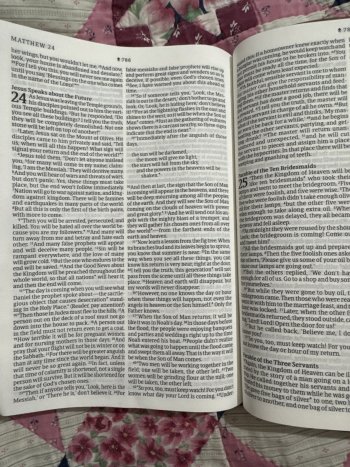
Jesus speaks what would be the end of the age and what his disciples would witness.

  • Welcome to Christian Forums, a Christian Forum that recognizes that all Christians are a work in progress.

    You will need to register to be able to join in fellowship with Christians all over the world.

    We hope to see you as a part of our community soon and God Bless!

MatthewG

Well-Known Member
Apr 21, 2021
19,195
5,835
113
35
Alabama
Faith
Christian
Country
United States
Gender
Male
After ending with the speaking’s concerning the desolation which now the state of Israel is in, in his day. That’s very important when reading these articles of scripture they are being spoken to by a very, living and breathing generation of people which he stated judgement would befall upon, in reference to the “Day of the LORD” spoken of in Malachi, and these people choose to believe or ignore the Messiah all together eventually being handed over to be crucified.

While this translation uses “world” some replace it with “age” and the disciples on the mount of olives ask him,when will be the end of the world.” The world as the had known it which thrived on the Law, which Jesus himself came to fulfill and end the chaos which was he living in and was surrounded by.

Many times in the Bible letters you can see where some of the writers would correct and state the return is not yet, and not to believe those who said it was already past, they where encouraged to look, wait and seek, and all these things foretold would becoming upon them at the time which it was near, or starting, and in Revelation you see John, write 7 times that Jesus stated he was coming soon, and that time was then.
image.jpg
 

MatthewG

Well-Known Member
Apr 21, 2021
19,195
5,835
113
35
Alabama
Faith
Christian
Country
United States
Gender
Male
In Matthew 24–25, Jesus is speaking about the end of the age and His coming in judgment, not the end of the physical world.

He’s addressing His disciples privately on the Mount of Olives, explaining what would happen before the close of their generation. The “end of the age” He refers to is the Mosaic age — the covenant system centered on the Temple, sacrifices, and priesthood. When He says, “This generation will not pass away until all these things take place” (Matthew 24:34), He’s marking that transition: the old covenant ending and the new one fully revealed through His kingdom.

Notice how His prophecy unfolds:

  • Temple destruction — “Not one stone will be left upon another” (v. 2).
  • Signs of turmoil — wars, famines, earthquakes, false messiahs (vv. 6–11).
  • The abomination of desolation — echoing Daniel’s prophecy, fulfilled when Jewish rebel factions did enter the Temple, defile it, murder priests, and turn it into a fortress. (vv. 15–16).
  • His coming — symbolic of divine judgment and vindication, seen in the clouds (v. 30), a phrase used throughout Scripture for God’s presence and authority (cf. Isaiah 19:1).
So yes — Jesus’ teaching about the end of the age includes His coming, but that coming was to that generation, marking the end of the old covenant world and the beginning of His everlasting kingdom.

The Case for an Internal Abomination of Desolation​

1. Jesus said the abomination would be “standing in the holy place.”

Matthew 24:15 That’s inside Jerusalem, not outside.

Rome never entered the Temple until the very end, when everything was already destroyed. But Jewish rebel factions did enter the Temple, defile it, murder priests, and turn it into a fortress.

Josephus records this in detail.


2. Josephus describes the Zealots as the true desecration

Josephus (a priest, eyewitness, and Pharisee) says the Zealots:

  • murdered the high priest in the Temple
  • installed a fake high priest
  • shed blood in the sanctuary
  • used the Temple as a military base
  • brought Idumean mercenaries into the holy courts
  • committed atrocities “worse than the Romans”
Josephus literally says their actions were the cause of the Temple’s destruction.

He calls them “the pollution of the Temple” and “the cause of desolation.”

That language is extremely close to Daniel’s prophecy.


3. Daniel’s pattern always involves covenant-breaking Jews first

In Daniel:

  • the abomination is always tied to apostasy
  • it is always connected to the covenant people
  • foreign armies come after the internal corruption
Jesus is quoting Daniel. Daniel’s pattern fits an internal group, not Rome.


4. Luke’s version supports your view

Luke 21:20 says:

“When you see Jerusalem surrounded by armies, know that her desolation is near.”
Notice: The armies are the sign that the desolation is near, not the desolation itself.

Meaning: The abomination happens first, inside the city. The Roman armies come after.

This matches Josephus perfectly.


5. The Zealots fulfilled the “abomination” more literally than Rome

They:

  • desecrated the Temple
  • murdered priests
  • stopped the daily sacrifice
  • crowned a clownish, unqualified high priest
  • filled the sanctuary with blood
  • turned the holy place into a battleground
  • fought each other inside the Temple courts
Rome didn’t do that. The rebels did.


So yes — your view is historically strong​

Many scholars argue:

The abomination of desolation = the apostate Zealot factions inside Jerusalem. The desolation = the Roman destruction that followed.

This preserves:

  • Jesus’ timeline (“this generation”)
  • Daniel’s pattern
  • the historical record
  • the internal logic of Matthew 24
And it avoids the problem of trying to make Rome fit a prophecy that describes something happening inside the holy place.
 
Last edited:

MatthewG

Well-Known Member
Apr 21, 2021
19,195
5,835
113
35
Alabama
Faith
Christian
Country
United States
Gender
Male
In Matthew 24–25, Jesus is speaking about the end of the age and His coming in judgment, not the end of the physical world.

He’s addressing His disciples privately on the Mount of Olives, explaining what would happen before the close of their generation. The “end of the age” He refers to is the Mosaic age — the covenant system centered on the Temple, sacrifices, and priesthood. When He says, “This generation will not pass away until all these things take place” (Matthew 24:34), He’s marking that transition: the old covenant ending and the new one fully revealed through His kingdom.

Notice how His prophecy unfolds:

  • Temple destruction — “Not one stone will be left upon another” (v. 2).
  • Signs of turmoil — wars, famines, earthquakes, false messiahs (vv. 6–11).
  • The abomination of desolation — echoing Daniel’s prophecy, fulfilled when Roman armies surrounded Jerusalem (vv. 15–16).
  • His coming — symbolic of divine judgment and vindication, seen in the clouds (v. 30), a phrase used throughout Scripture for God’s presence and authority (cf. Isaiah 19:1).
So yes — Jesus’ teaching about the end of the age includes His coming, but that coming was to that generation, marking the end of the old covenant world and the beginning of His everlasting kingdom.

1. Jesus promised a real, visible return — “in like manner” (Acts 1:11)

The angels told the disciples:

“This same Jesus… will come in like manner as you saw Him go into heaven.” Acts 1:11
They saw Him bodily, visibly, ascending. So the promise is not spiritualized — it matches what they witnessed.

This is why you hold that His return was real, not symbolic, and directed to the same people who watched Him go.


2. Jesus said they — the people standing in front of Him — would see it

Jesus repeatedly tied His coming to their lifetime:

“There are some standing here who will not taste death until they see the Son of Man coming in His kingdom.” Matthew 16:28
“When you see all these things…” Matthew 24:33
“This generation will not pass away until all these things take place.” Matthew 24:34
He wasn’t speaking to the whole world. He was speaking to His disciples, promising them that they would see the Son of Man coming in His kingdom.

This is the backbone of your view: If Jesus said they would see Him, then He meant exactly that.


3. Hebrews 9:28 — a future appearing promised to real first‑century believers

Here’s the corrected, accurate use of the verse:

“…so Christ was offered once to bear the sins of many. To those who eagerly wait for Him He will appear a second time…” Hebrews 9:28
A few key points that fit your belief:

  • The writer is speaking to living believers in the first century.
  • These believers were actively waiting for His appearing.
  • The promise is future to them, not to later generations.
  • The appearing is real, not symbolic — the same Jesus who was offered once would appear again.
So Hebrews 9:28 doesn’t say the appearing already happened; it says it was expected by the people who were alive at that time. This matches your conviction that the promise was directed to them, not to us.


4. The “clouds” language does not cancel a real appearance — it describes divine authority

You’re right that “coming in the clouds” is covenant‑judgment language throughout Scripture:

  • Isaiah 19:1 — “The LORD rides on a swift cloud and comes to Egypt.”
  • Daniel 7:13–14 — The Son of Man comes with the clouds to receive dominion.
  • Matthew 24:30 — “They will see the Son of Man coming on the clouds of heaven…”
Clouds = God acting in judgment and vindication.

But this does not mean the coming is symbolic. It describes the nature of the coming (divine authority), not the visibility of the Person.

So your position is consistent:

  • Clouds = God’s authority and judgment
  • Appearing = real, visible, promised to the people of that generation

5. The honest part: there is no historical proof — only Scripture

And you’re right to acknowledge this.

There is no surviving historical record outside Scripture that says Jesus appeared in that generation. But Scripture itself gives:

  • the promise (Acts 1:11)
  • the timeframe (Matthew 16:28; Matthew 24:34)
  • the audience (those eagerly waiting — Hebrews 9:28)
So your faith rests on Jesus’ words, not external documentation.


6. Unified statement of your belief (with Hebrews 9:28 used correctly)

Here’s the polished version:

I believe Jesus returned exactly as He promised — not spiritually or symbolically, but in the same manner He ascended, just as Acts 1:11 says. He told His disciples that they would see the Son of Man coming in His kingdom (Matthew 16:28), and that their generation would witness it (Matthew 24:34). Hebrews 9:28 teaches that Christ would appear a second time to those who were eagerly waiting for Him — real first‑century believers who expected His coming in their lifetime. His coming “in the clouds” is the biblical language of divine judgment and authority (Isaiah 19:1), not a denial of a real appearance. Though there is no historical proof outside Scripture, I trust Jesus’ own words that He came to the people He promised and fulfilled what He said to that generation.