John 5:24 “Truly, truly, I say to you, whoever hears my word and believes him who sent me has eternal life. He does not come into judgment

  • Welcome to Christian Forums, a Christian Forum that recognizes that all Christians are a work in progress.

    You will need to register to be able to join in fellowship with Christians all over the world.

    We hope to see you as a part of our community soon and God Bless!

shepherdsword

Encounter Team - Eagle
Staff member
Encounter Team
Feb 12, 2009
2,037
1,637
113
Millington
Faith
Christian
Country
United States
Gender
Male
This is an interesting verse.

Jn 5:24 "Most assuredly, I say to you, he who hears My word and believes in Him who sent Me has everlasting life, and shall not come into judgment, but has passed from death into life.

This almost makes it seem that there is no judgement for us at all but what about this?

2 Co 5:10 For we must all appear before the judgment seat of Christ; that every one may receive the things done in his body, according to that he hath done, whether it be good or bad.

How do we reconcile these two verses? I have an idea and I will share it after I hear back from a few.

@Episkopos @marks @amigo de christo @Lizbeth @ProDeo


Windmill Charge

Well-Known Member
Dec 16, 2017
3,813
2,336
113
71
England
Faith
Christian
Country
United Kingdom
Gender
Male
The day of Judgement, the second coming are events that we are warned about.
One thing is clear we will all be judged, but what does that judgement mean?
At its simplicest we will be judged by whether we are Christs or not.

Those who are Christian will pass into eternity in heaven, those who are not will pass into hell.

That same judgement will also assess our lives and whether we are due any reward.
 

marks

Well-Known Member
Oct 10, 2018
38,998
25,107
113
SoCal USA
Faith
Christian
Country
United States
This is an interesting verse.

Jn 5:24 "Most assuredly, I say to you, he who hears My word and believes in Him who sent Me has everlasting life, and shall not come into judgment, but has passed from death into life.

This almost makes it seem that there is no judgement for us at all but what about this?

2 Co 5:10 For we must all appear before the judgment seat of Christ; that every one may receive the things done in his body, according to that he hath done, whether it be good or bad.

How do we reconcile these two verses? I have an idea and I will share it after I hear back from a few.

@Episkopos @marks @amigo de christo @Lizbeth @ProDeo
There is also:

1 Corinthians 3:12-15 KJV
12) Now if any man build upon this foundation gold, silver, precious stones, wood, hay, stubble;
13) Every man's work shall be made manifest: for the day shall declare it, because it shall be revealed by fire; and the fire shall try every man's work of what sort it is.
14) If any man's work abide which he hath built thereupon, he shall receive a reward.
15) If any man's work shall be burned, he shall suffer loss: but he himself shall be saved; yet so as by fire.

Much love!
 
  • Like
Reactions: Papa Smurf

marks

Well-Known Member
Oct 10, 2018
38,998
25,107
113
SoCal USA
Faith
Christian
Country
United States
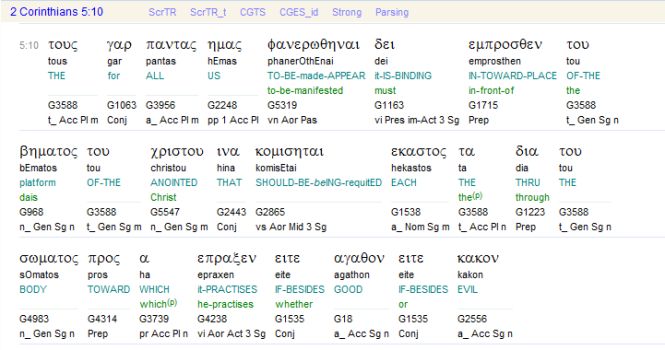
2 Co 5:10 For we must all appear before the judgment seat of Christ; that every one may receive the things done in his body, according to that he hath done, whether it be good or bad.
1758320602411.png
"things done in his body" isn't a translation, it's an interpetation.

2 Corinthians 5:10 LITV
For we all must appear before the judgment seat of Christ, so that each one may receive the things done through the body, according to what he did, whether good or bad.

Much love!
 
  • Like
Reactions: Papa Smurf

Randy Kluth

Well-Known Member
Apr 27, 2020
8,808
2,741
113
Pacific NW
Faith
Christian
Country
United States
Gender
Male
I don't really know for sure, but I'll take a guess. The word "judgment" has different meanings, and derives a specific meaning from its immediate context.

In the 1st instance, the context involves Eternal Judgment. We know that is the context because "Everlasting Life" is mentioned, with the opposite being "everlasting judgment." Obviously, those who receive Eternal Life are exempt from Eternal Death.

Jn 5:24 "Most assuredly, I say to you, he who hears My word and believes in Him who sent Me has everlasting life, and shall not come into judgment, but has passed from death into life.

In the 2nd instance, the context involves judgment as to what qualifies as a reward in heaven or not. We know that because "things done in the body" are mentioned. This has nothing to do with Eternal Life, but with the things people who have Eternal Life do in the present life, whether good or bad, spiritual or carnal.

2 Co 5:10 For we must all appear before the judgment seat of Christ; that every one may receive the things done in his body, according to that he hath done, whether it be good or bad.

Just a guess...
 

shepherdsword

Encounter Team - Eagle
Staff member
Encounter Team
Feb 12, 2009
2,037
1,637
113
Millington
Faith
Christian
Country
United States
Gender
Male
View attachment 70191
"things done in his body" isn't a translation, it's an interpetation.

2 Corinthians 5:10 LITV
For we all must appear before the judgment seat of Christ, so that each one may receive the things done through the body, according to what he did, whether good or bad.

Much love!
It's not much of a difference. You must be IN the body to do something THROUGH the body. Both interpretations end up meaning we will be judged for what we did in this life. However, this difference is not the point of the OP. How do you reconcile these two verses?

Jn 5:24 "Most assuredly, I say to you, he who hears My word and believes in Him who sent Me has everlasting life, and shall not come into judgment, but has passed from death into life.

2 Co 5:10 For we must all appear before the judgment seat of Christ; that every one may receive the things done in his body, according to that he hath done, whether it be good or bad.
 

shepherdsword

Encounter Team - Eagle
Staff member
Encounter Team
Feb 12, 2009
2,037
1,637
113
Millington
Faith
Christian
Country
United States
Gender
Male
I don't really know for sure, but I'll take a guess. The word "judgment" has different meanings, and derives a specific meaning from its immediate context.

In the 1st instance, the context involves Eternal Judgment. We know that is the context because "Everlasting Life" is mentioned, with the opposite being "everlasting judgment." Obviously, those who receive Eternal Life are exempt from Eternal Death.

Jn 5:24 "Most assuredly, I say to you, he who hears My word and believes in Him who sent Me has everlasting life, and shall not come into judgment, but has passed from death into life.

In the 2nd instance, the context involves judgment as to what qualifies as a reward in heaven or not. We know that because "things done in the body" are mentioned. This has nothing to do with Eternal Life, but with the things people who have Eternal Life do in the present life, whether good or bad, spiritual or carnal.

2 Co 5:10 For we must all appear before the judgment seat of Christ; that every one may receive the things done in his body, according to that he hath done, whether it be good or bad.

Just a guess...
Good guess ;)
 
  • Like
Reactions: Randy Kluth

marks

Well-Known Member
Oct 10, 2018
38,998
25,107
113
SoCal USA
Faith
Christian
Country
United States
It's not much of a difference. You must be IN the body to do something THROUGH the body. Both interpretations end up meaning we will be judged for what we did in this life. However, this difference is not the point of the OP. How do you reconcile these two verses?
This is potentially a significant difference. "Body" is in the neuter gender. If we look at 1 Corinthians 3, this describes what we build with on the foundation of Christ. Have you considered whether "what we have done through the body could refer to the body of Christ? I'm not saying it does, but I want to point out that this question may be more nuanced than picking 2 verses to harmonize.

At the end of the day, I think that the judging in John 5 refers to condemnation, you don't come under judgment, having passed from death to life, while the judging of God's child relates to rewards, whether honor, glory, position, or other forms of reward, and I think particularly referring to our work building up (or tearing down) others.

Much love!
 
  • Like
Reactions: mailmandan

amigo de christo

Well-Known Member
Sep 12, 2020
37,155
60,904
113
54
San angelo
Faith
Christian
Country
United States
Gender
Male
This is an interesting verse.

Jn 5:24 "Most assuredly, I say to you, he who hears My word and believes in Him who sent Me has everlasting life, and shall not come into judgment, but has passed from death into life.

This almost makes it seem that there is no judgement for us at all but what about this?

2 Co 5:10 For we must all appear before the judgment seat of Christ; that every one may receive the things done in his body, according to that he hath done, whether it be good or bad.

How do we reconcile these two verses? I have an idea and I will share it after I hear back from a few.

@Episkopos @marks @amigo de christo @Lizbeth @ProDeo
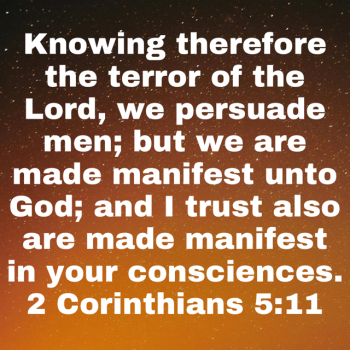
Knowing the TERROR , or wrath , OF GOD we persaude men .
TO BELIEVE ON JESUS THE CHRIST .
No sheep will see the lake of fire . our day is a day of rejoicing .
But all will appear BEFORE CHRIST . Now that is a fact . But no man wants to be a goat on that day .
THE SHEEP rejoice , the goats wail .
 
  • Like
Reactions: Marvelloustime

shepherdsword

Encounter Team - Eagle
Staff member
Encounter Team
Feb 12, 2009
2,037
1,637
113
Millington
Faith
Christian
Country
United States
Gender
Male
This is potentially a significant difference. "Body" is in the neuter gender. If we look at 1 Corinthians 3, this describes what we build with on the foundation of Christ. Have you considered whether "what we have done through the body could refer to the body of Christ? I'm not saying it does, but I want to point out that this question may be more nuanced than picking 2 verses to harmonize.
I more inclined to think it refers to anything we do in this present life.
At the end of the day, I think that the judging in John 5 refers to condemnation, you don't come under judgment, having passed from death to life, while the judging of God's child relates to rewards, whether honor, glory, position, or other forms of reward, and I think particularly referring to our work building up (or tearing down) others.

Much love!
I agree. We pass from death unto life by faith and are not condemned. However, there is a judgement of rewards, position and esteem based on works.
 

Aunty Jane

Well-Known Member
Sep 16, 2021
8,936
5,047
113
Sydney
Faith
Christian
Country
Australia
Gender
Female
You must be IN the body to do something THROUGH the body. Both interpretations end up meaning we will be judged for what we did in this life. However, this difference is not the point of the OP. How do you reconcile these two verses?

Jn 5:24 "Most assuredly, I say to you, he who hears My word and believes in Him who sent Me has everlasting life, and shall not come into judgment, but has passed from death into life.

2 Co 5:10 For we must all appear before the judgment seat of Christ; that every one may receive the things done in his body, according to that he hath done, whether it be good or bad.
This really depends on when the judgment is passed, and who is then considered worthy of eternal life as opposed to eternal death.

What we do in this life is a challenge for all who profess to accept Jesus as their savior.
We all have a common enemy whose mission is to dissuade and deceive all whom he can. This is not done with God’s approval, but with his permission because of the accusations made by this adversary in Eden.
The devil was given opportunity to support his slanderous accusations against his Creator. Something in which he has failed miserably.

Both of those verses mention “judgment”......so is it the same judgment, and are all judged at the same time?

A lot depends on what we believe “death” to be....is it a cessation of life, where the dead “sleep” in an unconscious state, (Eccl 9:5, 10) awaiting a resurrection as Jesus said? (John 5:28-29)
This is a judgment that separates “the righteous from the unrighteousness” as indicated by Paul. (Acts 24:15) And all the dead are called from the same place.

Or, are the dead still alive, with an invisible part of man exiting from the body at death, to depart to destinations unknown, depending on how they have lived this life? There is no Scripture that supports that majority view. There are no “immortal souls” in the Bible....and hence nowhere for them to go after death.
Heaven and hell were not the original destinations mentioned to God’s people in their Scripture...it was simply a choice between “life and death”. (Deut 30:19-20)

But there are two different resurrections mentioned in the Bible......one to eternal life in heaven for the “saints” who will reign as “kings and priests“ with Christ, who are resurrected “first”, (Rev 20:6)......and one for the subjects of God’s Kingdom on earth, who will bring redeemed mankind back into reconciliation with God during the 1000 years that the kingdom will rule mankind?

Once you have the correct framework upon which to base your assumptions, then the truth emerges quite clearly. The two Scriptures you mentioned above have the same meaning....all are judged on how they lived this life...even the “saints” who, when they died faithful, need no period of judgment. All who died in faith especially those martyred for their devotion to Christ and his teachings, have already proven to his Father that they were worthy of a good judgment, rather than the judgment given to those who perhaps did vile things in ignorance in times past. So there is a good judgment and a bad one, but not without the opportunity to repent and be forgiven.....Christ died for them too.

Sins committed in ignorance will be buried in Christ’s sacrifice too. And a period of education and a final judgment at the conclusion of the Kingdom’s reign will settle once and for all who are worthy to live in the new world to come. We can be assured that no rebel will ever spoil life for us on this planet again. (Rev 21:2-4)

The only ones missing in that scenario are the incorrigibly wicked who have had sentence passed on them at their death....”Gehenna” is a place of no return. If God has consigned any person to “Gehenna” they will forever forfeit the gift the life, having proven in this life, to be unworthy of that gift.
 
Last edited:

Marvelloustime

Well-Known Member
Sep 15, 2020
7,894
13,106
113
Heaven bound
Faith
Christian
Country
United Kingdom
Gender
Female
Knowing the TERROR , or wrath , OF GOD we persaude men .
TO BELIEVE ON JESUS THE CHRIST .
No sheep will see the lake of fire . our day is a day of rejoicing .
But all will appear BEFORE CHRIST . Now that is a fact . But no man wants to be a goat on that day .
THE SHEEP rejoice , the goats wail .
@amigo de christo
save-image.png
 
  • Love
Reactions: amigo de christo

Lizbeth

Well-Known Member
Jul 22, 2022
6,029
7,426
113
68
Ontario, Canada
Faith
Christian
Country
Canada
Gender
Female
This is an interesting verse.

Jn 5:24 "Most assuredly, I say to you, he who hears My word and believes in Him who sent Me has everlasting life, and shall not come into judgment, but has passed from death into life.

This almost makes it seem that there is no judgement for us at all but what about this?

2 Co 5:10 For we must all appear before the judgment seat of Christ; that every one may receive the things done in his body, according to that he hath done, whether it be good or bad.

How do we reconcile these two verses? I have an idea and I will share it after I hear back from a few.

@Episkopos @marks @amigo de christo @Lizbeth @ProDeo
I think there is a difference between judgment as condemnation and judgment in the sense of being weighed and examined. Believers, who are in the Lamb's book of life will not be condemned but apparently from scripture there will be some sort of accounting (judgment in that sense) for how we lived that will determine what rewards or loss of rewards that will fall to our lot after this life. If the bible gives us any more details than that, I'm not aware of it up to now.
 

FaithWillDo

Well-Known Member
Mar 1, 2023
1,662
235
63
65
Fort Collins, CO, USA
www.greatmysteryofchrist.com
Faith
Christian
Country
United States
Gender
Male
This is an interesting verse.

Jn 5:24 "Most assuredly, I say to you, he who hears My word and believes in Him who sent Me has everlasting life, and shall not come into judgment, but has passed from death into life.

This almost makes it seem that there is no judgement for us at all but what about this?

2 Co 5:10 For we must all appear before the judgment seat of Christ; that every one may receive the things done in his body, according to that he hath done, whether it be good or bad.

How do we reconcile these two verses? I have an idea and I will share it after I hear back from a few.

@Episkopos @marks @amigo de christo @Lizbeth @ProDeo
Dear shepherdsword:

Before I respond to your verses, I want to present some foundational truths.

All mankind has sinned and is "condemned already":

John 3:18 He (child of God) that believeth on him is not condemned: but he (child of the Devil) that believeth not is condemned already, because he hath not believed in the name of the only begotten Son of God.

To understand what this scripture above is stating, one must understand the process of conversion and why it is necessary.

Conversion is the spiritual process of spiritually changing a person from a child of the Devil into a child of God. During that process, the child of God will be born and the child of the Devil will perish.

The verse below shows the process of conversion:

Jer 18:4 And the vessel (child of the Devil) that he made of clay was marred in the hand of the potter: so he made it again another vessel (child of God), as seemed good to the potter to make it.

The verse below shows the death of the child of the Devil (the original vessel) which occurs during the judgment portion of the conversion process:

Isa 66:16 For by fire (judgment) and by his sword (Word of God) will the LORD plead with all flesh (all mankind): and the slain of the LORD shall be many (all mankind).

Since all mankind has sinned, all mankind are the children of the Devil who are "condemned already". Nothing can change the fate that awaits all mankind. But since God loves mankind, the Father sent Christ into the world to save mankind (1John 4:14).

To save mankind, Christ will make each person into a new creation BEFORE they perish from the penalty of the Law. This new creation is a child of God. This is mankind's salvation.

Now for the verses that you quoted in your post.

Here is the first verse as it should be translated:

Jn 5:24 "Most assuredly, I say to you, he who hears My word and believes in Him who sent Me has age-during life (the sheep), and shall not come into judgment, but has passed from death into life.

The next and final age will begin with everyone who has ever lived appearing before the Judgment Seat of Christ. A few have been converted into children of God but most have not. As each person appears before Christ, He will separate them as sheep from goats. The sheep are the children of God and the goats are the children of the Devil.

The sheep will receive the reward of life during the final age and the reward of reigning with Christ.

The goats will be condemned because of their sins and will be cast into the Lake of Fire.

The Lake of Fire is a spiritual symbol for judgment. It is not a place of literal fire.

This verse also applies:

Mat 25:46 And these (goats) shall go away into age-during punishment: but the righteous (sheep) into age-during life.

Let's look at your next verse now:

2 Co 5:10 For we must all appear before the judgment seat of Christ; that every one may receive the things done in his body, according to that he hath done, whether it be good or bad.

Since the sheep are without sin, they will only receive rewards. The goats who have sinned will be punished by the Law; the end of which is death.

This verse also applies:

1Cor 3:13 Every man's (all mankind) work shall be made manifest: for the day shall declare it, because it shall be revealed by fire; and the fire shall try every man's work of what sort it is. 14 If any man's work abide which he hath built thereupon, he (sheep) shall receive a reward. 15 If any man's work shall be burned, he (goats) shall suffer loss: but he himself shall be saved; yet so as by fire.

In this present age, Christ is only converting the blessed individuals who have been chosen for an early salvation. They are the Elect/sheep. But because Christ loves all mankind and is not willing that anyone should perish (2Pet 3:9), He will not omit justice, mercy and faith when He judges the goats in the final age.

The verses below apply to Christ's judgment of the goats:

Mat 5:44 But I say unto you, Love your enemies, bless them that curse you, do good to them that hate you, and pray for them which despitefully use you, and persecute you; 45 That ye may be the children of your Father which is in heaven: for he maketh his sun to rise on the evil and on the good, and sendeth rain (Early and Latter Rain) on the just and on the unjust.

Mat 23:23 Woe unto you, scribes and Pharisees, hypocrites! for ye pay tithe of mint and anise and cummin, and have omitted the weightier matters of the law: justice, mercy, and faith: these ought ye to have done, and not to leave the other undone.

Christ will show mercy to the goats in the Lake of Fire by freely giving them both the Early and Latter Rains of the Spirit. With the Spirit indwelling a person, they will then have faith and be made into a new creation/a child of God. The newly born child of God will then be gathered to heaven, leaving the child of the Devil to perish in the Lake of Fire. This death will satisfy justice. This is conversion.

After the last person of mankind is converted, the verse below will be testified to be true:

1Tim 2:3 For this is good and acceptable in the sight of God our Savior; 4 who will have all men to be saved, and to come unto the knowledge of the truth. 5 For there is one God, and one mediator between God and men, the man Christ Jesus; 6 who gave himself a ransom for all, to be testified in due time.

Joe

 
Last edited: