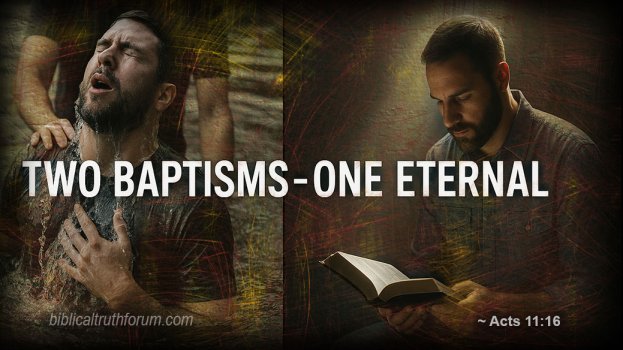
The Baptism That Saves: What Most People Miss in Acts 11:16

  • Welcome to Christian Forums, a Christian Forum that recognizes that all Christians are a work in progress.

    You will need to register to be able to join in fellowship with Christians all over the world.

    We hope to see you as a part of our community soon and God Bless!

What does the Bible say truly saves a person?

  • Faith in Jesus Christ and the indwelling Holy Spirit

  • Water baptism

  • Speaking in tongues

  • Obeying the law and commandments

  • Being a member of the right church

  • I’m not sure


Results are only viewable after voting.

bdavidc

Well-Known Member
Mar 31, 2025
1,142
1,116
113
67
Charlestown, IN
know-the-bible.com
Faith
Christian
Country
United States
Gender
Male
Two-Baptisms---One-Eternal.jpg

“And I remembered the word of the Lord, how he said, ‘John indeed baptized with water, but ye shall be baptized with the Holy Ghost.’” (Acts 11:16)
Two Baptisms – One Eternal

This verse is often misunderstood
, but when we look at it in context of the whole Bible, the meaning is clear. In Acts 11, Peter is explaining to Jewish believers what had just happened in the house of Cornelius, a Gentile. Cornelius and his household had heard the gospel, believed it, and were immediately filled with the Holy Spirit (Acts 10:44–46). This shocked the Jewish believers, because up to that point, they had assumed salvation and the Holy Spirit were limited to the Jews. Peter responds by recalling something Jesus Himself said, “John indeed baptized with water, but ye shall be baptized with the Holy Ghost” (Acts 1:5).

This is crucial. Peter is connecting what happened to the Gentiles in Acts 10 to Jesus’ promise before His ascension. They had just witnessed what Jesus foretold, a baptism, not of water, but of the Holy Spirit. It was a real-time fulfillment of that promise, proving that Gentiles who believed in Christ were accepted by God the same way Jewish believers were.

So what does it mean to be baptized with the Holy Spirit?
According to 1 Corinthians 12:13, “For by one Spirit are we all baptized into one body.” This is not a second experience, not a feeling, not tongues, and not an emotional high. It is the moment a person believes the gospel and is placed into the body of Christ by the Holy Spirit. That is what happened in Acts 2 with the Jews, and again in Acts 10 with the Gentiles. It was not tied to water; it was tied to faith.

John’s baptism with water was symbolic, preparing people to receive the coming Messiah (Mark 1:4). It showed repentance, but it could not save. The baptism of the Holy Spirit, however, is the true work of regeneration and salvation. Titus 3:5 puts it plainly, “Not by works of righteousness which we have done, but according to his mercy he saved us, by the washing of regeneration, and renewing of the Holy Ghost.”

When Peter remembered Jesus’ words in Acts 11:16, he recognized that what happened to Cornelius’ household was not some random event. It was the fulfillment of Christ’s promise that believers would be baptized with the Holy Spirit. It proved they were saved, not because they were Jews, not because they kept the law, not because they were baptized in water, but because they believed the gospel and received the Spirit.

That said, water baptism is still important. It does not save, but it is commanded. Jesus said in Matthew 28:19, “Go ye therefore, and teach all nations, baptizing them in the name of the Father, and of the Son, and of the Holy Ghost.” Acts 10:48 says that after Cornelius and his household received the Holy Spirit, Peter commanded them to be baptized in water. Baptism is the outward expression of inward faith. It shows that a person has died to sin and now walks in new life with Christ (Romans 6:4). If someone claims to be saved but refuses to obey Christ’s command to be baptized, that reveals a serious issue in the heart.

So yes, be baptized. But understand what saves you is not the water, it is whether you have truly been born again by the Holy Spirit through faith in Jesus Christ. Romans 8:9 says, “If any man have not the Spirit of Christ, he is none of his.” That is the baptism that matters most. And if you have received it, then do what the Bible commands: get baptized in water as a public declaration that you now belong to Christ. Obedience follows salvation; it does not cause it.

Acts 11:16 points us back to the promise of Christ, fulfilled in the lives of real people, not through ritual, but through faith. That is the baptism that saves. And water baptism is how we testify to the world that we belong to Him.

Read the entire article – Click Here
 
  • Like
Reactions: Nancy and rwb

Scott Downey

Well-Known Member
Dec 19, 2021
11,463
6,987
113
66
St. Thomas
Faith
Christian
Country
Virgin Islands, U.S.
Gender
Male
“For by one Spirit are we all baptized into one body.” Performed by God.
I Agree that a water baptism is not the baptism that saves

Paul was glad, thanking God he had not baptized anyone

1 Corinthians 1
10 Now I plead with you, brethren, by the name of our Lord Jesus Christ, that you all [d]speak the same thing, and that there be no [e]divisions among you, but that you be perfectly joined together in the same mind and in the same judgment. 11 For it has been declared to me concerning you, my brethren, by those of Chloe’s household, that there are [f]contentions among you. 12 Now I say this, that each of you says, “I am of Paul,” or “I am of Apollos,” or “I am of Cephas,” or “I am of Christ.” 13 Is Christ divided? Was Paul crucified for you? Or were you baptized in the name of Paul?

14 I thank God that I baptized none of you except Crispus and Gaius, 15 lest anyone should say that I had baptized in my own name. 16 Yes, I also baptized the household of Stephanas. Besides, I do not know whether I baptized any other.

17 For Christ did not send me to baptize, but to preach the gospel, not with wisdom of words, lest the cross of Christ should be made of no effect.

Ephesians 4
I, therefore, the prisoner [a]of the Lord, [b]beseech you to walk worthy of the calling with which you were called, 2 with all lowliness and gentleness, with longsuffering, bearing with one another in love, 3 endeavoring to keep the unity of the Spirit in the bond of peace.

4 There is one body and one Spirit, just as you were called in one hope of your calling; 5 one Lord, one faith, one baptism; 6 one God and Father of all, who is above all, and through all, and in [c]you all.
 
  • Like
Reactions: bdavidc

Scott Downey

Well-Known Member
Dec 19, 2021
11,463
6,987
113
66
St. Thomas
Faith
Christian
Country
Virgin Islands, U.S.
Gender
Male
Used to work with a fellow that said you had to be physically submerged in water to be saved.
He went to the Church of Christ.
The guy was very divisive.
He automatically said believing in Christ as described in Romans 10, was not salvation, anyone sprinkled by water in a church by a minister and believing in Christ was going to hell.

He liked to quote how the demons believe and tremble, but are not saved.
He hedged this by saying real believers get submerged in a water baptism by a man, and if you don't do it like his church, you are not a genuine believer, you are a fake Christian. To him, most Christian believers were sons of Satan.
 
  • Like
Reactions: JLB

Scott Downey

Well-Known Member
Dec 19, 2021
11,463
6,987
113
66
St. Thomas
Faith
Christian
Country
Virgin Islands, U.S.
Gender
Male
So that guy did not believe the scripture himself, the very accusation he threw out against many other Christians.

Romans 10
5 For Moses writes about the righteousness which is of the law, “The man who does those things shall live by them.” 6 But the righteousness of faith speaks in this way, “Do not say in your heart, ‘Who will ascend into heaven?’ ” (that is, to bring Christ down from above) 7 or, “ ‘Who will descend into the abyss?’ ” (that is, to bring Christ up from the dead). 8 But what does it say? “The word is near you, in your mouth and in your heart” (that is, the word of faith which we preach):

9 that if you confess with your mouth the Lord Jesus and believe in your heart that God has raised Him from the dead, you will be saved. 10 For with the heart one believes unto righteousness, and with the mouth confession is made unto salvation.

11 For the Scripture says, “Whoever believes on Him will not be put to shame.” 12 For there is no distinction between Jew and Greek, for the same Lord over all is rich to all who call upon Him.

13 For “whoever calls on the name of the Lord shall be saved.”
 
  • Like
Reactions: bdavidc

Gary Mac

Member
Jul 14, 2025
304
32
28
75
Fort Worth Tx
Faith
Christian
Country
United States
Salvation is the same one Jesus received from God Himself in Matt 3:16, received in yourself from God Himself.

All the things man has said about Him is second hand information edited from mans own opinions. God Himself is quite capable of conveying who He is and all of His heaven in you in who we are in Him, so obvious in the life of Jesus starting after Matt 3:16. Before that he was rabbi for the opinions of man about a god. God released him from those law when he open in him a new heaven and earth and who He actually is.

That is exactly why I follow who Jesus said he was in God instead of what others had to say about him. For me and by identification with the same God in me who was Jesus was of, Jesus has the better way in the Father.

After that event in Matt 3:16 Jesus said ye must be born again with that same renewing of mind that he received from God Himself if one is to be of the same Father of it. Luke 17:20-21 Jesus said the kingdom of God does not come with observation, it is within you. Not many believe Jesus in that do they?
 

DJT_47

Well-Known Member
Oct 29, 2022
1,544
479
83
Michigan/Sterling Heights
Faith
Christian
Country
United States
Gender
Male
View attachment 64843


Two Baptisms – One Eternal

This verse is often misunderstood
, but when we look at it in context of the whole Bible, the meaning is clear. In Acts 11, Peter is explaining to Jewish believers what had just happened in the house of Cornelius, a Gentile. Cornelius and his household had heard the gospel, believed it, and were immediately filled with the Holy Spirit (Acts 10:44–46). This shocked the Jewish believers, because up to that point, they had assumed salvation and the Holy Spirit were limited to the Jews. Peter responds by recalling something Jesus Himself said, “John indeed baptized with water, but ye shall be baptized with the Holy Ghost” (Acts 1:5).

This is crucial. Peter is connecting what happened to the Gentiles in Acts 10 to Jesus’ promise before His ascension. They had just witnessed what Jesus foretold, a baptism, not of water, but of the Holy Spirit. It was a real-time fulfillment of that promise, proving that Gentiles who believed in Christ were accepted by God the same way Jewish believers were.

So what does it mean to be baptized with the Holy Spirit?
According to 1 Corinthians 12:13, “For by one Spirit are we all baptized into one body.” This is not a second experience, not a feeling, not tongues, and not an emotional high. It is the moment a person believes the gospel and is placed into the body of Christ by the Holy Spirit. That is what happened in Acts 2 with the Jews, and again in Acts 10 with the Gentiles. It was not tied to water; it was tied to faith.

John’s baptism with water was symbolic, preparing people to receive the coming Messiah (Mark 1:4). It showed repentance, but it could not save. The baptism of the Holy Spirit, however, is the true work of regeneration and salvation. Titus 3:5 puts it plainly, “Not by works of righteousness which we have done, but according to his mercy he saved us, by the washing of regeneration, and renewing of the Holy Ghost.”

When Peter remembered Jesus’ words in Acts 11:16, he recognized that what happened to Cornelius’ household was not some random event. It was the fulfillment of Christ’s promise that believers would be baptized with the Holy Spirit. It proved they were saved, not because they were Jews, not because they kept the law, not because they were baptized in water, but because they believed the gospel and received the Spirit.

That said, water baptism is still important. It does not save, but it is commanded. Jesus said in Matthew 28:19, “Go ye therefore, and teach all nations, baptizing them in the name of the Father, and of the Son, and of the Holy Ghost.” Acts 10:48 says that after Cornelius and his household received the Holy Spirit, Peter commanded them to be baptized in water. Baptism is the outward expression of inward faith. It shows that a person has died to sin and now walks in new life with Christ (Romans 6:4). If someone claims to be saved but refuses to obey Christ’s command to be baptized, that reveals a serious issue in the heart.

So yes, be baptized. But understand what saves you is not the water, it is whether you have truly been born again by the Holy Spirit through faith in Jesus Christ. Romans 8:9 says, “If any man have not the Spirit of Christ, he is none of his.” That is the baptism that matters most. And if you have received it, then do what the Bible commands: get baptized in water as a public declaration that you now belong to Christ. Obedience follows salvation; it does not cause it.

Acts 11:16 points us back to the promise of Christ, fulfilled in the lives of real people, not through ritual, but through faith. That is the baptism that saves. And water baptism is how we testify to the world that we belong to Him.

Read the entire article – Click Here
One Baptism and it's water immersion, and 1 Peter 3:21 says it DOES save us. You are misreading Acts 11:16. Read starting from earlier in that chapter, like at verse 5. Those words were said to Peter by the Lord, and he was one of the 11 apostles upon which the Holy Ghost fell as recorded in Acts 2, all of which were in fact baptized with the Holy Spirit as they, the 11 apostles, then spoke in other tongues as a sign to the Jews who were then converted. The gifts of the Spirit were then made manifest by the apostles by the laying on of their hands. The words said to Peter as aforementioned don't apply to us, and applied uniquely to the 11 apostles.
 

Eternally Grateful

Well-Known Member
Feb 27, 2020
19,772
10,477
113
60
Columbus, ohio
Faith
Christian
Country
United States
Gender
Male
its sad many want to commit blasphemy by giving man the credit for a work which is can only be completed by the HS
 

Behold

Well-Known Member
Apr 11, 2020
24,464
9,216
113
Netanya or Pensacola
Faith
Christian
Country
Israel
Gender
Male
There are at least 7 "Baptisms" listed in the Holy Bible.

The one that Saves or regenerates the spirit in a sinner, is the one that produces this...

A.) "Born again">

And that is not water baptism............that is "by my Spirit, sayeth the Lord".
 
  • Like
Reactions: amigo de christo

DJT_47

Well-Known Member
Oct 29, 2022
1,544
479
83
Michigan/Sterling Heights
Faith
Christian
Country
United States
Gender
Male
yes

Yet there are many baptism. so which one saves?

the one performed by God.

or the one performed by man?
Water immersion into Christ. Pretty clear by scripture, since being baptized into Christ by immersion is the only way described in the bible that remits sin, places you in the body of believers which is the church, and enables the gift of the Spirit itself to dwell in you enabling you oo become a Christian and child of God.
 

bdavidc

Well-Known Member
Mar 31, 2025
1,142
1,116
113
67
Charlestown, IN
know-the-bible.com
Faith
Christian
Country
United States
Gender
Male
One Baptism and it's water immersion, and 1 Peter 3:21 says it DOES save us. You are misreading Acts 11:16. Read starting from earlier in that chapter, like at verse 5. Those words were said to Peter by the Lord, and he was one of the 11 apostles upon which the Holy Ghost fell as recorded in Acts 2, all of which were in fact baptized with the Holy Spirit as they, the 11 apostles, then spoke in other tongues as a sign to the Jews who were then converted. The gifts of the Spirit were then made manifest by the apostles by the laying on of their hands. The words said to Peter as aforementioned don't apply to us, and applied uniquely to the 11 apostles.
Scripture speaks of “one baptism” (Ephesians 4: 5) and the same Scripture goes on to tell us what that is. It is the work of the Spirit that unites the believer to Christ at the moment of faith. It is not water. “For by one Spirit are we all baptized into one body” (1 Corinthians 12:13). When Romans 6:3–4 speaks of baptism, it is being baptized into Christ and into His death, which is union with Christ by faith, not a tub of water. Your use of 1 Peter 3:21 ignores Peter’s own qualifier. Peter says baptism saves, “not the putting away of the filth of the flesh, but the answer of a good conscience toward God, by the resurrection of Jesus Christ.” He denies the physical washing saves and ties salvation to the resurrection received by faith. The Greek there for “answer” is eperotema, which is an appeal or pledge of a good conscience toward God. This implies a confession of faith in the risen Christ, not water removing dirt. Acts 10–11 refutes your idea that Acts 11:16 is for the apostles only. Peter preached to Cornelius and “the Holy Ghost fell on all them which heard the word” (Acts 10:44). They received the Spirit first and Peter “commanded them to be baptized in water” afterward (Acts 10:47–48). Peter then interprets that event with the promise of Jesus, “ye shall be baptized with the Holy Ghost” (Acts 11: 16), and proves that promise is for the Gentiles who will believe, not just the eleven apostles. Peter later puts the question to rest by saying, “God, which knoweth the hearts, bare them witness, giving them the Holy Ghost, even as he did unto us, and put no difference between us and them, purifying their hearts by faith” (Acts 15:8–9). The promise of the Spirit is “to all that are afar off, even as many as the Lord our God shall call” (Acts 2:39). Tongues were the sign of that promise but not everyone received tongues because Paul says not all speak with tongues (1 Corinthians 12: 30) and the Spirit distributes gifts as He wills (1 Corinthians 12:11). Salvation is the washing of regeneration and renewing of the Holy Ghost, “not by works of righteousness which we have done” (Titus 3:5). Water baptism was commanded by Christ and in obedience follows faith (Matthew 28: 19, Acts 10:48) but water never justified anyone. The thief on the cross was saved without water, because it is by faith in the crucified and risen Lord that we are saved (Luke 23:42–43; John 5:24). “If a man have not the Spirit of Christ, he is none of his” (Romans 8:9). That is the one baptism that saves and those who have received it should gladly obey the Lord in water baptism as a public confession, not as a cause of salvation.
 
  • Like
Reactions: Eternally Grateful

Pierac

Well-Known Member
Nov 15, 2021
1,007
288
83
63
Phoenix
Faith
Christian
Country
United States
Gender
Male


Mat 28:19 "Go therefore and make disciples of all the nations, baptizing them in the name of the Father and the Son and the
Holy Spirit,


Name
- This word of course brings to mind an actual name, such as John Doe. But what does it mean to a Jew.

Name - 1. designates more than the external person; it tends to express his basic character, his personality. We might say it is an emanation of the person himself. 2. authority of, expressing attributes, in acknowledgment or confession of (NABD & VED).

This definition helps us in a verse like John 17:26:

"I (Jesus) made known to them your name and I will make it known."

Jesus obviously did not come to inform the Apostles that God’s name is YHWH. He came to explain God’s character, His attributes, His will, so that we could come to truly know God and follow His ways. This understanding of the word "name" along with the definition of the next word "baptize" will clear up this misunderstood verse.

Baptize - We always think of being baptized in water, either as infants or adults. Yes, this definition is used many times in the New Testament, but there is also another meaning that we must store in the back of our minds.

Baptize - 1. to unite together, to become closely bound to (TGEL & VED).

Now we will put together the definitions of "name" and "baptize" to get the true meaning of Matthew 28:19. Vine’s Expository Dictionary of Old and New Testament Words has this commentary on this verse:

"The phrase in Matthew 28:19, ‘baptize them in the name’ would indicate that the baptized person was closely bound to, or became property of, the one in whose name he was baptized."

With these definitions we can safely paraphrase this verse as follows:

"Go out into the world and introduce or bring them into the knowledge of the Father, the Son, and the Holy Spirit."

Which is exactly what they did. The Apostles had to go into the world and explain to the Gentiles who God is, who the Son (The Messiah) is, and also about the power that they would receive from God’s Spirit. If we take it to mean that we are to water baptize people in the actual name of the Father, Son, and the Holy Spirit, then why is it that no one in the Bible ever uses this formula to water baptize believers?

There is a very strong position held by many scholars that this verse was not part of the original text of Matthew’s Gospel, as Eusebius, a third century Christian apologist, quoted the text in a shorter form rather than the form that now appears in the gospel. It reads,

"Go ye therefore and teach all nations, baptizing them in my name" (which is in agreement with the paraphrase that was just given above).

One commentator writes,

"There is much probability in the conjecture that it is the original text of the gospel, and that in the second century the longer clause supplanted the shorter ‘baptizing them in my name.’ An insertion of this kind, derived from liturgical use, would have rapidly been adopted by copyist and translators" (The International Critical Commentary, by Willoughby C. Allen Volume 26, pp. 307-308).

This position has strong Biblical support by the fact that the Apostles at no recorded instance baptize using the formula of "The Father, the Son, and the Holy Spirit" as Jesus supposedly commanded them to do. They always baptize "In the name of Jesus Christ."

Also the parallel passage in Mark 16:15-18 does not mention in any way this formula, and the Gospel of Mark is believed to be written before Matthew. But these are the results of using definitions that are different than the ones that the writers used…

Act 2:38 Peter said to them, "Repent, and each of you be baptized in the name of Jesus Christ for the forgiveness of your sins; and you will receive the gift of the Holy Spirit.

Act 8:16 For He had not yet fallen upon any of them; they had simply been baptized in the name of the Lord Jesus.

Act 10:47 "Surely no one can refuse the water for these to be baptized who have received the Holy Spirit just as we did, can he?" 48 And he ordered them to be baptized in the name of Jesus Christ. Then they asked him to stay on for a few days.

Act 19:3 And he said, "Into what then were you baptized?" And they said, "Into John's baptism." 4 Paul said, "John baptized with the baptism of repentance, telling the people to believe in Him who was coming after him, that is, in Jesus." 5 When they heard this, they were
baptized in the name of the Lord Jesus
.


As we share the gospel and make disciples, we’re not simply telling people to memorize a doctrine or repeat a prayer. We’re inviting them to be bound to the very essence of God’s presence and purpose. And we do this in the name of the Father, Son, and Holy Spirit—not just as a formula, but as a reflection of God’s ongoing work in the world.

So let us go out and introduce people not just to a title but to a living relationship with the Father, the Son, and the Holy Spirit. Let’s baptize them into a community of love, grace, and transformation.
 
  • Like
Reactions: Eternally Grateful

DJT_47

Well-Known Member
Oct 29, 2022
1,544
479
83
Michigan/Sterling Heights
Faith
Christian
Country
United States
Gender
Male
Scripture speaks of “one baptism” (Ephesians 4: 5) and the same Scripture goes on to tell us what that is. It is the work of the Spirit that unites the believer to Christ at the moment of faith. It is not water. “For by one Spirit are we all baptized into one body” (1 Corinthians 12:13). When Romans 6:3–4 speaks of baptism, it is being baptized into Christ and into His death, which is union with Christ by faith, not a tub of water. Your use of 1 Peter 3:21 ignores Peter’s own qualifier. Peter says baptism saves, “not the putting away of the filth of the flesh, but the answer of a good conscience toward God, by the resurrection of Jesus Christ.” He denies the physical washing saves and ties salvation to the resurrection received by faith. The Greek there for “answer” is eperotema, which is an appeal or pledge of a good conscience toward God. This implies a confession of faith in the risen Christ, not water removing dirt. Acts 10–11 refutes your idea that Acts 11:16 is for the apostles only. Peter preached to Cornelius and “the Holy Ghost fell on all them which heard the word” (Acts 10:44). They received the Spirit first and Peter “commanded them to be baptized in water” afterward (Acts 10:47–48). Peter then interprets that event with the promise of Jesus, “ye shall be baptized with the Holy Ghost” (Acts 11: 16), and proves that promise is for the Gentiles who will believe, not just the eleven apostles. Peter later puts the question to rest by saying, “God, which knoweth the hearts, bare them witness, giving them the Holy Ghost, even as he did unto us, and put no difference between us and them, purifying their hearts by faith” (Acts 15:8–9). The promise of the Spirit is “to all that are afar off, even as many as the Lord our God shall call” (Acts 2:39). Tongues were the sign of that promise but not everyone received tongues because Paul says not all speak with tongues (1 Corinthians 12: 30) and the Spirit distributes gifts as He wills (1 Corinthians 12:11). Salvation is the washing of regeneration and renewing of the Holy Ghost, “not by works of righteousness which we have done” (Titus 3:5). Water baptism was commanded by Christ and in obedience follows faith (Matthew 28: 19, Acts 10:48) but water never justified anyone. The thief on the cross was saved without water, because it is by faith in the crucified and risen Lord that we are saved (Luke 23:42–43; John 5:24). “If a man have not the Spirit of Christ, he is none of his” (Romans 8:9). That is the one baptism that saves and those who have received it should gladly obey the Lord in water baptism as a public confession, not as a cause of salvation.
Your misunderstanding is continued in all the scriptures you cited.

1corinthians 12:13 is actually "in one Spirit", not "by one Spirit". Check out the original Greek in the interlinear as well as other translations. The Greek word is 'en', = in.

1 Peter 3:21: the "qualifier" as you put it, doesn't change or alter in any way what Peter stated. He said baptism doth now save us. Did what he said after change in any way what 3:21 says? NO.

And the only 2 instances that the Spirit fell on anyone 1st was on the 11 apostles in Acts 2, and on Cornelius and his, in Acts 10. That's not the norm but the exception and in both cases it was for a specific reason; as a sign from God to validate what was occurring. In both cases, the church was established, 1st in Jerusalem amongst the Jews, and then in Caesarea amongst the Gentiles. The Gentiles were then immediately baptized.

And 1 Cor 15:8-9 simply reiterate that the Spirit fell on the Gentiles as a sign as previously stated, validating that the Gentiles were to also be included, once again, as a sign of approval from God, not as the norm as many erroneously believe.

And everyone who is baptized into Christ receives the holy spirit per Acts 2:38, not gifts of the Holy Spirit, but the spirit itself, the indwelling of the Holy Spirit. The gift of, not a gift or gifts from the spirit, but the gift of.

The thief on the cross was saved by Jesus while Jesus was alive, meaning it was done under the old covenant. Baptism as part of salvation, didn't come into play until after Jesus death when the NT came into effect. Read Hebrews 9:15-17. The NT required the death of the testator: Jesus! So, the thief was forgiven no different than others Jesus forgave while he was alive.

And, baptism is not some outward sign to others or a public declaration to anyone if anything. That's man made up nonsense and unscriptural. Read the account of the conversion of the Ethiopian eunuch in Acts8. The eunuch was baptized in the middle of nowhere by Philip who was the only other person there.
 

bdavidc

Well-Known Member
Mar 31, 2025
1,142
1,116
113
67
Charlestown, IN
know-the-bible.com
Faith
Christian
Country
United States
Gender
Male
Mat 28:19 "Go therefore and make disciples of all the nations, baptizing them in the name of the Father and the Son and the
Holy Spirit,


Name
- This word of course brings to mind an actual name, such as John Doe. But what does it mean to a Jew.

Name - 1. designates more than the external person; it tends to express his basic character, his personality. We might say it is an emanation of the person himself. 2. authority of, expressing attributes, in acknowledgment or confession of (NABD & VED).

This definition helps us in a verse like John 17:26:

"I (Jesus) made known to them your name and I will make it known."

Jesus obviously did not come to inform the Apostles that God’s name is YHWH. He came to explain God’s character, His attributes, His will, so that we could come to truly know God and follow His ways. This understanding of the word "name" along with the definition of the next word "baptize" will clear up this misunderstood verse.

Baptize - We always think of being baptized in water, either as infants or adults. Yes, this definition is used many times in the New Testament, but there is also another meaning that we must store in the back of our minds.

Baptize - 1. to unite together, to become closely bound to (TGEL & VED).

Now we will put together the definitions of "name" and "baptize" to get the true meaning of Matthew 28:19. Vine’s Expository Dictionary of Old and New Testament Words has this commentary on this verse:

"The phrase in Matthew 28:19, ‘baptize them in the name’ would indicate that the baptized person was closely bound to, or became property of, the one in whose name he was baptized."

With these definitions we can safely paraphrase this verse as follows:

"Go out into the world and introduce or bring them into the knowledge of the Father, the Son, and the Holy Spirit."

Which is exactly what they did. The Apostles had to go into the world and explain to the Gentiles who God is, who the Son (The Messiah) is, and also about the power that they would receive from God’s Spirit. If we take it to mean that we are to water baptize people in the actual name of the Father, Son, and the Holy Spirit, then why is it that no one in the Bible ever uses this formula to water baptize believers?

There is a very strong position held by many scholars that this verse was not part of the original text of Matthew’s Gospel, as Eusebius, a third century Christian apologist, quoted the text in a shorter form rather than the form that now appears in the gospel. It reads,

"Go ye therefore and teach all nations, baptizing them in my name" (which is in agreement with the paraphrase that was just given above).

One commentator writes,

"There is much probability in the conjecture that it is the original text of the gospel, and that in the second century the longer clause supplanted the shorter ‘baptizing them in my name.’ An insertion of this kind, derived from liturgical use, would have rapidly been adopted by copyist and translators" (The International Critical Commentary, by Willoughby C. Allen Volume 26, pp. 307-308).

This position has strong Biblical support by the fact that the Apostles at no recorded instance baptize using the formula of "The Father, the Son, and the Holy Spirit" as Jesus supposedly commanded them to do. They always baptize "In the name of Jesus Christ."

Also the parallel passage in Mark 16:15-18 does not mention in any way this formula, and the Gospel of Mark is believed to be written before Matthew. But these are the results of using definitions that are different than the ones that the writers used…

Act 2:38 Peter said to them, "Repent, and each of you be baptized in the name of Jesus Christ for the forgiveness of your sins; and you will receive the gift of the Holy Spirit.

Act 8:16 For He had not yet fallen upon any of them; they had simply been baptized in the name of the Lord Jesus.

Act 10:47 "Surely no one can refuse the water for these to be baptized who have received the Holy Spirit just as we did, can he?" 48 And he ordered them to be baptized in the name of Jesus Christ. Then they asked him to stay on for a few days.

Act 19:3 And he said, "Into what then were you baptized?" And they said, "Into John's baptism." 4 Paul said, "John baptized with the baptism of repentance, telling the people to believe in Him who was coming after him, that is, in Jesus." 5 When they heard this, they were
baptized in the name of the Lord Jesus.


As we share the gospel and make disciples, we’re not simply telling people to memorize a doctrine or repeat a prayer. We’re inviting them to be bound to the very essence of God’s presence and purpose. And we do this in the name of the Father, Son, and Holy Spirit—not just as a formula, but as a reflection of God’s ongoing work in the world.

So let us go out and introduce people not just to a title but to a living relationship with the Father, the Son, and the Holy Spirit. Let’s baptize them into a community of love, grace, and transformation.
Matthew 28:19 does not need to be redefined or rewritten; it says exactly what Jesus commanded. The Lord said to His disciples, “Go ye therefore, and teach all nations, baptizing them in the name of the Father, and of the Son, and of the Holy Ghost” (Matthew 28:19). To suggest that this verse was not original or that “name” means anything other than what the text plainly says is to insert man’s speculation into God’s Word. Scripture warns us against that repeatedly (Deuteronomy 4:2, Revelation 22:18–19).

The Bible itself tells us what “name” means. Yes, it conveys the idea of authority and character. But it never contradicts the reality of who God is. When people were baptized “in the name of Jesus Christ” (Acts 2: 38, Acts 10:48) that was not a contradiction to Matthew 28:19. Rather it was a shortcut to identify that it was Christian baptism in allegiance to Christ and not John’s baptism or some other baptism. That is perfectly consistent with the full command Jesus gave, because the Son is never separated from the Father and the Spirit.

Scripture also makes it clear that baptism is a command of obedience after repentance and faith, not simply a teaching tool. Romans 6:3–4 says, “Know ye not, that so many of us as were baptized into Jesus Christ were baptized into his death? Therefore we are buried with him by baptism into death: that like as Christ was raised up from the dead by the glory of the Father, even so we also should walk in newness of life.” That is water baptism identifying the believer with the death and resurrection of Christ.

So the Bible is clear. Matthew 28:19 is true and inspired, Acts is true and inspired, and they both work together. To pit them against one another or to claim additions is not Scripture, it is unbelief. The command is simple: Make disciples, baptize them in the name of the Father, the Son, and the Holy Spirit, and teach them to observe all that Christ commanded (Matthew 28:20).

You're not standing on the Bible, you're standing on man's commentaries and speculations. Matthew 28:19 is Scripture, and Jesus said, "baptizing them in the name of the Father, and of the Son, and of the Holy Ghost." To say it was added later is accusing God of not preserving His Word, but the Bible says, "The words of the LORD are pure words… Thou shalt keep them, O LORD, thou shalt preserve them from this generation for ever" (Psalm 12:6–7). Acts shows baptism done in Jesus' name to mark it as Christian baptism under His authority, not to cross out the words of Christ in Matthew. Both stand because both are God's Word. When you lean on scholars instead of Scripture, you've already left the foundation of truth.

How about we go out and introduce people to Jesus Christ and the truth of God’s Word, not a twisted man-centered version.
 
  • Like
Reactions: rwb

Pierac

Well-Known Member
Nov 15, 2021
1,007
288
83
63
Phoenix
Faith
Christian
Country
United States
Gender
Male
The Law of God, first codified by Moses, was not static. The Bible shows that under divine instruction, figures like Samuel (1 Sam. 10:25) and Joshua (Josh. 24:26) added to it. Ezra later edited and added to the Law when canonizing the Old Testament. These developments were part of God’s pattern of progressive revelation, showing that laws could be modified, expanded, or fulfilled as God saw fit.

Christ’s earthly ministry did not initiate Christianity as we know it. Instead, it was the culmination and magnification of the Mosaic Law, intended solely for Israel. Jesus emphasized the heart and spirit behind the law (e.g., Mat. 5:27–28), showing that law-keeping could never bring salvation. His death and resurrection marked the true beginning of the New Covenant and Christian salvation — not by law, but by grace through faith (John 1:17; Gal. 2:20).

Paul’s gospel diverged sharply from Jesus’ earlier teachings to Israel under the Old Covenant. Paul emphasized that salvation came only through Christ’s death and resurrection, not through the commands Jesus gave during His life. He argued that post-resurrection, believers no longer relate to Christ "after the flesh" (2 Cor. 5:16).

Initially, the Gospel was preached only to Jews (Matt. 10:5–6; Acts 2–3). The inclusion of Gentiles did not begin until Peter's vision and the conversion of Cornelius (Acts 10), a "God-fearer" familiar with Jewish customs. This paved the way for Paul’s ministry, which taught that Gentiles must be spiritually grafted into Israel to partake in the New Covenant (Rom. 11; Gal. 3:26–29; Eph. 2:11–12).

According to Paul, Gentiles could not be saved as Gentiles; they had to become spiritual Israelites, being "in Christ" who is the true Seed of Abraham. This allowed them to inherit the promises originally given only to Israel (Jer. 31:31–34).

A major theological conflict arose: Should Gentile converts adopt Jewish customs like circumcision, Sabbath-keeping, and dietary laws? Paul strongly opposed requiring such observances for salvation, a stance detailed in Acts, Galatians, and Corinthians. He emphasized freedom from the Law, asserting that the new life in Christ replaces the old written code with the unwritten law of the Spirit engraved on believers' hearts.

The Galatians’ Problem

The Galatians had been misled by some from Jerusalem who claimed that salvation required circumcision and adherence to the Mosaic Law. Paul rebukes them sharply: “O foolish Galatians, who has bewitched you...?” (Gal. 3:1)

In Galatians 3, Paul explains the purpose of the Law:
  • It was based on works and brought a curse (Gal. 3:2, 10)
  • It increased transgressions (Gal. 3:19)
  • It was delivered by angels, not directly by God (Gal. 3:19)
  • It offered no life and was not rooted in faith (Gal. 3:21, 23)
  • It served as a temporary “schoolmaster” leading to Christ (Gal. 3:24–26)
Paul emphasizes that Christians are no longer under the Law but live by the Spirit, marked by love, joy, peace, and faith (Gal. 5:22–23).
“Stand fast... and be not entangled again with the yoke of bondage.” (Gal. 5:1)

The Revelation of “The Mystery” (63 C.E.)

Around 63 C.E., Paul received a final revelation, which he called “The Mystery” (Eph. 3:4–5, 9; Col. 1:26). This teaching had been hidden since the beginning of time and revealed a deeper, mature stage of God’s plan.


Key distinctions:
  • It went beyond both the Old and New Covenants.
  • It emphasized the unity of all believers—Jews and Gentiles—in Christ.
  • It finalized earlier Gospel teachings with expanded understanding.
Paul’s new insights were not well-received. Many former supporters abandoned him (2 Tim. 1:15; 4:10). Even though Peter eventually affirmed Paul’s wisdom (2 Pet. 3:15–16), most Christians rejected this radical message.

Core Doctrinal Shifts in “The Mystery”

Paul's revelation redefined:
  • Salvation – by grace alone, apart from law or ritual.
  • Inheritance – shared equally among all believers.
  • The Body of Christ – a new, unified spiritual organism.
  • Israel’s Role – no longer central to God’s plan.
  • Religious Practices – such as festivals and sabbaths, now obsolete.
  • Our Position in Christ – seated with Him in the heavenly places (Eph. 2:6).
Though not a “new gospel,” “The Mystery” was the completion of the Gospel—God’s original, secret plan now revealed to all.

Contrast Number One

Earlier Gospel
: Peter taught that Christians should “grow in grace and knowledge” (2 Peter 3:18) and Jesus said the Holy Spirit would reveal more truths later (John 16:12–13).

Mystery: Paul explained that the "Mystery" was God's final revelation, completing the Gospel and showing how Christ is “the Fulness of the Godhead bodily” (Colossians 2:9–10). This teaching, once incomprehensible to the apostles, was revealed around 62/63 C.E. to mature believers.

Contrast Number Two


2. Earlier Gospel: Gentiles could be saved by being grafted into Israel, but they had to identify with Israel to inherit God's promises (Romans 11:11–25).


2. Mystery: With "the Mystery," all people—Jews and Gentiles—are united as “one new creation,” not defined by their ethnicity but by their status in Christ (Ephesians 3:6; Colossians 3:10–11). Citizenship is now heavenly, and believers are united with Christ in His exalted position (Ephesians 2:6; Colossians 3:1).

Contrast Number Three

3. Earlier Gospel: Being "in Christ" meant blessings like spiritual purity and anticipation of the future New Covenant, with a focus on a coming judgment (Romans 14:10–11; 2 Corinthians 5:10).


3. Mystery: In the “Mystery,” Christians are not just “Israelites,” but a new humanity with heavenly citizenship, united with Christ in His eternal glory (Ephesians 2:6; Colossians 3:1–4). The Judgment has already been passed with Christ, and believers share His divine status.


Contrast Number Four

4. Earlier Gospel: Christians could miss out on Kingdom rewards if they lived in deliberate sin (1 Corinthians 3:10–15; Hebrews 10:16–31).


4. Mystery: Even in the mature Gospel of “the Mystery,” one can miss the first resurrection if they persist in sin (Philippians 3:11; Ephesians 5:3–5). Salvation is certain, but full participation in God's Kingdom requires righteous conduct.

Contrast Number Five

5. Earlier Gospel: The early Gospel involved Jewish customs like circumcision and baptism, with apostles as mediators and forgivers of sins (Acts 15).

5. Mystery: With “the Mystery,” human mediators are no longer needed, as all believers are united with Christ, having participated in His life, death, and resurrection (Colossians 2:11–13). Christ became the perfect substitute for all requirements, and believers now meet all divine expectations through Him.

The teaching of “the Mystery” represents a more advanced understanding of the Gospel that surpasses the earlier, partial Gospel. It reveals the believer’s divine position “in Christ” and emphasizes a shift from earthly to heavenly citizenship, with a focus on spiritual unity, divine grace, and eternal reward.

What Are the Teachings of "The Mystery"?

The first principle of "the Mystery" is that since 63 C.E., Christians are no longer considered as Jews or Gentiles in God's eyes. Initially, Jewish and Gentile Christians had different religious obligations, but the New Covenant replaced the Law of Moses with faith and love. Baptism and the Lord’s Supper became the primary observances. "The Mystery" introduces a new legal status for Christians, where both Jews and Gentiles are unified as one body in Christ.

The Prime Teaching of "The Mystery"

The central teaching is that all Christians are "in Christ," and Christ is "in" all Christians. This status places believers in a high, heavenly position, as described in Colossians 1:27-28, with the ultimate hope of divine glory. This position was established before the world was created (Ephesians 1:4), highlighting that our salvation and divine status were secured in Christ from the beginning.

Christ’s Actions and Our Legal Standing

Christ's acts, like His circumcision, baptism, death, and resurrection, are imputed to Christians. When Christ was baptized and crucified, Christians were spiritually "in Christ," legally sharing in these events. Through His resurrection, Christians are also considered raised with Him (Colossians 3:1).

 

Attachments

  • 1757008832433.gif
    1757008832433.gif
    42 bytes · Views: 3
  • 1757008832423.gif
    1757008832423.gif
    42 bytes · Views: 3

bdavidc

Well-Known Member
Mar 31, 2025
1,142
1,116
113
67
Charlestown, IN
know-the-bible.com
Faith
Christian
Country
United States
Gender
Male
Your misunderstanding is continued in all the scriptures you cited.

1corinthians 12:13 is actually "in one Spirit", not "by one Spirit". Check out the original Greek in the interlinear as well as other translations. The Greek word is 'en', = in.

1 Peter 3:21: the "qualifier" as you put it, doesn't change or alter in any way what Peter stated. He said baptism doth now save us. Did what he said after change in any way what 3:21 says? NO.

And the only 2 instances that the Spirit fell on anyone 1st was on the 11 apostles in Acts 2, and on Cornelius and his, in Acts 10. That's not the norm but the exception and in both cases it was for a specific reason; as a sign from God to validate what was occurring. In both cases, the church was established, 1st in Jerusalem amongst the Jews, and then in Caesarea amongst the Gentiles. The Gentiles were then immediately baptized.

And 1 Cor 15:8-9 simply reiterate that the Spirit fell on the Gentiles as a sign as previously stated, validating that the Gentiles were to also be included, once again, as a sign of approval from God, not as the norm as many erroneously believe.

And everyone who is baptized into Christ receives the holy spirit per Acts 2:38, not gifts of the Holy Spirit, but the spirit itself, the indwelling of the Holy Spirit. The gift of, not a gift or gifts from the spirit, but the gift of.

The thief on the cross was saved by Jesus while Jesus was alive, meaning it was done under the old covenant. Baptism as part of salvation, didn't come into play until after Jesus death when the NT came into effect. Read Hebrews 9:15-17. The NT required the death of the testator: Jesus! So, the thief was forgiven no different than others Jesus forgave while he was alive.

And, baptism is not some outward sign to others or a public declaration to anyone if anything. That's man made up nonsense and unscriptural. Read the account of the conversion of the Ethiopian eunuch in Acts8. The eunuch was baptized in the middle of nowhere by Philip who was the only other person there.
I am not misunderstanding anything. You are twisting Scripture by overemphasizing water baptism while downplaying repentance and faith. The Bible teaches that salvation is by grace through faith in Christ alone (Ephesians 2:8–9). Baptism is commanded and important, but it follows salvation, it does not cause it.

Your arguments fall flat when placed in the context of the entire counsel of God’s Word. ἐν ἑνὶ πνεύματι (en heni pneumati) in 1 Corinthians 12: 13 literally says, “in/by one Spirit.” It is the Spirit Himself that places us into the body of Christ at salvation, not water. Trying to force that into water baptism distorts the point Paul is making that “whether one was a Jew or a Gentile, we all have become ‘one’ through the work of the Spirit.” 1 Peter 3:21 does say baptism saves, but he follows immediately with, “not the putting away of the filth of the flesh”, not the physical water, but “the answer of a good conscience toward God, by the resurrection of Jesus Christ.” It is Christ’s resurrection that has the power to save received through faith, not the water washing away sin. Regarding the Spirit falling, if this means at the moment of salvation, Acts 2, Acts 10, and Acts 19 all clearly teach the Spirit came at different moments, so He is given at salvation according to God’s will, not a set time or ritual. Romans 8: 9 is clear: “If any man have not the Spirit of Christ, he is none of his.” The thief on the cross did not use an “old covenant loophole” to escape judgment, but put his faith in Christ alone as Abraham did before him (Genesis 15:6, Romans 4:3). Jesus’ death was what activated the new covenant, and His interaction with the thief reveals salvation has always been by grace through faith, not works. Baptism is commanded by Christ (Matthew 28: 19), and it is the God-ordained outward act that identifies us with the death and resurrection of Christ (Romans 6:3–4), but it is never spoken of as the cause of salvation. Scripture is clear: salvation is the gift of God’s grace received through repentance and faith in Jesus Christ, and baptism is the act of obedience that follows, not the means by which our sins are washed away.
 
  • Like
Reactions: rwb and mailmandan

Pierac

Well-Known Member
Nov 15, 2021
1,007
288
83
63
Phoenix
Faith
Christian
Country
United States
Gender
Male
I am not misunderstanding anything. You are twisting Scripture by overemphasizing water baptism while downplaying repentance and faith. The Bible teaches that salvation is by grace through faith in Christ alone (Ephesians 2:8–9). Baptism is commanded and important, but it follows salvation, it does not cause it.

Your arguments fall flat when placed in the context of the entire counsel of God’s Word. ἐν ἑνὶ πνεύματι (en heni pneumati) in 1 Corinthians 12: 13 literally says, “in/by one Spirit.” It is the Spirit Himself that places us into the body of Christ at salvation, not water. Trying to force that into water baptism distorts the point Paul is making that “whether one was a Jew or a Gentile, we all have become ‘one’ through the work of the Spirit.” 1 Peter 3:21 does say baptism saves, but he follows immediately with, “not the putting away of the filth of the flesh”, not the physical water, but “the answer of a good conscience toward God, by the resurrection of Jesus Christ.” It is Christ’s resurrection that has the power to save received through faith, not the water washing away sin. Regarding the Spirit falling, if this means at the moment of salvation, Acts 2, Acts 10, and Acts 19 all clearly teach the Spirit came at different moments, so He is given at salvation according to God’s will, not a set time or ritual. Romans 8: 9 is clear: “If any man have not the Spirit of Christ, he is none of his.” The thief on the cross did not use an “old covenant loophole” to escape judgment, but put his faith in Christ alone as Abraham did before him (Genesis 15:6, Romans 4:3). Jesus’ death was what activated the new covenant, and His interaction with the thief reveals salvation has always been by grace through faith, not works. Baptism is commanded by Christ (Matthew 28: 19), and it is the God-ordained outward act that identifies us with the death and resurrection of Christ (Romans 6:3–4), but it is never spoken of as the cause of salvation. Scripture is clear: salvation is the gift of God’s grace received through repentance and faith in Jesus Christ, and baptism is the act of obedience that follows, not the means by which our sins are washed away.
From your post I can tell... you did not even read my post!!! Read post #14 again... Your welcome, and I forgive you for not reading my post/comment before posting what you believe/feel... just following what others have to say.... Stop posting feelings before you even read what others have posted... Facts.. not feelings... is what God wants from you! Every apostle and follower of Jesus... Baptised in the name of JESUS!!! This is a Biblical FACT!!! No matter now much you disagree!!! Your still wrong about Matthew 21:19... Jesus' followers did not disobey Jesus in matt 21:19.... They just disobeyed the traditions of men you continue to teach... and did what was right and baptised in the name of Jesus... as the book of Acts teaches!!!
 
Last edited:

Eternally Grateful

Well-Known Member
Feb 27, 2020
19,772
10,477
113
60
Columbus, ohio
Faith
Christian
Country
United States
Gender
Male
Water immersion into Christ. Pretty clear by scripture, since being baptized into Christ by immersion is the only way described in the bible that remits sin, places you in the body of believers which is the church, and enables the gift of the Spirit itself to dwell in you enabling you oo become a Christian and child of God.
actually. it says I was baptized into christ not into water.

try to study the greek word.. water is not always involved.
 
  • Like
Reactions: mailmandan