What happened to the 10 toes in Daniel 2?

  • Welcome to Christian Forums, a Christian Forum that recognizes that all Christians are a work in progress.

    You will need to register to be able to join in fellowship with Christians all over the world.

    We hope to see you as a part of our community soon and God Bless!

CTK

Well-Known Member
Aug 13, 2024
1,680
368
83
73
Albuquerque
Faith
Christian
Country
United States
For clues to who the clay of Dan 2 is, read these verses Lam 4.2, Isaiah 64.8, Jer Chptrs 18 and 19. Probably the best indicator is Ezek 4.1-3 (niv).
The second indicator is, imo, who the final battles are between, cause surely if the Lords coming is preceded by a last battle then whoever is in that battle are the protagonists and the Victor.
The last battles appear to be depicted in Psalm 83 -(the ten toes), Ezekiel 38,39, Zech 12-14, Rev 16. Who are they a coalition of the nations surrounding Israel, against Israel. Just as we are seeing on TV as we speak. Even the nations listed in Dan 2 are the same nations in power now, previously and in the near future.
Baylon (Iraq) - gone for now, Mede-Persia (Iran) - still on-going, Javan (Turkey) - the rising star, Erdogan has called for an islamic coalition to attack Israel three times since March 2025. (Another reason to consider Javan rather than Greece.)
The clay is Israel, the kon in Dan 11 is the coalition of nations surrounding Israel, the kos is Israel.
My prediction (worthless as it may be, and likely subject to change). We are currently at Dan 11.2 awaiting the fourth king of Persia, who will be richer than all the others, and who will stir up the kingdom of Javan (Turkey) then i expect (maybe incorrectly) we will revert to Dan 8.3+
Let me make a statement concerning the Book of Daniel if you do not mind. It is clearly mentioned that this writing was meant for His people and His city - and of course, that would mean Israel and Jerusalem. And further, much of Daniel focuses on the full restoration of His city and His people after they completed the 70 years in exile in Babylon. Meaning, this is where the prophecy belongs. It central theme is that restoration back to Jerusalem just in time for the arrival of the Messiah - on the first day of the 70th week of the chapter 9 prophecy. That is Daniel. But of course, Jesus knew He would go to the cross, and thus this book also records the larger theme that His sacrifice would be for the restoration and salvation of both Jew and Gentile into His Kingdom.

If we keep that focus, then we might consider that the return of His people back to Jerusalem occurs right within the earlier part of pagan Rome. And, that everything would indeed be restored in Jerusalem right before His arrival. So, if we return to the 4th kingdom of iron in the chapter 2 metal man image, what do we find at the base of the iron kingdom of Rome? We find the element of clay. Now, God made sure we understood there are only 4 kingdoms and ALL are metal, so why does He show clay in the bottom part of this iron kingdom? It is because they are to symbolize His people, the Jews held captive or under the control of Rome. At the time of the first century, Israel is restored, awaiting their Messiah and under the authority of Rome.

Now, it is impossible to go into any details or discuss at length the understanding and interpretations of chapter 2, but we can also see verse 2:34. This is where the Stone strikes the feet of the image and "breaks apart or separates" the two elements of iron and clay (only). Contrary to today's currently accepted intepretation, this symbolic striking represents His first coming during the Roman kingdom and when Jerusalem is restored. Verse 2:35 does indeed represent His return but between verses 34 and 35 are some 2000 years.

So, symbolically, Jesus came to separate the clay - His people and this would cause not only a separation of the clay from the iron but also within the clay itself. And not to go into the very complicated verses of 41-43, we do find that after the cross there are now two types of clay - pottery clay - which represents those of His people who would accept Him as their Messiah and ceramic or miry clay - those who would reject and crucify Him and continue in their pre-cross Jewish faith. If you look into Jeremiah, you will find that God is the Potter and He will mold those who He chooses for His purposes. So, now we have His followers after the cross who will go out into the world preaching the Word of God and the testimony of Jesus.

Please give this alittle thought and let me know what you think, thanks.
 

A Watchman

New Member
Aug 20, 2023
79
7
8
Tacoma
www.watchmanbiblestudy.com
Faith
Christian
Country
United States
Gender
Male
In Daniel 2, God identified the 4 metal kingdoms in His plan of salvation and restoration for His people and mankind. The four kingdoms are quite easily identified (IMO), as:

1) Gold - Babylon,

2) Silver - Medes- Persia,

3) Bronze - Greece,

4) Iron - Rome

Now, we easily can see that God's 4 kingdoms are all constructer of a different metal type.

But within the 4th iron kingdom of Rome, He places a non-metallic element within the feet of this kingdom - clay. And certainly, we all know that clay and any metal does not combine.

In the beginning of chapter 7, God gives us a new set of symbols for these same 4 kingdoms, but now we notice there has been some significant changes, apart from the different symbol, to the iron kingdom. Now, we see an unidentifiable 4th beast kingdom with 10 horns coming out of it. No more mention of the clay and no more mention of the 10 toes.

So what happend to the 10 toes?
I go through in greater detail in the vision of Daniel 2, but the short answer is the toes were the last kings of the Roman Empire that had reigned over Israel and caused her diaspora.

Zechariah 1:17-21 – "Cry yet, saying, Thus saith the LORD of hosts; My cities through prosperity shall yet be spread abroad; and the LORD shall yet comfort Zion, and shall yet choose Jerusalem. Then lifted I up mine eyes, and saw, and behold four horns. And I said unto the angel that talked with me, What [be] these? And he answered me, These [are] the horns which have scattered Judah, Israel, and Jerusalem. And the LORD shewed me four carpenters. Then said I, What come these to do? And he spake, saying, These [are] the horns which have scattered Judah, so that no man did lift up his head: but these are come to fray them, to cast out the horns of the Gentiles, which lifted up [their] horn over the land of Judah to scatter it."

This prophecy pairs nicely with Daniel 2 speaking of the four horns, Gentile nations, that scattered Judah, Israel, and Jerusalem. These pair up with Babylon, Medo-Persia, Greece, and Rome laid out in Nebuchadnezzar's dream Daniel interpreted. For each horn there is a "carpenter," or "craftsman" that casts out the horn. So we see Babylon as the horn and Medo-Persia as the carpenter that casts them out and becomes a horn itself. Then Greece casts them out and become the horn that is in turn cast out by Rome. But who is the Carpenter that casts out Rome?

Daniel 2:40-45 – "And the fourth kingdom shall be strong as iron: forasmuch as iron breaketh in pieces and subdueth all [things]: and as iron that breaketh all these, shall it break in pieces and bruise. And whereas thou sawest the feet and toes, part of potters' clay, and part of iron, the kingdom shall be divided; but there shall be in it of the strength of the iron, forasmuch as thou sawest the iron mixed with miry clay. And [as] the toes of the feet [were] part of iron, and part of clay, [so] the kingdom shall be partly strong, and partly broken. And whereas thou sawest iron mixed with miry clay, they shall mingle themselves with the seed of men: but they shall not cleave one to another, even as iron is not mixed with clay. And in the days of these kings shall the God of heaven set up a kingdom, which shall never be destroyed: and the kingdom shall not be left to other people, [but] it shall break in pieces and consume all these kingdoms, and it shall stand for ever. Forasmuch as thou sawest that the stone was cut out of the mountain without hands, and that it brake in pieces the iron, the brass, the clay, the silver, and the gold; the great God hath made known to the king what shall come to pass hereafter: and the dream [is] certain, and the interpretation thereof sure."

The fourth Carpenter is none other than Yeshua and His kingdom, the stone that shatters and then consumes the image such that there is no place found for it.

But the toes are the very end of the image, which from its beginning has been moving through time and each successive kingdom that ruled over Israel. So if the metals and clay represent kingdoms, the toes are the very last of the last kingdom of men who rule over Judah, Israel, and Jerusalem.

When referencing the toes and feet of iron and clay, the interpretation then says, "And in the days of these kings shall the God of heaven set up a kingdom, which shall never be destroyed." The end of the image, the 10 toes, are the final kings before the ultimate destruction and consumption of the kingdoms represented by the image into the kingdom of God.

Additionally, of the final 10 kings it's stated, "they shall mingle themselves with the seed of men: but they shall not cleave one to another." Chris White, in his book Daniel: A Commentary, speaks to this royal intermarriage that happened within the last 10 emperors of Rome from 425 to 476 AD there were several intermarriages in an attempt to prevent the collapse of the kingdom.

467 AD - Anthemius's daughter Alypia and Ricimer
469 AD - Leo's daughter Leontia and Anthemius' son Marcian
474 AD - Leo's niece and Julius Nepos

These all failed to prop up the dying kingdom and the military and political power of the Rome which ruled over Israel in the land and then kicked them out of it was no more.

All 4 kingdoms in Daniel 2 are destroyed, never to be found again, after the stone cut without hands strikes the feet. Daniel 2:34-35a,44-45 We know the kingdom of God was established before its King's death and resurrection. Additionally it is said to be setup "in the days of these kings" of the fourth kingdom. Yeshua's ministry was indeed in the days of the kings of the Roman Empire, though begun well before the final 10 kings of it. The final fourth kingdom of Western Rome, centuries after they destroyed Jerusalem, was no more and according to the prophecy are never found again, meaning there can be no revived Roman Empire according to scripture.

And even more correlation between history and the interpretation of Nebuchadnezzar's dream, the kingdoms of men were consumed by the mountain filling the whole earth. While Christianity began to spread throughout the Roman Empire, the consuming of the empire happened quite literally in 380 AD when Christianity became the state religion of Rome prior to the political empire's fall. For all of its failings, the true believers within the Roman Catholic Church advanced the Gospel throughout the world as best they could and utilized the resources of the Roman Empire to do so until it was no more. The establishment of the kingdom of God on earth grew slowly over time with the Gospel, consuming the Western Roman Empire in control of Jerusalem at its establishment and thereby spreading throughout the world. A great 25 minute overview of this can be viewed in the video by Epic History, How did Christianity become the most popular religion on Earth?

So from what I learned in my studies, the 10 toes were the last kings of Rome who tried and failed through intermarriage to save the empire and instead it was consumed by the church which remains to this day while the empire of Rome does not. The church has changed a lot and grown in understanding as the Gospel has been spread around the world. The mountain of Yeshua's kingdom has not yet been established physically, but the kingdom continues to grow to that yet future point.
 

CTK

Well-Known Member
Aug 13, 2024
1,680
368
83
73
Albuquerque
Faith
Christian
Country
United States
I go through in greater detail in the vision of Daniel 2, but the short answer is the toes were the last kings of the Roman Empire that had reigned over Israel and caused her diaspora.

Zechariah 1:17-21 – "Cry yet, saying, Thus saith the LORD of hosts; My cities through prosperity shall yet be spread abroad; and the LORD shall yet comfort Zion, and shall yet choose Jerusalem. Then lifted I up mine eyes, and saw, and behold four horns. And I said unto the angel that talked with me, What [be] these? And he answered me, These [are] the horns which have scattered Judah, Israel, and Jerusalem. And the LORD shewed me four carpenters. Then said I, What come these to do? And he spake, saying, These [are] the horns which have scattered Judah, so that no man did lift up his head: but these are come to fray them, to cast out the horns of the Gentiles, which lifted up [their] horn over the land of Judah to scatter it."

This prophecy pairs nicely with Daniel 2 speaking of the four horns, Gentile nations, that scattered Judah, Israel, and Jerusalem. These pair up with Babylon, Medo-Persia, Greece, and Rome laid out in Nebuchadnezzar's dream Daniel interpreted. For each horn there is a "carpenter," or "craftsman" that casts out the horn. So we see Babylon as the horn and Medo-Persia as the carpenter that casts them out and becomes a horn itself. Then Greece casts them out and become the horn that is in turn cast out by Rome. But who is the Carpenter that casts out Rome?

Daniel 2:40-45 – "And the fourth kingdom shall be strong as iron: forasmuch as iron breaketh in pieces and subdueth all [things]: and as iron that breaketh all these, shall it break in pieces and bruise. And whereas thou sawest the feet and toes, part of potters' clay, and part of iron, the kingdom shall be divided; but there shall be in it of the strength of the iron, forasmuch as thou sawest the iron mixed with miry clay. And [as] the toes of the feet [were] part of iron, and part of clay, [so] the kingdom shall be partly strong, and partly broken. And whereas thou sawest iron mixed with miry clay, they shall mingle themselves with the seed of men: but they shall not cleave one to another, even as iron is not mixed with clay. And in the days of these kings shall the God of heaven set up a kingdom, which shall never be destroyed: and the kingdom shall not be left to other people, [but] it shall break in pieces and consume all these kingdoms, and it shall stand for ever. Forasmuch as thou sawest that the stone was cut out of the mountain without hands, and that it brake in pieces the iron, the brass, the clay, the silver, and the gold; the great God hath made known to the king what shall come to pass hereafter: and the dream [is] certain, and the interpretation thereof sure."

The fourth Carpenter is none other than Yeshua and His kingdom, the stone that shatters and then consumes the image such that there is no place found for it.

But the toes are the very end of the image, which from its beginning has been moving through time and each successive kingdom that ruled over Israel. So if the metals and clay represent kingdoms, the toes are the very last of the last kingdom of men who rule over Judah, Israel, and Jerusalem.

When referencing the toes and feet of iron and clay, the interpretation then says, "And in the days of these kings shall the God of heaven set up a kingdom, which shall never be destroyed." The end of the image, the 10 toes, are the final kings before the ultimate destruction and consumption of the kingdoms represented by the image into the kingdom of God.

Additionally, of the final 10 kings it's stated, "they shall mingle themselves with the seed of men: but they shall not cleave one to another." Chris White, in his book Daniel: A Commentary, speaks to this royal intermarriage that happened within the last 10 emperors of Rome from 425 to 476 AD there were several intermarriages in an attempt to prevent the collapse of the kingdom.

467 AD - Anthemius's daughter Alypia and Ricimer
469 AD - Leo's daughter Leontia and Anthemius' son Marcian
474 AD - Leo's niece and Julius Nepos

These all failed to prop up the dying kingdom and the military and political power of the Rome which ruled over Israel in the land and then kicked them out of it was no more.

All 4 kingdoms in Daniel 2 are destroyed, never to be found again, after the stone cut without hands strikes the feet. Daniel 2:34-35a,44-45 We know the kingdom of God was established before its King's death and resurrection. Additionally it is said to be setup "in the days of these kings" of the fourth kingdom. Yeshua's ministry was indeed in the days of the kings of the Roman Empire, though begun well before the final 10 kings of it. The final fourth kingdom of Western Rome, centuries after they destroyed Jerusalem, was no more and according to the prophecy are never found again, meaning there can be no revived Roman Empire according to scripture.

And even more correlation between history and the interpretation of Nebuchadnezzar's dream, the kingdoms of men were consumed by the mountain filling the whole earth. While Christianity began to spread throughout the Roman Empire, the consuming of the empire happened quite literally in 380 AD when Christianity became the state religion of Rome prior to the political empire's fall. For all of its failings, the true believers within the Roman Catholic Church advanced the Gospel throughout the world as best they could and utilized the resources of the Roman Empire to do so until it was no more. The establishment of the kingdom of God on earth grew slowly over time with the Gospel, consuming the Western Roman Empire in control of Jerusalem at its establishment and thereby spreading throughout the world. A great 25 minute overview of this can be viewed in the video by Epic History, How did Christianity become the most popular religion on Earth?

So from what I learned in my studies, the 10 toes were the last kings of Rome who tried and failed through intermarriage to save the empire and instead it was consumed by the church which remains to this day while the empire of Rome does not. The church has changed a lot and grown in understanding as the Gospel has been spread around the world. The mountain of Yeshua's kingdom has not yet been established physically, but the kingdom continues to grow to that yet future point.
So you do have believe the clay sitting in the feet represent His people? And can you see perhaps that the stone represents the first coming of Jesus to establish His Kingdom and then we find in 35 His return? If you look at the language for 35 you will definitely see harvest language... but between 34 and 35 is from the cross to the return. And I do not know if you have unpacked 41-43, but this is where we discover what would take place after the cross. It discusses the coming of His church - clay and iron - not iron and clay, the problems with the growing church during the next 400 years, the corruption of the church and how the seed of men - Jewish Christians were essentially removed or kicked out of the Gentile christian church....

In the days of these kings - which would be the kings of the 4 kingdoms mentioned in chapter 2. God would indeed set up His kingdom... Daniel is really all about the coming Messiah during the period of these kings.. All of this had to take place before the destruction of the Temple in 70 AD. And most of Daniel speaks to the period from 606 BC to the time of the cross. But we can talk about all of this if you would like.
 
  • Like
Reactions: covenantee

covenantee

Well-Known Member
Feb 22, 2022
8,192
3,637
113
75
Canada
Faith
Christian
Country
Canada
Gender
Male
I go through in greater detail in the vision of Daniel 2, but the short answer is the toes were the last kings of the Roman Empire that had reigned over Israel and caused her diaspora.

Zechariah 1:17-21 – "Cry yet, saying, Thus saith the LORD of hosts; My cities through prosperity shall yet be spread abroad; and the LORD shall yet comfort Zion, and shall yet choose Jerusalem. Then lifted I up mine eyes, and saw, and behold four horns. And I said unto the angel that talked with me, What [be] these? And he answered me, These [are] the horns which have scattered Judah, Israel, and Jerusalem. And the LORD shewed me four carpenters. Then said I, What come these to do? And he spake, saying, These [are] the horns which have scattered Judah, so that no man did lift up his head: but these are come to fray them, to cast out the horns of the Gentiles, which lifted up [their] horn over the land of Judah to scatter it."

This prophecy pairs nicely with Daniel 2 speaking of the four horns, Gentile nations, that scattered Judah, Israel, and Jerusalem. These pair up with Babylon, Medo-Persia, Greece, and Rome laid out in Nebuchadnezzar's dream Daniel interpreted. For each horn there is a "carpenter," or "craftsman" that casts out the horn. So we see Babylon as the horn and Medo-Persia as the carpenter that casts them out and becomes a horn itself. Then Greece casts them out and become the horn that is in turn cast out by Rome. But who is the Carpenter that casts out Rome?

Daniel 2:40-45 – "And the fourth kingdom shall be strong as iron: forasmuch as iron breaketh in pieces and subdueth all [things]: and as iron that breaketh all these, shall it break in pieces and bruise. And whereas thou sawest the feet and toes, part of potters' clay, and part of iron, the kingdom shall be divided; but there shall be in it of the strength of the iron, forasmuch as thou sawest the iron mixed with miry clay. And [as] the toes of the feet [were] part of iron, and part of clay, [so] the kingdom shall be partly strong, and partly broken. And whereas thou sawest iron mixed with miry clay, they shall mingle themselves with the seed of men: but they shall not cleave one to another, even as iron is not mixed with clay. And in the days of these kings shall the God of heaven set up a kingdom, which shall never be destroyed: and the kingdom shall not be left to other people, [but] it shall break in pieces and consume all these kingdoms, and it shall stand for ever. Forasmuch as thou sawest that the stone was cut out of the mountain without hands, and that it brake in pieces the iron, the brass, the clay, the silver, and the gold; the great God hath made known to the king what shall come to pass hereafter: and the dream [is] certain, and the interpretation thereof sure."

The fourth Carpenter is none other than Yeshua and His kingdom, the stone that shatters and then consumes the image such that there is no place found for it.

But the toes are the very end of the image, which from its beginning has been moving through time and each successive kingdom that ruled over Israel. So if the metals and clay represent kingdoms, the toes are the very last of the last kingdom of men who rule over Judah, Israel, and Jerusalem.

When referencing the toes and feet of iron and clay, the interpretation then says, "And in the days of these kings shall the God of heaven set up a kingdom, which shall never be destroyed." The end of the image, the 10 toes, are the final kings before the ultimate destruction and consumption of the kingdoms represented by the image into the kingdom of God.

Additionally, of the final 10 kings it's stated, "they shall mingle themselves with the seed of men: but they shall not cleave one to another." Chris White, in his book Daniel: A Commentary, speaks to this royal intermarriage that happened within the last 10 emperors of Rome from 425 to 476 AD there were several intermarriages in an attempt to prevent the collapse of the kingdom.

467 AD - Anthemius's daughter Alypia and Ricimer
469 AD - Leo's daughter Leontia and Anthemius' son Marcian
474 AD - Leo's niece and Julius Nepos

These all failed to prop up the dying kingdom and the military and political power of the Rome which ruled over Israel in the land and then kicked them out of it was no more.

All 4 kingdoms in Daniel 2 are destroyed, never to be found again, after the stone cut without hands strikes the feet. Daniel 2:34-35a,44-45 We know the kingdom of God was established before its King's death and resurrection. Additionally it is said to be setup "in the days of these kings" of the fourth kingdom. Yeshua's ministry was indeed in the days of the kings of the Roman Empire, though begun well before the final 10 kings of it. The final fourth kingdom of Western Rome, centuries after they destroyed Jerusalem, was no more and according to the prophecy are never found again, meaning there can be no revived Roman Empire according to scripture.

And even more correlation between history and the interpretation of Nebuchadnezzar's dream, the kingdoms of men were consumed by the mountain filling the whole earth. While Christianity began to spread throughout the Roman Empire, the consuming of the empire happened quite literally in 380 AD when Christianity became the state religion of Rome prior to the political empire's fall. For all of its failings, the true believers within the Roman Catholic Church advanced the Gospel throughout the world as best they could and utilized the resources of the Roman Empire to do so until it was no more. The establishment of the kingdom of God on earth grew slowly over time with the Gospel, consuming the Western Roman Empire in control of Jerusalem at its establishment and thereby spreading throughout the world. A great 25 minute overview of this can be viewed in the video by Epic History, How did Christianity become the most popular religion on Earth?

So from what I learned in my studies, the 10 toes were the last kings of Rome who tried and failed through intermarriage to save the empire and instead it was consumed by the church which remains to this day while the empire of Rome does not. The church has changed a lot and grown in understanding as the Gospel has been spread around the world. The mountain of Yeshua's kingdom has not yet been established physically, but the kingdom continues to grow to that yet future point.
I concur with many of your observations. However, by the time of the Reformation, the identities of the entities in Daniel 7 had become apparent to it, fulfilled in the evolution of the (un)Holy Roman empire of the apostate Roman papacy. Thus:

Daniel 7

Ten historical Roman horns (kingdoms) which arose out of the fourth beast/kingdom of the Roman empire, and their first or early kings:

Heruli - Anthyrius I
Suevi - Hermeric
Burgundians - Gjúki
Huns - Attila
Ostrogoths - Theodoric
Visigoths - Alaric I
Vandals - Genseric
Lombards - Lethuc
Franks - Ascaric
Anglo-Saxons - Alfred the Great

Roman little horn (kingdom) and king:
The Roman papacy, governed by pope Gelasius I when the first of the three kings in Daniel 7:8,20,24, Odoacer of the Heruli, was overthrown in 493 AD.

The three kings overthrown ("subdued"):
Odoacer of the Heruli in 493 AD, Gelimer of the Vandals in 534 AD, Teia of the Ostrogoths in 553 AD.

Reformationist historian E. B. Elliott alludes to these in his epic "Horae Apocalypticae":
"I might cite three that were eradicated from before the Pope out of the list first given; viz. the Heruii under Odoacer, the Vandals, and the Ostrogoths."
 

A Watchman

New Member
Aug 20, 2023
79
7
8
Tacoma
www.watchmanbiblestudy.com
Faith
Christian
Country
United States
Gender
Male
So you do have believe the clay sitting in the feet represent His people?

I see the iron as Rome, which in the legs is strong, but toward the end is weakened and the mingling of the clay is compared to the mingling of the seed of men. So the clay would seem tied to those which Rome was attempting to bind in royal marriage to strengthen the kingdom, but failed. I wouldn't see this as God's people, whether Israel or the church because of this.

And can you see perhaps that the stone represents the first coming of Jesus to establish His Kingdom and then we find in 35 His return?

Ultimately I see Daniel 2 as completely fulfilled with the exception of "the stone that smote the image became a great mountain, and filled the whole earth" in verse 35. I think that the comparison of the kingdom of heaven to leaven and a mustard seed speaks to the process of going from the stone, which is Christ's first coming, to the mountain filling the whole earth, which is the reign of Yeshua in the Messianic Kingdom after Armageddon.

So the stone (Yeshua) striking the feet suggests the strike was before the toes, which fits historically as the kingdom arrived with His ministry, but the breaking apart of the image is in slow motion as time progresses as it isn't until 380 that Christianity became the empire's religion and a century later that the empire collapsed while the church remained. This to me is the effective consuming of the last of four progressive kingdoms and the image representing the rule of man as a whole.

Nebuchadnezzar's dream is about the transition from the kingdoms of men to the eternal kingdom of God and Israel and Jerusalem are the central points of it. The reason there are only four kingdoms is because Rome carried out God's judgment in the diaspora and separated Israel from Jerusalem. It's why we see a gap in many prophecies like Daniel 2's gap of the church age, the growing of the kingdom in the earth while Israel is separated from the land. Prophecy doesn't have much to say about Jerusalem when Israel is not in it. Daniel 9:24-27 is all about the pairing of Israel and Jerusalem.

Revelation 17-18 - The 7th head not yet having manifest, it's been 1,955 years since Rome ruled over Jerusalem inhabited by her people.

Daniel 10-12 - The scope of this prophecy is the transition of the head of Medo-Persia to Greece and up to the Seleucid king Antiochus IV. This is followed by a gap between verse 35 and 36 that starts with the end of the Seleucid reign and after an introduction to the false messiah, depicts his wars leading up to the abomination of desolation in Daniel 12:1.

Revelation 12
- The birth of the promised Seed of Abraham through Israel is tied to signs in the heavens that occur during the seventh month of the Hebrew calendar and we see the Messiah then caught up to God. This covers the first parousia of Yeshua from His birth to ascension. Then there is a gap from His ascension to the abomination of desolation when the Dragon is cast to earth and goes after the woman representing faithful Israel, whom he hates.

Romans 9-11
- Paul also depicts this gap coinciding with the Gospel going out from the Jews to the Gentiles in their unbelief. While not a precise timeline, it is clear that the blinding of Israel is declared just before Yeshua was cut off, but not for Himself. It was just after the triumphal entry that He foretold how their blindness and subsequent rejection of Him would lead to judgement. Matthew 23:37-39, Romans 11:25-27 It is when the fullness of the Gentiles is accomplished that the blindness of faithful Israel will be removed. So we see a gap of time from the time of Yeshua's ministry at His first coming to His second coming.

Luke 21 - Luke 21:7 begins much like Matthew 24:3 and Mark 13:3 do, with the disciples asking about the signs to come to pass. While Matthew and Mark's accounts speak about the end, Luke takes a detour to the disciples future and our past. In Luke 21:12 he says before all these events that will happen at the end they will be persecuted in the synagogues, imprisoned, and brought before kings. He then warns in verse 20-24 about the siege and destruction of Jerusalem in 70 AD, ending with a jump in time from that destruction to Jerusalem being trodden down by the Gentiles until the times of the Gentiles be fulfilled. Verse 25 goes back to the future with the depiction of the sixth seal, the return of Yeshua, and the time of our redemption. So again we see a gap of time from the time of Yeshua's ministry at His first coming to His second coming. As a side note connecting to the exact day prophecies I'll probably cover at a later time, this trampling of Jerusalem is likewise seen in Revelation 11:2 focused in more on the temple, but again states the Gentiles will trample the city for 42 months. So it would seem that this times of the Gentiles ends at the end of a 42 month period.

Hosea 3 - The children of Israel will abide many days without a king, prince, sacrifice, image, ephod, teraphim. In the latter days Israel will seek the Lord their God and David their king, and fear the Lord. The first destruction by Babylon of Jerusalem was 70 years, but when Rome destroyed her, it has been almost 2,000 years and still Israel has no king of the line of David and no sacrifice because there is no temple. But in the latter days they will seek the Lord and the line of David to lead them.

Daniel 9 - Verse 25 focuses on the first 69 weeks of years appointed to Israel. Verse 26 is an effective gap in time presenting the period of Yeshua's crucifixion and destruction of Jerusalem, the temple, and the diaspora. Verse 27 marks the end of this period of Israel not being in the land with the final 7 years leading to the Messianic Kingdom.

If you look at the language for 35 you will definitely see harvest language... but between 34 and 35 is from the cross to the return.

While the threshingfloor is part of the harvest, I only see it being used as an analogy to the chaff blowing away never to be found again. The important part is the seed that drops and remains. I think it's just making the point that the valueless chaff of the kingdoms of men won't remain.

I do see, with that clarification, that verse 34 is the first coming and 35 ends with the results of the second coming, establishing God's kingdom in Jerusalem on Mount Zion to reign over the earth.

And I do not know if you have unpacked 41-43, but this is where we discover what would take place after the cross. It discusses the coming of His church - clay and iron - not iron and clay, the problems with the growing church during the next 400 years, the corruption of the church and how the seed of men - Jewish Christians were essentially removed or kicked out of the Gentile christian church....

I see the interpretation in 41-43 as being tied to the dream in 33-35. That it's clarified the clay and iron mingling is tied to intermarriage, this has a more political empire aspect than the idea of mingling of Christian and pagan empire. While there were definitely problems of Gentile Christians separating from Jewish Christians and the roots of their faith, the context is more the kingdom of man when it comes to the iron and clay mixing and so since the stone striking and breaking up the iron and clay so it's not longer found doesn't fit with the church remaining and growing, I don't interpret it that way. Of course recognizing that historically what you suggest is true.

In the days of these kings - which would be the kings of the 4 kingdoms mentioned in chapter 2. God would indeed set up His kingdom... Daniel is really all about the coming Messiah during the period of these kings.. All of this had to take place before the destruction of the Temple in 70 AD. And most of Daniel speaks to the period from 606 BC to the time of the cross. But we can talk about all of this if you would like.

I personally think the days of these kings is referring to the kings of the fourth kingdom specifically since it is the time of the feet of Rome when the stone strikes the feet. From the legs to the toes is Rome and each metal is progressively replaced through time so the first 3 kingdoms I see as historical at the time of the kingdom of God arriving and don't have any active kings reigning like Rome does.

But I agree that the striking of the feet had to take place before 70 AD. I think that Yeshua's ministry established the kingdom of God and His death and resurrection in 30 AD was effectively the striking of the feet, sealing the New Testament in His blood. Though it could be argued Pentecost and the sealing by the Spirit of God those who would be His hands and feet in spreading the kingdom from there is part of that.

Ultimately I look at the stone striking and the consumption of the image as a slow motion process that lasted over 400 years to fully accomplish, but since the testimony of Yeshua is the spirit of prophecy, everything revolves around Him and it was His work that began the deconstruction of the kingdoms of men. We're a long way from the kind of rule of those four kingdoms in the Judeo-Christian West today, but we still have problems because men rule themselves. Ultimately when Yeshua rules men they will be better off, though many will still not like it because their hearts are full of wickedness.
 

CTK

Well-Known Member
Aug 13, 2024
1,680
368
83
73
Albuquerque
Faith
Christian
Country
United States
I see the iron as Rome, which in the legs is strong, but toward the end is weakened and the mingling of the clay is compared to the mingling of the seed of men. So the clay would seem tied to those which Rome was attempting to bind in royal marriage to strengthen the kingdom, but failed. I wouldn't see this as God's people, whether Israel or the church because of this.


Ultimately I see Daniel 2 as completely fulfilled with the exception of "the stone that smote the image became a great mountain, and filled the whole earth" in verse 35. I think that the comparison of the kingdom of heaven to leaven and a mustard seed speaks to the process of going from the stone, which is Christ's first coming, to the mountain filling the whole earth, which is the reign of Yeshua in the Messianic Kingdom after Armageddon.

So the stone (Yeshua) striking the feet suggests the strike was before the toes, which fits historically as the kingdom arrived with His ministry, but the breaking apart of the image is in slow motion as time progresses as it isn't until 380 that Christianity became the empire's religion and a century later that the empire collapsed while the church remained. This to me is the effective consuming of the last of four progressive kingdoms and the image representing the rule of man as a whole.

Nebuchadnezzar's dream is about the transition from the kingdoms of men to the eternal kingdom of God and Israel and Jerusalem are the central points of it. The reason there are only four kingdoms is because Rome carried out God's judgment in the diaspora and separated Israel from Jerusalem. It's why we see a gap in many prophecies like Daniel 2's gap of the church age, the growing of the kingdom in the earth while Israel is separated from the land. Prophecy doesn't have much to say about Jerusalem when Israel is not in it. Daniel 9:24-27 is all about the pairing of Israel and Jerusalem.

Revelation 17-18 - The 7th head not yet having manifest, it's been 1,955 years since Rome ruled over Jerusalem inhabited by her people.

Daniel 10-12 - The scope of this prophecy is the transition of the head of Medo-Persia to Greece and up to the Seleucid king Antiochus IV. This is followed by a gap between verse 35 and 36 that starts with the end of the Seleucid reign and after an introduction to the false messiah, depicts his wars leading up to the abomination of desolation in Daniel 12:1.

Revelation 12 - The birth of the promised Seed of Abraham through Israel is tied to signs in the heavens that occur during the seventh month of the Hebrew calendar and we see the Messiah then caught up to God. This covers the first parousia of Yeshua from His birth to ascension. Then there is a gap from His ascension to the abomination of desolation when the Dragon is cast to earth and goes after the woman representing faithful Israel, whom he hates.

Romans 9-11 - Paul also depicts this gap coinciding with the Gospel going out from the Jews to the Gentiles in their unbelief. While not a precise timeline, it is clear that the blinding of Israel is declared just before Yeshua was cut off, but not for Himself. It was just after the triumphal entry that He foretold how their blindness and subsequent rejection of Him would lead to judgement. Matthew 23:37-39, Romans 11:25-27 It is when the fullness of the Gentiles is accomplished that the blindness of faithful Israel will be removed. So we see a gap of time from the time of Yeshua's ministry at His first coming to His second coming.

Luke 21 - Luke 21:7 begins much like Matthew 24:3 and Mark 13:3 do, with the disciples asking about the signs to come to pass. While Matthew and Mark's accounts speak about the end, Luke takes a detour to the disciples future and our past. In Luke 21:12 he says before all these events that will happen at the end they will be persecuted in the synagogues, imprisoned, and brought before kings. He then warns in verse 20-24 about the siege and destruction of Jerusalem in 70 AD, ending with a jump in time from that destruction to Jerusalem being trodden down by the Gentiles until the times of the Gentiles be fulfilled. Verse 25 goes back to the future with the depiction of the sixth seal, the return of Yeshua, and the time of our redemption. So again we see a gap of time from the time of Yeshua's ministry at His first coming to His second coming. As a side note connecting to the exact day prophecies I'll probably cover at a later time, this trampling of Jerusalem is likewise seen in Revelation 11:2 focused in more on the temple, but again states the Gentiles will trample the city for 42 months. So it would seem that this times of the Gentiles ends at the end of a 42 month period.

Hosea 3 - The children of Israel will abide many days without a king, prince, sacrifice, image, ephod, teraphim. In the latter days Israel will seek the Lord their God and David their king, and fear the Lord. The first destruction by Babylon of Jerusalem was 70 years, but when Rome destroyed her, it has been almost 2,000 years and still Israel has no king of the line of David and no sacrifice because there is no temple. But in the latter days they will seek the Lord and the line of David to lead them.

Daniel 9 - Verse 25 focuses on the first 69 weeks of years appointed to Israel. Verse 26 is an effective gap in time presenting the period of Yeshua's crucifixion and destruction of Jerusalem, the temple, and the diaspora. Verse 27 marks the end of this period of Israel not being in the land with the final 7 years leading to the Messianic Kingdom.


While the threshingfloor is part of the harvest, I only see it being used as an analogy to the chaff blowing away never to be found again. The important part is the seed that drops and remains. I think it's just making the point that the valueless chaff of the kingdoms of men won't remain.

I do see, with that clarification, that verse 34 is the first coming and 35 ends with the results of the second coming, establishing God's kingdom in Jerusalem on Mount Zion to reign over the earth.


I see the interpretation in 41-43 as being tied to the dream in 33-35. That it's clarified the clay and iron mingling is tied to intermarriage, this has a more political empire aspect than the idea of mingling of Christian and pagan empire. While there were definitely problems of Gentile Christians separating from Jewish Christians and the roots of their faith, the context is more the kingdom of man when it comes to the iron and clay mixing and so since the stone striking and breaking up the iron and clay so it's not longer found doesn't fit with the church remaining and growing, I don't interpret it that way. Of course recognizing that historically what you suggest is true.


I personally think the days of these kings is referring to the kings of the fourth kingdom specifically since it is the time of the feet of Rome when the stone strikes the feet. From the legs to the toes is Rome and each metal is progressively replaced through time so the first 3 kingdoms I see as historical at the time of the kingdom of God arriving and don't have any active kings reigning like Rome does.

But I agree that the striking of the feet had to take place before 70 AD. I think that Yeshua's ministry established the kingdom of God and His death and resurrection in 30 AD was effectively the striking of the feet, sealing the New Testament in His blood. Though it could be argued Pentecost and the sealing by the Spirit of God those who would be His hands and feet in spreading the kingdom from there is part of that.

Ultimately I look at the stone striking and the consumption of the image as a slow motion process that lasted over 400 years to fully accomplish, but since the testimony of Yeshua is the spirit of prophecy, everything revolves around Him and it was His work that began the deconstruction of the kingdoms of men. We're a long way from the kind of rule of those four kingdoms in the Judeo-Christian West today, but we still have problems because men rule themselves. Ultimately when Yeshua rules men they will be better off, though many will still not like it because their hearts are full of wickedness.
Thanks for your interpretation. I think we can both agree just how difficult the book of Daniel can be!!!!!! I found if you place the Babylonian exile at the left time marker and then the cross at the end of the 70 weeks of years prophecy at 30 AD - 3.5 years before the cross, we have almost the entire book of Daniel covered. Then, we have the entire chapter 11 that picks up just as the Messiah will go to the cross and continues until the coming to power of the little horn around 500 AD.

And of course, that would mean the little horn, the 10 toes / horns, the clay, and the full restoration of His people and His city had taken place. And when one moves on to Revelation, it begins after the cross and essentially, Revelation almost becomes Daniel chapter 13...
 

A Watchman

New Member
Aug 20, 2023
79
7
8
Tacoma
www.watchmanbiblestudy.com
Faith
Christian
Country
United States
Gender
Male
I concur with many of your observations. However, by the time of the Reformation, the identities of the entities in Daniel 7 had become apparent to it, fulfilled in the evolution of the (un)Holy Roman empire of the apostate Roman papacy. Thus:

Daniel 7

Ten historical Roman horns (kingdoms) which arose out of the fourth beast/kingdom of the Roman empire, and their first or early kings:

Heruli - Anthyrius I
Suevi - Hermeric
Burgundians - Gjúki
Huns - Attila
Ostrogoths - Theodoric
Visigoths - Alaric I
Vandals - Genseric
Lombards - Lethuc
Franks - Ascaric
Anglo-Saxons - Alfred the Great

Roman little horn (kingdom) and king:
The Roman papacy, governed by pope Gelasius I when the first of the three kings in Daniel 7:8,20,24, Odoacer of the Heruli, was overthrown in 493 AD.

The three kings overthrown ("subdued"):
Odoacer of the Heruli in 493 AD, Gelimer of the Vandals in 534 AD, Teia of the Ostrogoths in 553 AD.

Reformationist historian E. B. Elliott alludes to these in his epic "Horae Apocalypticae":
"I might cite three that were eradicated from before the Pope out of the list first given; viz. the Heruii under Odoacer, the Vandals, and the Ostrogoths."

I look at Daniel 7 a little differently. I see distinct differences between Daniel 2 and 7 that are mutually exclusive in terms of tying them together.

I think it is best to examine each separate vision of Daniel in a silo first, without the preconceived connections to other prophecies. It's what I was doing in my series of posts on Substack.

In Revelation 17, the sixth head/king/mountain is Rome at the time of John's writing Revelation in 95/6 AD. It is the seventh head that has the ten horns and so they are distinct from the Roman Empire that fell with the fall of the sixth head in 476 AD. We're still waiting for the seventh king.

That Rome is the fourth kingdom of Daniel 2 and all four kingdoms were blown away like chaff never to be found again, limits its ability to be part of a future time of the end.

Daniel 7 is a vision of the end tied to the same time John was seeing in Revelation. But I see Daniel 7 as a kind of build up to the kingdom of the Beast John sees in Revelation 13 and 17.

Daniel sees four diverse beasts that all stand before each other. The word before is spatial, not temporal. They are contemporaneous with each other, existing at the same time in the same place. Daniel 2 sees four successive kingdoms reigning over Israel in her land that exist one at a time and are defeated and replaced over time. These are two different visions of different times and since Rome was gone as of 476 AD and the 7th kingdom hasn't come yet, Daniel 2 and 7 can't be visions of the same thing.

But Daniel 7 sees these four beasts as a lion, bear, leopard and 10-horned beast. These are diverse at the time of the end, but Revelation 13:2 sees the Dragon with all four of these aspects combined into one. This suggests that Daniel 7 is seeing the time before Revelation 13, a time when four kingdoms of kingdoms covering the four corners of the earth establish a geopolitical reality that revolves around the fourth beast representative of the Middle East. The other three beasts are some unknown conglomeration of powers at that time.

The 10 horns on the seventh head are 10 kings/kingdoms in the land. Genesis 15:18-21 speaks of the land given to the Seed of Abraham comprised of 10 kingdoms. While modern times don't see those ancient kingdoms, the land they were on is occupied by kingdoms today between the river in Egypt and the Euphrates. The head of land has 10 kings/kingdoms on it with a little king/kingdom that comes up after them.

This is what we've seen from history with the return of little Israel amongst the Islamic kingdoms in her land. But the little horn is a king who is identified with features of a man that tie him to the false messiah, Beast, Antichrist, etc. So while the seventh head is symbolically represented with the nations today, we still wait for the rise of a king of Israel. This is the king of Daniel 11:36-12:1 and Revelation 6:2, who is given a crown and goes forth conquering. His presence and actions causes the king of the north (Syria/Turkey) and the king of the south (Egypt) to attack him and his response plucks three kings, Egypt, north, and east.

I understand the traditional view that continues Rome in some ways, connecting Daniel 2 and 7 to have those historical traces reappear in the future, but a siloed examination of each vision and picking apart the language and underlying Hebrew, Aramaic, and Greek meaning points to Daniel 2 and 7 being mutually exclusive and the 10 toes being unrelated to the 10 horns.

While I agree the Papacy has its issues, it is not a military or governing body of a kingdom, though it tries to claim sole kingdom of God status. But it claims many things that don't line up with scripture and their claim isn't valid. And it's true that it has been behind the manipulation of many kingdoms which might suggest a kind of covert kingdom at times in history, but that's not what I see in the 10 horns.

The 10 horns exist together on the seventh head at the time of the end and the little horn comes up after them. The ones you listed are historical and therefore can't be at the time of the end that has not yet come. Many events that have not happened yet are tied to these symbolic representations so tying it to history doesn't fit what I've seen in my study of prophecy.
 

A Watchman

New Member
Aug 20, 2023
79
7
8
Tacoma
www.watchmanbiblestudy.com
Faith
Christian
Country
United States
Gender
Male
Thanks for your interpretation. I think we can both agree just how difficult the book of Daniel can be!!!!!! I found if you place the Babylonian exile at the left time marker and then the cross at the end of the 70 weeks of years prophecy at 30 AD - 3.5 years before the cross, we have almost the entire book of Daniel covered. Then, we have the entire chapter 11 that picks up just as the Messiah will go to the cross and continues until the coming to power of the little horn around 500 AD.

And of course, that would mean the little horn, the 10 toes / horns, the clay, and the full restoration of His people and His city had taken place. And when one moves on to Revelation, it begins after the cross and essentially, Revelation almost becomes Daniel chapter 13...
I definitely agree! Both understanding and trying to explain what I think I understand is a difficult process and is ever refining.

I have a feeling I'm much less historically minded in tying events to prophecy than yourself, though I agree much is fulfilled already. There is so much interwoven here a little and there a little that knowledge and understanding can be difficult.

Can you explain more your statement about the entire chapter 11 that picks up just as the Messiah will go to the cross and continues until the coming to power of the little horn around 500 AD?
 

Wish-it

Member
Apr 14, 2025
369
33
28
Wellington
Faith
Christian
Country
New Zealand
Gender
Male
Luke 11:20
But if I with the finger of God cast out devils, no doubt the kingdom of God is come upon you.
Romans 14:17
For the kingdom of God is not meat and drink; but righteousness, and peace, and joy in the Holy Ghost.

Those were fulfilled by Christ at His first coming, during the Roman empire.

Are there any NT references to the Kingdom of God that are associated with the Ottoman empire?
Im not convinced Rome is the correct assumption as to who the fourth beast is.
From the reading of scripture, there are themes throughout scripture. The brothers of Isaac and Jacob, who are Ishmael and Esau, are seen throughout.
The battle is always against the brothers.
Then and now. TV shows us who they are: the descendants of Ishmael and Esau.
Malachi 1.2 explains it as does Romans 9.10-14. Isaiah 46.10 says He told us the end from the beginning. I can believe it
It's more about the nations surrounding Israel, who will in the final battles fight against Israel. It was happening then. It's happening now.
Islamic nations surrounding Israel have 55 million square miles of land.
Israel 8 million square miles.
Seems a bit greedy to want the last 8 million.
I find it difficult to think of the Pope as terrifying, frightening and very powerful, Dan 7.7, or that he will attack Israel.
Hence islam over Rome.
 

Wish-it

Member
Apr 14, 2025
369
33
28
Wellington
Faith
Christian
Country
New Zealand
Gender
Male
Let me make a statement concerning the Book of Daniel if you do not mind. It is clearly mentioned that this writing was meant for His people and His city - and of course, that would mean Israel and Jerusalem. And further, much of Daniel focuses on the full restoration of His city and His people after they completed the 70 years in exile in Babylon. Meaning, this is where the prophecy belongs. It central theme is that restoration back to Jerusalem just in time for the arrival of the Messiah - on the first day of the 70th week of the chapter 9 prophecy. That is Daniel. But of course, Jesus knew He would go to the cross, and thus this book also records the larger theme that His sacrifice would be for the restoration and salvation of both Jew and Gentile into His Kingdom.

If we keep that focus, then we might consider that the return of His people back to Jerusalem occurs right within the earlier part of pagan Rome. And, that everything would indeed be restored in Jerusalem right before His arrival. So, if we return to the 4th kingdom of iron in the chapter 2 metal man image, what do we find at the base of the iron kingdom of Rome? We find the element of clay. Now, God made sure we understood there are only 4 kingdoms and ALL are metal, so why does He show clay in the bottom part of this iron kingdom? It is because they are to symbolize His people, the Jews held captive or under the control of Rome. At the time of the first century, Israel is restored, awaiting their Messiah and under the authority of Rome.

Now, it is impossible to go into any details or discuss at length the understanding and interpretations of chapter 2, but we can also see verse 2:34. This is where the Stone strikes the feet of the image and "breaks apart or separates" the two elements of iron and clay (only). Contrary to today's currently accepted intepretation, this symbolic striking represents His first coming during the Roman kingdom and when Jerusalem is restored. Verse 2:35 does indeed represent His return but between verses 34 and 35 are some 2000 years.

So, symbolically, Jesus came to separate the clay - His people and this would cause not only a separation of the clay from the iron but also within the clay itself. And not to go into the very complicated verses of 41-43, we do find that after the cross there are now two types of clay - pottery clay - which represents those of His people who would accept Him as their Messiah and ceramic or miry clay - those who would reject and crucify Him and continue in their pre-cross Jewish faith. If you look into Jeremiah, you will find that God is the Potter and He will mold those who He chooses for His purposes. So, now we have His followers after the cross who will go out into the world preaching the Word of God and the testimony of Jesus.

Please give this alittle thought and let me know what you think, thanks.
You asked the question, I attempted to answer it. Sorry, used to think it gad something to do with rome myself, probably from listening to others when growing up. Now, not so much, reading scripture ourselves, and trusting only scripture to confirm scripture, for the answers to our questions, there were too many gaps in the story.
Nothing to do with rome, the pope, the usa, everything to do with Israel, Jerusalem and the family of Abraham, Isaac and Jacob, and Him.
 

Wish-it

Member
Apr 14, 2025
369
33
28
Wellington
Faith
Christian
Country
New Zealand
Gender
Male
I concur with many of your observations. However, by the time of the Reformation, the identities of the entities in Daniel 7 had become apparent to it, fulfilled in the evolution of the (un)Holy Roman empire of the apostate Roman papacy. Thus:

Daniel 7

Ten historical Roman horns (kingdoms) which arose out of the fourth beast/kingdom of the Roman empire, and their first or early kings:

Heruli - Anthyrius I
Suevi - Hermeric
Burgundians - Gjúki
Huns - Attila
Ostrogoths - Theodoric
Visigoths - Alaric I
Vandals - Genseric
Lombards - Lethuc
Franks - Ascaric
Anglo-Saxons - Alfred the Great

Roman little horn (kingdom) and king:
The Roman papacy, governed by pope Gelasius I when the first of the three kings in Daniel 7:8,20,24, Odoacer of the Heruli, was overthrown in 493 AD.

The three kings overthrown ("subdued"):
Odoacer of the Heruli in 493 AD, Gelimer of the Vandals in 534 AD, Teia of the Ostrogoths in 553 AD.

Reformationist historian E. B. Elliott alludes to these in his epic "Horae Apocalypticae":
"I might cite three that were eradicated from before the Pope out of the list first given; viz. the Heruii under Odoacer, the Vandals, and the Ostrogoths."
Surely the word of God is where we search for our answers. When Jesus and the apostles answered questions they always went to scripture, always. We are to be led by the Spirit of God and the word of God, not from the pages of history books written by unbelievers, and even many believers. We have the same Spirit as the apostles, why clog ourselves up with the imaginings of the world.
Jer 33.3, Prov 25.2. Dan 2.28, Isa 46.10
 

covenantee

Well-Known Member
Feb 22, 2022
8,192
3,637
113
75
Canada
Faith
Christian
Country
Canada
Gender
Male
Im not convinced Rome is the correct assumption as to who the fourth beast is.
From the reading of scripture, there are themes throughout scripture. The brothers of Isaac and Jacob, who are Ishmael and Esau, are seen throughout.
The battle is always against the brothers.
Then and now. TV shows us who they are: the descendants of Ishmael and Esau.
Malachi 1.2 explains it as does Romans 9.10-14. Isaiah 46.10 says He told us the end from the beginning. I can believe it
It's more about the nations surrounding Israel, who will in the final battles fight against Israel. It was happening then. It's happening now.
Islamic nations surrounding Israel have 55 million square miles of land.
Israel 8 million square miles.
Seems a bit greedy to want the last 8 million.
I find it difficult to think of the Pope as terrifying, frightening and very powerful, Dan 7.7, or that he will attack Israel.
Hence islam over Rome.
Again, are there any NT references to the Kingdom of God that are associated with the Ottoman empire?
 

covenantee

Well-Known Member
Feb 22, 2022
8,192
3,637
113
75
Canada
Faith
Christian
Country
Canada
Gender
Male
Surely the word of God is where we search for our answers. When Jesus and the apostles answered questions they always went to scripture, always. We are to be led by the Spirit of God and the word of God, not from the pages of history books written by unbelievers, and even many believers. We have the same Spirit as the apostles, why clog ourselves up with the imaginings of the world.
Jer 33.3, Prov 25.2. Dan 2.28, Isa 46.10
Are you suggesting that the Reformation did not search the Word of God for its answers?

Its foundation doctrine:
Romans 1:17
...The just shall live by faith.

Is that in the Word of God?
 

Wish-it

Member
Apr 14, 2025
369
33
28
Wellington
Faith
Christian
Country
New Zealand
Gender
Male
I concur with many of your observations. However, by the time of the Reformation, the identities of the entities in Daniel 7 had become apparent to it, fulfilled in the evolution of the (un)Holy Roman empire of the apostate Roman papacy. Thus:

Daniel 7

Ten historical Roman horns (kingdoms) which arose out of the fourth beast/kingdom of the Roman empire, and their first or early kings:

Heruli - Anthyrius I
Suevi - Hermeric
Burgundians - Gjúki
Huns - Attila
Ostrogoths - Theodoric
Visigoths - Alaric I
Vandals - Genseric
Lombards - Lethuc
Franks - Ascaric
Anglo-Saxons - Alfred the Great

Roman little horn (kingdom) and king:
The Roman papacy, governed by pope Gelasius I when the first of the three kings in Daniel 7:8,20,24, Odoacer of the Heruli, was overthrown in 493 AD.

The three kings overthrown ("subdued"):
Odoacer of the Heruli in 493 AD, Gelimer of the Vandals in 534 AD, Teia of the Ostrogoths in 553 AD.

Reformationist historian E. B. Elliott alludes to these in his epic "Horae Apocalypticae":
"I might cite three that were eradicated from before the Pope out of the list first given; viz. the Heruii under Odoacer, the Vandals, and the Ostrogoths."

Again, are there any NT references to the Kingdom of God that are associated with the Ottoman empire?
Why would there need to be?
 

Wish-it

Member
Apr 14, 2025
369
33
28
Wellington
Faith
Christian
Country
New Zealand
Gender
Male
Are you suggesting that the Reformation did not search the Word of God for its answers?

Its foundation doctrine:
Romans 1:17
...The just shall live by faith.

Is that in the Word of God?
As I wasn't in the reformation, how would I know what they thought. And what relevance does the last 300 to 3000 years of history play in any part in our lives. Surely God speaks to each generation in their own time, and history books often written by heathens may not have all or any of the answers.
Again, are there any NT references to the Kingdom of God that are associated with the Ottoman empire?
Relevance?
 

CTK

Well-Known Member
Aug 13, 2024
1,680
368
83
73
Albuquerque
Faith
Christian
Country
United States
I definitely agree! Both understanding and trying to explain what I think I understand is a difficult process and is ever refining.

I have a feeling I'm much less historically minded in tying events to prophecy than yourself, though I agree much is fulfilled already. There is so much interwoven here a little and there a little that knowledge and understanding can be difficult.

Can you explain more your statement about the entire chapter 11 that picks up just as the Messiah will go to the cross and continues until the coming to power of the little horn around 500 AD?
Here is a cut out of the narrative for verse 11:5 from my Daniel commentary. It should provide you with a brief understanding of how chapter 11 will move forward. It literally took me 7 months to find the "key" to interpreting chapter 11 - and then the difficult work of interpreting it only began. The "key" was to identify when, who, and what was 11:5 referring to - a military power or kingdom, a continued discussion of some generals after Alexander that had no purpose in the discussion of God's plan of restoration in Daniel? This, for me, was monumental.


Daniel 11:5

5And the king of the south shall be strong, and one of his princes; and he shall be strong above him, and have dominion; his dominion shall be a great dominion.

The King of the South shall become strong

It is in Daniel 11:5–6 that we first meet the two main figures who will carry the conflict of the chapter: the King of the South and the King of the North.

How they are identified at this point is crucial. Most commentaries read them as post-Alexander Greek dynasties — the Ptolemies in the south and the Seleucids in the north — and then trace Daniel 11 through a long series of Hellenistic conflicts. But if we follow that path, the chapter becomes mostly a catalog of border wars and political rivalries, disconnected from the very timeline God has just given in Daniel 9 and Daniel 10.

Daniel 9 has already shifted the prophetic focus from general empire history to a specific prophetic clock: the seventy weeks of years leading to “Messiah the Prince.” The first sixty-nine weeks are devoted to the restoration of Jerusalem and the covenant order after Babylon’s destruction. The city is rebuilt. The sanctuary is restored. Worship resumes. The feasts, sacrifices, priesthood, and calendar return to visible operation. By the end of those sixty-nine weeks, the covenant nation is no longer in exile or ruin. Israel is back in the land, outwardly restored, and standing at the appointed moment for the Messiah to appear.

That is the backdrop to Daniel 11:5. When Gabriel says that “the king of the South shall become strong,” this should not be read as a sudden detour into the struggles of Greek successor kingdoms. In prophetic context, strength can speak of restoration, stabilization, and being established in one’s appointed role. Here, the South is not merely a geographic region in the Hellenistic world. It is the covenant South — the restored land where God placed His people, His sanctuary, and His promises.

By the opening of the first century, that covenant South is visibly strong again. The temple stands. Sacrifices are offered. Passover is kept. Sabbaths are observed. The priesthood functions. Jerusalem has been restored as the visible center of covenant life. Israel has been brought back into the position required for the Messiah to appear according to the seventy-weeks prophecy.

In that sense, the King of the South in verse 5 is best understood not as a Greek general, but as the restored covenant power of Israel, ultimately embodied in her Anointed King, Jesus. The strength of the King of the South is not imperial conquest. It is covenant strength and prophetic readiness. Israel stands restored in outward form, and within that restored covenant setting the Messiah arrives.

Read this way, verse 5 becomes a hinge, not a detour. It links the completion of the sixty-nine weeks in Daniel 9 to the arrival of the Messiah and to the events that unfold in the final week. Gabriel is not rewinding the reader into the age of Alexander’s generals. He is moving forward into the period he came to explain: what happens when Messiah comes, is rejected, and is cut off, while history continues beyond the cross. This is why the historical approach becomes inadequate at this point. Daniel 11:1–4 has already acknowledged Persia, Greece, Alexander, and the division of Alexander’s kingdom. Those verses close out what must be accounted for from the second and third kingdoms.

The four divisions after Alexander are not the mission figures of the third kingdom. They are close-out markers. They show that Alexander’s kingdom was broken, divided, and brought to its fragmented end. They do not carry the central prophetic burden of the chapter.

The true burden begins when Gabriel moves beyond that close-out stage. From verse 5 onward, the chapter is no longer concerned with preserving the political details of Greek dynastic struggles. It is concerned with the history that follows the arrival and rejection of Messiah. Daniel 10 has already prepared us for this. The Certain One revealed Himself first in overwhelming glory and then in human likeness, showing Daniel that the glorious One would come as Man and that Messiah would be cut off. Gabriel’s question — “Do you know why I have come to you?” — is then answered by the revelation that follows. He has come to show Daniel that the end does not arrive immediately after Messiah is cut off. God’s plan continues beyond the cross.

That is why verse 5 must be read from the standpoint of Daniel 9 and 10, not merely from the standpoint of Hellenistic history. The seventy weeks have brought Israel to visible restoration. The Messiah has arrived in the world of the fourth kingdom. The covenant South stands ready. Opposite that covenant setting stands the power of the North.

At the same time, verse 5 quietly introduces the other main actor in the drama: the King of the North. In biblical imagery, the South is associated here with the covenant land, sanctuary, and promises, while the North is regularly connected with the direction from which invasion, judgment, and opposition come. Read in this framework, the King of the North is not simply another Greek dynasty competing with the Ptolemies. He is the power standing over against the covenant South.

Within the interpretation followed here, that Northern power is Rome — the fourth kingdom — first in its pagan form during the earthly ministry of Jesus, and later in its papal form as a religious-political power that seeks to stand in Christ’s place. This preserves the structure Daniel has already built. The fourth kingdom is the world into which Messiah comes. It is also the world from which the little horn emerges. Daniel 11 therefore moves naturally from restored Israel and Messiah’s arrival into the conflict that develops within the fourth kingdom after the cross.

Gabriel’s opening confirms this movement. In verses 2–4, he briefly sketches the remaining Persian kings, the rise of the mighty Greek king, and the breaking of his empire into four parts. Then he moves on. Persia and Greece have already received their prophetic treatment in the earlier visions. They are now placed behind the reader. The seventy-weeks prophecy has carried the story to its turning point: the coming of Messiah, His rejection, and His sacrifice. From that point forward, the true drama concerns what happens after the Messiah appears.

Verse 5, then, is not a passing transition. It is a declaration and a timestamp. The sixty-nine weeks have reached their appointed goal. Israel stands restored in outward covenant form. The Messiah has come. The fourth kingdom holds the world’s power. The South is strong because the covenant setting has been restored and the Anointed King has arrived.

From this point forward, Daniel 11 will not trace the rise and fall of the first three kingdoms. That work is finished. Gabriel will now unfold the post-cross conflict: how the fourth kingdom reacts to Messiah, how opposition develops, how a counterfeit religious power rises within the Roman world, how truth is corrupted, and how God continues to carry His plan forward until final judgment.

In that storyline, the King of the South and the King of the North are not merely regional rivals. They are the two great poles of the prophetic drama: the covenant South centered in Christ, and the Northern power centered in Rome. Their conflict will define the age between the cross and the end.
 

Wish-it

Member
Apr 14, 2025
369
33
28
Wellington
Faith
Christian
Country
New Zealand
Gender
Male
Except, according to the verse, it does:


Iron and clay are successfully mingled. It says so in the verse. The point is that the 'mingling' is not done through the normal cleaving process of procreation. It is done by some other unnatural or supernatural means.

The other means is described here:


It was a form of kenosis. The Ten Kings are not of this world. The mingling is a hybrid program by fallen angels as per Scripture.
Read Psalm 83 and decide. How else does the king of Assyria end up as the AC. If you follow the progression in Dan 7,8 recognising that Dan 8.9 doesnt add the 10 toes into the equation. But Dan 11.4 is vague about it as well. But the battles of most of the 10 are mentioned in Isaiah, Jeremiah, Ezekiel by name
 

Wish-it

Member
Apr 14, 2025
369
33
28
Wellington
Faith
Christian
Country
New Zealand
Gender
Male
The ten toe kings are the ten horn kings of Revelation 17:12.

Revelation 17:12 And the ten horns which thou sawest are ten kings, which have received no kingdom as yet; but receive power as kings one hour with the beast.

In Daniel 2, what happens in the days of the ten toes kings ?

In Revelation, what happens in the days of the ten horn kings ?

The answer is the kingdom of God is set up here on earth to rule over all kingdoms when Jesus returns.
And the seven heads?
 

Douggg

Well-Known Member
Nov 26, 2020
5,931
490
83
77
Memphis
Faith
Christian
Country
United States
Gender
Male
And the seven heads?
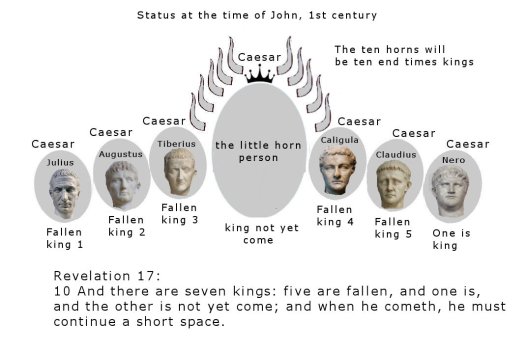
The seven heads represent a location where the woman sits (verse 9). And also seven kings (verse 10).

Revelation 17:
9 And here is the mind which hath wisdom. The seven heads are seven mountains, on which the woman sitteth.

10 And there are seven kings: five are fallen, and one is, and the other is not yet come; and when he cometh, he must continue a short space.

five fallen: Julius Caesar,, Augustus Caesar, Tiberius Caesar, Caligula Caesar, Claudius Caesar
one is: Nero Caesar
other not yet come: end times little horn person.


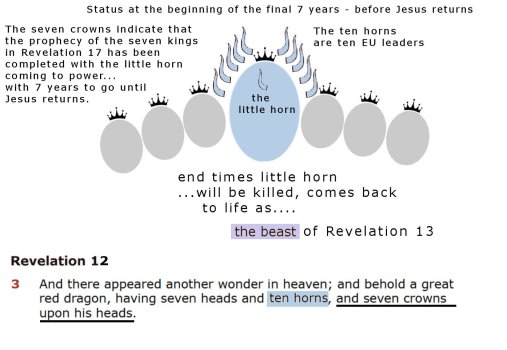
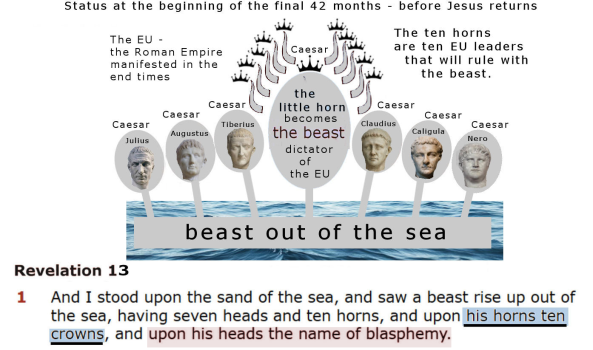
Three charts below.

1. Status at the time of John, 1st century, Revelation 17:10
2. Status at the beginning of the 7 years, end times, Revelation 12:3
3. Status 42 months before Jesus returns, Revelation 13:1


Caesars.jpg

Revelation 12  heads and   horns.jpg

1791690229948.png


I think the name of blasphemy could be "Caesar".
 
Last edited: