When did the 2nd temple literally initially cease being the holy place?

  • Welcome to Christian Forums, a Christian Forum that recognizes that all Christians are a work in progress.

    You will need to register to be able to join in fellowship with Christians all over the world.

    We hope to see you as a part of our community soon and God Bless!

David in NJ

Well-Known Member
Jul 20, 2021
16,393
8,952
113
50
Denville
Faith
Christian
Country
United States
Gender
Male
You have not listened very well. Do you understand what the number seven signifies in Revelation? Did God mention seven literal angels here, bringing messages to the seven literal churches? Read my post again.


Do you know who this Angel of the Lord is? The Hebrew word for "angel" is "Malak" which simply means a messenger. Someone who carries a message. Someone performs some other specific commission from God, such as a miracle, and reprsent more or less officially the one God sending him. So who is this angel of the Lord?

Judges 13:18-22
  • "And the angel of the LORD said unto him, Why askest thou thus after my name, seeing it is secret?
  • So Manoah took a kid with a meat offering, and offered it upon a rock unto the LORD: and the angel did wondrously; and Manoah and his wife looked on.
  • For it came to pass, when the flame went up toward heaven from off the altar, that the angel of the LORD ascended in the flame of the altar. And Manoah and his wife looked on it, and fell on their faces to the ground.
  • But the angel of the LORD did no more appear to Manoah and to his wife. Then Manoah knew that he was an angel of the LORD.
  • And Manoah said unto his wife, We shall surely die, because we have seen God."
Again, the word is messenger. The great "I AM" was the messenger of the Lord, because His name is a mystery / secret. Selah! So this is the same "I AM" who spoke with mistress in Genesis 16:9-11 for God Himself is a messenger, "Malak".

The problem is that many Christians normally think of when they hear the word "angel", they automatically think about supernatural being sent out by God from heaven. But that is only because of Christian tradition, theologian's eisegesis, and long-standing church customs. But NOT from anything actually spoken about in Scripture detailing the mythical angelic beings. Anyone who thinks that is not true, show me! As in the Children of Israel whom He brought out of the land of Egypt, and yet they rebelled. The result?

Psalms 78:49
  • "He cast upon them the fierceness of his anger, wrath, and indignation, and trouble, by sending evil [messengers] among them."
God sent no evil angels among them; he sent evil messengers, and they all died in the wilderness. Selah!
A human becomes a "supernatural being" in their spirit, when they are Born-Again by the SUPERnatural Spirit of God

God equates supernatural angels with people who have His Spirit = they are also called "elohim" making them "sons of God"
 

TribulationSigns

Well-Known Member
May 1, 2023
2,710
952
113
56
Somewhere west of Mississippi River
Faith
Christian
Country
United States
A human becomes a "supernatural being" in their spirit, when they are Born-Again by the SUPERnatural Spirit of God

God equates supernatural angels with people who have His Spirit = they are also called "elohim" making them "sons of God"

Time out. Geez...

Did you even read what I wrote carefully? The focus was clearly on the Angel of the Lord. Do you agree—or not—that the Angel of the Lord is God Himself, appearing as a messenger? In Genesis 16:9–11, it's unmistakably the Lord Himself speaking to Hagar. That’s the point.

But instead of addressing that you started, you suddenly veered off into a completely different topic—talking about humans becoming ‘supernatural beings’ or somehow being equated with angels through God's Spirit. What does that even have to do with the original point? Why are you dodging the real subject here? Let’s stay on topic: Who is the Angel of the Lord? That’s the discussion—don’t try to distract from it.
 

Zao is life

Well-Known Member
Oct 3, 2020
5,244
1,863
113
Africa
Faith
Christian
Country
South Africa
Gender
Male
Except no one that insists this is meaning the first century can tell us exactly what the AOD looked like that they saw, where it then caused them such alarm that they fled to the mountains, and didn't even bother to take any thing out of his house first, nor return back to take his clothes.

Yeah, you are so right! The words imply something that happens suddenly, as in the days of Lot - but that did not happen in A.D70:

In AD70 the Roman armies first besieged the city for a long time, until their battering rams managed to breach its walls. Then within the city they had to besiege the temple, and were not able to get into it until their battering rams breached the temple's walls, because the Jews who escaped when the armies had breached the city's walls, had locked themselves inside the temple.

But Jesus' words do imply something way more sudden, saying that the one who is on his housetop should not even go down to take any thing out of his house - and this tells us a LOT about these words:

1 Thessalonians 5
2 For yourselves know perfectly that the day of the Lord so cometh as a thief in the night.
3 For when they shall say, Peace and safety; then sudden destruction cometh upon them, as travail upon a woman with child; and they shall not escape.

I'm sure that the Jews were not saying "Peace and Safety" in A.D70.

1 Thessalonians 5
4 But ye, brethren, are not in darkness, that that day should overtake you as a thief.
5 Ye are all the children of light, and the children of the day: we are not of the night, nor of darkness.
6 Therefore let us not sleep, as do others; but let us watch and be sober.

Revelation 3
3 Remember therefore how thou hast received and heard, and hold fast, and repent. If therefore thou shalt not watch, I will come on thee as a thief, and thou shalt not know what hour I will come upon thee.

Revelation 16
15 Behold, I come as a thief. Blessed is he that watcheth, and keepeth his garments, lest he walk naked, and they see his shame.

Matthew connects our "watching" to seeing the abomination of desolation standing in the holy place.

Matthew 24
14 And this gospel of the kingdom shall be preached in all the world for a witness unto all nations; and then shall the end come.

9 Then shall they deliver you up to tribulation, and shall kill you: and ye shall be hated of all nations for my name’s sake.
10 And then shall many be offended, and shall betray one another, and shall hate one another.
11 And many false prophets shall rise, and shall deceive many.
12 And because iniquity shall abound, the love of many shall wax cold.
13 But he that shall endure unto the end, the same shall be saved.

15 When ye therefore shall see the abomination of desolation, spoken of by Daniel the prophet, stand in the holy place, (whoso readeth, let him understand:)
16 Then let them which be in Judaea flee into the mountains:
17 Let him which is on the housetop not come down to take any thing out of his house:
18 Neither let him which is in the field return back to take his clothes.

Luke 17
24 For as the lightning, that lighteneth out of the one part under heaven, shineth unto the other part under heaven; so shall also the Son of man be in his day.
25 But first must he suffer many things, and be rejected of this generation.
26 And as it was in the days of Noah, so shall it be also in the days of the Son of man.
27 They did eat, they drank, they married wives, they were given in marriage, until the day that Noah entered into the ark, and the flood came, and destroyed them all.
28 Likewise also as it was in the days of Lot; they did eat, they drank, they bought, they sold, they planted, they builded;
29 But the same day that Lot went out of Sodom it rained fire and brimstone from heaven, and destroyed them all.
30 Even thus shall it be in the day when the Son of man is revealed.
31 In that day, he which shall be upon the housetop, and his stuff in the house, let him not come down to take it away: and he that is in the field, let him likewise not return back.
32 Remember Lot’s wife.

There was nothing about the Roman siege of Jerusalem and destruction of the Temple that was nearly as sudden as what Jesus was talking about in the above verses, in the day He comes as a thief.

Your post was very insightful, IMO.
 
  • Like
Reactions: David in NJ

Spiritual Israelite

Well-Known Member
Apr 13, 2022
16,946
6,867
113
Midwest
Faith
Christian
Country
United States
Gender
Male
Yeah, you are so right! The words imply something that happens suddenly, as in the days of Lot - but that did not happen in A.D70:

In AD70 the Roman armies first besieged the city for a long time, until their battering rams managed to breach its walls. Then within the city they had to besiege the temple, and were not able to get into it until their battering rams breached the temple's walls, because the Jews who escaped when the armies had breached the city's walls, had locked themselves inside the temple.

But Jesus' words do imply something way more sudden, saying that the one who is on his housetop should not even go down to take any thing out of his house - and this tells us a LOT about these words:

1 Thessalonians 5
2 For yourselves know perfectly that the day of the Lord so cometh as a thief in the night.
3 For when they shall say, Peace and safety; then sudden destruction cometh upon them, as travail upon a woman with child; and they shall not escape.

I'm sure that the Jews were not saying "Peace and Safety" in A.D70.

1 Thessalonians 5
4 But ye, brethren, are not in darkness, that that day should overtake you as a thief.
5 Ye are all the children of light, and the children of the day: we are not of the night, nor of darkness.
6 Therefore let us not sleep, as do others; but let us watch and be sober.
The church will be caught up to meet the Lord in the air just before 1 Thesalonians 5:2-3 occurs, so there will be no believers left on the earth to flee to the mountains at that point. There is no relation between Matthew 24:15-21 and 1 Thessalonians 5:2-3.

Also, fleeing to the mountains was not something the Jews could do quickly, so they would need time to get to the mountains. They would not be fleeing to avoid sudden destruction. There would be no time for that. So, you are trying to conflate two unrelated passages.
 

Davidpt

Well-Known Member
Dec 6, 2023
2,512
798
113
68
East Texas
Faith
Christian
Country
United States
As to the Op of this thread. Something I need to point out yet again, is this.

Matthew 24:15 When ye therefore shall see the abomination of desolation, spoken of by Daniel the prophet, stand in the holy place, (whoso readeth, let him understand:)
16 Then let them which be in Judaea flee into the mountains:
17 Let him which is on the housetop not come down to take any thing out of his house:
18 Neither let him which is in the field return back to take his clothes.
19 And woe unto them that are with child, and to them that give suck in those days!
20 But pray ye that your flight be not in the winter, neither on the sabbath day

If taking these things to be meaning the first century leading up to 70 AD, this obviously means everything has to be taken in a literal sense in that case. The questions then needing to be asked, if taking these things to be meaning the first century leading up to 70 AD, does any of it defy logic if taken literal? Let's see.

Then let them which be in Judaea flee into the mountains. Does that defy logic if applying it in the literal sense pertaining to the first century leading up to 70 AD? I would say no.

What about this? Let him which is on the housetop not come down to take any thing out of his house:
Neither let him which is in the field return back to take his clothes

Does that defy logic if applying it in the literal sense pertaining to the first century leading up to 70 AD? It is clearly questionable if applying that literally since it has to be applied to this part first--- When ye therefore shall see the abomination of desolation, spoken of by Daniel the prophet, stand in the holy place

Which then raises the question, what if the housetop they are on at the time, nor the field they are in at the time, is somewhere the holy place is not even in their line of sight? How can they then see something they can't see from where they are at the time, then be so alarmed by seeing what they can't see from where they are, then fleeing to the mountains, no time to pack first? Get out now, at that very split second, as if a volcano nearby has just erupted and is sending flowing lava in their direction. No time to pack, have to get out before it is too late to get out and that the flowing lava consumes you.

What about this? And woe unto them that are with child, and to them that give suck in those days!

Does that defy logic if applying it in the literal sense pertaining to the first century leading up to 70 AD?
It is clearly questionable if applying that literally. Because it then begs the question, why only focus on nursing mothers? Why is there only woe on them? What about children and disabled ppl, for example? Why not woe on them as well?

What about this? But pray ye that your flight be not in the winter, neither on the sabbath day. Does that defy logic if applying it in the literal sense pertaining to the first century leading up to 70 AD? I would say no.

How should one proceed in this case. Only go by what is not questionable if applying in a literal sense, but ignore what is questionable if applying in a literal sense? This approach obviously makes no sense. What makes sense is this. If some of it is questionable if applying these things in a literal sense to the the first century leading up to 70 AD, then we have to conclude that it is not reasonable to apply these things in this manner if some of these things when being applied in this manner are questionable when being applied in this manner.

If zero is questionable when applying it in this manner, that's another story. In that case it could be perfectly reasonable to apply all of the above in verses 15-20 in this manner, a literal manner.
 

Spiritual Israelite

Well-Known Member
Apr 13, 2022
16,946
6,867
113
Midwest
Faith
Christian
Country
United States
Gender
Male
As to the Op of this thread. Something I need to point out yet again, is this.

Matthew 24:15 When ye therefore shall see the abomination of desolation, spoken of by Daniel the prophet, stand in the holy place, (whoso readeth, let him understand:)
16 Then let them which be in Judaea flee into the mountains:
17 Let him which is on the housetop not come down to take any thing out of his house:
18 Neither let him which is in the field return back to take his clothes.
19 And woe unto them that are with child, and to them that give suck in those days!
20 But pray ye that your flight be not in the winter, neither on the sabbath day

If taking these things to be meaning the first century leading up to 70 AD, this obviously means everything has to be taken in a literal sense in that case. The questions then needing to be asked, if taking these things to be meaning the first century leading up to 70 AD, does any of it defy logic if taken literal? Let's see.

Then let them which be in Judaea flee into the mountains. Does that defy logic if applying it in the literal sense pertaining to the first century leading up to 70 AD? I would say no.
But, you don't think that is supposed to be applied in a literal sense. Do you have any guesses as to what that would mean in a non-literal sense?

What about this? Let him which is on the housetop not come down to take any thing out of his house:
Neither let him which is in the field return back to take his clothes

Does that defy logic if applying it in the literal sense pertaining to the first century leading up to 70 AD? It is clearly questionable if applying that literally since it has to be applied to this part first--- When ye therefore shall see the abomination of desolation, spoken of by Daniel the prophet, stand in the holy place

Which then raises the question, what if the housetop they are on at the time, nor the field they are in at the time, is somewhere the holy place is not even in their line of sight? How can they then see something they can't see from where they are at the time, then be so alarmed by seeing what they can't see from where they are, then fleeing to the mountains, no time to pack first? Get out now, at that very split second, as if a volcano nearby has just erupted and is sending flowing lava in their direction. No time to pack, have to get out before it is too late to get out and that the flowing lava consumes you.
There is no requirement that it would be something that everyone could see first before anyone started fleeing to the mountains. Once some saw it happening then word spread about it in the rest of Judea and that's when people knew they need to flee. Also, as we can see in Luke 21:20-24, people would have understood that Jerusalem being surrounded by armies would indicate that they needed to flee to the mountains at that point, also.

What about this? And woe unto them that are with child, and to them that give suck in those days!

Does that defy logic if applying it in the literal sense pertaining to the first century leading up to 70 AD?
It is clearly questionable if applying that literally. Because it then begs the question, why only focus on nursing mothers? Why is there only woe on them? What about children and disabled ppl, for example? Why not woe on them as well?
It says nursing mothers and pregnant women. Then that are with child are pregnant women, which is why other translations refer to "pregnant women" instead of "them that are with child" which is not clear. You obviously think "them that are with child" are the same as "them that give suck", but that is not the case. Anyway, it should be obvious why having to flee would be a problem for pregnant women and nursing mothers. What do you expect, that Jesus should have listed every single type of person that would have trouble fleeing at that time? That's ridiculous. It doesn't mean He was saying other types of people would have no trouble fleeing. He just gave a couple examples of types of people who would have trouble fleeing, showing that it would be a particularly difficult time for some people.

What about this? But pray ye that your flight be not in the winter, neither on the sabbath day. Does that defy logic if applying it in the literal sense pertaining to the first century leading up to 70 AD? I would say no.
Yet, you don't apply that in a literal sense. Any guesses as to how that can be applied in a non-literal sense?

How should one proceed in this case. Only go by what is not questionable if applying in a literal sense, but ignore what is questionable if applying in a literal sense?
What you think is questionable is not questionable to others. Yet, you assume that anything that's questionable to you also has to be questionable to everyone.

This approach obviously makes no sense.
Maybe not for you since you find some of it to be questionable as to whether it can be applied literally or not. I have no such questions personally, so my approach to interpreting the passage does not have the problems that yours does.

What makes sense is this. If some of it is questionable if applying these things in a literal sense to the the first century leading up to 70 AD, then we have to conclude that it is not reasonable to apply these things in this manner if some of these things when being applied in this manner are questionable when being applied in this manner.
Why are you acting as if the word "questionable" means unlikely? The word questionable just means it's not certain one way or another.

If zero is questionable when applying it in this manner, that's another story. In that case it could be perfectly reasonable to apply all of the above in verses 15-20 in this manner, a literal manner.
It is perfectly reasonable to apply all of Matthew 24:15-21 in a literal manner. Your argument that it should not be applied literally would be much more convincing if you actually could at least offer a guess as to what it could mean in a non-literal way. But, you've never even done that as far as I can recall.
 
  • Like
Reactions: covenantee

Timtofly

Well-Known Member
Apr 9, 2020
9,705
630
113
Mount Morris
Faith
Christian
Country
United States
Gender
Male
You misunderstand everything you read. I didn't say that no one fled until 70 AD. Jesus said to flee when they saw Jerusalem surrounded by armies. I didn't say that didn't happen until 70 AD. They didn't actually destroy Jerusalem until 70 AD. The Christians who heeded Jesus's warning had fled the area before that happened.


I agree. They fled before that. I didn't say otherwise. You just misread what I said because that's what you do.
You are the one misunderstanding. "Not fleeing until 70AD", was not my point.


"When ye therefore shall see the abomination of desolation, spoken of by Daniel the prophet, stand in the holy place, (whoso readeth, let him understand: ) Then let them which be in Judaea flee into the mountains:
Let him which is on the housetop not come down to take any thing out of his house:"

Matthew 24 is not the same event as Luke 21. Not even the same century.

You are the one claiming both times of fleeing is the same event, ie 70AD. The Roman armies will not be the abomination that they need to flee from after the Second Coming.
 

Timtofly

Well-Known Member
Apr 9, 2020
9,705
630
113
Mount Morris
Faith
Christian
Country
United States
Gender
Male
Is it possible that the word 'generation' in this context could be referring to 'tares' vs. 'wheat'? In other words, can the term be pointing to all of those who are not saved, who could be living at any point in time? Could a 'generation of vipers' mean the same thing? It is just another way of saying tares?

They will not 'pass away' could mean they will not be thrown into the lake of fire until everything is fulfilled.
People being thrown into the Lake of Fire can only happen after the Second Coming has happened.

The abomination of desolation only happens after the Second Coming. You still only have that one last generation that does not completely end until that point in time.

If we have a person today who is 114 to 120 years old, their generation has literally passed away, except for them, or a few others the same age.

Why would you need to call them "tares", just because they outlived all others in their generation? For all intent and purpose, their generation has passed away. In fact, other generations have come and gone in 100 years. Then people argue over how long is a generation.

On average there is a new generation every 20 years. That generation lives on average, 70 years. It is a Biblical principle, that God waits to do stuff, until after a generation passes away. I am not sure what the point is to spiritualize that phrase to mean anything else, than just naturally dying.

God waited to free Israel from Egypt until all had forgotten the generation of Joseph.
 

Davidpt

Well-Known Member
Dec 6, 2023
2,512
798
113
68
East Texas
Faith
Christian
Country
United States
Didn't see a need for starting a new thread since the folowing is on topic per this thread I had already started.

My attempt(or at least one attempt thus far) at trying to combine some of Matthew 24 and Luke 21.

Matthew 24:4 And Jesus answered and said unto them, Take heed that no man deceive you.
Matthew 24:5 For many shall come in my name, saying, I am Christ; and shall deceive many.
Matthew 24:6 And ye shall hear of wars and rumours of wars: see that ye be not troubled: for all these things must come to pass, but the end is not yet.
Matthew 24:7 For nation shall rise against nation, and kingdom against kingdom: and there shall be famines, and pestilences, and earthquakes, in divers places.
Luke 21:11 And great earthquakes shall be in divers places, and famines, and pestilences; and fearful sights and great signs shall there be from heaven.
Matthew 24:8 All these are the beginning of sorrows.
----------------------------------------
Luke 21:12 But before all these, they shall lay their hands on you, and persecute you, delivering you up to the synagogues, and into prisons, being brought before kings and rulers for my name's sake.
Luke 21:13 And it shall turn to you for a testimony.
Luke 21:14 Settle it therefore in your hearts, not to meditate before what ye shall answer:
Luke 21:15 For I will give you a mouth and wisdom, which all your adversaries shall not be able to gainsay nor resist.
Luke 21:16 And ye shall be betrayed both by parents, and brethren, and kinsfolks, and friends; and some of you shall they cause to be put to death.
Luke 21:17 And ye shall be hated of all men for my name's sake.
Luke 21:18 But there shall not an hair of your head perish.
Luke 21:19 In your patience possess ye your souls.
Luke 21:20 And when ye shall see Jerusalem compassed with armies, then know that the desolation thereof is nigh.
Luke 21:21 Then let them which are in Judaea flee to the mountains; and let them which are in the midst of it depart out; and let not them that are in the countries enter thereinto.
Luke 21:22 For these be the days of vengeance, that all things which are written may be fulfilled.
Luke 21:23 But woe unto them that are with child, and to them that give suck, in those days! for there shall be great distress in the land, and wrath upon this people.
Luke 21:24 And they shall fall by the edge of the sword, and shall be led away captive into all nations: and Jerusalem shall be trodden down of the Gentiles, until the times of the Gentiles be fulfilled.
------------------------------------
(My commentary concerning Luke 21:12-24. At this point these things are only affecting things regionally. But once Jeusalem falls in 70 AD, which then led to verse 24---shall be led away captive into all nations--from that point on things switched gears and started affecting things globally eventually, thus the verses in Matthew 24 that follow. And why not? Is one going to argue, that prior to 70 AD these events were already meaning globally rather than only regionally still? Is one going to argue that once all Christians fled out of the region that it didn't eventually affect things globally? After all, unless Christians fled out of that region, how was the gospel supposed to spread throughout all nations eventually?

Look at verse 9 below. Look what it says---and ye shall be hated of all nations. How can that possibly be true unless the gospel has spread globally? How can all nations hate someone before 70 AD for His name's sake, when His name hasn't even spread to all nations as of yet? I can't believe I never thought of this before? This explains how Jesus can say some of the same things in Luke 21:20-23 and Matthew 24:16-20 without it involving the same era of time, the same events. Luke 21:20-23 is involving regional, the literal. Matthew 24:15-21 is involving global, the spiritual.)
-------------------------------------------
Matthew 24:9 Then shall they deliver you up to be afflicted, and shall kill you: and ye shall be hated of all nations for my name's sake.
Matthew 24:10 And then shall many be offended, and shall betray one another, and shall hate one another.
Matthew 24:11 And many false prophets shall rise, and shall deceive many.
Matthew 24:12 And because iniquity shall abound, the love of many shall wax cold.
Matthew 24:13 But he that shall endure unto the end, the same shall be saved.
Matthew 24:14 And this gospel of the kingdom shall be preached in all the world for a witness unto all nations; and then shall the end come.
Matthew 24:15 When ye therefore shall see the abomination of desolation, spoken of by Daniel the prophet, stand in the holy place, (whoso readeth, let him understand:)
Matthew 24:16 Then let them which be in Judaea flee into the mountains:
Matthew 24:17 Let him which is on the housetop not come down to take any thing out of his house:
Matthew 24:18 Neither let him which is in the field return back to take his clothes.
Matthew 24:19 And woe unto them that are with child, and to them that give suck in those days!
Matthew 24:20 But pray ye that your flight be not in the winter, neither on the sabbath day:
Matthew 24:21 For then shall be great tribulation, such as was not since the beginning of the world to this time, no, nor ever shall be.
Matthew 24:22 And except those days should be shortened, there should no flesh be saved: but for the elect's sake those days shall be shortened.
Matthew 24:23 Then if any man shall say unto you, Lo, here is Christ, or there; believe it not.
Matthew 24:24 For there shall arise false Christs, and false prophets, and shall shew great signs and wonders; insomuch that, if it were possible, they shall deceive the very elect.
Matthew 24:25 Behold, I have told you before.
Matthew 24:26 Wherefore if they shall say unto you, Behold, he is in the desert; go not forth: behold, he is in the secret chambers; believe it not.
Matthew 24:27 For as the lightning cometh out of the east, and shineth even unto the west; so shall also the coming of the Son of man be.
Matthew 24:28 For wheresoever the carcase is, there will the eagles be gathered together.
Matthew 24:29 Immediately after the tribulation of those days shall the sun be darkened, and the moon shall not give her light, and the stars shall fall from heaven, and the powers of the heavens shall be shaken:
Matthew 24:30 And then shall appear the sign of the Son of man in heaven: and then shall all the tribes of the earth mourn, and they shall see the Son of man coming in the clouds of heaven with power and great glory.
Matthew 24:31 And he shall send his angels with a great sound of a trumpet, and they shall gather together his elect from the four winds, from one end of heaven to the other.
 

Spiritual Israelite

Well-Known Member
Apr 13, 2022
16,946
6,867
113
Midwest
Faith
Christian
Country
United States
Gender
Male
Didn't see a need for starting a new thread since the folowing is on topic per this thread I had already started.

My attempt(or at least one attempt thus far) at trying to combine some of Matthew 24 and Luke 21.

Matthew 24:4 And Jesus answered and said unto them, Take heed that no man deceive you.
Matthew 24:5 For many shall come in my name, saying, I am Christ; and shall deceive many.
Matthew 24:6 And ye shall hear of wars and rumours of wars: see that ye be not troubled: for all these things must come to pass, but the end is not yet.
Matthew 24:7 For nation shall rise against nation, and kingdom against kingdom: and there shall be famines, and pestilences, and earthquakes, in divers places.
Luke 21:11 And great earthquakes shall be in divers places, and famines, and pestilences; and fearful sights and great signs shall there be from heaven.
Matthew 24:8 All these are the beginning of sorrows.
----------------------------------------
Luke 21:12 But before all these, they shall lay their hands on you, and persecute you, delivering you up to the synagogues, and into prisons, being brought before kings and rulers for my name's sake.
Luke 21:13 And it shall turn to you for a testimony.
Luke 21:14 Settle it therefore in your hearts, not to meditate before what ye shall answer:
Luke 21:15 For I will give you a mouth and wisdom, which all your adversaries shall not be able to gainsay nor resist.
Luke 21:16 And ye shall be betrayed both by parents, and brethren, and kinsfolks, and friends; and some of you shall they cause to be put to death.
Luke 21:17 And ye shall be hated of all men for my name's sake.
Luke 21:18 But there shall not an hair of your head perish.
Luke 21:19 In your patience possess ye your souls.
Luke 21:20 And when ye shall see Jerusalem compassed with armies, then know that the desolation thereof is nigh.
Luke 21:21 Then let them which are in Judaea flee to the mountains; and let them which are in the midst of it depart out; and let not them that are in the countries enter thereinto.
Luke 21:22 For these be the days of vengeance, that all things which are written may be fulfilled.
Luke 21:23 But woe unto them that are with child, and to them that give suck, in those days! for there shall be great distress in the land, and wrath upon this people.
Luke 21:24 And they shall fall by the edge of the sword, and shall be led away captive into all nations: and Jerusalem shall be trodden down of the Gentiles, until the times of the Gentiles be fulfilled.
------------------------------------
(My commentary concerning Luke 21:12-24. At this point these things are only affecting things regionally. But once Jeusalem falls in 70 AD, which then led to verse 24---shall be led away captive into all nations--from that point on things switched gears and started affecting things globally eventually, thus the verses in Matthew 24 that follow. And why not? Is one going to argue, that prior to 70 AD these events were already meaning globally rather than only regionally still? Is one going to argue that once all Christians fled out of the region that it didn't eventually affect things globally? After all, unless Christians fled out of that region, how was the gospel supposed to spread throughout all nations eventually?

Look at verse 9 below. Look what it says---and ye shall be hated of all nations. How can that possibly be true unless the gospel has spread globally? How can all nations hate someone before 70 AD for His name's sake, when His name hasn't even spread to all nations as of yet? I can't believe I never thought of this before? This explains how Jesus can say some of the same things in Luke 21:20-23 and Matthew 24:16-20 without it involving the same era of time, the same events.
Why would you not think that Matthew 24:9 is parallel to Luke 21:17?

Luke 21:17 And ye shall be hated of all men for my name's sake.

Matthew 24:9 Then shall they deliver you up to be afflicted, and shall kill you: and ye shall be hated of all nations for my name's sake.

These are clearly parallel verses, yet you have the timing of Luke 21:17 in the past before 70 AD and you have the timing of Matthew 24:9 in the future or, at least, long after the fulfillment of Luke 21:17. Explain that.

It should be clear that Luke 21:8-19 is parallel to Matthew 24:4-14. I thought you said before that you believed that to be the case and believe He then answered the first question the disciples asked only in Luke 21:20-24. Did you change your view since then because I pointed out how hypocritical it was to criticize me for having Him go back and forth in time in Matthew 24 when you were doing the same thing with how you interpreted Luke 21?

Luke 21:20-23 is involving regional, the literal. Matthew 24:15-21 is involving global, the spiritual.)
-------------------------------------------
Matthew 24:9 Then shall they deliver you up to be afflicted, and shall kill you: and ye shall be hated of all nations for my name's sake.
Matthew 24:10 And then shall many be offended, and shall betray one another, and shall hate one another.
Matthew 24:11 And many false prophets shall rise, and shall deceive many.
Matthew 24:12 And because iniquity shall abound, the love of many shall wax cold.
Matthew 24:13 But he that shall endure unto the end, the same shall be saved.
Matthew 24:14 And this gospel of the kingdom shall be preached in all the world for a witness unto all nations; and then shall the end come.
Matthew 24:15 When ye therefore shall see the abomination of desolation, spoken of by Daniel the prophet, stand in the holy place, (whoso readeth, let him understand:)
Matthew 24:16 Then let them which be in Judaea flee into the mountains:
Matthew 24:17 Let him which is on the housetop not come down to take any thing out of his house:
Matthew 24:18 Neither let him which is in the field return back to take his clothes.
Matthew 24:19 And woe unto them that are with child, and to them that give suck in those days!
Matthew 24:20 But pray ye that your flight be not in the winter, neither on the sabbath day:
Matthew 24:21 For then shall be great tribulation, such as was not since the beginning of the world to this time, no, nor ever shall be.
Matthew 24:22 And except those days should be shortened, there should no flesh be saved: but for the elect's sake those days shall be shortened.
I have asked you to do this many times (combine Matthew 24 and Luke 21 together so I can see what order you think Jesus said what He did in the Olivet Discourse) and you never did. But, now you decide to do it? Better late than never, I guess.

Anyway, what this shows is that you think Jesus said what is recorded in Matthew 24:15-22 very shortly after saying what is recorded in Luke 21:20-24. So, very shortly after saying "when ye shall see Jerusalem compassed with armies, then know that the desolation thereof is nigh. Then let them which are in Judaea flee to the mountains... But woe unto them that are with child, and to them that give suck, in those days! for there shall be great distress in the land, and wrath upon this people" you have Him saying something very similar: "When ye therefore shall see the abomination of desolation, spoken of by Daniel the prophet, stand in the holy place, (whoso readeth, let him understand) Then let them which be in Judaea flee into the mountains:.... And woe unto them that are with child, and to them that give suck in those days!...For then shall be great tribulation, such as was not since the beginning of the world to this time, no, nor ever shall be.".

Nowhere does Jesus clarify that He was talking about the need for those in Judea to flee to the mountains literally the first time He said it but spiritually the second time. Same thing when it comes to Him saying that no one should leave the area or come into the area at that point when they see something that would cause desolation in Jerusalem. No indication at all that He would have been speaking literally in one passage and spiritually in the other.

Imagine how confused the disciples would have been with Him saying what is written in Matthew 24:15-22 a few seconds after finishing what is written in Luke 21:20-24 and how confused they would have been. Surely, Him again saying "when you see..." something related to desolation in Jerusalem then let those in Judea flee to the mountains after having just said that a few seconds before would have left the disciples scratching their heads. And then saying something again related to no one coming in or going out at that point and then saying again "And woe unto them that are with child, and to them that give suck in those days!"? followed by saying there would be great distress/tribulation at that time? You think they wouldn't have asked Him "Didn't you just say these things already a few second ago"? I can't take the idea seriously that Luke 21:20-24a and Matthew 24:15-22 are not parallel passages. You expect me to believe that Jesus repeated several of the same things He had just said a few second prior, but was talking about different events. No way.
 

Davidpt

Well-Known Member
Dec 6, 2023
2,512
798
113
68
East Texas
Faith
Christian
Country
United States
The following is my view in a nutshell except I used ChatGPT to better express my view. That does not equal I get my theology from ChatGPT, lol. That equals that I'm using ChatGPT as a tool to better express my view. Huge difference. IOW, this post reflects my own theological position. I did, however, use ChatGPT to help organize and format my thoughts into a more readable structure. The theological content, interpretive framework, and conclusions are my own ---not generated or suggested by ChatGPT. I’m simply using the tool to assist with clarity, flow, and presentation, not for doctrinal input.


------------------------------
Two Temples, Two Realms: Rethinking the Timing and Scope of Matthew 24 and Luke 21

Introduction

Many interpretations of the Olivet Discourse assume that Luke 21:20–24 and Matthew 24:15–21 refer to the exact same event. This assumption is often based on the shared language — “flee to the mountains,” “woe to them that are with child,” and warnings of desolation. But this overlooks a vital structural and contextual difference in what Jesus is addressing.

This article argues that:

  • Luke 21:20–24 refers to the literal, regional fall of Jerusalem in 70 AD, dealing with the physical temple.
  • Matthew 24:15–21 refers to the global, spiritual conflict, the fate of the spiritual temple (cf. 2 Thessalonians 2:4).

The result is a progressive and layered view of prophecy, not a flat one-dimensional timeline.

---

1. Shared Language, Different Scope

Luke 21:20–24 – Literal and Regional
Luke 21:20 – “When ye shall see Jerusalem compassed with armies…”
Luke 21:21 – “Then let them which are in Judaea flee to the mountains…”
Luke 21:23 – “Wrath upon this people…”

Jesus gives local, geographic instructions. This is about the siege of Jerusalem and the destruction of the Herodian temple in 70 AD. These instructions are literal and regionally specific.

Matthew 24:15–21 – Spiritual and Global
Matthew 24:15 – “When ye therefore shall see the abomination of desolation… stand in the holy place…”
Matthew 24:16 – “Then let them which be in Judaea flee…”
Matthew 24:21 – “For then shall be great tribulation…”

While the wording overlaps, the scope does not. The broader context of Matthew 24 (vv. 9–14) refers to a global hatred, deception, apostasy, and a worldwide gospel mission — things that were not yet true before 70 AD.

---

2. Commentary on Luke 21:12–24

At this point in Luke’s Gospel, the events are still affecting things regionally. But once Jerusalem falls (Luke 21:24 — “shall be led away captive into all nations”), a new phase begins — one that gradually unfolds globally.

Commentary:
Unless Christians fled from that region after 70 AD, how was the gospel supposed to spread throughout all nations eventually? The persecution drives the expansion. Look at Matthew 24:9 — “Ye shall be hated of all nations.” That can’t be fulfilled before the gospel reaches all nations. Therefore, Matthew 24:9–14 fits logically after the regional events of Luke 21.

---

3. The Turning Point: 70 AD

Luke 21:24 is the shift from local to global:

“Jerusalem shall be trodden down of the Gentiles, until the times of the Gentiles be fulfilled.”

This verse marks the transition. After Jerusalem falls, the Church spreads. This sets the stage for the rest of Matthew 24, including:

Matthew 24:9 – “Ye shall be hated of all nations…”
Matthew 24:14 – “This gospel of the kingdom shall be preached in all the world…”
Matthew 24:15 – “When ye therefore shall see the abomination of desolation…”

This is not the same time frame or event as Luke 21:20–24. It follows it.

---

4. Two Types of Fleeing

The command to flee is used in both passages, but the meaning is not the same:

  • Luke 21: Fleeing is literal and geographical. Christians literally fled to Pella before 70 AD.
  • Matthew 24: Fleeing is spiritual — fleeing apostasy, deception, and false teaching.

This fits with Paul’s warning in:

2 Thessalonians 2:4 – “He as God sitteth in the temple of God, shewing himself that he is God.”

This is not about the Herodian temple. It’s a desecration of the spiritual temple — the people of God (cf. 1 Corinthians 3:16-17).

---

5. Clarifying Matthew 24’s Progression

Matthew 24:8 calls the early signs “the beginning of sorrows.”
Luke 21:12 says, “But before all these…” — again indicating these are two different phases.

Matthew 24:9–14 occurs after the regional judgment and includes:
  • Persecution from all nations
  • Apostasy and betrayal
  • False prophets
  • Global gospel proclamation

Only after this global phase does the “abomination of desolation” in verse 15 appear, followed by a spiritual call to flee.

---

6. The Holy Place: Literal or Spiritual?

Some insist Matthew 24:15's “holy place” must refer to the physical temple. But Scripture defines the people of God as the temple:

1 Corinthians 3:16 – “Ye are the temple of God…”
1 Corinthians 3:17 – “If any man defile the temple of God, him shall God destroy…”
2 Thessalonians 2:4 – “He as God sitteth in the temple of God…”

The “abomination” may therefore be spiritual — a corruption or usurpation within the Church itself.

---

Conclusion: Two Temples, Two Fulfillments

Rather than collapsing all of Luke 21 and Matthew 24 into a single narrative, Jesus presents a staged progression:

  • Luke 21:20–24 = Regional judgment on Jerusalem and the physical temple
  • Matthew 24:9–31 = Global expansion, persecution, spiritual defilement, and eventual gathering

Both chapters use similar language, but describe different events in different realms]. The commands to flee, the distress, the tribulation — all must be interpreted within their proper context.

A balanced view doesn’t force either a purely literal or purely spiritual reading across the board. Instead, we recognize:
  • Luke 21 involves a literal fall.
  • Matthew 24 expands into a spiritual and global framework.

In short: There are two temples, two realms, and one unfolding plan.
 
Last edited:

Exegesis

Member
Jun 22, 2025
417
92
28
62
Salt Lake
Faith
Christian
Country
United States
Gender
Male
The abomination of desolation only happens after the Second Coming.

Thanks @Timtofly . I used to believe that because I never bothered to double check everything.

Once I did a thorough check, I concluded that the Abomination of Desolation was the Crucifixion.
 
  • Like
Reactions: CTK

Spiritual Israelite

Well-Known Member
Apr 13, 2022
16,946
6,867
113
Midwest
Faith
Christian
Country
United States
Gender
Male
The following is my view in a nutshell except I used ChatGPT to better express my view. That does not equal I get my theology from ChatGPT, lol. That equals that I'm using ChatGPT as a tool to better express my view. Huge difference. IOW, this post reflects my own theological position. I did, however, use ChatGPT to help organize and format my thoughts into a more readable structure. The theological content, interpretive framework, and conclusions are my own ---not generated or suggested by ChatGPT. I’m simply using the tool to assist with clarity, flow, and presentation, not for doctrinal input.


------------------------------
Two Temples, Two Realms: Rethinking the Timing and Scope of Matthew 24 and Luke 21

Introduction

Many interpretations of the Olivet Discourse assume that Luke 21:20–24 and Matthew 24:15–21 refer to the exact same event. This assumption is often based on the shared language — “flee to the mountains,” “woe to them that are with child,” and warnings of desolation. But this overlooks a vital structural and contextual difference in what Jesus is addressing.

This article argues that:

  • Luke 21:20–24 refers to the literal, regional fall of Jerusalem in 70 AD, dealing with the physical temple.
  • Matthew 24:15–21 refers to the global, spiritual conflict, the fate of the spiritual temple (cf. 2 Thessalonians 2:4).

The result is a progressive and layered view of prophecy, not a flat one-dimensional timeline.

---

1. Shared Language, Different Scope

Luke 21:20–24 – Literal and Regional


Jesus gives local, geographic instructions. This is about the siege of Jerusalem and the destruction of the Herodian temple in 70 AD. These instructions are literal and regionally specific.

Matthew 24:15–21 – Spiritual and Global


While the wording overlaps, the scope does not. The broader context of Matthew 24 (vv. 9–14) refers to a global hatred, deception, apostasy, and a worldwide gospel mission — things that were not yet true before 70 AD.

---

2. Commentary on Luke 21:12–24

At this point in Luke’s Gospel, the events are still affecting things regionally. But once Jerusalem falls (Luke 21:24 — “shall be led away captive into all nations”), a new phase begins — one that gradually unfolds globally.

Commentary:


---

3. The Turning Point: 70 AD

Luke 21:24
is the shift from local to global:


This verse marks the transition. After Jerusalem falls, the Church spreads. This sets the stage for the rest of Matthew 24, including:


This is not the same time frame or event as Luke 21:20–24. It follows it.

---

4. Two Types of Fleeing

The command to flee is used in both passages, but the meaning is not the same:

  • Luke 21: Fleeing is literal and geographical. Christians literally fled to Pella before 70 AD.
  • Matthew 24: Fleeing is spiritual — fleeing apostasy, deception, and false teaching.

This fits with Paul’s warning in:


This is not about the Herodian temple. It’s a desecration of the spiritual temple — the people of God (cf. 1 Corinthians 3:16-17).

---

5. Clarifying Matthew 24’s Progression

Matthew 24:8
calls the early signs “the beginning of sorrows.”
Luke 21:12 says, “But before all these…” — again indicating these are two different phases.

Matthew 24:9–14 occurs after the regional judgment and includes:
  • Persecution from all nations
  • Apostasy and betrayal
  • False prophets
  • Global gospel proclamation

Only after this global phase does the “abomination of desolation” in verse 15 appear, followed by a spiritual call to flee.

---

6. The Holy Place: Literal or Spiritual?

Some insist Matthew 24:15's “holy place” must refer to the physical temple. But Scripture defines the people of God as the temple:


The “abomination” may therefore be spiritual — a corruption or usurpation within the Church itself.

---

Conclusion: Two Temples, Two Fulfillments

Rather than collapsing all of Luke 21 and Matthew 24 into a single narrative, Jesus presents a staged progression:

  • Luke 21:20–24 = Regional judgment on Jerusalem and the physical temple
  • Matthew 24:9–31 = Global expansion, persecution, spiritual defilement, and eventual gathering

Both chapters use similar language, but describe different events in different realms]. The commands to flee, the distress, the tribulation — all must be interpreted within their proper context.

A balanced view doesn’t force either a purely literal or purely spiritual reading across the board. Instead, we recognize:

  • Luke 21 involves a literal fall.
  • Matthew 24 expands into a spiritual and global framework.

In short: There are two temples, two realms, and one unfolding plan.
Can you please address what I said in post #1170? This post does not address the questions I asked in that post.

Also, why do you think that Luke's account of the Olivet Discourse would be so different than Matthew and Mark's accounts? You seem to have it as being very different even though, despite your use of chatGPT to help you, it's still not easy to follow how exactly you are interpreting Matthew 24 compared to Luke 21.

Do you see Luke 21:8-19 as being parallel to Matthew 24:4-14? It seems like, based on what you're saying, that you have all of Luke 21:8-19 occurring before 70 AD and maybe Matthew 24:4-8 occurring before 70 AD and then Matthew 24:9-14 after that?

Do you see verses like the following as being parallel? They have very obvious similarities.

Luke 21:16 And ye shall be betrayed both by parents, and brethren, and kinsfolks, and friends; and some of you shall they cause to be put to death. 17 And ye shall be hated of all men for my name's sake. 18 But there shall not an hair of your head perish. 19 In your patience possess ye your souls.

Matthew 24:9 Then shall they deliver you up to be afflicted, and shall kill you: and ye shall be hated of all nations for my name's sake. 10 And then shall many be offended, and shall betray one another, and shall hate one another. 11 And many false prophets shall rise, and shall deceive many. 12 And because iniquity shall abound, the love of many shall wax cold. 13 But he that shall endure unto the end, the same shall be saved. 14 And this gospel of the kingdom shall be preached in all the world for a witness unto all nations; and then shall the end come.

It seems that you have the Luke 21 passage as occurring before 70 AD and the Matthew 24 passage after 70 AD. If so, why is that? Why would you have Luke basically recording entirely different things that Jesus said in the Olivet Discourse than what Matthew and Mark recorded? You make it as if Luke 21 is an entirely different discourse than Matthew 24 and Mark 13. What do you see as being parallel between Matthew 24 and Luke 21? It seems like you have them being parallel in maybe only a few verses? Is that accurate? If so, why would that be the case?
 

ewq1938

Mod
Staff member
Jul 11, 2015
8,499
1,698
113
Faith
Christian
Country
United States
Gender
Male
Thanks @Timtofly . I used to believe that because I never bothered to double check everything.

Once I did a thorough check, I concluded that the Abomination of Desolation was the Crucifixion.


Mat 24:15 When ye therefore shall see the abomination of desolation, spoken of by Daniel the prophet, stand in the holy place, (whoso readeth, let him understand:)

The crucifixion was not in the holy place so that interpretation is wrong.
 

CTK

Well-Known Member
Aug 13, 2024
1,518
316
83
72
Albuquerque
Faith
Christian
Country
United States
Mat 24:15 When ye therefore shall see the abomination of desolation, spoken of by Daniel the prophet, stand in the holy place, (whoso readeth, let him understand:)

The crucifixion was not in the holy place so that interpretation is wrong.
No, Jesus was STANDING…
 
  • Like
Reactions: Exegesis

Exegesis

Member
Jun 22, 2025
417
92
28
62
Salt Lake
Faith
Christian
Country
United States
Gender
Male
Mat 24:15 When ye therefore shall see the abomination of desolation, spoken of by Daniel the prophet, stand in the holy place, (whoso readeth, let him understand:)

The crucifixion was not in the holy place so that interpretation is wrong.

Hi @ewq1938 .

I went over that and other verses here...


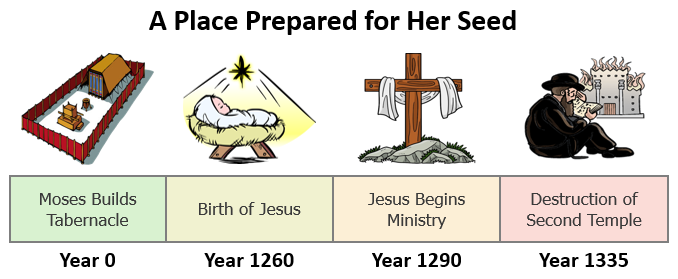
The bottom line is that the 'abomination that maketh desolate' happened at 1290 in the timeline...

Daniel 12:11 "And from the time that the daily sacrifice shall be taken away, and the abomination that maketh desolate set up, there shall be a thousand two hundred and ninety days."

That is the time when Jesus began his ministry, i.e., thirty years after he was born at 1260 in the timeline.

The desolation occurred roughly forty-five years later, at 1335 in the timeline. The dates are very clear and specific. There is no getting around them. Also, since the daily sacrifice became obsolete when Jesus finished his work on the cross, it further proves that 1290 is the correct date for the setting up, not 1335.

Do you even have the 1335 figured out? How do you interpret it? Are you able to do it without endless mental gymnastics and flip-flopping from day=year to day=day?

I use the entire Bible to interpret Daniel, not just a single verse. This means that verses in Revelation about the woman 'nourished for 1260 days' as well as the Two Witnesses are included. They all need to precisely match up in an easy to understand manner for me to come to a conclusion.

1752061460665.png
 

Davidpt

Well-Known Member
Dec 6, 2023
2,512
798
113
68
East Texas
Faith
Christian
Country
United States
Hi @ewq1938 .

I went over that and other verses here...


The bottom line is that the 'abomination that maketh desolate' happened at 1290 in the timeline...


That is the time when Jesus began his ministry, i.e., thirty years after he was born at 1260 in the timeline.

The desolation occurred roughly forty-five years later, at 1335 in the timeline. The dates are very clear and specific. There is no getting around them. Also, since the daily sacrifice became obsolete when Jesus finished his work on the cross, it further proves that 1290 is the correct date for the setting up, not 1335.

Do you even have the 1335 figured out? How do you interpret it? Are you able to do it without endless mental gymnastics and flip-flopping from day=year to day=day?

I use the entire Bible to interpret Daniel, not just a single verse. This means that verses in Revelation about the woman 'nourished for 1260 days' as well as the Two Witnesses are included. They all need to precisely match up in an easy to understand manner for me to come to a conclusion.


Per this interpretation you have one being blessed if they make it to 70 AD, as if there was anything blessed about 70 AD. Especially if one was an unbelieving Jew at the time still living in that region.

Daniel 12:12 Blessed is he that waiteth, and cometh to the thousand three hundred and five and thirty days.


You can not ignore this---Blessed is he that waiteth. So who is that your interpretation has waiting until 70 AD in order to be blessed with being slaughtered by the Romans at the time? This alone shows how absurd your timeline is pertaining to these 1335 days. Your interpretation has one looking forward to 70 AD occurring so that they can blessed with death, I guess.

Your timeline shows that verse 12 is meaning this---Blessed is he that waiteth, and cometh to 70 AD. Cometh to 70 AD to then do what? Be slaughtered by the Romans? And that equals being blessed exactly how????

Can 1335 days be meaning 1335 years? Maybe. But even so, it makes no sense to have the 1335th year ending with 70 AD, assuming days can mean years here, when there was nothing blessed about 70 AD. Plus I still can't figure out who your timeline has waiting until 70 AD so that they can be blessed for having come to 70 AD? Not to mention, what did it look like at the time to be blessed for having come to 70 AD? Describe that in detail if you could, what it looked like to be blessed for having come to 70 AD.
 
Last edited:

grafted branch

Well-Known Member
Dec 11, 2023
1,978
334
83
49
Washington
Faith
Christian
Country
United States
Also, since the daily sacrifice became obsolete when Jesus finished his work on the cross, it further proves that 1290 is the correct date for the setting up, not 1335.
Mark 2:10 But that ye may know that the Son of man hath power on earth to forgive sins, (he saith to the sick of the palsy,)

Hebrews 7;27 Who needeth not daily, as those high priests, to offer up sacrifice, first for his own sins, and then for the people's: for this he did once, when he offered up himself.

It could be argued that the daily sacrifice was taken away when the Son of man forgave sins prior to the cross and made obsolete at the cross. Daniel 12:11 says from the time the daily sacrifice shall be taken away.
 
  • Love
Reactions: Exegesis

CTK

Well-Known Member
Aug 13, 2024
1,518
316
83
72
Albuquerque
Faith
Christian
Country
United States
Mark 2:10 But that ye may know that the Son of man hath power on earth to forgive sins, (he saith to the sick of the palsy,)

Hebrews 7;27 Who needeth not daily, as those high priests, to offer up sacrifice, first for his own sins, and then for the people's: for this he did once, when he offered up himself.

It could be argued that the daily sacrifice was taken away when the Son of man forgave sins prior to the cross and made obsolete at the cross. Daniel 12:11 says from the time the daily sacrifice shall be taken away.
For what it is worth....

There are two points being discussed here:

1) Did the sacrifice of the Messiah do away with any further animal sacrifices that were conducted daily and annually for the foregiveness of sin. And I don't see how any cannot agree to this..Jeus was the Passover Lamb - His sacrifice was the perfect sacrifice and removed any need for this ceremony found within the Levitical ceremonies to continue.


2) I believe the second issue is the determination of how to calculate the 1290 and the 1335 days prophecy. And are they days, years, end time events or at the time of Jesus. I believe that almost everyone on the planet feels they are both end time events.

But if one attempts to interpret the prophecies within Daniel as it applies to Christ and perhaps not another king or kingdom (secular event), they might get closer to understanding these time prophecies in Daniel - and that goes for each of them (except chapter 4's 7 times prophecy which is not directly related to Christ but the issue is clearly a time determination -days, weeks, months, years, etc.)

But these two time elements - 1290 and 1335 speak directly to the Messiah - His first coming and His fulfillment of the 4 spring festivals while the 1335 speaks to His return where He will fulfill the last 3 fall festivals.

But regarding the 1290 days, we are given the two necessary points in time - the beginning and the end of this 1290 day period. Specifically, we are given the "set up of the abomination that causes desolation," as the beginning point and the ending point is the "time the daily sacrifices are taken away." Well, the daily sacrifices are taken away or no longer needed because of the cross. And the "set up" of the AOD. This can only represent one day as it speaks to the Messiah: the first day of the 70th week of the 70 weeks of years prophecy is when Jesus was baptized in the Jordan. This was the beginning of His ministry and essentially, the beginning of the countdown to the cross exactly 3.5 years later or 1260 days. So why doesn't this prophecy simply use 42 months or 3.5 years - they would both be correct? But the reason that this is specifically using "days" and no other unit of measure is because of the manner in which the Jews maintain - not their calendar, but how they maintain the feast days so Passover, and the rest of the spring feast days will always take place in the spring.


Again, this is not a calendar issue but the maintenance of the 7 festivals each year....(thus the use of days),


Daniel’s seventy-weeks-of-years prophecy is given in years, with the last week representing seven years. Using 360 days for each prophetic year, the period from the first day of the seventieth week to His crucifixion is 3.5 years or 1,260 days (3.5 years x 360 days per year). However, an adjustment is necessary to account for the Jewish calendar's reconciliation of the solar and lunar calendars, ensuring the spring feast days occur in the spring. Over a nineteen-year cycle, the calendar is adjusted seven times in years 3, 6, 8, 11, 14, 17, and 19, adding a 30 day adjustment to that year. During any three-year period within this cycle, there must be at least one 30-day adjustment. Thus, the 1,260-day span between the "set up of the abomination" and the crucifixion includes an additional 30 days, totaling 1,290 days. This adjustment is crucial because it aligns with the prophecy’s timeline and helps us understand the timing of His second coming.


As you know, Jesus was on this earth for 3.5 years beginning with His baptism. So, before the cross they had to be at least one 30 day adjustment period to ensure the spring feast days occurred in the spring.