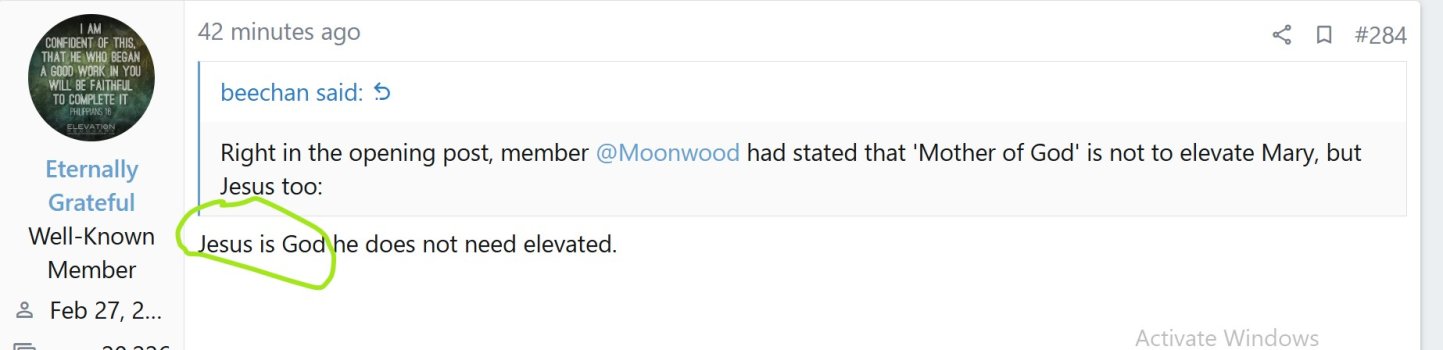
Jesus was God long before Mary was born. The eternal Word did not begin to exist in Mary's womb. As Scripture says, "In the beginning was the Word, and the Word was with God, and the Word was God" (John 1:1).
A common misunderstanding is to confuse
Incarnation with
creation.
- Creation means bringing something into existence that did not previously exist.
- Incarnation means an already-existing divine Person taking on a human nature.
Therefore, Jesus was not created in Mary's womb. Rather, the eternal Son of God became flesh and entered human history through Mary. "The Word became flesh and dwelt among us" (John 1:14).
Mary did not create God the Word. She conceived and gave birth to God the Word
Incarnate. The Incarnation marks the beginning of Christ's human life, not the beginning of His divine existence.
Scripture teaches all of the following:
- Jesus is God (John 1:1; John 20:28; Titus 2:13; Hebrews 1:8).
- Mary conceived and gave birth to Jesus (Luke 1:31; Luke 2:6-7).
- Elizabeth called Mary "the mother of my Lord" (Luke 1:43).
- Mary is called the mother of Jesus (John 2:1; Acts 1:14).
- Jesus is the fruit of Mary's womb (Luke 1:42).
None of these verses say that Mary created God or existed before God. Rather, they teach that the eternal Son of God took on a true human nature through her.
Christians do not believe Mary is the origin, source, or creator of God. They believe that the eternal Son, who already existed before creation itself, was conceived by the Holy Spirit and born of the Virgin Mary.
Mary gave birth to Jesus because He became man through her. She did not create Jesus' divinity because His divinity is eternal. That is the difference between Creation and Incarnation.
Your position actually creates a bigger problem than the one you're trying to avoid.
You say Mary only gave birth to a human body and that Jesus entered that body at birth. But Scripture teaches that the one conceived in Mary's womb was already the Son of God before His birth.
- The angel told Mary, "you will conceive in your womb and bear a son" (Luke 1:31).
- Elizabeth, while Jesus was still in Mary's womb, called Mary "the mother of my Lord" (Luke 1:43).
- John the Baptist leaped in Elizabeth's womb at the presence of Jesus in Mary's womb (Luke 1:41-44).
Scripture never says that the Word entered a merely human body at the moment of birth. Rather, it says:
"The Word became flesh" (John 1:14).
The Word did not merely inhabit a human body. He became man.
Hebrews 10:5 says, "a body you prepared for me," but it does not say Christ was absent from that body until birth. In fact, the incarnation began at conception when Mary conceived by the Holy Spirit (Luke 1:35).
Also, mothers do not give birth merely to bodies. Mothers give birth to persons. Mary did not give birth to a nature, a body, or a shell. She gave birth to Jesus Christ, who is one divine Person with two natures, divine and human.
As for the phrase "Mother of God" being pagan, the question is simple:
Was the person born of Mary God the Son?
If yes, then Mary is the mother of God the Son according to His human birth.
If no, then the person born of Mary was not God the Son.
There is no middle position where Jesus is God, Mary is His mother, yet Mary is not the mother of the Person who is God.
The title
"Mother of God" means
Mother of God the Word Incarnate, not originator of God's divine nature. Mary did not create God; She gave birth to the eternal Word who became man (John 1:14). Thus, as Elizabeth declared, She is "the mother of my Lord" (Luke 1:43). The title affirms who Jesus is, not where God came from.
In other words, Mary is not the mother of the Father, the Holy Spirit, or the divine nature itself. She is the mother of
God the Word incarnate, because the Person born of Her is the eternal Son of God Who became man. She did not give divinity to Jesus, but She did give birth to Jesus, and Jesus is God.