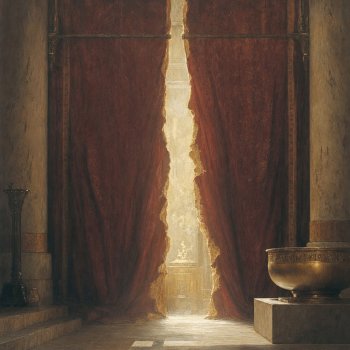
Scripture tells us that the veil of the Temple was torn from top to bottom. In Hebrew thought, that veil, the "parokhet," was not decorative. It was a boundary. It marked the line between the manifest presence of God and everything outside of it. Only one man, once a year, could pass through it, and even then with blood, fear, and careful preparation. The veil didn't just separate space. It reinforced a mindset: God is holy; you are not. Stay back.
CHERUBIM WOVEN INTO THE VEIL
When you trace its design, you begin to see something remarkable. Woven into that veil were cherubim. That detail is not accidental. The last time cherubim appeared in Scripture before the tabernacle, they were stationed at the east of Eden, guarding the way to the tree of life. In other words, the veil was not just a curtain in a building. It was a living reminder that humanity had been shut out of direct access to God since the fall. Every time a priest stood before it, he was standing at the edge of a guarded garden.
THE VEIL WAS TORN TOP TO BOTTOM
Now consider what happened when Jesus died. That veil, massive in size and thickness, was torn from top to bottom. It wasn't torn from the bottom up, as if man had reached for God, but from Heaven downward, as if God Himself had taken hold of the barrier and ripped it open. This was not an invitation extended cautiously. This was a declaration made decisively. The way back into the presence of God was no longer restricted.
THE VEIL REPRESENTS HIS FLESH
Hebrews brings this into even sharper focus when it tells us that the veil represents His flesh. That means the tearing of the veil in the Temple was directly connected to the tearing of Christ's body on the cross. As His body was broken, the barrier was broken. As His blood was poured out, access was opened. What had been guarded for generations was now made available through a finished work, not human effort.
PHENOMENON OBSERVED PRIOR TO THE DESTRUCTION OF THE SECOND TEMPLE
The Talmud records that in the decades leading up to the destruction of the Second Temple, several unusual things began to occur. The scarlet thread, associated with atonement on Yom Kippur, no longer turned white, which symbolized the forgiveness of sins; the western lamp would not remain lit; and the heavy Temple doors reportedly opened on their own.
These accounts point to a growing awareness that something within the sacrificial system had shifted. From our perspective, we understand why. The true atonement had already been made.
THE FINISHED WORK OF THE CROSS REMOVED SPIRITUAL DISTANCE FROM GOD'S PRESENCE
This means that the work of Christ did more than forgive sin. It removed distance. It dismantled the internal and external barriers that kept people living on the outside of God's presence.
The tragedy is that many Believers still live as though the veil is intact. They stand at a distance, aware of God but not fully engaging Him, forgiven but not free, invited yet hesitant.
ALBERT FINCH MINISTRY
Statement Of Faith Nameless & Faceless Ministries - Statement of Faith
Ministry Phone: 281-396-4379