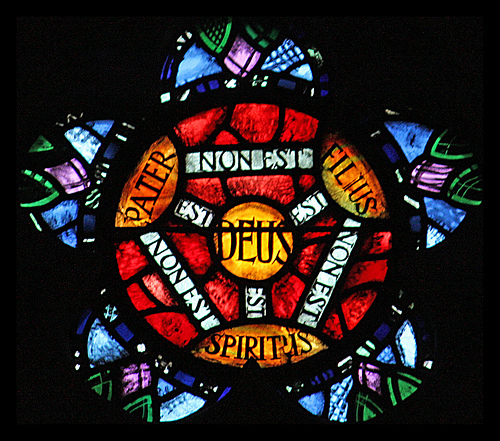
Trinitarian (or at least binitarian) theology was a necessary development because of the remarkable first century claims attributing to Jesus Christ characteristics normally associated with God:
- Pre-existing from the beginning and being "God" or "a god" and "with God" (John 1:1-2, 15; John 17:5)
- Pre-existing and having the "form" of God (Philippians 2:6)
- Having God's "fullness" (Colossians 1:19)
- Creator of all things (John 1:3, Colossians 1:16)
- Holding together all things (Colossians 1:17)
- Having authority over all things (Colossians 1:18)
These claims conflict with the non-negotiable basic claim of Judaism: That YHWH our God is One.
There are other passages; these are the ones that come to mind first. I've read that the early church had some traditions also, but I don't know enough about them; I'll leave that to others. You also have the problem that Jesus is depicted as a Person distinct from the Father, having His own will (Matthew 26:39 and synoptic parallel in Luke; also John 6:38), relating to the Father in a distinct way, and having human characteristics such as being able to die, being able to be tempted, not being omniscient (Matthew 24:36), getting tired, needing to eat (and presumably go to the latrine)...
You can only live with cognitive dissonance so long; you have to resolve the contradictory claims inherent in Christianity somehow, or throw out the Bible. Trinitarianism wasn't the only solution tried over the first few centuries either. Some of the other threads talk about Arianism and Sabellianism and a "lesser god" theory and a "dual-nature" theology and others. It's complex, it's convoluted, and they had to import some Greek concepts about "form" and "substance" and "hypostasis", but it's necessary, because a real contradiction exists in scripture.