Does Daniel 11 Describe King Herod and His Dynasty?

  • Welcome to Christian Forums, a Christian Forum that recognizes that all Christians are a work in progress.

    You will need to register to be able to join in fellowship with Christians all over the world.

    We hope to see you as a part of our community soon and God Bless!

Exegesis

Member
Jun 22, 2025
417
92
28
62
Salt Lake
Faith
Christian
Country
United States
Gender
Male
So far, I see a majority of researchers agreeing on the first dozen or so verses of Daniel 11.

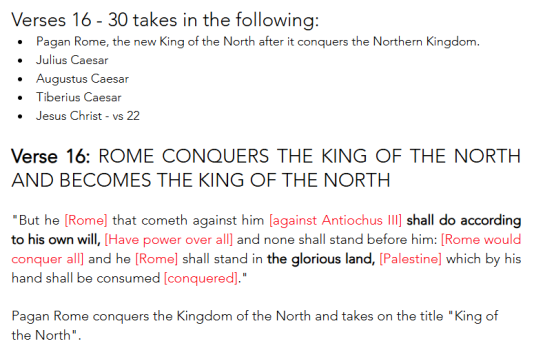
Things start to get weird around Daniel 11:14-16. Here is a website going off on a tangent about 'Pagan Rome':

1752355003013.png

I am not a Seventh Day Adventist, but it sounds like some of the stuff they promote. I personally am not a believer in Mystery Babylon being the Papacy or Pope or whatever. That is garbage teachings. That being said, we should not throw the baby out with the bathwater. Maybe there is something to Rome being in the later Daniel 11 picture.

And so, if Daniel 11 does veer off into Rome territory, then the Herod Dynasty theory would have more merit to it.
 

Randy Kluth

Well-Known Member
Apr 27, 2020
8,808
2,741
113
Pacific NW
Faith
Christian
Country
United States
Gender
Male
This one is confusing:


According to many scholars, the one mentioned above is Antiochus IV Epiphanes:


I don't see him mentioned in your post:


What am I missing?

Again, we see Antiochus IV Epiphanes as being 'widely interpreted' for Daniel 11:16:


If we keep going with the verses, we see that this figure comes to an end here:


So now, Antiochus IV Epiphanes is dead. A new person arrives after him:


That person is now dead as well. Next we have this person:


This obviously cannot be Antiochus IV Epiphanes, yet the scholars say it is:


Can anyone here make sense of this?
Yes, Antiochus 4 comes into the picture in verse 21, as the commentary you quoted indicates. But before verse 21 there are other kings, identified as Northern and Southern kings who are *not* Antiochus 4.
 

Randy Kluth

Well-Known Member
Apr 27, 2020
8,808
2,741
113
Pacific NW
Faith
Christian
Country
United States
Gender
Male
Again, we see Antiochus IV Epiphanes as being 'widely interpreted' for Daniel 11:16:

Dan 11.16 may be identified by some scholars as Antiochus 4. Other scholars would identify him as a predecessor to Antiochus 4--Antiochus 3 "the Great." See Daniel 11:16 Commentaries: "But he who comes against him will do as he pleases, and no one will be able to withstand him; he will also stay for a time in the Beautiful Land, with destruction in his hand.
 

Exegesis

Member
Jun 22, 2025
417
92
28
62
Salt Lake
Faith
Christian
Country
United States
Gender
Male
Yes, Antiochus 4 comes into the picture in verse 21, as the commentary you quoted indicates. But before verse 21 there are other kings, identified as Northern and Southern kings who are *not* Antiochus 4.

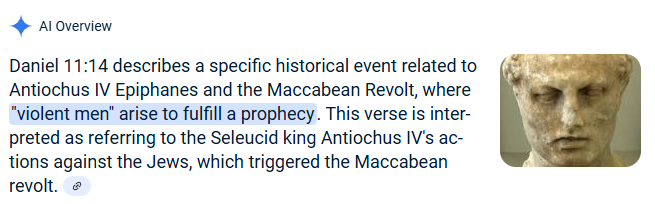
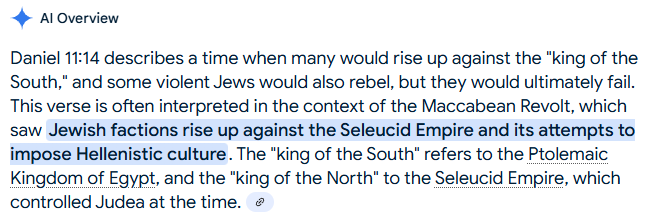
What you wrote goes against well documented major historical events, as well as majority research. Daniel 11:14 is about the Maccabean Revolt which includes Antiochus IV Epiphanes:

1752381605674.png

1752381463601.png

And...

1752381524237.png
 

Exegesis

Member
Jun 22, 2025
417
92
28
62
Salt Lake
Faith
Christian
Country
United States
Gender
Male
This is quite interesting:

Daniel 11:14 "And in those times there shall many stand up against the king of the south: also the robbers of thy people shall exalt themselves to establish the vision; but they shall fall."

So, Antiochus IV Epiphanes is part of this whole 'establish the vision' theme? And just what vision were they trying to fulfill? You mean like trying to place a counterfeit Abomination of Desolation to make the Messiah return before his appointed time? Looks like it was a fail.

If true, some of you fell for it bigly. The Abomination of Desolation came later.
 

TribulationSigns

Well-Known Member
May 1, 2023
2,709
952
113
56
Somewhere west of Mississippi River
Faith
Christian
Country
United States
Can anyone here make sense of this?

Again, only by an unsound hermeneutic and man-made interpretation of the Bible. Because God makes no mention of the erection of a pagan altar in the temple, or Antiochus Epiphanes, or 168 BC, or of AD 70. There is not one word where God speaks of such dates or occurrences. This is another private interpretation of man, unsubstantiated by the Biblical record.

According to many scholars, the one mentioned above is Antiochus IV Epiphanes:

Again, that is just man's speculation and suppositions. For the TRUTH is, the prophet Daniel never "EVER" prophesied of the erection of a pagan altar in the temple by Antiochus Epiphanes in 168 BC, nor of Romans in AD 70. An unfortunate penchant of man is that he transposes his own personal ideas onto the Bible.

2nd Peter 1:20
  • "Knowing this first, that no prophecy of the scripture is of any private interpretation."
The prophecy of scripture is not subject to our own private or personal interpretations, since it is the divinely inspired word of the Living God, and not subject to the will of man. Holy men of God spoke as they were moved by the Holy Ghost, and thus interpretations of their words can only be through God's word. Not through man's supposition, not through reading our own imaginations into scripture, and certainly not through the words of secular historians! A sound hermeneutic and ordered exegesis of scripture is paramount in understanding prophesy. And it starts with comparing scripture with scripture, not with man's words. Letting God interpret His own words, not man. Christ referenced Daniel, not Josephus.

Daniel 9:27
  • "And he shall confirm the covenant with many for one week: and in the midst of the week he shall cause the sacrifice and the oblation to cease, and for the overspreading of abominations he shall make it desolate, even until the consummation, and that determined shall be poured upon the desolate."
Daniel 8:9-14
  • "And out of one of them came forth a little horn, which waxed exceeding great, toward the south, and toward the east, and toward the pleasant land.
  • And it waxed great, even to the host of heaven; and it cast down some of the host and of the stars to the ground, and stamped upon them.
  • Yea, he magnified himself even to the prince of the host, and by him the daily sacrifice was taken away, and the place of his sanctuary was cast down.
  • And an host was given him against the daily sacrifice by reason of transgression, and it cast down the truth to the ground; and it practiced, and prospered.
  • Then I heard one saint speaking, and another saint said unto that certain saint which spake, How long shall be the vision concerning the daily sacrifice, and the transgression of desolation, to give both the sanctuary and the host to be trodden under foot?
  • And he said unto me, Unto two thousand and three hundred days; then shall the sanctuary be cleansed."
The continual, or daily was not taken away by Antiochus or Titus or any other man, but by the spirit Satan. He is the little power that should arise and magnify himself in "THE TEMPLE OF GOD" and cast the truth down. What truth was in the physical Jewish Temple in Jerusalem in AD 70? NOTHING! Lest we forget, it was "by reason of transgression an host was given against the daily sacrifice." That is the prophecy. Christ further illuminated it, declaring that abomination would stand in the Holy Place. The Jewish Temple was not the Holy Place of God in AD 70, nor was it brought to desolation by Antiochus Epiphanes in 168 BC. The fact is, neither Titus nor Antiochus Epiphanes is the little horn that God declares shall cast the truth down (Jerusalem didn't have the truth in AD 70), take away the continual (daily), which Jerusalem didn't have to be cast down, throw the place of the Prince down (the Jewish temple was not the place of the Prince in AD 70), and tread down the host for 2300 days, cleaning the Sanctuary.

Sorry, Antiochus doesn't qualify anymore than Josephus qualifies to interpret God's word! That is as disjointed a theory that I have read. No, the well-traveled AD 70 theory is all just a pipe dream, a tradition, a very bad private interpretation that disregards all the Biblical facts, substituting speculations for sound exegesis.
 

Douggg

Well-Known Member
Nov 26, 2020
5,494
440
83
77
Memphis
Faith
Christian
Country
United States
Gender
Male
What you wrote goes against well documented major historical events, as well as majority research. Daniel 11:14 is about the Maccabean Revolt which includes Antiochus IV Epiphanes:

No, Daniel 11 does not start talking about Anitochus IV until Daniel 11:21 (the vile person) and ends talking about Antiochus IV in Daniel 11:32 when the Maccabees did “exploits” allowing for the re-dedication of the Temple in Jerusalem.

Anitochus IV was a Seleucid king of the north. He had battles with Ptolemaic Egyptian kings of the south. Between Daniel 11:21 and Daniel 11:28 are those battles. In Daniel 11:29, Antiochus IV tries a third time to defeat the Ptolemaic Egyptian king of the south, but is met with Roman war ships on his way south.

On shore, the Roman spokesman met with Antiochus IV and told him that if he continued south to make war on the Egyptian king - that would mean Antiochus IV would also be at war with Rome. And the Roman spokesman wanted to know Antiochus IV's decision.

Antiochus IV tried to delay his response, saying that he would get back to him. The Roman spokesman was having none of that. And the Roman spokeman drew a line in the sand that circled Antiochus IV - and said to give his answer before stepping out of the line.

So Antiochus IV agreed to turn back and call off his attack on the Egyptian king. Heading back north, Antiochus IV took out his anger at being forced to retreat on the Jews in Jerusalem and set up an idol of Zeus in the temple - the historic abomination of desolation. In Daniel 11:31.
 
Last edited:

Randy Kluth

Well-Known Member
Apr 27, 2020
8,808
2,741
113
Pacific NW
Faith
Christian
Country
United States
Gender
Male
What you wrote goes against well documented major historical events, as well as majority research. Daniel 11:14 is about the Maccabean Revolt which includes Antiochus IV Epiphanes:


And...

There are differences of opinion *by scholars* on many instances of prophetic interpretation in Daniel. Antiochus 4 does not fit, in my judgment, here in 11.14. Antiochus the Great, Antiochus 4's father, fits much better, in my opinion. And scholars agree with me, as I posted above in the commentaries indicated: Daniel 11:16 Commentaries: "But he who comes against him will do as he pleases, and no one will be able to withstand him; he will also stay for a time in the Beautiful Land, with destruction in his hand.

Ellicot: This has been applied to the conduct of Antiochus the Great, but history does not speak of any acts of destruction committed by him in Palestine.
Barnes: The following language of Josephus respecting the effect of these wars will justify and explain what is here said by the angel: "Now it happened that, in the reign of Antiochus the Great, who ruled over all Asia, the Jews, as well as the inhabitants of Coelo-Syria, suffered greatly...
Gill: But he that cometh against him shall do according to his own will, and none shall stand before him,.... Antiochus the great, who came against Ptolemy king of Egypt, would do in those parts where he came as he pleased...


If you want to believe the scholars who say this is Antiochus 4, it's okay by me. I'm just letting you know that the scholars obviously disagree on this. It seems apparent to me that it either fits or doesn't fit based on how you wish to read the evidence.
 
  • Like
Reactions: Exegesis

Douggg

Well-Known Member
Nov 26, 2020
5,494
440
83
77
Memphis
Faith
Christian
Country
United States
Gender
Male
Thanks @Douggg and @Randy Kluth for the latest posts. I appreciate it.

I will review them and get back to you when I have time.
Regarding my post, here are more specifics from Wikipedia....

In 168 BC, a Roman Consul named Gaius Popillius Laenas drew a circular line in the sand around King Antiochus IV of the Seleucid Empire, then said, "Before you cross this circle I want you to give me a reply for the Roman Senate" – implying that Rome would declare war if the King stepped out of the circle without committing to leave Egypt immediately. Weighing his options, Antiochus wisely decided to withdraw. Only then did Popillius agree to shake hands with him.
 
  • Like
Reactions: Exegesis

Exegesis

Member
Jun 22, 2025
417
92
28
62
Salt Lake
Faith
Christian
Country
United States
Gender
Male
To all. I am putting together a spreadsheet of Daniel 11. If anyone wants to comment, correct, etc. I would appreciate it. I am interested in how much folks agree and where the main differences are.

Here is what I have for the first five verses.

Daniel Chapter 11 (King James Version)
Verse: 1
"Also I in the first year of Darius the Mede, even I, stood to confirm and to strengthen him."
Character FocusTimelineCommentary
• Daniel
• Angel Gabriel
• Darius the Mede
539 BCA divine messenger, likely Gabriel, continues the vision from the previous chapter. The "first year of Darius the Mede" refers to the period immediately following the fall of Babylon to the Medo-Persian Empire in 539 BC.
Verse: 2
"And now will I shew thee the truth. Behold, there shall stand up yet three kings in Persia; and the fourth shall be far richer than they all: and by his strength through his riches he shall stir up all against the realm of Grecia."
Character FocusTimelineCommentary
• Cambyses
• Bardiya (Smerdis)
• Darius I
• Xerxes I
539 BCThis refers to the succession of Persian rulers following Cyrus the Great. Historically, these kings are identified as 1) Cambyses, 2) Bardiya (also known as Smerdis), 3) Darius I and 4) Xerxes I. Xerxes' wealth enabled him to amass a vast army to launch a campaign against Greece, leading to the famous battles of Thermopylae and Salamis.
Verse: 3
"And a mighty king shall stand up, that shall rule with great dominion, and do according to his will."
Character FocusTimelineCommentary
• Alexander the Great336 BCThis is widely understood to be Alexander the Great, the king of Macedonia
Verse: 4
"And when he shall stand up, his kingdom shall be broken, and shall be divided toward the four winds of heaven; and not to his posterity, nor according to his dominion which he ruled: for his kingdom shall be plucked up, even for others beside those."
Character FocusTimelineCommentary
• Alexander the Great
• Cassander
• Lysimachus
• Seleucus
• Ptolemy
323 BCAfter Alexander's death in 323 BC, his empire did not remain intact. Instead, it was divided among his four generals, known as the Diadochi: Cassander, Lysimachus, Seleucus, and Ptolemy. This division is symbolically represented by the "four winds of heaven," indicating the scattering of his empire in all directions.
Verse: 5
"And the king of the south shall be strong, and one of his princes; and he shall be strong above him, and have dominion; his dominion shall be a great dominion."
Character FocusTimelineCommentary
• Ptolemy I Soter
• Seleucus I Nicator
305 BCThe King of the South is Ptolemy I Soter. "One of his princes" is a subordinate of the King of the South who rises to greater power. Historically, this is often identified as Seleucus I Nicator, who became a significant ruler in the Seleucid Empire

I will pause the study here for now. Again, I want to see if everyone can at least agree on the first five interpretations before moving on to the next set.
 
Last edited:

Douggg

Well-Known Member
Nov 26, 2020
5,494
440
83
77
Memphis
Faith
Christian
Country
United States
Gender
Male
To all. I am putting together a spreadsheet of Daniel 11. If anyone wants to comment, correct, etc. I would appreciate it. I am interested in how much folks agree and where the main differences are.

Here is what I have for the first five verses.

Daniel Chapter 11 (King James Version)
Verse: 1
"Also I in the first year of Darius the Mede, even I, stood to confirm and to strengthen him."
Character FocusTimelineCommentary
• Daniel
• Angel Gabriel
• Darius the Mede
539 BCA divine messenger, likely Gabriel, continues the vision from the previous chapter. The "first year of Darius the Mede" refers to the period immediately following the fall of Babylon to the Medo-Persian Empire in 539 BC.
Verse: 2
"And now will I shew thee the truth. Behold, there shall stand up yet three kings in Persia; and the fourth shall be far richer than they all: and by his strength through his riches he shall stir up all against the realm of Grecia."
Character FocusTimelineCommentary
• Cambyses
• Bardiya (Smerdis)
• Darius I
• Xerxes I
539 BCThis refers to the succession of Persian rulers following Cyrus the Great. Historically, these kings are identified as 1) Cambyses, 2) Bardiya (also known as Smerdis), 3) Darius I and 4) Xerxes I. Xerxes' wealth enabled him to amass a vast army to launch a campaign against Greece, leading to the famous battles of Thermopylae and Salamis.
Verse: 3
"And a mighty king shall stand up, that shall rule with great dominion, and do according to his will."
Character FocusTimelineCommentary
• Alexander the Great336 BCThis is widely understood to be Alexander the Great, the king of Macedonia
Verse: 4
"And when he shall stand up, his kingdom shall be broken, and shall be divided toward the four winds of heaven; and not to his posterity, nor according to his dominion which he ruled: for his kingdom shall be plucked up, even for others beside those."
Character FocusTimelineCommentary
• Alexander the Great
• Cassander
• Lysimachus
• Seleucus
• Ptolemy
323 BCAfter Alexander's death in 323 BC, his empire did not remain intact. Instead, it was divided among his four generals, known as the Diadochi: Cassander, Lysimachus, Seleucus, and Ptolemy. This division is symbolically represented by the "four winds of heaven," indicating the scattering of his empire in all directions.
Verse: 5
"And the king of the south shall be strong, and one of his princes; and he shall be strong above him, and have dominion; his dominion shall be a great dominion."
Character FocusTimelineCommentary
• Ptolemy I Soter
• Seleucus I Nicator
305 BCThe King of the South is Ptolemy I Soter. "One of his princes" is a subordinate of the King of the South who rises to greater power. Historically, this is often identified as Seleucus I Nicator, who became a significant ruler in the Seleucid Empire

I will pause the study here for now. Again, I want to see if everyone can at least agree on the first five interpretations before moving on to the next set.
Exegesis,

I am curious. What program are you using to form the framework of your spreadsheet (table) ?

The structure appears to be well thought out.

In the first column,
You quote the verse highlighted in blue. Highlighted in blue was a good decision.
then below, the "Character focus"

In the second column,
the timeline year

In the third column,
commentary

To do all of Daniel 11 is a massive undertaking. Best wishes on your effort. As most people here know, I am big on timeline charts and diagrams.

I agree with your interpretations of the first five verses btw.
 
Last edited:

Exegesis

Member
Jun 22, 2025
417
92
28
62
Salt Lake
Faith
Christian
Country
United States
Gender
Male
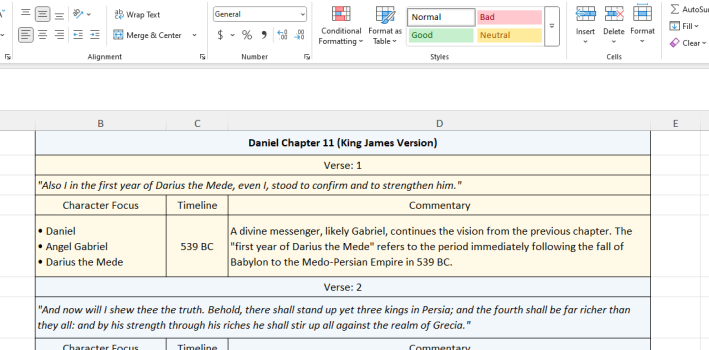
I am curious. What program are you using to form the framework of your spreadsheet (table) ?

I am using Microsoft Excel. It looks a bit different in the actual file:

1752443657174.png

I have to highlight the cells, copy them and then paste here. It doesn't all transfer over unfortunately.

The structure appears to be well thought out.

Thanks.

To do all of Daniel 11 is a massive undertaking. Best wishes on your effort. As most people here know, I am big on timeline charts and diagrams.

Yeah, it's a lot of work alright. I've seen some of your charts. It's a good way to keep tack of things.

I agree with your interpretations of the first five verses btw.

Yay!
 

Jay Ross

Well-Known Member
Jun 20, 2011
9,371
3,491
113
QLD
Faith
Christian
Country
Australia
Gender
Male
I have to highlight the cells, copy them and then paste here. It doesn't all transfer over unfortunately.

I find that it is best to copy the selected Xcel cells into Word and then edit the document in Word to how I would want it to look before copying and pasting it on this forum.

It is how I would do it.

This is just a suggestion you may like to try
 
  • Like
Reactions: Exegesis

Stumpmaster

Well-Known Member
Apr 5, 2009
2,749
1,791
113
71
Hamilton, New Zealand
Faith
Christian
Country
New Zealand
Gender
Male
I've remembered four important things about Antiochus Epiphanes.

  • Antiochus: A dynastic name used by several rulers of the Seleucid Empire, derived from Antiochos, meaning “steadfast” or “resolute.”
  • Epiphanes (Greek: Ἐπιφανής): Translates to “God Manifest” or “Illustrious One.” It was a title Antiochus IV adopted to assert his divine status, essentially claiming to be the earthly manifestation of a god—likely Zeus.
  • Many contemporaries found this self-deification outrageous. In fact, some mockingly called him “Epimanes” (Ἐπιμανής), meaning “The Mad One,” a pun on Epiphanes.
  • In biblical and eschatological contexts, Antiochus Epiphanes is often seen as a precursor to the Antichrist, embodying rebellion against God and persecution of the faithful.
 
  • Like
Reactions: Exegesis

Exegesis

Member
Jun 22, 2025
417
92
28
62
Salt Lake
Faith
Christian
Country
United States
Gender
Male
I was able to get five more done:

Daniel Chapter 11 - King James Version (Unless Otherwise Noted)
Verse: 6
"And in the end of years they shall join themselves together; for the king’s daughter of the south shall come to the king of the north to make an agreement: but she shall not retain the power of the arm; neither shall he stand, nor his arm: but she shall be given up, and they that brought her, and he that begat her, and he that strengthened her in these times."
Character FocusTimelineCommentary
• Ptolemy II Philadelphus
• Berenice
• Antiochus II Theos
• Laodice
252 BCThe daughter mentioned here is historically identified as Berenice, the daughter of Ptolemy II Philadelphus of Egypt. She was given in marriage to Antiochus II Theos of the Seleucid Empire to solidify the alliance. After the death of Ptolemy II, Antiochus II took back his former wife, Laodice, who then orchestrated the murder of Berenice and her son.
Verse: 7
"But out of a branch of her roots shall one stand up in his estate, which shall come with an army, and shall enter into the fortress of the king of the north, and shall deal against them, and shall prevail:"
Character FocusTimelineCommentary
• Berenice
• Ptolemy III Euergetes
• Seleucus II Callinicus
246 BC"Branch of her roots" refers to Ptolemy III Euergetes, a brother of Berenice. Ptolemy III Euergetes sought to avenge the death of Berenice. Ptolemy III Euergetes rose to power after the death of his father, Ptolemy II Philadelphus. The "king of the North" refers to the Seleucid Empire, specifically Seleucus II Callinicus, who ruled after Antiochus II. Ptolemy III's campaign was notably successful, as he managed to secure victories and expand his influence.
Verse: 8
"And shall also carry captives into Egypt their gods, with their princes, and with their precious vessels of silver and of gold; and he shall continue more years than the king of the north."
Character FocusTimelineCommentary
• Ptolemy III Euergetes246 BCThis passage is likely about Ptolemy III Euergetes of Egypt, who invaded the Seleucid Empire and took spoils back to Egypt.
Verse: 9
King James Version - "So the king of the south shall come into his kingdom, and shall return into his own land."
New International Version - "Then the king of the North will invade the realm of the king of the South but will retreat to his own country."
Character FocusTimelineCommentary
• Ptolemy III Euergetes
• Seleucus Callinicus
246 BCKJV - Assuming the king of the south is Ptolemy Euergetes, the verse completes the statements of the previous verse, and seems to describe the triumphant return of Euergetes into Egypt.

NIV - Assuming the king of the north is Seleucus Callinicus attempting to invade Egypt, the verse may be describing his unsuccessful attempts to invade Egypt.
Verse: 10
"But his sons shall be stirred up, and shall assemble a multitude of great forces: and one shall certainly come, and overflow, and pass through: then shall he return, and be stirred up, even to his fortress."
Character FocusTimelineCommentary
• Seleucus II Callinicus
• Seleucus III Ceraunus
Antiochus III the Great
219 BC"His sons" refers to the sons of the king of the North, likely Seleucus II Callinicus, whose sons were Seleucus III Ceraunus and Antiochus III the Great. The assembling of a great army signifies the preparation for significant military campaigns. Historically, Antiochus III, known for his military prowess, gathered substantial forces to reclaim territories lost to the Ptolemies. The imagery of advancing "like a flood" suggests an overwhelming and unstoppable military campaign. Antiochus III's campaigns were marked by rapid and decisive movements, reclaiming territories in the Levant. The "fortress" likely refers to a strategic stronghold or city, possibly in the region of Coele-Syria, which was a contested area between the Seleucids and Ptolemies.

Time to take a break. I will post more when I get time.
 

Wish-it

Member
Apr 14, 2025
350
32
28
Wellington
Faith
Christian
Country
New Zealand
Gender
Male
I've remembered four important things about Antiochus Epiphanes.

  • Antiochus: A dynastic name used by several rulers of the Seleucid Empire, derived from Antiochos, meaning “steadfast” or “resolute.”
  • Epiphanes (Greek: Ἐπιφανής): Translates to “God Manifest” or “Illustrious One.” It was a title Antiochus IV adopted to assert his divine status, essentially claiming to be the earthly manifestation of a god—likely Zeus.
  • Many contemporaries found this self-deification outrageous. In fact, some mockingly called him “Epimanes” (Ἐπιμανής), meaning “The Mad One,” a pun on Epiphanes.
  • In biblical and eschatological contexts, Antiochus Epiphanes is often seen as a precursor to the Antichrist, embodying rebellion against God and persecution of the faithful.
Or could all be in the future. Not the past. We seem to spend hours searching in history rather than searching scripture for the answers. Do God care about our generation? I'm sure He spoke to that generation in their time, now it's our turn to hear what He has to say to us.
 

Wish-it

Member
Apr 14, 2025
350
32
28
Wellington
Faith
Christian
Country
New Zealand
Gender
Male
Poor baby.


And you have not refuted anything I say anyway. Just complained about the tone of my response, eh?


LOL. Time of the End has nothing to do with your pipe dream of 70AD theories. Here is a long lesson for you, "Exegesis"

In Scripture "the time of the end," as well as "the last days," refers to the whole New Testament period. That is when knowledge was increased and when the servants of God were sent to "go forth" (to and fro) with the gospel to the whole earth. It started with Christ's death and resurrection after He witnessed to the nation of Israel, and it ends with his triumphant return on the clouds of glory. I believe that this is the time of the increase in knowledge and when many (the elect) run to and fro or "go forth" with the power of the Revelation of God, through the Holy Spirit poured out at Pentecost. This refers to the great knowledge through the Holy Spirit that has been given to us and signified by the sign at Pentecost.

Acts 2:14-21

  • "But Peter, standing up with the eleven, lifted up his voice, and said unto them, Ye men of Judaea, and all ye that dwell at Jerusalem, be this known unto you, and hearken to my words:
  • For these are not drunken, as ye suppose, seeing it is but the third hour of the day.
  • But this is that which was spoken by the prophet Joel;
  • And it shall come to pass in the last days, saith God, I will pour out of my Spirit upon all flesh: and your sons and your daughters shall prophesy, and your young men shall see visions, and your old men shall dream dreams:
  • And on my servants and on my handmaidens I will pour out in those days of my Spirit; and they shall prophesy:
  • And I will shew wonders in heaven above, and signs in the earth beneath; blood, and fire, and vapour of smoke:
  • The sun shall be turned into darkness, and the moon into blood, before that great and notable day of the Lord come:
  • And it shall come to pass, that whosoever shall call on the name of the Lord shall be saved."
This is the uncovering of the seal on the book, the revelation of the Holy Spirit, the time when His servants will dream dreams and have visions, the time when we understand we have one Priest in Christ where we are all made kings and priests unto God through Him. This is the time when we receive the knowledge to understand that we are now all Kings and Priests unto him. Thus we prophesy, see visions, dream dreams, and interpret mysteries because knowledge of the word has increased. The mystery of God kept secret for so long was uncovered by Christ, yet progressively revealed to us in His own time. The whole New Testament period is the time when "that which was kept a mystery or secret" from the beginning, would be revealed by Christ sending the Holy Spirit to enlighten all His servants. When Christ sent the comforter to us, He began that revelation to increase knowledge in the earth of Him, and I believe it increases more as we near the end of all things. The latter days when Christ gives us a mouth and words of fire where none can gainsay or resist.

Romans 16:25-26
  • "Now to him that is of power to stablish you according to my gospel, and the preaching of Jesus Christ, according to the revelation of the mystery, which was kept secret since the world began,
  • But now is made manifest, and by the scriptures of the prophets, according to the commandment of the everlasting God, made known to all nations for the obedience of faith:"

The mystery is that Israel would be made up of Jews and Gentiles, and according to the gospel revealed in the faith of Christ. Note in Daniel, he is told to shut up the words and seal the book until the time of the end, meaning it was not meant to be understood until that time. While the apostle John is told not to seal up the visions of the book God had given him, meaning it was now to be revealed. That's why it is called the book of the Apocalypse (uncovering), or revealing the secrets of the knowledge that was before kept secret.

Revelation 22:6
  • "And he said unto me, These sayings are faithful and true: and the Lord God of the holy prophets sent his angel to shew unto his servants the things which must shortly be done."

The Lord sent His Messenger to reveal the mystery of what things would shortly be done. And with Christ's death and resurrection, that revelation started and it is revealed to the election of the Israel of God, while the nation of Israel (in part) is blinded to it.

Daniel 12:4
  • "But thou, O Daniel, shut up the words, and seal the book, even to the time of the end: many shall run to and fro, and knowledge shall be increased."

God's messenger Daniel was told to keep this a mystery until the time of the end when Christ would come, while after Christ came God's messenger John was told not to keep the things a mystery, but to reveal these things to the servants of God. This necessarily would increase the knowledge that was before restricted. Revelation is given in cryptic symbolism and parabolic imagery so that the wicked might be confounded by its mystery. By contrast, the election is given "of the Spirit" to understand these mysteries or secrets. A principle God explained plainly in places like Matthew 13:

Matthew 13:10-11
  • "And the disciples came, and said unto him, Why speakest thou unto them in parables?
  • He answered and said unto them, Because it is given unto you to know the mysteries of the kingdom of heaven, but to them it is not given."

People often ask me, why did God make the book of Revelation so difficult to understand. My answer is always because it is revealed only to those who hold the word of God as their ultimate authority in interpretations, meaning interpretations belong to God (Genesis 41:15-16; 40:8 ). It is the few who want to do that. Those who seek worldly, carnal, and extrabiblical interpretations, are confounded by the symbolism. While those who interpret by scripture alone (Sola Scriptura) through the Spirit of Christ, have these truths revealed to them. These are those called of God to receive truth, while others refuse the truth presented by God in love. Visa'vis, even as Daniel in the previous verse 3 prophesied in the symbolism of us being "as" stars. Something Revelation also carries through in that book.

(Continue to next post)

Exactly, too many spend their time in history, videos, forefathers and newspaper than in the Word of God. Its time to leave them all behind and concentrate on His Word and His Spirit and treat prophecy as that.
 

Wish-it

Member
Apr 14, 2025
350
32
28
Wellington
Faith
Christian
Country
New Zealand
Gender
Male
I believe in this context the "time of the end" refers to the end of a particular period of prophecy, such as the time of a particular reign. In this context, "time of the end" is the end of an era that was fulfilled some time in the ancient past, and is not an eschatological prophecy.

The belief that certain prophecies were fulfilled in the time of Christ's earthly ministry is not, strictly, "Preterism." Prophecies always have a time when they are fulfilled, whether in current history or at the end of the age. When we were told that Jesus would come in to Jerusalem riding on a donkey, it was fulfilled at Jesus' 1st Coming, and cannot be called "Preterism." When the Olivet Discourse prophesied that Jerusalem and the Temple would fall in Jesus' generation, it was fulfilled in 70 AD, but cannot be called "Preterism."

The fact Preterists view the Olivet Discourse as being fulfilled in the time surrounding Jesus' 1st Coming does not make the view as such strictly a "Preterist interpretation." The early Church Fathers saw the Abomination of Desolation as the event in which the Roman Army surrounded Jerusalem, and destroyed both the city and the sanctuary (Dan 9.26-27). This is not "Preterism," since Preterism did not even exist in the time of the early Church Fathers. Rather, this is the Olivet Discourse as being interpreted, properly, as prophecy fulfilled in ancient history.

The idea that nearly *all* of biblical prophecy was fulfillled at Jesus' 1st Coming is "Preterism" properly. But there is no easy term to describe the Olivet Discourse being fulfilled largely at Jesus' 1st Coming without it appearing to be "Preterism" as many Futurists see it today.

I've had extensive arguments about whether Dan 11 refers to Herod or to Antiochus (or even to Antichrist) in its latter portions. I'm convinced it refers to Antiochus 4.
"I believe in this context the "time of the end" refers to the end of a particular period of prophecy, such as the time of a particular reign. In this context, "time of the end" is the end of an era that was fulfilled some time in the ancient past, and is not an eschatological prophecy."
Also Dan 12.6,9,13 all allude to the very end, even to "Daniel's end of days, he will rise to receive his inheritance."
 

TribulationSigns

Well-Known Member
May 1, 2023
2,709
952
113
56
Somewhere west of Mississippi River
Faith
Christian
Country
United States
Exactly, too many spend their time in history, videos, forefathers and newspaper than in the Word of God. Its time to leave them all behind and concentrate on His Word and His Spirit and treat prophecy as that.

Thought so too. Sometimes, I prefer to respond with a post for anyone else who has spiritual ears to hear... like you. Glad it helped.
 
  • Like
Reactions: Wish-it