CTK
Well-Known Member
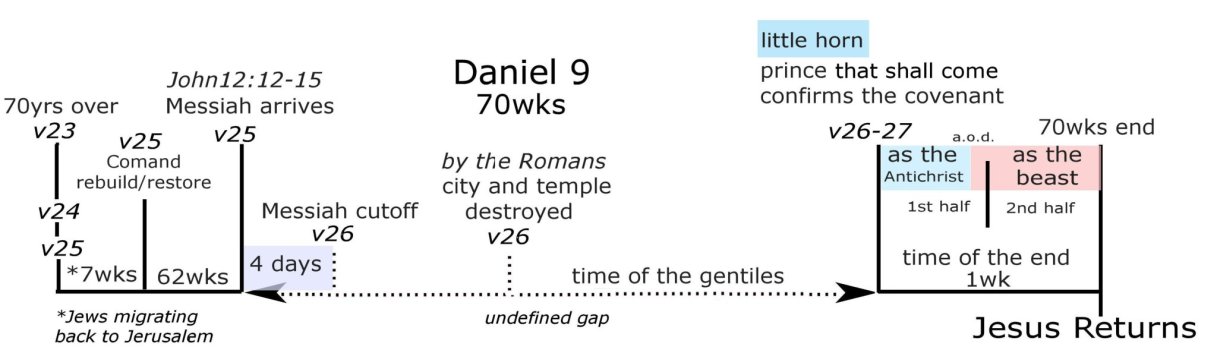
Does this make any sense... please let me know, and thanks,My thought has been that the 70th Week is not said to be a full Week--only that is the last Week among 70 Weeks. That last Week is the 70th Week whether it is half a Week or a full Week. I think the 70th Week was fulfilled as a Half-Week.
Daniel 9:24a — Seventy weeks are determined
Daniel 9:24b—For your people and your holy city
Gabriel’s introduction in Daniel 9:24 opens one of the most critical time-based prophecies in Scripture. He begins not with symbols or imagery, but with a definitive statement: “Seventy weeks are determined…” This declaration establishes the structured nature of this prophecy, consistent with the interpretive pattern found in Daniel’s earlier chapters. Just as Daniel 2, 7, and 8 present visions followed by clear interpretation sequences, Daniel 9 follows suit—not through symbolic beasts or metal images, but through precise time markers.
This prophecy is not vague, metaphorical, or flexible. It is fixed, measured, and divinely determined—a 490-year time span laid out like a blueprint. The Hebrew word for “determined” (chathak) literally implies something “cut out” or “shaped,” reinforcing the idea that these seventy weeks are carved from history for a very specific purpose. They are set apart by God Himself, placed on a divine timeline to mark the unfolding of salvation history.
Gabriel makes it unmistakably clear who this prophecy is for: “your people and your holy city.” This is not a global prophecy for all nations—it is specifically directed toward the Jewish people and Jerusalem. There is no ambiguity here. The seventy weeks apply to Daniel’s people (the Jews) and Daniel’s city (Jerusalem). This is the covenant context.
This direct address reinforces the covenantal relationship between God and Israel. It also means that the seventy-week clock will unfold within Jewish history, culminating in events that will take place in Jerusalem and through the Jewish Messiah. Any attempt to transplant this prophecy onto a different group or era misaligns it from the clear framework Gabriel has laid out.
This sharpens the urgency and responsibility given to the Jewish nation: they are not left in the dark about the timing of the Messiah. They are entrusted with a precise countdown—a spiritual compass that points directly to the long-awaited Redeemer. Unlike the more general historical timelines in Daniel 2 and 7, which chart the rise and fall of empires, this prophecy divides its 490 years into three distinct sections, each with spiritual and historical significance:
7 weeks (49 years): A period marking the rebuilding of Jerusalem, beginning with the decree to restore and rebuild the city.
62 weeks (434 years): A long span leading up to the appearance of the Messiah, during which the Jewish people would prepare for His arrival.
1 week (7 years): The final and most critical segment, where the Messiah would fulfill the mission of salvation—through His life, death, and resurrection.
This division is not random. It is intentional, designed to provide clear prophetic checkpoints. Each phase moves toward the ultimate goal: the appearance and atoning work of the Messiah. These divisions also serve as guardrails for interpretation, helping the faithful to stay on course and preventing the prophecy from being spiritualized or redefined beyond its original purpose.
As the Jewish people returned from exile, the earlier visions given to Daniel—the chazon (broad prophetic sequence) and the mareh (focused vision of the Messiah)—were no longer to be “sealed” or kept hidden. The seventy-weeks prophecy is the key that unseals the earlier visions. It was given specifically to the Jewish nation so they could study, discern, and prepare.