

National Salvation - The Ethnē in Biblical Soteriology and Eschatology.

  • Welcome to Christian Forums, a Christian Forum that recognizes that all Christians are a work in progress.

    You will need to register to be able to join in fellowship with Christians all over the world.

    We hope to see you as a part of our community soon and God Bless!

St. SteVen

Well-Known Member
Feb 5, 2023
18,269
6,823
113
71
Minneapolis
Faith
Christian
Country
United States
This interesting article showed up in my email. - @St. SteVen

National Salvation

The Ethnē in Biblical Soteriology and Eschatology.​


All humans will be judged and ultimately saved, not as isolated individuals, nor as an abstract universal collective, but as nations.
This, I contend, is the consistent teaching of Scripture, and of our Christian forefathers.
Painting by Albert Bierstadt (“Lake Tahoe,” 1868)

As it currently stands in the modern day, there is a nearly ubiquitous tendency—one that is almost entirely novel and out of step with the Biblical worldview—to flatten out all anthropological distinctions by presuming that the only categories of any meaningful significance are “humanity” in the generic universal sense, and “human beings” in the atomized individual sense. But this is simply untrue, especially from a Scriptural standpoint, in nearly every respect. For instance…
As it pertains to divine judgement:
When the Son of Man comes in his glory… all the nations will be gathered before him, and he will separate them [i.e., “the nations”] one from another as a shepherd separates the sheep from the goats. […] From his mouth comes a sharp sword with which to strike down the nations, and he will rule them with a rod of iron. He will tread the winepress of the fury of the wrath of God the Almighty.¹
As it pertains to discipleship and the preaching of the gospel:
All authority in heaven and on earth has been given to me. Go therefore and disciple all the nations, baptizing them [i.e., “the nations”] in the name of the Father and of the Son and of the Holy Spirit, teaching them [i.e., “the nations”] to observe all that I have commanded you. […] an eternal gospel to proclaim to those who dwell on earth, to every nation and tribe and language and people.²
And as it pertains to the efficacious accomplishment and application of salvation:
The fullness of the nations [will] come in. […] All nations will come and worship you […] By [the New Jerusalem’s] light will the nations walk, and the kings of the earth will bring…into it the glory and the honor of the nations. […] The leaves of the tree [of life] were for the healing of the nations.³

Notice that these passages do not speak merely of individual persons ‘from’ or ‘out of’ various nations, nor of some ambiguous concept of ‘diverse humanity’ as a universal collective. Rather, a natural reading recognizes that the Bible here repeatedly refers to “nations” as such, being judged, and evangelized, and saved as nations. In all these facets of God’s unfolding redemptive-historical work, we see a consistent pattern of intra-human group-level identity involved inextricably alongside the universal and individual human level. This cannot be conjured away through hermeneutical obfuscation.

Many New Testament scholars assume that any and all references to “the nations” or “all nations” in the New Testament must simply mean “the Gentiles” generally, as opposed to the Hebrews/Israelites alone. But such is a reductionist and misleading oversimplification. In reality, the term also has a particular denotation beyond merely the vague category of “non-Jews.” “Nations” (“ethnē” in Biblical Greek) is most often used in the specific sense of people-groups: ethno-racial entities defined by shared ancestry and identity, with the shared culture, language, dwelling, and political organization that typically accompanies this. And “all nations” thus denotes all of these people-groups as such.
As the Apostle Paul reminds us,
[God] made from one man every nation [“ethnos”] of mankind to live on all the face of the earth, having determined allotted periods and the boundaries of their dwelling place.⁴
This Pauline interpretation of the will of God for humanity as revealed at Babel, explains why he does not hesitate to expresses a superlative love for his own “kinsmen according to the flesh” (Rom. 9:3), before arriving at the glorious conclusion that the entirety of his nation (i.e., his “ethnos”) will eventually be saved altogether (Rom. 11:26).

It is undoubtedly true that there is also a sense in which salvation is a matter of individual repentance and faith, and simultaneously a matter of humanity as a universal entity. Yet it is crucial that we cease to overlook this additional theme of the repentance and salvation of the nations as nations. Were we to be more thoroughly immersed in the world of Biblical and historical Christianity in its original context (rather than our own postmodern, liberal milieu), we would better grasp and appreciate this aspect of Scripture’s soteriological and eschatological emphasis.
May God grant us the wisdom and balance to properly see these meaningful distinctions, rather than mindlessly neglecting or foolishly rejecting them.

Soli Deo Gloria.

1 Matthew 25:31-32; Revelation 19:15.

2 Matthew 28:18-20; Revelation 14:6.

3 Romans 11:25; Revelation 15:4; 21:24, 26; 22:2.

4 Acts 17:26.
 

St. SteVen

Well-Known Member
Feb 5, 2023
18,269
6,823
113
71
Minneapolis
Faith
Christian
Country
United States
Here are those scriptures.
Notice the significance of "the nations".


Matthew 25:31-32 RSV
“When the Son of man comes in his glory,
and all the angels with him,
then he will sit on his glorious throne.
32 Before him will be gathered all the nations,
and he will separate them one from another
as a shepherd separates the sheep from the goats,

Revelation 19:15 RSV
From his mouth issues a sharp sword with which to smite the nations,
and he will rule them with a rod of iron; he will tread the wine press
of the fury of the wrath of God the Almighty.

Matthew 28:18-20 RSV
And Jesus came and said to them,
“All authority in heaven and on earth has been given to me.
19 Go therefore and make disciples of all nations,
baptizing them in the name of the Father and of the Son and of the Holy Spirit,
20 teaching them to observe all that I have commanded you;
and lo, I am with you always, to the close of the age.”

Revelation 14:6 RSV
Then I saw another angel flying in midheaven,
with an eternal gospel to proclaim to those who dwell on earth,
to every nation and tribe and tongue and people;

Romans 11:25 RSV
Lest you be wise in your own conceits,
I want you to understand this mystery,
brethren: a hardening has come upon part of Israel,
until the full number of the Gentiles come in,

Revelation 15:4 RSV
Who shall not fear and glorify thy name, O Lord?
For thou alone art holy.
All nations shall come and worship thee,
for thy judgments have been revealed.”

Revelation 21:24, 26 RSV
24 By its light shall the nations walk;
and the kings of the earth shall bring their glory into it, ...
26 they shall bring into it the glory and the honor of the nations.

Revelation 22:2 RSV
through the middle of the street of the city;
also, on either side of the river, the tree of life
with its twelve kinds of fruit, yielding its fruit each month;
and the leaves of the tree were for the healing of the nations.

Acts 17:26 RSV
And he made from one every nation of men
to live on all the face of the earth,
having determined allotted periods
and the boundaries of their habitation,
 

Lambano

Well-Known Member
Jul 13, 2021
10,000
12,774
113
Island of Misfit Toys
Faith
Christian
Country
United States
Gender
Male
Εθνῶν is the word the LXX translators used for the Hebrew הַגּוֹיִם, "Goyim", meaning "everybody who is not us". In that concordance, where does the context indicate ἐθνῶν should be properly translated "Gentiles"?

Remember, our concept of a "Nation" is different from what it was in Biblical times. The United States is a "Nation", but we are becoming less and less of a "People".
 
Last edited:
  • Like
Reactions: St. SteVen

St. SteVen

Well-Known Member
Feb 5, 2023
18,269
6,823
113
71
Minneapolis
Faith
Christian
Country
United States
Εθνῶν is the word the LXX translators used for the Hebrew הַגּוֹיִם, "Goyim", meaning "everybody who is not us". In that concordance, where does the context indicate ἐθνῶν should be properly translated "Gentiles"?
Good question.
From the Jewish perspective, there are only two kinds of people, Jews and Gentiles.
Gentiles then, being everyone who is not Jewish by heritage. (blood)

Remember, our concept of a "Nation" is different from what it was in Biblical times.
Worth discussing.
The Bible boils it down to every tribe and tongue.
 

St. SteVen

Well-Known Member
Feb 5, 2023
18,269
6,823
113
71
Minneapolis
Faith
Christian
Country
United States
Remember, our concept of a "Nation" is different from what it was in Biblical times.
I find it interesting how the nations play into the final judgment.
Even the separation of the sheep and goats. Whole nations sent to the right or left.

And in evangelism, "make disciples of all nations".

And after the judgement (evaluation) the leaves of the Tree of Life are for the healing of the nations.
 

Lambano

Well-Known Member
Jul 13, 2021
10,000
12,774
113
Island of Misfit Toys
Faith
Christian
Country
United States
Gender
Male
I find it interesting how the nations play into the final judgment.
Even the separation of the sheep and goats. Whole nations sent to the right or left.

And in evangelism, "make disciples of all nations".

And after the judgement (evaluation) the leaves of the Tree of Life are for the healing of the nations.
Mentally translate "Ethnon" to "Gentiles" and see if the sense of what Jesus is saying changes.
 

St. SteVen

Well-Known Member
Feb 5, 2023
18,269
6,823
113
71
Minneapolis
Faith
Christian
Country
United States
Mentally translate "Ethnon" to "Gentiles" and see if the sense of what Jesus is saying changes.
As in all ethnicities?
Go into all the world and make disciples of all ethnicities.
That works.

A lot better than "all predestined evangelicals". - LOL
 

St. SteVen

Well-Known Member
Feb 5, 2023
18,269
6,823
113
71
Minneapolis
Faith
Christian
Country
United States
Matthew 28:18-20 RSV
And Jesus came and said to them,
“All authority in heaven and on earth has been given to me.
19 Go therefore and make disciples of all nations,
baptizing them in the name of the Father and of the Son and of the Holy Spirit,
20 teaching them to observe all that I have commanded you;
and lo, I am with you always, to the close of the age.”

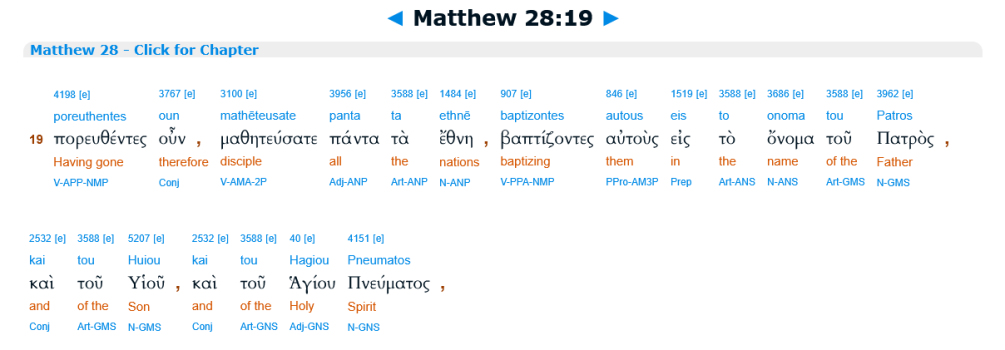
The wording in the Great Commission is very interesting.
To make disciples of all NATIONS. Baptizing, the individuals, obviously.
But we are sent to the NATIONS. NT Greek interlinear below.

1762434853159.png
 

JLB

Well-Known Member
Mar 25, 2012
1,307
537
113
Spring Texas
Faith
Christian
Country
United States
Gender
Male
This interesting article showed up in my email. - @St. SteVen

National Salvation

The Ethnē in Biblical Soteriology and Eschatology.​


All humans will be judged and ultimately saved, not as isolated individuals, nor as an abstract universal collective, but as nations.
This, I contend, is the consistent teaching of Scripture, and of our Christian forefathers.
Painting by Albert Bierstadt (“Lake Tahoe,” 1868)

As it currently stands in the modern day, there is a nearly ubiquitous tendency—one that is almost entirely novel and out of step with the Biblical worldview—to flatten out all anthropological distinctions by presuming that the only categories of any meaningful significance are “humanity” in the generic universal sense, and “human beings” in the atomized individual sense. But this is simply untrue, especially from a Scriptural standpoint, in nearly every respect. For instance…
As it pertains to divine judgement:

As it pertains to discipleship and the preaching of the gospel:

And as it pertains to the efficacious accomplishment and application of salvation:


Notice that these passages do not speak merely of individual persons ‘from’ or ‘out of’ various nations, nor of some ambiguous concept of ‘diverse humanity’ as a universal collective. Rather, a natural reading recognizes that the Bible here repeatedly refers to “nations” as such, being judged, and evangelized, and saved as nations. In all these facets of God’s unfolding redemptive-historical work, we see a consistent pattern of intra-human group-level identity involved inextricably alongside the universal and individual human level. This cannot be conjured away through hermeneutical obfuscation.

Many New Testament scholars assume that any and all references to “the nations” or “all nations” in the New Testament must simply mean “the Gentiles” generally, as opposed to the Hebrews/Israelites alone. But such is a reductionist and misleading oversimplification. In reality, the term also has a particular denotation beyond merely the vague category of “non-Jews.” “Nations” (“ethnē” in Biblical Greek) is most often used in the specific sense of people-groups: ethno-racial entities defined by shared ancestry and identity, with the shared culture, language, dwelling, and political organization that typically accompanies this. And “all nations” thus denotes all of these people-groups as such.
As the Apostle Paul reminds us,

This Pauline interpretation of the will of God for humanity as revealed at Babel, explains why he does not hesitate to expresses a superlative love for his own “kinsmen according to the flesh” (Rom. 9:3), before arriving at the glorious conclusion that the entirety of his nation (i.e., his “ethnos”) will eventually be saved altogether (Rom. 11:26).

It is undoubtedly true that there is also a sense in which salvation is a matter of individual repentance and faith, and simultaneously a matter of humanity as a universal entity. Yet it is crucial that we cease to overlook this additional theme of the repentance and salvation of the nations as nations. Were we to be more thoroughly immersed in the world of Biblical and historical Christianity in its original context (rather than our own postmodern, liberal milieu), we would better grasp and appreciate this aspect of Scripture’s soteriological and eschatological emphasis.
May God grant us the wisdom and balance to properly see these meaningful distinctions, rather than mindlessly neglecting or foolishly rejecting them.

Soli Deo Gloria.

1 Matthew 25:31-32; Revelation 19:15.

2 Matthew 28:18-20; Revelation 14:6.

3 Romans 11:25; Revelation 15:4; 21:24, 26; 22:2.

4 Acts 17:26.

The nations refers to ethnic groups, which is showing the Jewish audience that Gentiles are included in God's kingdom.


It's not about nations as in countries or land mass, but all people's (Gentiles and Jews).


1 Now [in Haran] the LORD had said to Abram,
“Go away from your country,
And from your relatives
And from your father’s house,
To the land which I will show you;
2 And I will make you a great nation,
And I will bless you [abundantly],
And make your name great (exalted, distinguished);
And you shall be a blessing [a source of great good to others];
3 And I will bless (do good for, benefit) those who bless you,
And I will curse [that is, subject to My wrath and judgment] the one who curses (despises, dishonors, has contempt for) you.
And in you all the families (nations) of the earth will be blessed.” Genesis 12:1-3 AMP

  • in you all the families (nations) of the earth will be blessed.

"In you" refers to the Messiah; The Seed from which all (saved) humanity will populate the earth in the ages to come.


This includes Gentiles. Something that the first century Jewish mind struggled to comprehend.
 
  • Like
Reactions: St. SteVen

St. SteVen

Well-Known Member
Feb 5, 2023
18,269
6,823
113
71
Minneapolis
Faith
Christian
Country
United States
Acts 17:26 RSV
And he made from one every nation of men
to live on all the face of the earth,
having determined allotted periods
and the boundaries of their habitation,
The NATIONS happened as part of the plan of God for humankind.
Of only one language originally (I wonder what it was) they were
separated at the Tower of Babel. (according to the narrative)

Acts 17:26 NIV
From one man he made all the nations,
that they should inhabit the whole earth;
and he marked out their appointed times in history
and the boundaries of their lands.
 

Lambano

Well-Known Member
Jul 13, 2021
10,000
12,774
113
Island of Misfit Toys
Faith
Christian
Country
United States
Gender
Male
As in all ethnicities?
Go into all the world and make disciples of all ethnicities.
That works.
"Go and teach all the Gentiles..."

(Mrs. Danielson, my Junior High School English teacher, would be appalled at verbing the noun "disciple", though I have heard it used that way in a bible study setting. "Go and disciple all the Gentiles...")
 
  • Like
Reactions: St. SteVen

St. SteVen

Well-Known Member
Feb 5, 2023
18,269
6,823
113
71
Minneapolis
Faith
Christian
Country
United States
"Go and teach all the Gentiles..."

(Mrs. Danielson, my Junior High School English teacher, would be appalled at verbing the noun "disciple", though I have heard it used that way in a bible study setting. "Go and disciple all the Gentiles...")
Yes, it is MUCH more than a noun in Christian circles.
Disciple, discipled, discipler, discipling.

- Who will disciple the nations?
- Who discipled you when you first encountered Jesus?
- Will you mature to be a discipler too?
- Was discipling new believers part of your role on the missions trip?
 

Jack

Well-Known Member
May 3, 2022
15,804
5,942
113
Midwest
Faith
Christian
Country
United States
This interesting article showed up in my email. - @St. SteVen

National Salvation

The Ethnē in Biblical Soteriology and Eschatology.​

All humans will be judged and ultimately saved, not as isolated individuals, nor as an abstract universal collective, but as nations.
This, I contend, is the consistent teaching of Scripture, and of our Christian forefathers.
Painting by Albert Bierstadt (“Lake Tahoe,” 1868)

As it currently stands in the modern day, there is a nearly ubiquitous tendency—one that is almost entirely novel and out of step with the Biblical worldview—to flatten out all anthropological distinctions by presuming that the only categories of any meaningful significance are “humanity” in the generic universal sense, and “human beings” in the atomized individual sense. But this is simply untrue, especially from a Scriptural standpoint, in nearly every respect. For instance…
As it pertains to divine judgement:

As it pertains to discipleship and the preaching of the gospel:

And as it pertains to the efficacious accomplishment and application of salvation:


Notice that these passages do not speak merely of individual persons ‘from’ or ‘out of’ various nations, nor of some ambiguous concept of ‘diverse humanity’ as a universal collective. Rather, a natural reading recognizes that the Bible here repeatedly refers to “nations” as such, being judged, and evangelized, and saved as nations. In all these facets of God’s unfolding redemptive-historical work, we see a consistent pattern of intra-human group-level identity involved inextricably alongside the universal and individual human level. This cannot be conjured away through hermeneutical obfuscation.

Many New Testament scholars assume that any and all references to “the nations” or “all nations” in the New Testament must simply mean “the Gentiles” generally, as opposed to the Hebrews/Israelites alone. But such is a reductionist and misleading oversimplification. In reality, the term also has a particular denotation beyond merely the vague category of “non-Jews.” “Nations” (“ethnē” in Biblical Greek) is most often used in the specific sense of people-groups: ethno-racial entities defined by shared ancestry and identity, with the shared culture, language, dwelling, and political organization that typically accompanies this. And “all nations” thus denotes all of these people-groups as such.
As the Apostle Paul reminds us,

This Pauline interpretation of the will of God for humanity as revealed at Babel, explains why he does not hesitate to expresses a superlative love for his own “kinsmen according to the flesh” (Rom. 9:3), before arriving at the glorious conclusion that the entirety of his nation (i.e., his “ethnos”) will eventually be saved altogether (Rom. 11:26).

It is undoubtedly true that there is also a sense in which salvation is a matter of individual repentance and faith, and simultaneously a matter of humanity as a universal entity. Yet it is crucial that we cease to overlook this additional theme of the repentance and salvation of the nations as nations. Were we to be more thoroughly immersed in the world of Biblical and historical Christianity in its original context (rather than our own postmodern, liberal milieu), we would better grasp and appreciate this aspect of Scripture’s soteriological and eschatological emphasis.
May God grant us the wisdom and balance to properly see these meaningful distinctions, rather than mindlessly neglecting or foolishly rejecting them.

Soli Deo Gloria.

1 Matthew 25:31-32; Revelation 19:15.

2 Matthew 28:18-20; Revelation 14:6.

3 Romans 11:25; Revelation 15:4; 21:24, 26; 22:2.

4 Acts 17:26.
 

St. SteVen

Well-Known Member
Feb 5, 2023
18,269
6,823
113
71
Minneapolis
Faith
Christian
Country
United States
Romans 11:25 RSV
Lest you be wise in your own conceits,
I want you to understand this mystery,
brethren: a hardening has come upon part of Israel,
until the full number of the Gentiles come in,
Many Christians limit "the full number of the Gentiles" to those predestined to believe.
But this scripture uses no such limitations. It means all the nations outside Israel.

Romans 11:25-26 NIV
I do not want you to be ignorant of this mystery, brothers and sisters,
so that you may not be conceited: Israel has experienced a hardening in part
until the full number of the Gentiles has come in,
26 and in this way all Israel will be saved....
 

Jack

Well-Known Member
May 3, 2022
15,804
5,942
113
Midwest
Faith
Christian
Country
United States
Christian salvation is a matter between each person and God.
 

Lambano

Well-Known Member
Jul 13, 2021
10,000
12,774
113
Island of Misfit Toys
Faith
Christian
Country
United States
Gender
Male
Christian salvation is a matter between each person and God.
That subject came up during one of our Bible studies. The way my pastor explained it: Americans are individualistic, and that attitude spills over into our theology. Biblically, however, group identity, being part of God's people is important. (Also known theologically as "election".) This is why, in the Old Testament, being "cut off" from God's people is a punishment akin to death. In the New Testament, Paul expresses that group identity as being "in Christ".

Our salvation is "in Christ", not in ourselves.
 
  • Like
Reactions: St. SteVen