Is it possible to lose salvation?

  • Welcome to Christian Forums, a Christian Forum that recognizes that all Christians are a work in progress.

    You will need to register to be able to join in fellowship with Christians all over the world.

    We hope to see you as a part of our community soon and God Bless!

Ronald Nolette

Well-Known Member
Aug 24, 2020
16,509
4,788
113
71
South Carolina
Faith
Christian
Country
United States
Gender
Male
Not to overlook this--

Setting aside that it seems you're overplaying the scope of kinsman redeemership to pull a bit of sleight of hand here to try to wave this passage away (a preliminary review of the relevant OT passages in Leviticus and Ruth suggests, but I'd need to look more closely there and the Mishnaic sources to say for sure); regardless, you're ignoring the fundamental point of the text. Jesus gave the beloved disciple to Mary to be her son; and vice versa. As St. Hilary of Poitiers put it, if the brothers had been Mary's biological sons, "she would never have been given over in the moment of the passion [crucifixion] to the apostle John as his mother, the Lord saying to each, "Woman, behold your son," and to John, "Behold your mother" [John 19:26-27], as he bequeathed filial love to a disciple as a consolation to the one desolate [i.e., left without a son]. (Commentary on Matthew 1:4 [A.D. 354]).”
And you are overlooking the fact that John had no home of his own. He was a teen when He was called to be with Jesus. Did not have a home to take her to and was an Apostle so he was a road warrior. And we have no record of Hom having a wife either. So it makes it very hard for John to be the one. But as Lazarus is the onl;y named disciple whom it is written that Jesus loved. He did have a home and did have the ability to take her to a home and care for her. Once again Jesus as the eldest son of Mary decided who got her if he considered his younger brethren unworthy.


Though this does not speak directly, it shows the eldest son has great leeway in apportioning the proerty of the estate upon his death (and yes a mother was considered property just like daughters)
 

MonoBiblical

Well-Known Member
Apr 18, 2024
1,560
257
83
52
midwest
Faith
Christian
Country
United States
Another ad hominem instead of evidence.
What a
surprise . . .
What a surprise. You didn't read the scripture which proves you are wrong.
Time for YOU to concede defeat on this point . . .
It is used only once in Luke's genealogy, and is the equivalent of bar, and ben, and boan in Hebrew. Enough said. It isn't about tekna which includes God's adopted children.
Again, Einstein – it’s a prophetic TITLE for the Son, like “Prince of Peace”.
It is interjection about the last days of Israel. Good news that the kingdom of God was near.
And yet, YOU can’t provide a SHRED of evidence for this.
You deny the author of Mark is Peter's son, then thou don't trust the facts those in the bible at all.
Since I’ve pretty much destroyed your weak “uios/tekna” argument, you should probably just concede defeat on this one as well . . .
You didn't notice tekna, and you still don't know the difference between the uios and tekna. Tekna refers usually to mom, and uios refers to dad.

All you have proven is that you don't know what you are talking about.
 

Ronald Nolette

Well-Known Member
Aug 24, 2020
16,509
4,788
113
71
South Carolina
Faith
Christian
Country
United States
Gender
Male
Then why do you steadfastly ignore both scripture and the historical record on this topic? (See my other comments)
According to you I do, but according to teh experts, I do not.
This is really garbled, but trying to make sense of it--

What? After berating others for being ungrammatical and setting yourself up as some kind of Koine authority, is your argument on this really now not what the Greek text says but rather where certain English translators put a comma?
Now you are twisting the truth. I never implied I was a greek expert. I do know how to navigate through the experts though.
For one, your point doesn’t make sense regardless because that's exactly where you should put the comma if "Mary of Clopas" is a postpositive adjective describing who is Jesus's mother's "sister" (You also seem to be trying to read back into the greek text where an English comma should go, which is too confused to respond to)

Further, you have not responded to *what the Greek text says,* particularly how the author uses "kai."
Your argument is moot considering your Romanist church puts the comma in the same place. Yes Greek had no commas and in English we have to place them where they belong. I trust God even inspired your Romansit translators when they put the comma where all others have. and for English grammar, if Mary's sister was Mary wife of Cleophas, then the comma would appear after Mary.

And once again a definition of Adelphoi from New TEstament Greek:

John 19:25
Now there stood by the cross of Jesus his mother, and his mother's sister, Mary the wife of Cleophas, and Mary Magdalene.

Transliteration
adelphē (Key)
Pronunciation
ad-el-fay'
speaker3_a.svg

Part of Speech
feminine noun
Root Word (Etymology)
From ἀδελφός (G80)
Greek Inflections of ἀδελφή [?]
mGNT
26x in 9 unique form(s) TR
24x in 7 unique form(s) LXX
102x in 8 unique form(s)
ἀδελφαὶ — 3x
ἀδελφὰς — 4x
ἀδελφάς — 1x
ἀδελφὴ — 7x
ἀδελφή — 1x
ἀδελφὴν — 5x
ἀδελφῆς — 3x
Dictionary Aids
Vine's Expository Dictionary: View Entry
TDNT Reference: 1:144,22
KJV Translation Count — Total: 24x
The KJV translates Strong's G79 in the following manner: sister (24x).
Outline of Biblical Usage [?]
  1. a full, own sister
    1. one connected by the tie of the Christian religion
    Strong’s Definitions [?](Strong’s Definitions Legend)
    ἀδελφή adelphḗ, ad-el-fay'; feminine of G80; a sister (naturally or ecclesiastically):—sister.
    Thayer's Greek Lexicon [?](Jump to Scripture Index)
    STRONGS G79:
    ἀδελφή, -ῆς, ἡ (see ἀδελφός) (from Aeschylus down), sister;
    1. a full, own sister (i. e. by birth): Matthew 19:29; Luke 10:39; John 11:1, 3, 5; John 19:25; Romans 16:15, etc.; respecting the sisters of Christ, mentioned in Matthew 13:56; Mark 6:3, see ἀδελφός, 1.
    2. one connected by the tie of the Christian religion: 1 Corinthians 7:15; 1 Corinthians 9:5; Philemon 1:2 L T Tr WH; James 2:15; with a subjective genitive, a Christian woman especially dear to one, Romans 16:1.
 

Ronald Nolette

Well-Known Member
Aug 24, 2020
16,509
4,788
113
71
South Carolina
Faith
Christian
Country
United States
Gender
Male
And this is ultimately beside the point. But really just underscores your deep confusion coexisting simultaneously somehow with your professed proficiency.

Whether Hebrew or Aramaic, in either language, their respective terms for "brother" were (even more?) undisputedly used to speak of other kin as well. (Strong's Hebrew: 251. אָח (ach) -- brother, brothers, relativeszzz ; Bad Aramaic Made Easy). So whether Hebrew or Aramaic, transliterating would lead to using adelphos for a term unquestionably had a broader semantic range than mere biological sibling. And this underscores a point the early church fathers recognized (Jerome, for example, in his work against Helvidius), even if we're not talking about instances of transliteration - that the use of "brothers" by the NT Greek authors was influenced by the Semitic range of the word they were familiar with.
No, it is very much the point.

Yes in the OT brother was used more broadly trhan in the New as I have showed you from the varied experet Koine Greek NT sources. One has to be careful going from old to new for there are nuances when transliterating, as I showed you in teh two examples provided previosuly.
 

MonoBiblical

Well-Known Member
Apr 18, 2024
1,560
257
83
52
midwest
Faith
Christian
Country
United States
No, it is very much the point.

Yes in the OT brother was used more broadly trhan in the New as I have showed you from the varied experet Koine Greek NT sources. One has to be careful going from old to new for there are nuances when transliterating, as I showed you in teh two examples provided previosuly.
I suspect them to mean less different sperm. Sorry about being graphic.
 

Ronald Nolette

Well-Known Member
Aug 24, 2020
16,509
4,788
113
71
South Carolina
Faith
Christian
Country
United States
Gender
Male
WRONG.

The Church has ALWAYS used the term, “Anathema” as a temporary condition. There is NO Catholic teaching which holds that the Church can condemn a person’s soul to Hell – and there NEVER has been. We'vw ALWAYS believed that this power is reserved for GOD alone . . .

You vomit out these idiotic statements because you refuse to do your homework.
Probably because you’re wind up converting . .
Right as I showed you from the decree of a pope! Unless of course the Vicar of Christ was wrong!!!!!!!

This is right out of a Roman Catholic Encyclopedia:

In the Roman Catholic Church an anathema is not merely a symbolic protest. Here is the definition of “anathema” from the Catholic Encyclopedia:

Anathema remains a major excommunication which is to be promulgated with great solemnity. A formula for this ceremony was drawn up by Pope Zachary (741-52) in the chapter Debent duodecim sacerdotes, Cause xi, quest. iii. The Roman Pontifical reproduces it in the chapter Ordo excommunicandi et absolvendi, distinguishing three sorts of excommunication: minor excommunication, formerly incurred by a person holding communication with anyone under the ban of excommunication; major excommunication, pronounced by the Pope in reading a sentence; and anathema, or the penalty incurred by crimes of the gravest order, and solemnly promulgated by the Pope. In passing this sentence, the pontiff is vested in amice, stole, and a violet cope, wearing his mitre, and assisted by twelve priests clad in their surplices and holding lighted candles. He takes his seat in front of the altar or in some other suitable place, amid pronounces the formula of anathema which ends with these words: "Wherefore in the name of God the All-powerful, Father, Son, and Holy Ghost, of the Blessed Peter, Prince of the Apostles, and of all the saints, in virtue of the power which has been given us of binding and loosing in Heaven and on earth, we deprive N-- himself and all his accomplices and all his abettors of the Communion of the Body and Blood of Our Lord, we separate him from the society of all Christians, we exclude him from the bosom of our Holy Mother the Church in Heaven and on earth, we declare him excommunicated and anathematized and we judge him condemned to eternal fire with Satan and his angels and all the reprobate, so long as he will not burst the fetters of the demon, do penance and satisfy the Church; we deliver him to Satan to mortify his body, that his soul may be saved on the day of judgment." Whereupon all the assistants respond: "Fiat, fiat, fiat." The pontiff and the twelve priests then cast to the ground the lighted candles they have been carrying, and notice is sent in writing to the priests and neighbouring bishops of the name of the one who has been excommunicated and the cause of his excommunication, in order that they may have no communication with him. Although he is delivered to Satan and his angels, he can still, and is even bound to repent. The Pontifical gives the form for absolving him and reconciling him with the Church. The promulgation of the anathema with such solemnity is well calculated to strike terror to the criminal and bring him to a state of repentance, especially if the Church adds to it the ceremony of the Maranatha. (Emphasis mine.)

Pope Zachary calls you a liar!!
You vomit out these idiotic statements because you refuse to do your homework.
Probably because you’re wind up converting . . .
Why would I convert when After I was saved I was given teh choice by my parish priest of the following:

1. Recant my position on Mary, purgatory and transubstantiation.
2. Undergo a formal tribunal on the charges of Heresy by a domincan tribunal
3. Leave teh Catholic church which I was born and baptized into.

I chose to leave. He compared me to Martin Luther, whom at that time ( I was a new Christian) I didn't even know who he was!
 

MonoBiblical

Well-Known Member
Apr 18, 2024
1,560
257
83
52
midwest
Faith
Christian
Country
United States
@BreadOfLife I noticed you also cherry picked the evidence.
  1. a son
    1. rarely used for the young of animals
    2. generally used of the offspring of men
    3. in a restricted sense, the male offspring (one born by a father and of a mother)
    4. in a wider sense, a descendant, one of the posterity of any one,
      1. the children of Israel
      2. sons of Abraham
    5. used to describe one who depends on another or is his follower
      1. a pupil
        • son of man (i.e. a progeny of man)
          1. term describing man, carrying the connotation of weakness and mortality
          2. son of man, symbolically denotes the fifth kingdom in Daniel 7:13 and by this term its humanity is indicated in contrast with the barbarity and ferocity of the four preceding kingdoms (the Babylonian, the Median and the Persian, the Macedonian, and the Roman) typified by the four beasts. In the book of Enoch (2nd Century) it is used of Christ.
          3. used by Christ himself, doubtless in order that he might intimate his Messiahship and also that he might designate himself as the head of the human family, the man, the one who both furnished the pattern of the perfect man and acted on behalf of all mankind. Christ seems to have preferred this to the other Messianic titles, because by its lowliness it was least suited to foster the expectation of an earthly Messiah in royal splendour.
        • son of God (i.e. a progeny of God directly)
          1. used to describe Adam (Lk. 3:38)
          2. used to describe those who are born again (Lk. 20:36) (i.e. dead) and of angels and of Jesus Christ
          3. of those whom God esteems as sons, whom he loves, protects and benefits above others
            1. in the OT used of the Jews
            2. in the NT of Christians
            3. those whose character God, as a loving father, shapes by chastisements (Heb. 12:5-8)
        • 4.
          1. those who revere God as their father, the pious worshippers of God, those who in character and life resemble God, those who are governed by the Spirit of God, repose the same calm and joyful trust in God which children do in their parents (Rom. 8:14, Gal. 3:26), and hereafter in the blessedness and glory of the life eternal will openly wear this dignity of the sons of God. Term used preeminently of Jesus Christ, as enjoying the supreme love of God, united to him in affectionate intimacy, privy to his saving councils, obedient to the Father's will in all his acts
You don't know anything.
 

RomeSweetHome

New Member
Sep 18, 2025
58
12
8
36
New York
Faith
Christian
Country
United States
I cannot find anything re John 19:25 from either Bergsma or Hahn.
It seems this is not an important topic and is not commented upon.

I have the new St. Ignatius study bible with commentary by Hahn.
Nothing on John 19:25 !

However, I read different versions and the few that make it very clear go with 3 Marys at the foot of the cross.
The following took the effort to make it very clear:
NEW LIVING TRANSLATION
KING JAMES VERSION
CONTEMPORARY ENGLISH VERSION
GOD'S WORD
THE NEW TESTAMENT...A TRANSLATION

I feel comfortable with 3.
Also the grammar (commas) does favor 3.

Mary the wife of Clopas is describing the second Mary --- (which would be the sister of Mary the mother of Jesus).
Another reason for this reading, beyond the immediate context and how the author uses "kai" in the verse itself, is that this reading is consistent with how the author likes to use "kai" in lists generally.

John 2:11 is an example where each item in the list also gets separated by a "kai": Jesus (he), "and" his mother, "and" the brothers, "and" his disciples, went down to Capernaum.

Μετὰ τοῦτο κατέβη εἰς Καφαρναοὺμ αὐτὸς καὶ ἡ μήτηρ αὐτοῦ καὶ οἱ ἀδελφοὶ καὶ οἱ μαθηταὶ αὐτοῦ

John 2:14, just a few verses later, similarly--Jesus finds people in the temple selling cattle "and" sheep "and" doves.

καὶ εὗρεν ἐν τῷ ἱερῷ τοὺς πωλοῦντας βόας καὶ πρόβατα καὶ περιστερὰς καὶ τοὺς κερματιστὰς καθημένους

It also comports with how we see the author uses postpositive adjective phrases to describe people or things he mentions. So John 1:40, "Andrew, the brother of Simon Peter, was one of the two . . . ."

Ἦν Ἀνδρέας ὁ ἀδελφὸς Σίμωνος Πέτρου εἷς ἐκ τῶν δύο τῶν ἀκουσάντων παρὰ Ἰωάνου καὶ ἀκολουθησάντων αὐτῷ

Or John 6:1, Jesus went over the "Sea of Galiliee, [that is, the Sea] of Tiberias."

Μετὰ ταῦτα ἀπῆλθεν ὁ Ἰησοῦς πέραν τῆς θαλάσσης τῆς Γαλιλαίας τῆς Τιβεριάδος

Or John 6:8, similar to John 1:40, another mention of "Andrew, the brother of Simon Peter."

λέγει αὐτῷ εἷς ἐκ τῶν μαθητῶν αὐτοῦ, Ἀνδρέας ὁ ἀδελφὸς Σίμωνος Πέτρου

Or John 6:42, "isn't this Jesus, the son of Joseph . . . ?"

καὶ ἔλεγον Οὐχ οὗτός ἐστιν Ἰησοῦς ὁ υἱὸς Ἰωσήφ, οὗ ἡμεῖς οἴδαμεν τὸν πατέρα καὶ τὴν μητέρα; πῶς νῦν λέγει ὅτι Ἐκ τοῦ οὐρανοῦ καταβέβηκα

Or John 6:71, "now he was speaking of Judas, [son of] Simon Iscariot."

ἔλεγεν δὲ τὸν Ἰούδαν Σίμωνος Ἰσκαριώτου· οὗτος γὰρ ἔμελλεν παραδιδόναι αὐτόν, εἷς ἐκ τῶν δώδεκα.

So while it's certainly not necessary to the dogma of the perpetual virginity to find in John 19:25 a use of "sister" to speak of someone who was not actually a biological sibling of the mother of Jesus; and we need not be dogmatic about how to read the verse, this is why I stand by why, correctly read, it indeed refers to three people--the mother of Jesus, her sister Mary of Clopas, and Mary Magdalene.

And for what its worth, not Hahn or Bergsma directly, but I did find this article from their organization, the St. Paul Center, expressing this view: Who Were the Women at the Crucifixion? - St. Paul Center
 
Last edited:

BreadOfLife

Well-Known Member
Jan 2, 2017
22,505
3,785
113
Faith
Christian
Country
United States
Gender
Male
@BreadOfLife I noticed you also cherry picked the evidence.
  1. a son
    1. rarely used for the young of animals
    2. generally used of the offspring of men
    3. in a restricted sense, the male offspring (one born by a father and of a mother)
    4. in a wider sense, a descendant, one of the posterity of any one,
      1. the children of Israel
      2. sons of Abraham
    5. used to describe one who depends on another or is his follower
      1. a pupil
        • son of man (i.e. a progeny of man)
          1. term describing man, carrying the connotation of weakness and mortality
          2. son of man, symbolically denotes the fifth kingdom in Daniel 7:13 and by this term its humanity is indicated in contrast with the barbarity and ferocity of the four preceding kingdoms (the Babylonian, the Median and the Persian, the Macedonian, and the Roman) typified by the four beasts. In the book of Enoch (2nd Century) it is used of Christ.
          3. used by Christ himself, doubtless in order that he might intimate his Messiahship and also that he might designate himself as the head of the human family, the man, the one who both furnished the pattern of the perfect man and acted on behalf of all mankind. Christ seems to have preferred this to the other Messianic titles, because by its lowliness it was least suited to foster the expectation of an earthly Messiah in royal splendour.
        • son of God (i.e. a progeny of God directly)
          1. used to describe Adam (Lk. 3:38)
          2. used to describe those who are born again (Lk. 20:36) (i.e. dead) and of angels and of Jesus Christ
          3. of those whom God esteems as sons, whom he loves, protects and benefits above others
            1. in the OT used of the Jews
            2. in the NT of Christians
            3. those whose character God, as a loving father, shapes by chastisements (Heb. 12:5-8)
        • 4.
          1. those who revere God as their father, the pious worshippers of God, those who in character and life resemble God, those who are governed by the Spirit of God, repose the same calm and joyful trust in God which children do in their parents (Rom. 8:14, Gal. 3:26), and hereafter in the blessedness and glory of the life eternal will openly wear this dignity of the sons of God. Term used preeminently of Jesus Christ, as enjoying the supreme love of God, united to him in affectionate intimacy, privy to his saving councils, obedient to the Father's will in all his acts
You don't know anything.
All YOU did waas re-post wghat already I posted.

The evidence above PROVE that your previously-strict definition was DEAD wrong . . .
 

RomeSweetHome

New Member
Sep 18, 2025
58
12
8
36
New York
Faith
Christian
Country
United States
I need to make a correction here concerning a dialogue with rome Sweet Rome, in debating on Mary's perpetua virginity, I said that if Mary meant to stay a virgin she would have and God would have inspired her to say in the Perfect tense and subjunctive mood. that was incorrect. It would have been the perfect tense, active voice and participle mood. It would in a long english sentence say: "how can this be since I have not had sex with a man, am not having sex with a man, nor will I be having sex with a man." That would make her perpetually virgin, but she did not say that!

She said it in the Present, Active INdicative. Which in a long English phrase(paraphrase) would say: "how can this be seeing as I have not had any sex with a man".
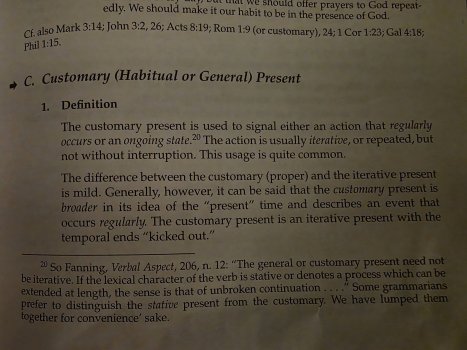
Maybe this will make sense when I get to the end of this thread, and maybe you will have responded to the points I made that have gone unanswered about the "quite common" use of present active indicative (according to an evangelical Greek scholar) to refer to states of being intended to be continued in the future (which is the only way to make sense of Mary's response to a future tense message delivered to her; otherwise, you make her and the author of the text incoherent), but let me just pause to observe how, incoherently, you simultaneously recognize that Luke 1:34 is present active indicative and then, in trying to convey what that means, you turn it into a perfect tense construction ("have not had"), the tense you say it would need to be in (combined with the subjunctive mood) to prove the doctrine. Perplexing.
 

MonoBiblical

Well-Known Member
Apr 18, 2024
1,560
257
83
52
midwest
Faith
Christian
Country
United States
All YOU did waas re-post wghat already I posted.

The evidence above PROVE that your previously-strict definition was DEAD wrong . . .
It proves you were selective and inaccurate. Animals have uioi but they don't always follow each other or even depend on each other.
 

RomeSweetHome

New Member
Sep 18, 2025
58
12
8
36
New York
Faith
Christian
Country
United States
And I can get my experts that show him wrong! Appeal to authority is a very subjective thing.

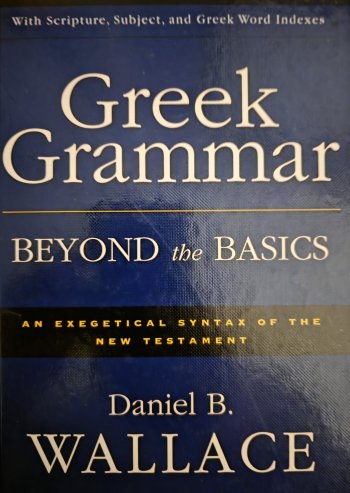
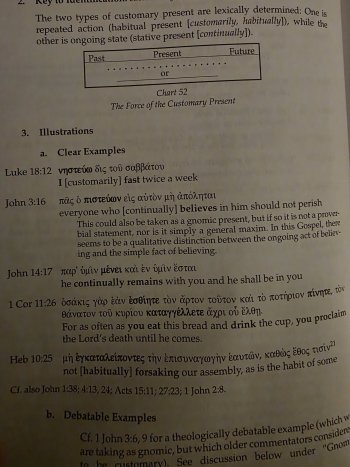
Please, marshall the evidence that contradicts Wallace's point. I am addding screenshots of the pages of his text. Greek Grammar Beyond the Basics (specifically, pp. 521-22), to help you in this endeavor.

This isn't an appeal to authority - it's to point out that you, with your supposed one year of Greek and Hebrew, respond ("Wallace needs some work") as if you know better than one of your own guys who literally wrote the book on Greek grammar (which whoever taught you Greek probably studied from, depending on when you supposedly studied it)! It's to highlight the incoherent hubris you display over and over again as we get deeper into the discussion.

Wrong again. What I wrote is the real exegesis and hermeneutic for that verse. The present tense includes past action if modified like Mary did . Once again if Mary was proclaiming hersel fto stay a virgin, God would have inspired it in the perfect active participle, as I showed you .

Your comment wasn't coherent - literally a copy paste that cut off mid sentence. So Im still not sure what you were trying to say, but your point still butchers the text - why would Mary respond to a future tense message (you will conceive) with perplexity as to how that could happen, because she had not previously known a man, even though she was about to some point soon (how you read the passage)? Her response in context *only makes sense* if her statement carries not just past and present but also future tense significance (i.e., if she is saying that she "do[es] not know man" as a matter of habit/practice, meaning not only that she has not in the past or currently "known man" but also that she has no plans to "know man" in the future).

Tense voice and mood matter, though to you maybe not so much.

The ad hominem is farcical, coming while you simultaneously make a hash of the text and respond with literal gobbledygook.

The perfect does speak of an action completed in the ast once for all! So it would have worked out in the English as Mary saying- I have not known a man, do not know and will not know- that is what the perfect does- it is a completed thought or action.

Maybe in certain instances (like when accompanied by "forever" or what have you, which obviously conveys future permanence, like one of your examples; or when the text is alluding to a permanent theological truth, kind of like the other of your examples), but not as the baseline function.

Mounce, Basics of Biblical Greek, p. 224: "the perfect indicates a completed action whose effects are felt in the speaker's present."

Wallace, Beyond the Basics, p. 573: "The force of the present tense is simply that it describes an event that, completed in the past (we are speaking of the perfect indicative here), has results existing in the present time . . . ." (You've now thrown subjunctive into the mix, so not precisely applicable, but still sharing given where we started).

Porter, Idioms of the Greek New Testament, p. 41, calls the "future" use of the perfect tense a "rare usage."

And your example of a cake is incongruent with perpetual virginity.

What?

As far as the present. Just listing the tense is totally inadequate to understand in English what Greek says. If one is talking about I tithe and there is a plan to continue, it would be written in the present active subjunctive, simply because the future in this has room for doubt. Need more than just the tense to get to know what is said.

There is an idea implicit in your arguments here that we need to bring to the surface before we can make any headway. You seem to think that there is only one way to express an idea in Greek grammar and that the authors functioned like mathematicians, selecting precisely based on the exclusive functions (or something like that). Both notions are wrong; crack open any Greek grammar worth its salt, and you will see explanations for the wide and overlapping range of functions various grammatical constructs can have and the wide range of uses apparent in the NT. Which makes your "God would have inspired" point nonsensical - God inspired what he inspired, and it's our job to make sense of it in context and in light of the grammar and usage of the day, not (in your case) superimpose our own notions of what God should have said/would have said based on half a year (or one year?) of Greek language study!

Let's go back to Luke 18, which you seem to be trying to address but don't quite. The pharisee says "I fast" and "I tithe." Present active indicative in both instances. Are you really denying what is smack-you-in-the-face obvious from the text in context? That he is bragging about his past, present, and future practices? I.e. he is saying "I have fasted twice a week in the past, that is still my practice presently, and that is my intended practice going forward, which is why I am so righteous." Ditto for tithing.

Your argument embodies precisely the sort of exegetical fallacies regarding grammar my first year (evangelical) Greek professor warned me of--ignoring the meaning of the words on the page in context and actual usage, in favor of trying to take something that might be true in some contexts but then acting as if it is universal and inexorable (here, your apparent idea that Greek authors have to use subjunctive mood to speak to future action, or something like that). I won't engage in the same ad hominems you have, except to note that it seems the same lessons were either not conveyed to you or else were lost on you.

Simply because
Greek tenses require mood and voice to fully know what is being said.

No doubt mood and tense matter. Of course they do. But this doesn't advance your argument. See comments above.

If Mary was telling of perpetual virginity- when she said I know not man- it would be perfect, active participle which rendered in full English, I have no tknown a man ever, nor will I ever be knowing a man! Write Mounce and Wallace yourself on this speicific and see if I lie or not.

See comments above. And just speaking to the incoherence of all this, now participles enter the picture? What?

 

Attachments

  • 1000014987.jpg
    1000014987.jpg
    370 KB · Views: 5
  • 20251123_202743.jpg
    20251123_202743.jpg
    376.9 KB · Views: 3
  • 20251123_202801.jpg
    20251123_202801.jpg
    378.6 KB · Views: 3
Last edited:
  • Like
Reactions: MonoBiblical

MonoBiblical

Well-Known Member
Apr 18, 2024
1,560
257
83
52
midwest
Faith
Christian
Country
United States
Now, I am not one who hates Wallace and other intermediate grammar, but I Mounce's and similar "basic" Greek grammars are complicated enough, and that the intermediate grammars are overrated. It seems that James White ignores them or uses them just as a guide.

My two cents. Hope its gold.
 

MonoBiblical

Well-Known Member
Apr 18, 2024
1,560
257
83
52
midwest
Faith
Christian
Country
United States
Please, marshall the evidence that contradicts Wallace's point. I am addding screenshots of the pages of his text (specifically, pp. 521-22)View attachment 74280


This isn't an appeal to authority - it's to point out that you, with your supposed one year of Greek and Hebrew, think you know better than one of your own guys who literally wrote the book on Greek grammar (and who whoever taught you Greek probably studied from, depending on when you supposedly studied it)!


Your comment wasn't coherent - literally a copy paste that cut off mid sentence. So Im still not sure what you were trying to say, but your point still butchers the text - why would Mary respond to a future tense message (you will conceive) with perplexity as to how that could happen, because she had not previously known a man? Her response in context *only makes sense* if her statement carries future tense significance.


The ad hominem is farcical, coming while you simultaneously make a hash of the text and respond with literal gobbledygook.


Maybe in certain instances (like when accompanied by "forever" or what have you, which obviously conveys future permanence, like one of your examples; or when the text is alluding to a permanent theological truth, kind of like the other of your examples), but not as the baseline function.

Mounce, Basics of Biblical Greek, p. 224: "the perfect indicates a completed action whose effects are felt in the speaker's present."

Wallace, Beyond the Basics, p. 573: "The force of the present tense is simply that it describes an event that, completed in the past (we are speaking of the perfect indicative here), has results existing in the present time . . . ."

Porter, Idioms of the Greek New Testament, p. 41, calls the "future" use of the perfect tense a "rare usage."


What?


There is an idea implicit in your argument that we need to bring to the surface before we can make any headway. You seem to think that there is only one way to express an idea in Greek grammar and that the authors functioned like mathematicians, selecting very precisely based on the exclusive functions (or something like that). Both notions are wrong; crack open any Greek grammar of repute, and you will see explanations for the wide and overlapping range of functions various grammatical constructs can have.

Let's go back to Luke 18, which you seem to be trying to address but still managed to ignore. The pharisee says "I fast" and "I tithe." Present active indicative in both instances. Are you really denying what is smack-you-in-the-face obvious from the text in context? That he is bragging about his past, present, and future practices? I.e. he is saying "I have fasted twice a week in the past, that is still my practice presently, and that is my intended practice going forward, which is why I am so righteous." Ditto for tithing.

Your argument embodies precisely the sort of exegetical fallacies regarding verbal grammar my first year (evangelical) Greek professor warned me of--ignoring the meaning of the words on the page in context and actual usage, in favor of trying to take something that might be true in some contexts but then acting as if it is universal and inexorable (here, your apparent idea that Greek authors have to use subjunctive mood to speak to future action, or something). I won't engage in the same ad hominems you have, except to note that it seems the same lessons were either not conveyed to you or else were lost on you.


No doubt mood and tense matter. Of course they do. But this doesn't advance your argument. See comments above.


See comments above. And just speaking to the incoherence of all this, now participles enter the picture? What?

Not something I disagree with Wallace directly on though.
 

RomeSweetHome

New Member
Sep 18, 2025
58
12
8
36
New York
Faith
Christian
Country
United States
Please, marshall the evidence that contradicts Wallace's point. I am addding screenshots of the pages of his text. Beyond the Basics of Biblical Greek (specifically, pp. 521-22), to help you in this endeavor.

This isn't an appeal to authority - it's to point out that you, with your supposed one year of Greek and Hebrew, respond ("Wallace needs some work") as if you know better than one of your own guys who literally wrote the book on Greek grammar (which whoever taught you Greek probably studied from, depending on when you supposedly studied it)! It's to highlight the incoherent hubris you display over and over again as we get deeper into the discussion.


Your comment wasn't coherent - literally a copy paste that cut off mid sentence. So Im still not sure what you were trying to say, but your point still butchers the text - why would Mary respond to a future tense message (you will conceive) with perplexity as to how that could happen, because she had not previously known a man? Her response in context *only makes sense* if her statement carries future tense significance.


The ad hominem is farcical, coming while you simultaneously make a hash of the text and respond with literal gobbledygook.


Maybe in certain instances (like when accompanied by "forever" or what have you, which obviously conveys future permanence, like one of your examples; or when the text is alluding to a permanent theological truth, kind of like the other of your examples), but not as the baseline function.

Mounce, Basics of Biblical Greek, p. 224: "the perfect indicates a completed action whose effects are felt in the speaker's present."

Wallace, Beyond the Basics, p. 573: "The force of the present tense is simply that it describes an event that, completed in the past (we are speaking of the perfect indicative here), has results existing in the present time . . . ." (You've now thrown subjunctive into the mix, so not precisely applicable, but still sharing given where we started).

Porter, Idioms of the Greek New Testament, p. 41, calls the "future" use of the perfect tense a "rare usage."


What?


There is an idea implicit in your arguments here that we need to bring to the surface before we can make any headway. You seem to think that there is only one way to express an idea in Greek grammar and that the authors functioned like mathematicians, selecting precisely based on the exclusive functions (or something like that). Both notions are wrong; crack open any Greek grammar of repute, and you will see explanations for the wide and overlapping range of functions various grammatical constructs can have and the wide range of uses apparent in the NT. Which makes your "God would have inspired" point nonsensical - God inspired what he inspired, and it's our job to make sense of it in context and in light of the grammar and usage of the day, not (in your case) superimpose our own notions of what God should have said/would have said based on half a year (or one year?) of Greek language study!

Let's go back to Luke 18, which you seem to be trying to address but don't quite. The pharisee says "I fast" and "I tithe." Present active indicative in both instances. Are you really denying what is smack-you-in-the-face obvious from the text in context? That he is bragging about his past, present, and future practices? I.e. he is saying "I have fasted twice a week in the past, that is still my practice presently, and that is my intended practice going forward, which is why I am so righteous." Ditto for tithing.

Your argument embodies precisely the sort of exegetical fallacies regarding grammar my first year (evangelical) Greek professor warned me of--ignoring the meaning of the words on the page in context and actual usage, in favor of trying to take something that might be true in some contexts but then acting as if it is universal and inexorable (here, your apparent idea that Greek authors have to use subjunctive mood to speak to future action, or something like that). I won't engage in the same ad hominems you have, except to note that it seems the same lessons were either not conveyed to you or else were lost on you.


No doubt mood and tense matter. Of course they do. But this doesn't advance your argument. See comments above.


See comments above. And just speaking to the incoherence of all this, now participles enter the picture? What?
Looks like the screenshots got clipped. O well. Buy the book, and then find someone to walk through it with you - it'd do you a world of good!
 

MonoBiblical

Well-Known Member
Apr 18, 2024
1,560
257
83
52
midwest
Faith
Christian
Country
United States
Looks like the screenshots got clipped. O well. Buy the book, and then find someone to walk through it with you - it'd do you a world of good!
I don't think you understand that the non-aorist present tense is always continuous. Thus, "I am fasting" which is continuous in English gets a better Greek meaning.

Cheers.

And your example of a cake is incongruent with perpetual virginity.
RomeSweetRome says:
What?

The someone does not believe in a perpetual virginity, but rather perpetual chastity. Just to clarify.
 
Last edited:

RomeSweetHome

New Member
Sep 18, 2025
58
12
8
36
New York
Faith
Christian
Country
United States
Now, I am not one who hates Wallace and other intermediate grammar, but I Mounce's and similar "basic" Greek grammars are complicated enough, and that the intermediate grammars are overrated. It seems that James White ignores them or uses them just as a guide.

My two cents. Hope its gold.

I mean, definitely just guides to doing the language work oneself as the ultimate goal, for sure. And no grammarian is infallible, of course. But helpful. And I am trying to cite to Protestant (specifically evangelical) authorities and avoid citing to Catholic authorities whenever possible, given that seems to be the rules that have been laid down here by others.
 
  • Like
Reactions: MonoBiblical

RomeSweetHome

New Member
Sep 18, 2025
58
12
8
36
New York
Faith
Christian
Country
United States
Nope! I simply used Greek dictionaries, Lexicons and linguistic study guides to show me. Once again if jesus brothers are cousins then this is how this passage would read:

You move goalposts as a pastime. It's comically bad faith by you.

I gave you actual usage across the Koine period through to the NT time. Then you said give me dictionaries/lexicons and I'd "have a leg to stand on." Silly as that request was, I did. Now those are treated as if irrelevant.

Now do John 19:25 again, this time addressing the text in context (and see my other recent comments on that for more).

And also address how, with a few (and almost uniformly heretical, for reasons we'd agree on) exceptions, Christians for 16 centuries, starting (outside the NT authors themselves) with Ignatius (50-115 AD or so) and Polycarp (70-150 AD or so) and a bevy of others down the ages through all the way to past the Protestant Reformation, believed this; especially the early figures, who would've been alive at the time and would've known or would've been just a generation or two removed. And let's add another data point to the mix--explain how Origen could recognize by the middle of the third century, no later than about 250 AD, that the belief in the perpetual virginity was so established and accepted that no "right thinking" (i.e., orthodox) Christian would disagree.

All this, well before your supposed Constantinian corruption of true Christianity post-313, I would point out.
 
  • Like
Reactions: Wrangler

MonoBiblical

Well-Known Member
Apr 18, 2024
1,560
257
83
52
midwest
Faith
Christian
Country
United States
You move goalposts as a pastime. It's comically bad faith by you.

I gave you actual usage across the Koine period through to the NT time. Then you said give me dictionaries/lexicons and I'd "have a leg to stand on." Silly as that request was, I did. Now those are treated as if irrelevant.

Now do John 19:25 again, this time addressing the text in context (and see my other recent comments on that for more).

And also address how, with a few (and almost uniformly heretical, for reasons we'd agree on) exceptions, Christians for 16 centuries, starting (outside the NT authors themselves) with Ignatius (50-115 AD or so) and Polycarp (70-150 AD or so) and a bevy of others down the ages through all the way to past the Protestant Reformation, believed this; especially the early figures, who would've been alive at the time and would've known or would've been just a generation or two removed. And let's add another data point to the mix--explain how Origen could recognize by the middle of the third century, no later than about 250 AD, that the belief in the perpetual virginity was so established and accepted that no "right thinking" (i.e., orthodox) Christian would disagree.

All this, well before your supposed Constantinian corruption of true Christianity post-313, I would point out.
With Origen, there comes much forgery. He was a proto-Arian heretic. I have reconstructed his beliefs based on rumors and what the Arians believed.
 

RomeSweetHome

New Member
Sep 18, 2025
58
12
8
36
New York
Faith
Christian
Country
United States
And you are overlooking the fact that John had no home of his own. He was a teen when He was called to be with Jesus. Did not have a home to take her to and was an Apostle so he was a road warrior. And we have no record of Hom having a wife either. So it makes it very hard for John to be the one. But as Lazarus is the onl;y named disciple whom it is written that Jesus loved. He did have a home and did have the ability to take her to a home and care for her. Once again Jesus as the eldest son of Mary decided who got her if he considered his younger brethren unworthy.


Though this does not speak directly, it shows the eldest son has great leeway in apportioning the proerty of the estate upon his death (and yes a mother was considered property just like daughters)

Exercises in missing the point.

Whoever is the beloved disciple, the point remains--Jesus wouldn't have needed to give his mother a new, adopted son, if she had another son (one who quickly became a believer after the resurrection, 1 Corinthians 15:7). And historically speaking, he likely wouldn't have, if she had another son.

In any event, I'll spot you that, standing alone, this doesn't dictate itself one way or the other absolutely (but I stand by it because, at minimum, it is certainly more consistent with the perpetual virginity than it is with the evangelical protestant view (apparent by your speculation in your comments on this thus far), as Christians throughout history have had no trouble recognizing). And the dogma is made unmistakable by Luke 1 and the overwhelming history. So we can focus on those other points for now.
 
Last edited: