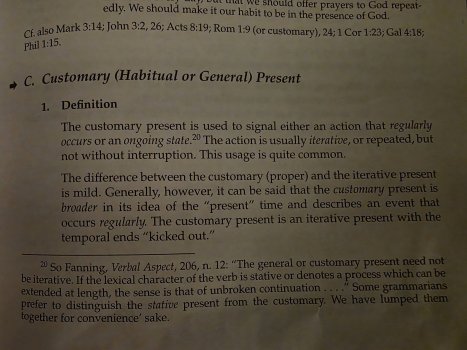
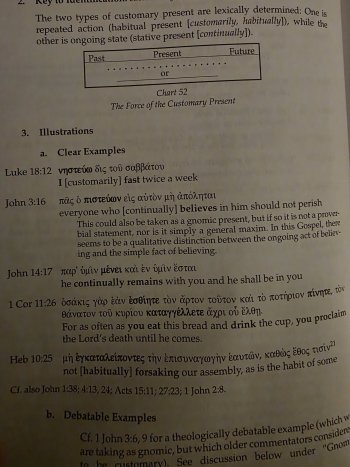
Please, marshall the evidence that contradicts Wallace's point. I am addding screenshots of the pages of his text (specifically, pp. 521-22)
View attachment 74280
This isn't an appeal to authority - it's to point out that you, with your supposed one year of Greek and Hebrew, think you know better than one of your own guys who literally wrote the book on Greek grammar (and who whoever taught you Greek probably studied from, depending on when you supposedly studied it)!
Your comment wasn't coherent - literally a copy paste that cut off mid sentence. So Im still not sure what you were trying to say, but your point still butchers the text - why would Mary respond to a future tense message (you will conceive) with perplexity as to how that could happen, because she had not previously known a man? Her response in context *only makes sense* if her statement carries future tense significance.
The ad hominem is farcical, coming while you simultaneously make a hash of the text and respond with literal gobbledygook.
Maybe in certain instances (like when accompanied by "forever" or what have you, which obviously conveys future permanence, like one of your examples; or when the text is alluding to a permanent theological truth, kind of like the other of your examples), but not as the baseline function.
Mounce, Basics of Biblical Greek, p. 224: "the perfect indicates a completed action whose effects are felt in the speaker's present."
Wallace, Beyond the Basics, p. 573: "The force of the present tense is simply that it describes an event that, completed in the past (we are speaking of the perfect indicative here), has results existing in the present time . . . ."
Porter, Idioms of the Greek New Testament, p. 41, calls the "future" use of the perfect tense a "rare usage."
What?
There is an idea implicit in your argument that we need to bring to the surface before we can make any headway. You seem to think that there is only one way to express an idea in Greek grammar and that the authors functioned like mathematicians, selecting very precisely based on the exclusive functions (or something like that). Both notions are wrong; crack open any Greek grammar of repute, and you will see explanations for the wide and overlapping range of functions various grammatical constructs can have.
Let's go back to Luke 18, which you seem to be trying to address but still managed to ignore. The pharisee says "I fast" and "I tithe." Present active indicative in both instances. Are you really denying what is smack-you-in-the-face obvious from the text in context? That he is bragging about his past, present, and future practices? I.e. he is saying "I have fasted twice a week in the past, that is still my practice presently, and that is my intended practice going forward, which is why I am so righteous." Ditto for tithing.
Your argument embodies precisely the sort of exegetical fallacies regarding verbal grammar my first year (evangelical) Greek professor warned me of--ignoring the meaning of the words on the page in context and actual usage, in favor of trying to take something that might be true in some contexts but then acting as if it is universal and inexorable (here, your apparent idea that Greek authors have to use subjunctive mood to speak to future action, or something). I won't engage in the same ad hominems you have, except to note that it seems the same lessons were either not conveyed to you or else were lost on you.
No doubt mood and tense matter. Of course they do. But this doesn't advance your argument. See comments above.
See comments above. And just speaking to the incoherence of all this, now participles enter the picture? What?