Most Likely, You’ve Never Read the True Bible in English

  • Welcome to Christian Forums, a Christian Forum that recognizes that all Christians are a work in progress.

    You will need to register to be able to join in fellowship with Christians all over the world.

    We hope to see you as a part of our community soon and God Bless!

JLB

Well-Known Member
Mar 25, 2012
1,307
537
113
Spring Texas
Faith
Christian
Country
United States
Gender
Male
You’re mixing up three completely different decrees and three different historical moments. Let’s just look at the facts and the actual text:

1. In the Old Testament there is a prophet named Daniel. Around 600 years before Jesus, he received a prophecy that exactly 483 years (69 × 7) after a certain royal decree, the Messiah would appear (Daniel 9:25-26).

Daniel the Prophet was inspired by the Lord to understand that the time for the release of the children of Israel from captivity, according to what the Lord spoke through Jeremiah was at hand.

Daniel starting fasting and praying for that very thing.

In the first year of Darius the son of Ahasuerus, of the lineage of the Medes, who was made king over the realm of the Chaldeans— in the first year of his reign I, Daniel, understood by the books the number of the years specified by the word of the LORD through Jeremiah the prophet, that He would accomplish seventy years in the desolations of Jerusalem. Daniel 9:1-2

Darius the son of Ahasuerus, who was referred to as Darius the Mede, and was the Persian king who took over as the world ruling king from the king of Babylon, specifically Nebuchadnezzar's son, Belshazzar.

Darius the Mede is the king who put Daniel in the Lion's den.

Cyrus was to come to power soon after this king, and would give the decree to restore and rebuild the city and the temple.
 

Chrysostomos

Well-Known Member
Apr 5, 2025
864
309
63
Kiev
Faith
Christian
Country
Ukraine
Daniel the Prophet was inspired by the Lord to understand that the time for the release of the children of Israel from captivity, according to what the Lord spoke through Jeremiah was at hand.

Daniel starting fasting and praying for that very thing.

In the first year of Darius the son of Ahasuerus, of the lineage of the Medes, who was made king over the realm of the Chaldeans— in the first year of his reign I, Daniel, understood by the books the number of the years specified by the word of the LORD through Jeremiah the prophet, that He would accomplish seventy years in the desolations of Jerusalem. Daniel 9:1-2

Darius the son of Ahasuerus, who was referred to as Darius the Mede, and was the Persian king who took over as the world ruling king from the king of Babylon, specifically Nebuchadnezzar's son, Belshazzar.

Darius the Mede is the king who put Daniel in the Lion's den.

Cyrus was to come to power soon after this king, and would give the decree to restore and rebuild the city and the temple.
1. Daniel 9:1-2
Yes, Daniel was reading Jeremiah’s prophecy about the 70 years of Jerusalem’s desolation and was praying for that exact thing to be fulfilled.
→ That is a separate prophecy about the 70-year Babylonian captivity (Jer 25:11-12; 29:10).

2. In Daniel 9:24-27 God gives Daniel a new, much longer prophecy — the 70 weeks (490 years) — which begins not with the end of the 70-year captivity, but from
“the going forth of the commandment to restore and to build Jerusalem” (the city and its walls).
This is a completely different countdown and a different decree.

3. Jeremiah’s 70 years really did end with Cyrus’s decree in 538 BC — that fulfilled the captivity.
But Daniel 9:25 does not say “from the end of the 70 years of captivity.”
It says: “from the going forth of the commandment to restore and build Jerusalem.”
Jerusalem as a functioning city with walls was only restored in 457–445 BC (the decrees to Ezra and Nehemiah under Artaxerxes).

4. In plain language: Jeremiah’s 70 years → captivity ends → Cyrus’s decree (temple only) → 538 BC
Daniel’s 70 weeks → new countdown → restoration of the city and walls → Artaxerxes’s decree 457 BC → exactly 483 years → Jesus in AD 27

You’re mixing two different prophecies and two different decrees.
The Bible itself clearly separates them: the 70 years of captivity ended with Cyrus, but the 70 weeks begin with the decree to restore the city — and that decree only came in the 20th year of Artaxerxes.That’s why the starting point of the 70 weeks is not Cyrus and not the end of the 70-year captivity, but the decree of 457/458 BC.
Anything else is trying to join what Scripture deliberately keeps separate.

This is the classic mistake almost everyone makes who doesn’t want the prophecy to point to Jesus.
That’s why they simply mix up two completely different prophecies and two different decrees.
It’s like saying: “Daniel was praying about the end of the captivity → therefore everything written later in chapter 9 must also be about the end of the captivity.” But that’s not true.
God gave him a new, much longer prophecy, and its starting point is explicitly tied to the decree “to restore and rebuild Jerusalem” (the city and its walls), not the temple.
 

Ronald Nolette

Well-Known Member
Aug 24, 2020
16,509
4,788
113
71
South Carolina
Faith
Christian
Country
United States
Gender
Male
Have you ever questioned the accuracy of your English Bible? Most popular translations of the Old Testament, like the King James Version (KJV), New International Version (NIV), and English Standard Version (ESV), are based on the Masoretic Text (MT), a Hebrew version of the Tanakh (the Jewish Bible, equivalent to the Old Testament) standardized by Jewish scholars between the 7th and 10th centuries AD, but edited as early as the 1st–2nd centuries AD after the destruction of the Second Temple (70 AD). Evidence suggests these edits deliberately shortened the chronology of the patriarchs in Genesis 5 and 11, obscuring messianic prophecies like the 70 weeks in Daniel 9:24–27, which points to Jesus Christ. In contrast, the Septuagint (LXX), a Greek translation from the 3rd–2nd centuries BC, aligns closely with His life and ministry.

In Genesis 11, the Masoretic Text records Arphaxad fathering Shelah at age 35, while the Septuagint says 135—a 100-year difference. This pattern repeats across patriarchs, making the timeline from Adam to Abraham 1,948 years in the MT versus ~3,312 years in the LXX, a gap of 1,300–1,500 years. Why does this matter? The Septuagint’s longer timeline better matches archaeological evidence, such as the dating of Egypt’s pyramids (2600 BC) or Sumerian civilization (4000–3500 BC), lending credibility to the biblical narrative. More crucially, it supports the prophecy of Daniel’s 70 weeks. Starting from Artaxerxes I’s decree in 458 BC (Ezra 7:11–26), the 7 + 62 weeks (483 years) end in 26/27 AD, coinciding with Jesus’ baptism. The final week (7 years) covers His ministry and crucifixion (30–33 AD). The Masoretic Text’s shorter timeline and less explicit wording (“anointed one” vs. “Christ” in the LXX) make this prophecy less clear, potentially leading readers to doubt its connection to Jesus.

Why did Jewish scholars alter the Masoretic Text? Likely to weaken messianic interpretations after Christianity’s rise, as the Septuagint’s chronology clearly points to Jesus. So why did English translators, following the Catholic Vulgate (4th century), use the Masoretic Text instead of the Septuagint, which was quoted in the New Testament and used by early Christians? Jerome, who translated the Vulgate, prioritized Hebrew manuscripts (Hebraica veritas), possibly to align with Jewish communities or standardize the text. Yet, the Dead Sea Scrolls show the Septuagint often reflects older Hebrew texts, suggesting it’s more reliable. Most English Bibles inherit this choice, obscuring the prophecy’s clarity.

Fortunately, a few English translations do justice to the Septuagint’s chronology and wording, preserving its alignment with Jesus as the Messiah. These include:
Brenton’s Septuagint (1844)
New English Translation of the Septuagint (NETS) (2007)
Orthodox Study Bible (2008)

Sadly, these translations are rare, and most English-speaking Christians are unaware of them, relying instead on Masoretic-based Bibles that obscure the full clarity of prophecies like Daniel’s 70 weeks. This raises a critical question: if the Septuagint offers a more accurate timeline pointing to Jesus, why do we continue using translations that muddy the waters?

Well we m ust remember that the OT was originally written in Hebrew. The LXX is a translation!

And I do not buy the chronologies of Egypt and Sumerian or any other secular set. Many have been shown to be altered by the civilizations themselves for their own glory.

I fully trust Scripture that we have been here c. 6,000 years +or -
 

Chrysostomos

Well-Known Member
Apr 5, 2025
864
309
63
Kiev
Faith
Christian
Country
Ukraine
Well we m ust remember that the OT was originally written in Hebrew. The LXX is a translation!

And I do not buy the chronologies of Egypt and Sumerian or any other secular set. Many have been shown to be altered by the civilizations themselves for their own glory.

I fully trust Scripture that we have been here c. 6,000 years +or -
That position creates more problems than it solves.

The Septuagint is NOT just “a translation made yesterday.”
It was translated from Hebrew texts that existed 700–900 years BEFORE the Masoretic Text was standardized.
The Dead Sea Scrolls (which pre-date the MT by 800–1000 years) contain fragments that agree with the LXX chronology, not the MT.

So we’re not choosing “Greek translation” over “Hebrew original” — we’re choosing older Hebrew manuscripts (reflected in LXX) over later medieval Hebrew manuscripts (MT).

You say you “don’t buy” Egyptian and Sumerian dates because “many have been shown to be altered by the civilizations themselves for their own glory.”

That’s a common claim, but the actual Egyptian chronology is built on hundreds of synchronized king-lists,
astronomical observations written into the records (Sothic cycles, lunar dates),
links with Assyrian and Babylonian records that line up perfectly.

It’s not just one pharaoh or one dynasty that could have padded their numbers.
Egyptian chronology is built on thousands of independent documents, astronomical observations, king-lists, private contracts, scarab seals, carbon-14 dates from dozens of sites, and cross-links with Assyrian and Babylonian records — and they all line up with each other.
To reject that, you have to claim a perfectly coordinated 4,000-year global forgery. That’s simply not realistic.

That’s a much bigger leap of faith than simply admitting the Masoretic scribes shortened Genesis 5 & 11.

So we don’t have to call thousands of ancient records and modern scientific measurements a giant lie.
We only have to recognize that the Masoretic numbers in Genesis 5 & 11 were shortened centuries after Christ ( deliberately, to distance the timeline from Jesus).
The Septuagint and the pre-Masoretic Hebrew texts preserved the original longer (and historically accurate) chronology.
 

Wick Stick

Well-Known Member
Sep 21, 2023
2,424
1,486
113
46
Phoenix
Faith
Christian
Country
United States
Have you ever questioned the accuracy of your English Bible? Most popular translations of the Old Testament, like the King James Version (KJV), New International Version (NIV), and English Standard Version (ESV), are based on the Masoretic Text (MT), a Hebrew version of the Tanakh (the Jewish Bible, equivalent to the Old Testament) standardized by Jewish scholars between the 7th and 10th centuries AD, but edited as early as the 1st–2nd centuries AD after the destruction of the Second Temple (70 AD). Evidence suggests these edits deliberately shortened the chronology of the patriarchs in Genesis 5 and 11, obscuring messianic prophecies like the 70 weeks in Daniel 9:24–27, which points to Jesus Christ. In contrast, the Septuagint (LXX), a Greek translation from the 3rd–2nd centuries BC, aligns closely with His life and ministry.

In Genesis 11, the Masoretic Text records Arphaxad fathering Shelah at age 35, while the Septuagint says 135—a 100-year difference. This pattern repeats across patriarchs, making the timeline from Adam to Abraham 1,948 years in the MT versus ~3,312 years in the LXX, a gap of 1,300–1,500 years. Why does this matter? The Septuagint’s longer timeline better matches archaeological evidence, such as the dating of Egypt’s pyramids (2600 BC) or Sumerian civilization (4000–3500 BC), lending credibility to the biblical narrative. More crucially, it supports the prophecy of Daniel’s 70 weeks. Starting from Artaxerxes I’s decree in 458 BC (Ezra 7:11–26), the 7 + 62 weeks (483 years) end in 26/27 AD, coinciding with Jesus’ baptism. The final week (7 years) covers His ministry and crucifixion (30–33 AD). The Masoretic Text’s shorter timeline and less explicit wording (“anointed one” vs. “Christ” in the LXX) make this prophecy less clear, potentially leading readers to doubt its connection to Jesus.

Why did Jewish scholars alter the Masoretic Text? Likely to weaken messianic interpretations after Christianity’s rise, as the Septuagint’s chronology clearly points to Jesus. So why did English translators, following the Catholic Vulgate (4th century), use the Masoretic Text instead of the Septuagint, which was quoted in the New Testament and used by early Christians? Jerome, who translated the Vulgate, prioritized Hebrew manuscripts (Hebraica veritas), possibly to align with Jewish communities or standardize the text. Yet, the Dead Sea Scrolls show the Septuagint often reflects older Hebrew texts, suggesting it’s more reliable. Most English Bibles inherit this choice, obscuring the prophecy’s clarity.

Fortunately, a few English translations do justice to the Septuagint’s chronology and wording, preserving its alignment with Jesus as the Messiah. These include:
Brenton’s Septuagint (1844)
New English Translation of the Septuagint (NETS) (2007)
Orthodox Study Bible (2008)

Sadly, these translations are rare, and most English-speaking Christians are unaware of them, relying instead on Masoretic-based Bibles that obscure the full clarity of prophecies like Daniel’s 70 weeks. This raises a critical question: if the Septuagint offers a more accurate timeline pointing to Jesus, why do we continue using translations that muddy the waters?

First, good post. The anti-Christian bias of the Masoretes and how it has influenced our Bibles in a bad way is something that is rarely recognized.

However, the undermining of Biblical chronology should be a relatively minor concern. The New Testament ALSO undermines the chronology of the Old Testament. Paul twice tells us to ignore the genealogies there. Jesus teaches a different method of determining heredity (instead of genealogies).
 

cardiologist

New Member
Nov 28, 2025
18
6
3
Rhein Main
Faith
Christian
Country
Germany
Gender
Male
So why did English translators, following the Catholic Vulgate (4th century), use the Masoretic Text instead of the Septuagint, which was quoted in the New Testament and used by early Christians?

How do you prove that the New Testament quotes the "Septuagint"?
 

shepherdsword

Encounter Team - Eagle
Staff member
Encounter Team
Feb 12, 2009
2,034
1,631
113
Millington
Faith
Christian
Country
United States
Gender
Male
Have you ever questioned the accuracy of your English Bible? Most popular translations of the Old Testament, like the King James Version (KJV), New International Version (NIV), and English Standard Version (ESV), are based on the Masoretic Text (MT), a Hebrew version of the Tanakh (the Jewish Bible, equivalent to the Old Testament) standardized by Jewish scholars between the 7th and 10th centuries AD, but edited as early as the 1st–2nd centuries AD after the destruction of the Second Temple (70 AD). Evidence suggests these edits deliberately shortened the chronology of the patriarchs in Genesis 5 and 11, obscuring messianic prophecies like the 70 weeks in Daniel 9:24–27, which points to Jesus Christ. In contrast, the Septuagint (LXX), a Greek translation from the 3rd–2nd centuries BC, aligns closely with His life and ministry.

In Genesis 11, the Masoretic Text records Arphaxad fathering Shelah at age 35, while the Septuagint says 135—a 100-year difference. This pattern repeats across patriarchs, making the timeline from Adam to Abraham 1,948 years in the MT versus ~3,312 years in the LXX, a gap of 1,300–1,500 years. Why does this matter? The Septuagint’s longer timeline better matches archaeological evidence, such as the dating of Egypt’s pyramids (2600 BC) or Sumerian civilization (4000–3500 BC), lending credibility to the biblical narrative. More crucially, it supports the prophecy of Daniel’s 70 weeks. Starting from Artaxerxes I’s decree in 458 BC (Ezra 7:11–26), the 7 + 62 weeks (483 years) end in 26/27 AD, coinciding with Jesus’ baptism. The final week (7 years) covers His ministry and crucifixion (30–33 AD). The Masoretic Text’s shorter timeline and less explicit wording (“anointed one” vs. “Christ” in the LXX) make this prophecy less clear, potentially leading readers to doubt its connection to Jesus.

Why did Jewish scholars alter the Masoretic Text? Likely to weaken messianic interpretations after Christianity’s rise, as the Septuagint’s chronology clearly points to Jesus. So why did English translators, following the Catholic Vulgate (4th century), use the Masoretic Text instead of the Septuagint, which was quoted in the New Testament and used by early Christians? Jerome, who translated the Vulgate, prioritized Hebrew manuscripts (Hebraica veritas), possibly to align with Jewish communities or standardize the text. Yet, the Dead Sea Scrolls show the Septuagint often reflects older Hebrew texts, suggesting it’s more reliable. Most English Bibles inherit this choice, obscuring the prophecy’s clarity.

Fortunately, a few English translations do justice to the Septuagint’s chronology and wording, preserving its alignment with Jesus as the Messiah. These include:
Brenton’s Septuagint (1844)
New English Translation of the Septuagint (NETS) (2007)
Orthodox Study Bible (2008)

Sadly, these translations are rare, and most English-speaking Christians are unaware of them, relying instead on Masoretic-based Bibles that obscure the full clarity of prophecies like Daniel’s 70 weeks. This raises a critical question: if the Septuagint offers a more accurate timeline pointing to Jesus, why do we continue using translations that muddy the waters?
Neither the Septuagint (LXX) nor the Masoretic Text (MT) is “more accurate” in every case.

Sometimes the Masoretic Text preserves the original Hebrew better.
Sometimes the Septuagint preserves the older reading better.
The Dead Sea Scrolls (DSS) prove this.
Below is the clearest and most scholarly-accurate explanation.

⭐ 1. The Masoretic Text is generally the most carefully preserved Hebrew text

The MT (finalized ~7th–10th century CE) reflects a very ancient Hebrew tradition that the Dead Sea Scrolls show existed centuries earlier.

MT is usually more accurate in:

  • Torah (Genesis, Exodus, Leviticus, Numbers, Deuteronomy)
  • Ezekiel
  • Minor Prophets
  • Most Psalms
These books in the DSS are very close to the MT, confirming its reliability.
So the MT is usually the best base text for the Hebrew Bible.

⭐ 2. BUT in some books the Septuagint preserves an older or better version

The Septuagint began ~250–100 BCE.
It was translated from Hebrew manuscripts older than the MT.
In some books, the Hebrew behind the LXX (now lost) is preserved in the DSS — proving that the LXX sometimes reflects an earlier Hebrew text than the MT.

LXX is often more accurate in:

  • Jeremiah → LXX is shorter by ~13%; DSS confirms this shorter Hebrew text existed.
  • 1 Samuel → DSS confirm LXX sometimes preserves the correct wording where MT is damaged.
  • Daniel → LXX has older versions of parts of the text.
  • Job → LXX is ~1/6 shorter; DSS show Hebrew variants existed.
So LXX is sometimes closer to the original Hebrew than the MT.

⭐ 3. The Dead Sea Scrolls show that there was NO single “original” Hebrew text

The DSS (200–50 BCE) reveal three parallel Hebrew traditions:

Hebrew TypeLater Representative% in DSS
Proto-MasoreticMT~45–50%
Proto-SeptuagintLXX~20–25%
Qumran-styleunique~25%

This means:

  • The Masoretic Text represents only one ancient tradition.
  • The Septuagint represents another ancient tradition.
  • Neither is universally “better.”

⭐ 4. Which one should be treated as “most accurate”?

✔️ For Jewish Scripture and most Christian translationsMT is the base text

Because:
  • It is consistent
  • It is carefully preserved
  • It reflects a single stabilized textual tradition after 100 CE

✔️ For textual criticism (finding the oldest or original wording)Both MT and LXX must be compared

Because:
  • In certain passages, the LXX preserves the earlier Hebrew
  • DSS often validate the LXX’s underlying readings
  • In other passages, MT is clearly superior
Serious scholars use BOTH.

⭐ 5. Practical summary: Which is “more accurate”?

✔️ Most books:

Masoretic Text is more accurate.

✔️ Some books (Jeremiah, Samuel, Job, parts of Daniel):

Septuagint preserves the older form.

✔️ Best approach:

Masoretic Text + Septuagint + Dead Sea Scrolls together give the most accurate reconstruction.
 

Ronald Nolette

Well-Known Member
Aug 24, 2020
16,509
4,788
113
71
South Carolina
Faith
Christian
Country
United States
Gender
Male
So we don’t have to call thousands of ancient records and modern scientific measurements a giant lie.
We only have to recognize that the Masoretic numbers in Genesis 5 & 11 were shortened centuries after Christ ( deliberately, to distance the timeline from Jesus).
The Septuagint and the pre-Masoretic Hebrew texts preserved the original longer (and historically accurate) chronology.
And your proof of this is?

You should do a study on how the Jewish scribes throughout the ages wrote and checked the Scriptures after copying them. You would have far more confidence in the Masoretic text than the LXX then.

Remember the dead Sea scrolls were from Essenes.


Were the Essenes a heretical sect of Judaism?​

The Essenes, also known as the Essenians, were a distinct Jewish sect during the Second Temple period. They were known for their ascetic lifestyle, communal living, and strict adherence to purity laws. The Essenes were distinct from other Jewish groups of the time, such as the Pharisees, Sadducees, and Zealots. Their practices, beliefs, and influence have become increasingly significant, particularly with the discovery of the Dead Sea Scrolls, which many scholars attribute to the Essene community. The Essenes were never numerous; Pliny fixed their number at some 4,000 in his day. Like the Pharisees, the Essenes meticulously observed the Law of Moses, the sabbath, and ritual purity. They also professed belief in immortality and divine punishment for sin. However, unlike the Pharisees, the Essenes denied the resurrection of the body and refused to immerse themselves in public life. With few exceptions, they shunned Temple worship and were content to live ascetic lives of manual labor in seclusion. The sabbath was reserved for day-long prayer and meditation on the Torah (first five books of the Bible). Oaths were frowned upon, but once taken they could not be rescinded. After a year’s probation, proselytes received their Essenian emblems but could not participate in common meals for two more years. Those who qualified for membership were called upon to swear piety to God, justice toward men, hatred of falsehood, love of truth, and faithful observance of all other tenets of the Essene sect. Thereafter new converts were allowed to take their noon and evening meals in silence with the others. Following the discovery of the Dead Sea Scrolls (late 1940s and 1950s) in the vicinity of Khirbat Qumrān, most scholars have agreed that the Qumrān community was Essenian

While not necessarily heretical, they were a very esoteric sect. And as some of the non-biblical scrolls showed , they had a verydiffering lifestyle- like some of the extreme monks of the Roman church.
 

Jack

Well-Known Member
May 3, 2022
15,801
5,941
113
Midwest
Faith
Christian
Country
United States
'Christians' attack our Bible because they don't like what God said!
 

Wick Stick

Well-Known Member
Sep 21, 2023
2,424
1,486
113
46
Phoenix
Faith
Christian
Country
United States
How do you prove that the New Testament quotes the "Septuagint"?
There are several places where the Masoretic interpretation of the Hebrew text doesn't agree with the Septuagint translation of it. The New Testament follows the Septuagint where they diverge.

The classic example is Matthew quoting Isaiah "the virgin shall be with child." The Septuagint has the word "virgin" (Gr: parthenos), while the Hebrew word used there actually means "veiled woman," rather than virgin.
 

cardiologist

New Member
Nov 28, 2025
18
6
3
Rhein Main
Faith
Christian
Country
Germany
Gender
Male
The classic example is Matthew quoting Isaiah "the virgin shall be with child." The Septuagint has the word "virgin" (Gr: parthenos), while the Hebrew word used there actually means "veiled woman," rather than virgin.

What is a "veiled women", in the ancient near east, but a woman whom no man had known? The word does indeed have such a meaning, but it was the custom of that time and culture to keep women of any esteem from the common or public conversation. They were kept hidden.

And so you will find in the bible, that Isaacs future wife Rebekah is called with that very name "Almah" (in Genesis 24:43), of whom it is expressly said, that she was a virgin, and that no man had known her (in Genesis 24:16).

So that argument doesn't hold.

But you also said:
There are several places where the Masoretic interpretation of the Hebrew text doesn't agree with the Septuagint translation of it. The New Testament follows the Septuagint where they diverge.

Here, for all the alleged places, I would like to have some proof that the New Testament writers actually quote the "Septuagint".
 

ProDeo

Well-Known Member
Nov 20, 2024
1,813
1,503
113
51
Deventer
Faith
Christian
Country
Netherlands
LXX is often more accurate in:
  • Jeremiah → LXX is shorter by ~13%; DSS confirms this shorter Hebrew text existed.
  • 1 Samuel → DSS confirm LXX sometimes preserves the correct wording where MT is damaged.
  • Daniel → LXX has older versions of parts of the text.
  • Job → LXX is ~1/6 shorter; DSS show Hebrew variants existed.
So LXX is sometimes closer to the original Hebrew than the MT.

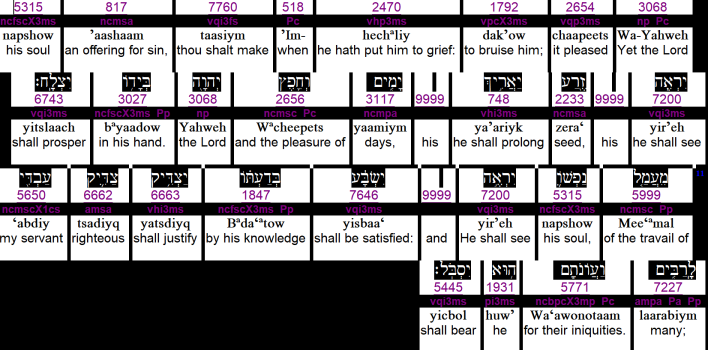
Masoretic Text Septuagint / LXX Isa 53:10 Yet it was the will of the LORD to crush | 10 The Lord also is pleased to purge him from his | him; he has put him to grief; when his soul makes an | stroke. If ye can give an offering for sin, your | offering for guilt, he shall see his offspring; he | soul shall see a long-lived seed: | shall prolong his days; the will of the LORD shall | | prosper in his hand. | |

What about Isa 53:10, which version do you think is correct ?

Quite an importance verse.

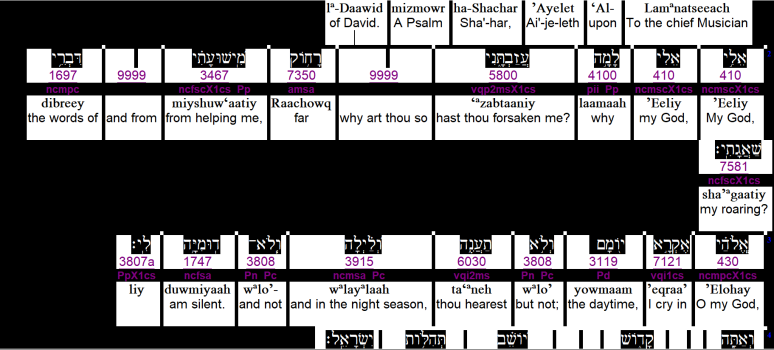
And there is another quite important one, Psalm 22 which is about Christ in the Masoretic Text, but in the LXX it's about David.

2 O God, my God, attend to me: why hast thou forsaken me? the account of my transgressions is far from my salvation.

The the account of my transgressions can't be about Christ.
 

cardiologist

New Member
Nov 28, 2025
18
6
3
Rhein Main
Faith
Christian
Country
Germany
Gender
Male
The classic example is Matthew quoting Isaiah "the virgin shall be with child." The Septuagint has the word "virgin" (Gr: parthenos), while the Hebrew word used there actually means "veiled woman," rather than virgin.

And by the way, suppose that Isaiah meant to say anything but a virgin. What sign would that be? It's the ordinary course of nature for a woman to conceive a child.

What about Isa 53:10, which version do you think is correct ?

It's always the Hebrew.

The the account of my transgressions can't be about Christ.

Why then do you think Jesus quotes this Psalm when dying on the cross? Why does he cry out 'My God, My God, why hast thou forsaken me'?
 
  • Like
Reactions: David Lamb

cardiologist

New Member
Nov 28, 2025
18
6
3
Rhein Main
Faith
Christian
Country
Germany
Gender
Male
@ProDeo

Look, Psalm 40 is also attributed to Jesus in the New Testament. But look what it says, Verse 12:

For evils have encompassed me beyond number; my iniquities have overtaken me, and I cannot see; they are more than the hairs of my head; my heart fails me.
 

shepherdsword

Encounter Team - Eagle
Staff member
Encounter Team
Feb 12, 2009
2,034
1,631
113
Millington
Faith
Christian
Country
United States
Gender
Male
Masoretic Text Septuagint / LXX Isa 53:10 Yet it was the will of the LORD to crush | 10 The Lord also is pleased to purge him from his | him; he has put him to grief; when his soul makes an | stroke. If ye can give an offering for sin, your | offering for guilt, he shall see his offspring; he | soul shall see a long-lived seed: | shall prolong his days; the will of the LORD shall | | prosper in his hand. | |

What about Isa 53:10, which version do you think is correct ?

Quite an importance verse.
Here is the actual Masoretic text:
1764411548028.png


And there is another quite important one, Psalm 22 which is about Christ in the Masoretic Text, but in the LXX it's about David.

2 O God, my God, attend to me: why hast thou forsaken me? the account of my transgressions is far from my salvation.

The the account of my transgressions can't be about Christ.
"the account of my transgressions " is not in the actual Masoretic text. That's just a bad translation of the text:

1764411687936.png
 

ProDeo

Well-Known Member
Nov 20, 2024
1,813
1,503
113
51
Deventer
Faith
Christian
Country
Netherlands
@shepherdsword , @cardiologist

The question was, what to believe, the Septuagint used in the time of Jesus, the NT is based on OR the Masoretic Text, created in the 10th century and in use today.
 

JLB

Well-Known Member
Mar 25, 2012
1,307
537
113
Spring Texas
Faith
Christian
Country
United States
Gender
Male
In Daniel 9:24-27 God gives Daniel a new, much longer prophecy — the 70 weeks (490 years) — which begins not with the end of the 70-year captivity, but from
“the going forth of the commandment to restore and to build Jerusalem” (the city and its walls).
This is a completely different countdown and a different decree.

‘This was given by decree by Cyrus, according to the word of the Lord.


Who confirms the word of His servant,
And performs the counsel of His messengers;
Who says to Jerusalem, ‘You shall be inhabited,’
To the cities of Judah, ‘You shall be built,’
And I will raise up her waste places;
Who says to the deep, ‘Be dry!
And I will dry up your rivers’;
Who says of Cyrus, ‘He is My shepherd,
And he shall perform all My pleasure,
Saying to Jerusalem, “You shall be built,”
And to the temple, “Your foundation shall be laid.”
 

cardiologist

New Member
Nov 28, 2025
18
6
3
Rhein Main
Faith
Christian
Country
Germany
Gender
Male
The question was, what to believe, the Septuagint used in the time of Jesus, the NT is based on OR the Masoretic Text, created in the 10th century and in use today.

The "Septuagint" is fine as a translation. Just as a good english translation is still a good edition of the Bible. But it can never replace the original language, and this is the actual words of God in it's purest form.

Also, people seem to accept as a given that there is this "Septuagint", the official Greek translation of the whole Old Testament. That's not the case. The translation of the Hebrew Bible into Greek by the 70 (or 72) was actually only the first five books of Moses. But there were many other Greek translations aswell, also of the whole Old Testament. And people editied them, too, just as today, when we make a Bible translation better. We call it then the revised, or the new version of that specific Bible.

Watch this, from the fine and widely accepted evangelical scholar Peter J. Williams:


bdavidc

Well-Known Member
Mar 31, 2025
1,133
1,105
113
67
Charlestown, IN
know-the-bible.com
Faith
Christian
Country
United States
Gender
Male
Have you ever questioned the accuracy of your English Bible? Most popular translations of the Old Testament, like the King James Version (KJV), New International Version (NIV), and English Standard Version (ESV), are based on the Masoretic Text (MT), a Hebrew version of the Tanakh (the Jewish Bible, equivalent to the Old Testament) standardized by Jewish scholars between the 7th and 10th centuries AD, but edited as early as the 1st–2nd centuries AD after the destruction of the Second Temple (70 AD). Evidence suggests these edits deliberately shortened the chronology of the patriarchs in Genesis 5 and 11, obscuring messianic prophecies like the 70 weeks in Daniel 9:24–27, which points to Jesus Christ. In contrast, the Septuagint (LXX), a Greek translation from the 3rd–2nd centuries BC, aligns closely with His life and ministry.

In Genesis 11, the Masoretic Text records Arphaxad fathering Shelah at age 35, while the Septuagint says 135—a 100-year difference. This pattern repeats across patriarchs, making the timeline from Adam to Abraham 1,948 years in the MT versus ~3,312 years in the LXX, a gap of 1,300–1,500 years. Why does this matter? The Septuagint’s longer timeline better matches archaeological evidence, such as the dating of Egypt’s pyramids (2600 BC) or Sumerian civilization (4000–3500 BC), lending credibility to the biblical narrative. More crucially, it supports the prophecy of Daniel’s 70 weeks. Starting from Artaxerxes I’s decree in 458 BC (Ezra 7:11–26), the 7 + 62 weeks (483 years) end in 26/27 AD, coinciding with Jesus’ baptism. The final week (7 years) covers His ministry and crucifixion (30–33 AD). The Masoretic Text’s shorter timeline and less explicit wording (“anointed one” vs. “Christ” in the LXX) make this prophecy less clear, potentially leading readers to doubt its connection to Jesus.

Why did Jewish scholars alter the Masoretic Text? Likely to weaken messianic interpretations after Christianity’s rise, as the Septuagint’s chronology clearly points to Jesus. So why did English translators, following the Catholic Vulgate (4th century), use the Masoretic Text instead of the Septuagint, which was quoted in the New Testament and used by early Christians? Jerome, who translated the Vulgate, prioritized Hebrew manuscripts (Hebraica veritas), possibly to align with Jewish communities or standardize the text. Yet, the Dead Sea Scrolls show the Septuagint often reflects older Hebrew texts, suggesting it’s more reliable. Most English Bibles inherit this choice, obscuring the prophecy’s clarity.

Fortunately, a few English translations do justice to the Septuagint’s chronology and wording, preserving its alignment with Jesus as the Messiah. These include:
Brenton’s Septuagint (1844)
New English Translation of the Septuagint (NETS) (2007)
Orthodox Study Bible (2008)

Sadly, these translations are rare, and most English-speaking Christians are unaware of them, relying instead on Masoretic-based Bibles that obscure the full clarity of prophecies like Daniel’s 70 weeks. This raises a critical question: if the Septuagint offers a more accurate timeline pointing to Jesus, why do we continue using translations that muddy the waters?
The problem with what you wrote is simple. You are building an argument that depends almost entirely on history, tradition, scribal theories, manuscript timelines and human reconstruction. Scripture itself never tells us that the Hebrew text was altered to hide prophecies. It never tells us that Genesis 5 or 11 were shortened. It never tells us that Daniel’s seventy weeks depend on choosing one manuscript tradition over another. It never tells us that the clarity of prophecy rests on archaeological timelines. When we go beyond what God has said, we lose the foundation. “Do not go beyond what is written” ~1 Corinthians 4:6.

The Bible never teaches that God’s Word was corrupted or edited to weaken messianic prophecies. Instead, it teaches the exact opposite. “The words of the LORD are pure words” and “You shall preserve them” ~Psalm 12:6–7. Scripture says God guards His own Word. It also says that all Scripture is God-breathed and profitable for teaching ~2 Timothy 3:16. God did not leave His people dependent on comparing textual traditions to discover Christ. He revealed His Son plainly in the Scriptures already given.

Daniel’s seventy weeks prophecy does not depend on historical calculations or archaeological dates. The text itself says that the Messiah will come, be cut off and bring an end to sin and iniquity ~Daniel 9:24–26. The New Testament confirms that Jesus Himself fulfills the Law and the Prophets, not because of chronology charts but because He actually accomplished what Scripture declared ~Luke 24:27. The apostles preached that Jesus fulfilled these prophecies without appealing to alternate manuscript traditions. They simply opened the Scriptures and showed Christ in them ~Acts 17:2–3.

The claim that Jewish scribes altered the text to hide Jesus is not taught anywhere in the Bible. Scripture warns about false teachers, but it never accuses God’s covenant people of intentionally corrupting the Old Testament to erase messianic prophecy. That idea is speculation, not Scripture. The Bible also never commands believers to abandon the Hebrew text in favor of another textual tradition. God gave His Word to Israel, and Paul says that was a gift of stewardship, not corruption ~Romans 3:1–2.

Finally, the suggestion that the average Christian is reading a Bible that “muddies” prophecy undermines what God Himself says about His Word. Scripture says it is a “lamp to our feet and a light to our path” ~Psalm 119:105. It says the sacred writings “are able to make you wise unto salvation through faith which is in Christ Jesus” ~2 Timothy 3:15. If a prophecy depends on obscure manuscript theories to see Christ clearly, then it is not the prophecy Scripture describes. But God’s Word is clear. The gospel is revealed plainly. Christ fulfills the Law, the Prophets and the Writings exactly as God intended.

If an argument requires going outside the Bible to accuse the Bible of being unclear, then the argument is not coming from Scripture. The truth rests on what God has spoken, not on what man has reconstructed.