How did the Trinity doctrine develop in the early church?

  • Welcome to Christian Forums, a Christian Forum that recognizes that all Christians are a work in progress.

    You will need to register to be able to join in fellowship with Christians all over the world.

    We hope to see you as a part of our community soon and God Bless!

The Learner

Well-Known Member
Aug 21, 2022
4,833
1,453
113
69
Brighton
Faith
Christian
Country
United States
Gender
Male
Hermas, c. AD 170
I wish to explain to you what the Holy Spirit that spoke with you in the form of the Church showed you, for that Spirit is the Son of God. (Shepherd of Hermas. Similitude 9th. Ch. 1.)

Athenagoras, c. AD 177
We acknowledge ... a Son of God. Don't let anyone think it ridiculous that God should have a Son. ... The Son of God is the Logos of the Father ... He is the first product of the Father, not as though he was being brought into existence, for from the beginning God, who is the eternal Mind, had the Logos in himself. (A Plea for the Christians 10)

What then? Because the multitude, who cannot distinguish between matter and God, or see how great is the interval which lies between them, pray to idols made of matter, are we therefore, who do distinguish and separate the uncreated and the created, that which is and that which is not, that which is apprehended by the understanding and that which is perceived by the senses, and who give the fitting name to each of them,—are we to come and worship images? If, indeed, matter and God are the same, two names for one thing, then certainly, in not regarding stocks and stones, gold and silver, as gods, we are guilty of impiety. But if they are at the greatest possible remove from one another—as far asunder as the artist and the materials of his art—why are we called to account? (A Plea for the Christians 15)

We acknowledge a God, and a Son, his Logos, and a Holy Spirit, united in essence—the Father, the Son, the Spirit—because the Son is the Intelligence, Reason, and Wisdom of the Father, and the Spirit an effluence, as light from fire. (A Plea for the Christians 24)

Irenaeus, AD 183 - 186
Learn then, foolish men [i.e., the gnostics], that Jesus who suffered for us, and who dwelt among us, is himself the Word of God. … He, the only-begotten Son of the only God, who, according to the good pleasure of the Father, became flesh for the sake of men. (Against Heresies I:9:3)

[The Gospel] according to John relates [Jesus Christ's] original, effectual, and glorious generation from the Father, thus declaring, "In the beginning was the Word, and the Word was with God, and the Word was God" [John 1:1]. (Against Heresies III:11:8)

How is Christ the end of the Law if he is not also the final cause of it? For he who has brought in the end himself also made the beginning. And it is he who says to Moses, "I have surely seen the affliction of my people who are in Egypt, and I have come down to deliver them" [Ex. 3:7-8]. It was customary from the beginning for the Word of God to ascend and descend for the purpose of saving those who were in affliction. (Against Heresies IV:12:4)
 

The Learner

Well-Known Member
Aug 21, 2022
4,833
1,453
113
69
Brighton
Faith
Christian
Country
United States
Gender
Male
Clement of Alexandria, c. AD 190
Though despised as to appearance, [Jesus] was in reality adored, the expiator of sin, the Savior, the clement, the Divine Word; he that is truly most apparently Deity. He is made equal to the Lord of the universe because he was his Son, and the Word was in God. (Exhortation to the Heathen 10)

The Lord is the hierophant [interpreter of sacred mysteries] and seals while illuminating him who is initiated. He presents to the Father him who believes to be kept safe for ever. Such are the reveries of my mysteries. If it is your wish, be also initiated, and you shall join the choir along with angels around the unbegotten and indestructible and the only true God, the Word of God, raising the hymn with us. This Jesus, who is eternal, the one great High Priest of the one God, and of His Father, prays for and exhorts men. (Exhortation to the Heathen 12)

I call on the whole race of men, whose Creator I am, by the will of the Father. Come to Me, that you may be put in your due rank under the one God and the one Word of God … for to you of all mortals I grant the enjoyment of immortality. For I want to … confer on you both the Word and the knowledge of God, my complete self. This am I, this God wills … this [is] the harmony of the Father; this is the Son, this is Christ, this the Word of God, the arm of the Lord, the power of the universe, the will of the Father … I desire to restore you according to the original model, that you may become also like me. (Exhortation to the Heathen 12)

It cannot be said that the Lord is not willing to save humanity because of ignorance, as though he does not know how each on is to be cared for. Ignorance does nat apply to the God who, before the foundation of the world, was the Counselor of the Father. For he was the Wisdom in which the Sovereign God delighted [Prov. 8:30]. The Son is the power of God. He is the Father's most ancient Word before the production of all things and his Wisdom. He is then properly called the Teacher of the beings he formed. Nor does he ever abandon the care of mankind by being distracted by pleasure, not the One who assumed flesh—which by nature is susceptible to suffering—and trained it to such an extent that it could not suffer. (Miscellanies VII:2

We are therefore to love him equally with God. And he loves Christ Jesus who does his will and keeps his commandments. (Who Is the Rich Man Who Shall Be Saved 29)

Tertullian, c. AD 200
We ... believe that there is one only God—but under the following dispensation, or oikonomia [Tertullian quotes the Greek word for "order," "dispensation," or "arrangement" here], as it is called—that this one only God has also a Son, his Word, who proceeded from himself, by whom all things were made and without whom nothing was made. ...

That this rule of faith has come down to us from the beginning of the Gospel ... will be apparent both from the lateness of date which marks all heresies and also from the absolutely novel character of our new-fangled Praxeas. (Against Praxeas 2)

But as for me, who derive the Son from no other source but from the substance of the Father ... how can I possibly be destroying the Monarchy from the faith [i.e., removing the singular rule of God as modalists accused trinitarians of doing], when I preserve it in the Son just as it was committed to him by the Father. (Against Praxeas 4, emphasis mine because of its importance to the Nicene Creed)

Before all things God was alone … He was alone because there was nothing external to him except himself. Yet even then he was not alone,for he had with him that which he possessed in himself, that is to say, his own Reason. [Which is how Tertullian translates the Greek "Logos"] (Against Praxeas 5)

God is rational, and Reason was first in him … This Reason was his own thought, which the Greeks call Logos, by which term we also designate Word [Tertullian is writing in Latin and used the word "Sermo"], and therefore it is now usual with our people, owing to the simple translation of [Logos] to say that the Word was in the beginning with God, even though it would be more suitable to regard Reason as the more ancient. God did not have Word from the beginning, but he had Reason even before the beginning. Word itself consists of Reason, which it thus proves to have been the first to exist as being its own substance. Not that this distinction is of any practical importance.

[Are you looking for a meaning to all that? The basic premise is that the Logos existed in the beginning with God, and Tertullian has some philosophical reasons for wanting to translate that as Reason rather than Word, even though Word is more common] (Against Praxeas 5)

Although God had not sent out his Word, he still had him within himself … as he silently planned and arranged within himself everything which he was afterwards to utter through his Word. (Against Praxeas 5)

Observe, then, that when you are silently conversing with yourself, this very process is carried on within you by your reason, which meets you with a word at every movement of your thought … Whatever you think, there is a word … You must speak it in your mind …

Thus, in a certain sense, the word is a second person within you, through which in thinking you utter speech … The word is itself a different thing from yourself. Now how much more fully is all this transacted in God, whose image and likeness you are? (Against Praxeas 5)

This power and disposition of the Divine Intelligence is also set forth in the Scriptures under the name of Wisdom; for what can be better entitled to the name of Wisdom than the Reason or the Word of God?† Listen therefore to Wisdom herself, constituted in the character of a Second Person: "At the first the Lord created me as the beginning of his ways … " that is to say, he created and generated me in his own intelligence. Then, again, observe the distinction between them implied in the companionship of Wisdom with the Lord [referencing the Father]. "When he prepared the heaven," says Wisdom, "I was present with him." (Against Praxeas 6)

Now, as soon as it pleased God to put forth into their respective substances and forms the things which he had planned and ordered within himself, in conjunction with his Wisdomís Reason and Word, he first put forth the Word himself … in order that all things might be made through him through whom they had been planned and disposed. (Against Praxeas 6)

At that time the Word assumes his own form and glorious garb, his own sound and vocal utterance, when God says, "Let there be light." This is the perfect nativity of the Word, when he proceeds forth from God … "The Lord created me as the beginning of His ways;" then afterward begotten, to carry all into effect: "When he prepared the heaven, I was present with him." In this way he makes him equal to him, for by proceeding from himself he became his first-begotten Son … and His only-begotten also, because alone begotten of God, in a way peculiar to himself, from the womb of his own heart, just as the Father himself testifies: "My heart," says he, "has emitted my most excellent Word." (Against Praxeas 7)
 

The Learner

Well-Known Member
Aug 21, 2022
4,833
1,453
113
69
Brighton
Faith
Christian
Country
United States
Gender
Male
He became the Son of God and was begotten when he proceeded forth from him. … But you [Praxeas, a heretic who held to modalism ("Jesus only")] will not allow him to be really a substantive being, by having a substance of his own in such a way that he may be regarded as an objective thing and a person, and so be able to make two, the Father and the Son, God and the Word.

For you will say, what is a word but a voice and sound of the mouth … but for the rest a sort of void, empty, and incorporeal thing. I, on the contrary, contend that nothing empty and void could have come forth from God … for all things which were made through him, he made. … How could he who is empty have made things which are solid, and he who is void have made things which are full, and he who is incorporeal have made things which have body? … Is that Word of God, then, a void and empty thing, which is called the Son, who is himself designated God? "The Word was with God, and the Word was God" [Jn. 1:1] … This for certain is he "who, being in the form of God, thought it not robbery to be equal with God" [Php. 2:6].

In what form of God? Of course he means in some form, not in none. For who will deny that God is a body even though "God is Spirit" [Jn. 4:24] For Spirit has a bodily substance of its own kind, in its own form. … Whatever, therefore, was the substance of the Word that I designate a Person, I claim for it the name of Son; and while I recognize the Son, I assert his distinction as second to the Father. (Against Praxeas 7)

[Written against modalism or "Jesus only"] If you want me to believe him to be both the Father and the Son, show me some other passage where it is declared, "The Lord said to himself, ‘I am my own Son, today have I begotten myself.’" … On your side, however, you must make Him out to be a liar, an impostor, and a tamperer with his word, if, when he was himself a Son to himself, he assigned the part of his Son to be played by another. All the Scriptures attest the clear existence of—and distinction [of persons] in—the Trinity, and indeed furnish us with our Rule of faith. He who speaks, and he of whom he speaks and to whom he speaks, cannot possibly seem to be one and the same. (Against Praxeas 11)

I shall follow the apostle [Paul], so that if the Father and the Son are alike to be invoked, I shall call the Father "God" and invoke Jesus Christ as "Lord."

But when Christ alone [is invoked], I shall be able to call him "God." As the same apostle says, "Of whom is Christ, who is over all, God blessed forever" [Rom. 9:5].

For I should give the name of "sun" even to a sunbeam, considered by itself. But if I were mentioning the sun from which the ray emanates, I would certainly withdraw the name of sun from the mere beam. For although I do not make two suns, still I shall reckon both the sun and its ray to be as much two things—and two forms of one undivided substance—as God and his Word, as the Father and the Son. (Against Praxeas 13)

"No one has seen God at any time" [1 Jn. 4:12]. What God does he mean? The Word? But he [the Holy Spirit, through the Scriptures] has already said, "Him we have seen and heard, and our hands have handled, the Word of Life" [1 Jn. 1:1-2]. Well, what God does he mean? It is of course the Father, with whom was the Word, the only-begotten Son, who is in the bosom of the Father, and has revealed him himself. ... Moreover, he expressly called Christ God, saying, "Of whom are the fathers, of whom as concerning the flesh Christ came, who is over all, God blessed forever" [Rom. 9:5]. He shows us also that the Son of God, who is the Word of God, is visible, because he who became flesh was called Christ. Of the Father, however, he says to Timothy, "Whom none among men has seen, nor indeed can see," and he accumulates the description in still ampler terms, "Who alone has immortality and dwells in the light that no one can approach" [1 Tim. 6:16]. It was of him, too, that he said in a previous passage, "Now to the King eternal, immortal, invisible, to the only God" [1 Tim. 1:17], so that we might apply the contrary qualities to the Son himself—mortality, accessibility—of whom the apostle testifies that "He died according to the Scriptures" [1 Cor. 15:3]and that "He was seen by himself last of all" [1 Cor. 15:8]. This happened, of course, by means of the light that was accessible, although it was not without imperiling his sight that he experienced that light [Acts 22:11] (Against Praxeas 15)
 

The Learner

Well-Known Member
Aug 21, 2022
4,833
1,453
113
69
Brighton
Faith
Christian
Country
United States
Gender
Male
Origen, c. AD 230
Since many saints participate in the Holy Spirit, he cannot therefore be understood to be a body, which being divided into corporeal parts, is partaken of by each one of the saints. Instead, he is manifestly a sanctifying power, in which all are said to have a share who have deserved to be sanctified by his grace. (De Principiis I:1:3)

The Holy Spirit is an intellectual existence and subsists and exists in a unique manner. (De Principiis I:1:3)

Having refuted, then, as well as we could, every notion which might suggest that we were to think of God as in any degree corporeal, we go on to say that, according to strict truth, God is incomprehensible and incapable of being measured. (De Principiis I:1:5)

God, therefore, is not to be thought of as being either a body or as existing in a body, but as an uncompounded intellectual nature. (De Principiis I:1:6)

Whatever … is a porperty of bodies cannot be said of either the Father or the Son, but what belongs to the nature of Deity is common to the Father and the Son. … Because, then, neither seeing nor being seen can be properly applied to an incorporeal and invisible nature, neither is the Father, in the Gospel, said to be seen by the Son nor the Son by the Father, but the One is said to be known by the Other. (De Principiis I:1:8)

By this divine sense, therefore, not of the eyes but of a pure heart, which is the mind, God may be seen by those who are worthy. For you will certainly find in all the Scriptures, both old and new, the term "heart" repeatedly used instead of "mind." (De Principiis I:1:9)

In the first place, we must note that the nature of that deity which is in Christ in respect to his being the only-begotten Son of God is one thing, and that human nature which he assumed in these last times for the purposes of the dispensation is another. (De Principiis I:2:1)

Wisdom as a "She"
Both the Hebrew word for wisdom, chokmah, and the Greek word, sophia, are feminine nouns. That's meaningless to those of us who speak only English; however, in languages that give gender to nouns, writers have no choice but to refer to feminine nouns as "she" and "her."

This does not mean that they are thinking that the noun is actually female. For example, the German tasse means cup. It is feminine, so it appropriate to refer to the coffee cup in your hand as "she," while referring to the masculine coffee in the cup as "he."

It's funny to us English-speakers, but it's perfectly normal in languages with gender applied to nouns.

Therefore it is essential that we not be thrown off when Proverbs refers to Wisdom as "she." That does not necessarily mean that Wisdom is female. Origen here states clearly that the "Son" of God is the Wisdom of Proverbs, yet he refers to Wisdom as "she" nonetheless. That's because this is the proper thing to do in Greek grammar, not because he believes Wisdom or the Son of God is female.

For [the Son] is termed Wisdom according to the expression of Solomon: "The Lord created me the beginning of his ways and among his works before he made any other thing. He founded me before the ages" [Prov. 8:22-23]. … He is also styled Firstborn, as the apostle has declared, " … who is the firstborn of every creature" [Col. 1:15]. The Firstborn, however, is not by nature a different person from the Wisdom, but one and the same. Finally, the apostle Paul says that "Christ is the power of God and the wisdom of God" [1 Cor. 1:24]. Let no one, however, imagine that we mean anything impersonal when we call him the Wisdom of God … If, then, it is once rightly understood that the only-begotten Son of God is his Wisdom existing in substance, I do not know whether our curiosity ought to advance beyond this. (De Principiis I:2:1-2)

Who that is capable of entertaining reverential thoughts or feelings regarding God can suppose or believe that God the Father ever existed, even for a moment of time, without having generated this Wisdom? For in that case we must say either that God was unable to generate Wisdom before he produced her … or that he possessed the power indeed, but—what cannot be said of God without impiety—was unwilling to use it, both of which suppositions, it is obvious to all, are alike absurd and impious … Therefore we have always held that God is the Father of his only-begotten Son, who was born of him in truth and derives from him what he is, but without any beginning. (De Principiis I:2:2)

Since all the creative power of the coming creation was included in the very existence of Wisdom … having been formed beforehand and arranged by the power of foreknowledge—because of these very creatured which had been described (as it were) and prefigured in Wisdom herself, does Wisdom say, in the words of Solomon, that she was created the beginning of the ways of God, inasmuch as she contained within herself either the beginnings, or forms, or species of all creation. (De Principiis I:2:2)

John … says in the beginning of his Gospel, when defining God by a special definition to be the Word, "And God was the Word, and this was in the beginning with God" (Jn. 1:1). Let him, then, who assigns a beginning to the Word or Wisdom of God, take care not to be not guilty of impiety against the unbegotten Father himself, since he denies that he had always been a Father, had generated the Word, and had possessed wisdom in all preceding periods, whether they be called times or ages. (De Principiis I:2:3)

Whatever … we have said of the Wisdom of God will be appropriately applied to and understood of the Son of God because he is the Life, the Word, theTruth, and the Resurrection. For all these titles are derived from his power and operations, and in none of them is there the slightest ground for understanding anything of a corporeal nature which might seem to denote size, from, or color. (De Principiis I:2:4)

It is monstrous and unlawful to compare God the Father, in the generation of his only-begotten Son, … to any man or other living thing engaged in such an act. For we must of necessity hold that there is something exceptional and worthy of God which does not admit of any comparison at all, not merely in things, but which cannot even be conceived by human thought or discovered by perception. Thus, do not imagine that a human mind would be able to comprehend how the unbegotten God is made the Father of the only-begotten Son because his generation is as eternal and everlasting as the brilliancy which is produced from the sun. (De Principiis I:2:4)
 

The Learner

Well-Known Member
Aug 21, 2022
4,833
1,453
113
69
Brighton
Faith
Christian
Country
United States
Gender
Male
[The Son] is the true Light which enlightens every man that comes into this world, but he has nothing in common with the light of the sun. Our Savior, therefore, is the image of the invisible God, inasmuch as compared with the Father himself he is the Truth, and as compared with us, to whom he reveals the Father, he is the image by which we come to the knowledge of the Father, whom no one knows save the Son and he to whom the Son is pleased to reveal him. And the method of revealing him is through the understanding, for he by whom the Son himself is understood understands, as a consquence, the Father also, according to his own words, "He that has seen me has seen the Father also" [Jn. 14:9]. (De Principiis I:2:6)

The Son of God, who was in the form of God, divesting himself [of his glory], makes it his object … to demonstrate to us the fullness of his deity. For instance, suppose that there were a statue so enormous that it filled the whole world and which, because of its size, could be seen by no one. [Now suppose] another statue were formed completely resembling it … so that those who were unable to behold the one of enormous proportions should, on seeing the latter, acknowledge that they had seen the former … By some such similitude the Son of God, divesting himself of his equality with the Father and showing us the way to the knowledge of him, is made the express image of his person. (De Principiis I:2:8)

The Son of God, though placed in the very insignificant form of a human body, showed that there was in him an immense and invisible greatness because of the resemblance of h is words and power to the Father. (De Principiis I:2:8)

The following very long quote is included because it gives such an unusual and full picture of the Son's relationship to the Father. It's very, um … abstract.

However, if we understand that the whole church understood the Son to have been generated [birthed or begotten in an inexplicable way] as the Word and Wisdom of God in the beginning, then this passage explains Origen's argument that the Son was always generated and that his generation was before the beginning.

Let us see now what is the meaning of the expression which is found in the Wisdom of Solomon [included in the Roman Catholic and Orthodox canons and some of the pre-Nicene lists of books of Scripture], where it is said of Wisdom that "it is a kind of breath of the power of God, the purest efflux of the glory of the Almighty, the splendor of the Eternal Light, the spotless mirror of the working or power of God, and the image of his goodness" [Wisdom 7:25-26]. These, then, are the definitions which he gives of God, pointing out by each one of them certain attributes of the Wisdom of God … With all propriety he says that Wisdom is the breath of the power of God … although the breath of all this mighty and immeasurable power … proceed from the power itself, as the will does from the mind, yet even this will of God is nevertheless made to become the power of God. Another power, accordingly, is produced, which exists with properties of its own, a kind of breath, as Scripture says, of the primal and unbegotten power of God, deriving from him its being and never at any time non-existent. For if anyone were to assert that it did not formerly exist, but came into existence afterwards, let him explain the reason why the Father, who gave it being, did not do so before. If he shall grant that there was once a beginning, when that breath proceeded from the power of God, we shall ask him again, why not even before the beginning? … By which it is shown that the breath of God's power always existed, having no beginning save God himself. … And according to the expression of the apostle, that Christ is "the power of God" [1 Cor. 1:24] it ought to be termed not only the breath of the power of God, but power out of power. (De Principiis I:2:9)

Hippolytus, c. AD 225
These things then, brothers, are declared by the Scriptures. And the blessed John, in the testimony of his Gospel, gives us an account of this economy [the "order" or "plan"] and acknowledges this Word as God, when he says, "In the beginning was the Word, and the Word was with God, and the Word was God" [Jn. 1:1]. If, then, the Word was with God, and was also God, what follows? Would one say that he speaks of two Gods? I shall not indeed speak of two Gods, but of one; of two Persons however, and of a third economy, viz., the grace of the Holy Spirit. For the Father indeed is One, but there are two Persons, because there is also the Son; and then there is the third, the Holy Spirit. The Father decrees, the Word executes, and the Son is revealed, through whom the Father is believed on. The economy of harmony is led back to one God; for God is One. It is the Father who commands, and the Son who obeys, and the Holy Spirit who gives understanding: the Father who is above all, and the Son who is through all, and the Holy Spirit who is in all. And we cannot otherwise think of one God, but by believing in truth in Father and Son and Holy Spirit. ... The Father’s Word, therefore, knowing the economy and the will of the Father, to wit, that the Father seeks to be worshipped in none other way than this, gave this charge to the disciples after He rose from the dead: "Go, and teach all nations, baptizing them in the name of the Father, and of the Son, and of the Holy Spirit" [Matt. 28:19]. And by this He showed, that whosoever omitted any one of these, failed in glorifying God perfectly. For it is through this Trinity that the Father is glorified. For the Father willed, the Son did, the Spirit manifested. ("Against the Heresy of One Noetus." par. 14. In Ante-Nicene Fathers. Vol. V. American Ed. Edinburgh: T&T Clark, 1885.)

Eusebius of Caesarea (the historian), c. AD 325
Whoever then defines the Son as made of things that are not, and as a creature produced from nothing pre-existing, forgets that while he concedes the name of Son, he denies him to be a Son in reality. For he that is made of nothing, cannot truly be the Son of God, any more than the other things which have been made; but the true Son of God, forasmuch as he is begotten of the Father, is properly denominated the only-begotten and beloved of the Father. For this reason also, he himself is God; for what can the offspring of God be, but the perfect resemblance of him who begot him?

A sovereign indeed builds a city, but does not beget it; and is said to beget a son, not to build one. An artisan, also, may be called the framer, but not the father of his work; while he could by no means be styled the framer of him whom he had begotten. So also the God of the Universe is the Father of the Son; but might be fitly termed the Framer and Maker of the world. And although it is once said in Scripture, "The Lord created me the beginning of his ways on account of his works" [Prov. 8:22], yet it becomes us to consider the import of this phrase, which I shall hereafter explain; and not, as Marcellus has done, from a single passage to jeopardize the most important doctrine of the church. (cited in Ecclesiastical History of Socrates Scholasticus II:21)
 

The Learner

Well-Known Member
Aug 21, 2022
4,833
1,453
113
69
Brighton
Faith
Christian
Country
United States
Gender
Male
The Didache, AD 80-160
And concerning baptism, thus baptize: Having first said all these things, baptize into the name of the Father, of the Son, and of the Holy Spirit, in flowing water. But if you do not have flowing water, baptize into other water; and if you cannot in cold, in warm. But if you do not have either, pour out water three times upon the head into the name of Father and Son and Holy Spirit. But before the baptism let the baptizer fast, and the baptized, and whichever others can; but you shall order the baptized to fast one or two days before. (ch. 7)

Irenaeus, c. A.D. 185
And again, giving to the disciples the power of regeneration into God, he said to them, "Go and disciple all nations, baptizing them in the name of the Father, and of the Son, and of the Holy Ghost." (Against Heresies III:17:1)

Tertullian, c. A.D. 200
In the next quote, the argument being addressed is that while Christians should seek and study within the faith, it is inappropriate to research outside the teachings of the apostles. That teaching was given from God to Jesus to the apostles to the church by the revelation of the Holy Spirit, not by research. It was an argument against gnosticism and its bizarre doctrines.

It is only at the last that he instructs [the apostles] to "go and disciple all nations, and baptize them," when they were so soon to receive "the Holy Spirit, the Comforter, who would guide them into all the truth" [Jn. 16:13]. And this, too, leads to the same conclusion. If the apostles, who were ordained to be teachers to the Gentiles, were themselves to have the Comforter for their teacher, far more needless was it to say to us, "Seek, and ye shall find," to whom was to come, without research, our instruction by the apostles, and to the apostles themselves by the Holy Spirit. (Prescription Against Heretics 8)

Christ Jesus our Lord ... did, while he lived on earth, himself declare what he was, what he had been, what the Father’s will was which he was administering, [and] what the duty of man was which he was prescribing, either openly to the people or privately to his disciples, of whom He had chosen the twelve chief ones to be at His side, and whom he destined to be the teachers of the nations. Accordingly, after one of these had been struck off [Judas], he commanded the eleven others, on his departure to the Father, to "go and disciple all nations," who were to be baptized into "the Father, and into the Son, and into the Holy Spirit." Immediately, therefore, that is what the apostles did, whom this designation ["apostle"] indicates as "the sent." (Prescription Against Heretics 20)

We have set forth Jesus Christ as none other than the Christ of the Creator. Our proofs we have drawn from his doctrines, maxims, affections, feelings, miracles, sufferings, and even resurrection—as foretold by the prophets. Even to the last he taught us, when he sent forth his apostles to preach his gospel "among all nations," for he thus fulfilled the Psalm: "Their sound is gone out through all the earth, and their words to the end of the world." [Ps. 19:4] (Against Marcion IV:43)

For the law of baptizing has been imposed, and the formula prescribed: "Go," he says, "disciple the nations, baptizing them into the name of the Father, of the Son, and of the Holy Spirit." The comparison with this law of that definition, "Unless a man have been reborn of water and Spirit, he shall not enter into the kingdom of the heavens" (Jn. 3:5) has tied faith to the necessity of baptism. (On Baptism 13)
 

The Learner

Well-Known Member
Aug 21, 2022
4,833
1,453
113
69
Brighton
Faith
Christian
Country
United States
Gender
Male
Hippolytus, c. A.D. 225


The Father’s Word, therefore, knowing the economy [the "order" or "plan"] and the will of the Father, to wit, that the Father seeks to be worshipped in none other way than this, gave this charge to the disciples after He rose from the dead: "Go, and teach all nations, baptizing them in the name of the Father, and of the Son, and of the Holy Spirit." And by this He showed, that whosoever omitted any one of these, failed in glorifying God perfectly. For it is through this Trinity that the Father is glorified. For the Father willed, the Son did, the Spirit manifested. ("Against the Heresy of One Noetus." par. 14. In Ante-Nicene Fathers. Vol. V. American Ed. Edinburgh: T&T Clark, 1885.)

Cyprian, AD 249-258
The Lord, when, after his resurrection, he sent forth His apostles, charges them, saying, "All power is given unto me in heaven and in earth. Go therefore, and teach all nations, baptizing them in the name of the Father, and of the Son, and of the Holy Spirit; teaching them to observe all things whatsoever I have commanded you." And the Apostle John, remembering this charge, subsequently lays it down in his epistle: "Hereby," says he, "we know that we know him, if we keep his commandments. He that says he knows him, and does not keep his commandments, is a liar, and the truth is not in him" [1 Jn. 2:3-4]. You prompt the keeping of these precepts; you observe the divine and heavenly commands. This is to be a confessor of the Lord; this is to be a martyr of Christ,—to keep the firmness of one’s profession inviolate among all evils, and secure. (Epistle 24:2)

Lest therefore we should walk in darkness, we ought to follow Christ, and to observe his precepts, because he himself told his apostles in another place, as he sent them forth, All power is given to me in heaven and earth. Go, therefore, and teach all nations, baptizing them in the name of the Father, and of the Son, and of the Holy Spirit, teaching them to observe all things whatsoever I have commanded you." Therefore, if we wish to walk in the light of Christ, let us not depart from his precepts and admonitions, giving thanks that, while he instructs for the future what we ought to do, he pardons for the past where we in our simplicity have erred. (Epistle 62:18)

For the Lord after his resurrection, sending his disciples, instructed and taught them in what manner they ought to baptize, saying, “All power is given to me in heaven and in earth. Go, therefore, and teach all nations, baptizing them in the name of the Father, and of the Son, and of the Holy Spirit." He suggests the Trinity, in whose sacrament the nations were to be baptized. (Epistle 72:5)

Lucius of Castra Galbae, A.D. 257
And again, after his resurrection, sending his apostles, he charged them, saying, "All power is given to me, in heaven and in earth. Go and teach all nations, baptizing them in the name of the Father, and of the Son, and of the Holy Spirit." Since, therefore, it is obvious that heretics—that is, the enemies of Christ—have not the sound confession of the sacrament; moreover, that schismatics cannot season others with spiritual wisdom, since they themselves, by departing from the Church, which is one, having lost the savor, have become contrary to it,—let it be done as it is written, "The house of those that are contrary to the law owes a cleansing" [Prov. 14:9. LXX.]. And it is a consequence that those who, having been baptized by people who are contrary to the Church, are polluted, must first be cleansed, and then at length be baptized. ("The Seventh Council of Carthage Under Cyprian")

Vincentius of Thibaris, AD 257
We know that heretics are worse than Gentiles. If, therefore, being converted, they should wish to come to the Lord, we have assuredly the rule of truth which the Lord by his divine precept commanded to His apostles, saying, "Go, lay on hands in my name, expel demons" [Mk. 16:17-18]. And in another place: "Go and teach the nations, baptizing them in the name of the Father, of the Son, and of the Holy Ghost." Therefore first of all by imposition of hands in exorcism, secondly by the regeneration of baptism, they may then come to the promise of Christ. ("The Seventh Council of Carthage Under Cyprian")
 

The Learner

Well-Known Member
Aug 21, 2022
4,833
1,453
113
69
Brighton
Faith
Christian
Country
United States
Gender
Male
Anonymous, c. AD 255
Whence also the Lord Christ charges upon Peter, and moreover also upon the rest of His disciples, "Go and preach the Gospel to the nations, baptizing them in the name of the Father, and of the Son, and of the Holy Spirit." That is, that that same Trinity which operated figuratively in Noah’s days through the dove, now operates in the Church spiritually through the disciples. ("A Treatise Against the Heretic Novatian by an Anonymous Bishop")

Victorinus, d. 304
He calls the apostles his feet, who, being wrought by suffering, preached his word in the whole world; for he rightly named those by whose means the preaching went forth, "feet." Whence also the prophet anticipated this, and said: "We will worship in the place where His feet have stood" [Ps. 132:7]. Because where they first of all stood and confirmed the Church, that is, in Judea, all the saints shall assemble together, and will worship their Lord. ... The many waters are understood to be many peoples, or the gift of baptism that he sent forth by the apostles, saying: "Go, teach all nations, baptizing them in the name of the Father, and of the Son, and of the Holy Spirit." ("Commentary on the Apocalypse of the Blessed John")
 

The Learner

Well-Known Member
Aug 21, 2022
4,833
1,453
113
69
Brighton
Faith
Christian
Country
United States
Gender
Male
Philip Schaff, 1893
The first six chapters [of the Didache] are evidently adapted for those who need elementary instruction, more particularly for Catechumens of Gentile descent, as distinct from Jewish candidates for Baptism. The remaining chapters of the Didache relate chiefly to the administration of Baptism, to Prayer, Fasting, and to the services of the Lord's Day, and to the celebration of the Agape and the Eucharist. This same division of subjects is observed in the two classes of S. Cyril's Catechetical Lectures.
 

The Learner

Well-Known Member
Aug 21, 2022
4,833
1,453
113
69
Brighton
Faith
Christian
Country
United States
Gender
Male
I saw I was not keeping up, so I read thru.

Please pray my shoulders are in serious pain.
 

MonoBiblical

Well-Known Member
Apr 18, 2024
1,560
257
83
52
midwest
Faith
Christian
Country
United States
1. The Bible says the Wicked will vanish and will never be found.
2. The Bible also says the fire in Gehenna and Sodom and Gomorrah will never go out?
3. Jesus says only few are finding the road that leads to life.

Please, how do you make sense of all these words found in the Bible?
Two words. Original languages.
 

walter

Well-Known Member
Feb 24, 2024
362
262
63
67
Arizona
Faith
Christian
Country
United States
Then why don't you quote what Jesus said about Hell Fire?

You don't even believe the JW translation!

NWT: Rev 20:10 " they will be tormented day and night forever and ever.
How can you include all these scriptures in your understanding?
Is it possible to take every word literally? In your opinion how do we know which words are literal and which words are figurative?

Psalm 37:20
But the wicked shall perish; And the enemies of the LORD, Like the splendor of the meadows, shall vanish. Into smoke they shall vanish away. New King James Version

Revelation 20:10
And the devil who had deceived them was thrown into the lake of fire and sulfur, into which the beast and the false prophet had already been thrown. There they will be tormented day and night forever and ever. Berean Standard Bible

Mark 9:43
If your hand causes you to sin, cut it off. It is better for you to enter into life maimed, rather than having two hands, to go to hell, into the fire that shall never be quenched
New King James Version

Mark 9:47
47 And if your eye causes you to sin, gouge it out. It’s better to enter the Kingdom of God with only one eye than to have two eyes and be thrown into hell, 48 ‘where the maggots never die and the fire never goes out.’ New Living Translation

Matthew 7:13-14
“Enter through the narrow gate. For wide is the gate and broad is the road that leads to destruction, and many enter through it. 14 But small is the gate and narrow the road that leads to life, and only a few find it. NIV

John 3:36
The one believing in the Son has eternal life, but the one not obeying the Son will not see life, but the wrath of God abides on him." Berean Literal Bible
 
Last edited:
  • Haha
Reactions: The Learner

St. SteVen

Well-Known Member
Feb 5, 2023
18,269
6,823
113
71
Minneapolis
Faith
Christian
Country
United States
Only Yahweh is called “ho theos”....Jesus never is.
That's debatable.

Matthew 1:23 NIV
“The virgin will conceive and give birth to a son,
and they will call him Immanuel”[a] (which means “God with us”).

Isaiah 9:6 NIV
For to us a child is born,
to us a son is given,
and the government will be on his shoulders.
And he will be called
Wonderful Counselor, Mighty God,
Everlasting Father, Prince of Peace.
 
  • Love
Reactions: The Learner

Grailhunter

Well-Known Member
Jun 19, 2019
14,204
6,181
113
69
FARMINGTON
Faith
Christian
Country
United States
Gender
Male
Clement of Rome, AD 95-96

By [Jesus] the Lord has willed that we should taste of immortal knowledge, "who, being the brightness of His majesty, is by so much greater than the angels, as He hath by inheritance obtained a more excellent name than they" [Heb. 1:3-4]. For it is thus written, "Who maketh His angels spirits, and His ministers a flame of fire" [Ps. 104:4; Heb. 1:7]. But concerning His Son the Lord spoke thus: "Thou art my Son, to-day have I begotten Thee. Ask of Me, and I will give Thee the heathen for Thine inheritance, and the uttermost parts of the earth for Thy possession" [Ps. 2:7-8; Heb. 1:5]. (1 Clement 36)

Ignatius of Antioch, AD 110
Our God, Jesus Christ, was, according to the appointment of God, conceived in the womb by Mary, of the seed of David, but by the Holy Spirit. (Letter to the Ephesians 18)

Do ye all come together in common, and individually, through grace, in one faith of God the Father, and of Jesus Christ His only-begotten Son, and the first-born of every creature" [Col. 1:15] but of the seed of David according to the flesh, being under the guidance of the Comforter. (Letter to the Ephesians 20)

Ignatius, who is also called Theophorus, to the Church which has obtained mercy, through the majesty of the Most High Father, and Jesus Christ, His only-begotten Son; the Church which is beloved and enlightened by the will of Him that willeth all things which are according to the love of Jesus Christ our God. (greeting to the Letter to the Romans)

Ignatius … to the church of God the Most High Father and his beloved Son, Jesus Christ, … I glorify God, even Jesus Christ, who has given you such wisdom … (Letter to the Smyrneans intro-ch. 1)

Anonymous, Letter to Diognetus, AD 80 - 130
This is he who was from the beginning, who appeared as if new, and was found old, and yet who is ever born afresh in the hearts of the saints. This is he who, being from everlasting, is today called the Son. (Letter to Diognetus 11)

Justin Martyr, c. AD 150
Jesus Christ is the only proper Son who has been begotten by God, being His Word and first-begotten, and power; and, becoming man according to His will, He taught us these things for the conversion and restoration of the human race. (First Apology 23)

And that God the Father of all would bring Christ to heaven after He had raised Him from the dead, and would keep Him there until He has subdued His enemies the devils, and until the number of those who are foreknown by Him as good and virtuous is complete, on whose account He has still delayed the consummation—hear what was said by the prophet David. These are his words: "The Lord said unto My Lord, Sit Thou at My right hand, until I make Thine enemies Thy footstool. The Lord shall send to Thee the rod of power out of Jerusalem; and rule Thou in the midst of Thine enemies. With Thee is the government in the day of Thy power, in the beauties of Thy saints: from the womb of morning have I begotten Thee" [Ps. 110:1-3, LXX]. (First Apology 45)

For they who are called devils attempt nothing else than to seduce men from God who made them, and from Christ His first-begotten. (First Apology 58)

"No one knows the Father but the Son, nor the Son but the Father, and those to whom the Son will reveal him" [Matt. 21:27]. The Jews, accordingly, being are throughout of the opinion that it was the Father of the universe who spoke to Moses [in the burning bush], though the One who spoke to him was the Son of God. … They are justly charged, both by the Spirit of Prophecy and by Christ himself, with knowing neither the Father nor the Son. Those who affirm that the Son is the Father are proven neither to be acquainted with the Father nor to know that the Father has a Son. The Son, being the first-begotten Word of God, is God. Of old he appeared in the shape of and in the likeness of an angel to Moses and other prophets, but now in the time of your reign [i.e., during the Roman empire] … he became man by a virgin … for the salvation of those who believe in him. (First Apology 63).

There is then brought to the president of the brethren [I think this refers to whoever is presiding at a meeting, but no one knows for certain] bread and a cup of wine mixed with water. He takes them, gives praise and glory to the Father of the universe through the name of the Son and of the Holy Spirit, and offers thanks at considerable length for our being counted worthy to receive these things at his hands. (First Apology 65)

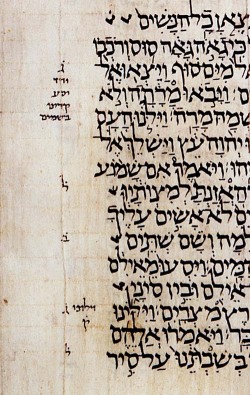
Leningrad Codex of the Hebrew Scriptures
For all things with which we are supplied, we bless the Maker of all through his Son Jesus Christ and through the Holy Spirit. (First Apology 67)

But to the Father of all, who is unbegotten, there is no name given. .. And His Son, who alone is properly called Son, the Word who also was with him and was begotten before the works, when at first He created and arranged all things by Him, is called Christ, in reference to His being anointed and Godís ordering all things through him. (Second Apology 6)

Our Saviour Jesus Christ … being the Word of God, inseparable from Him in power, having assumed [the form of] man, who had been made in the image and likeness of God, restored to us the knowledge of the religion of our ancient forefathers. (Hortatory Address to the Greeks 38)

Permit me first to recount the prophecies, which I wish to do in order to prove that Christ is called both God and Lord of hosts and Jacob in parable by the Holy Spirit. (Dialogue with Trypho 36)

[Trypho the Jew speaking to Justin about Christians in general] Trypho said, " … You utter many blasphemies. You're attempting to persuade us that this crucified man was with Moses and Aaron, spoke to them in the pillar of the cloud, became crucified, ascended up to heaven, will come again to earth, and ought to be worshiped!"

Then I answered, "I know that, as the word of God says, this great wisdom of God, the Maker of all things, and the Almighty, is hidden from you." (Dialogue with Trypho 38)

In the fourty-fourth Psalm [LXX, in our Masoretic text, it's the 45th], these words are … referred to Christ: "My heart has brought forth a good Word" [v. 1, considered by the early Christians to be a reference to the birth of the Son/Word in eternity past]. (Dialogue with Trypho 38)


Care to share your point to these?
 
  • Love
Reactions: The Learner

Jack

Well-Known Member
May 3, 2022
15,814
5,949
113
Midwest
Faith
Christian
Country
United States
How can you include these scriptures in your understanding?
Is it possible to take every word literally?
Yeah, unless there's very good reason. Jesus warned us several times about Hell Fire. He didn't make up horror stories.
Psalm 37:20
But the wicked shall perish; And the enemies of the LORD, Like the splendor of the meadows, shall vanish. Into smoke they shall vanish away. New King James Version

Revelation 20:10
And the devil who had deceived them was thrown into the lake of fire and sulfur, into which the beast and the false prophet had already been thrown. There they will be tormented day and night forever and ever. Berean Standard Bible
Amen!
Mark 9:43
If your hand causes you to sin, cut it off. It is better for you to enter into life maimed, rather than having two hands, to go to hell, into the fire that shall never be quenched
Amen!
New King James Version

Mark 9:47
47 And if your eye causes you to sin, gouge it out. It’s better to enter the Kingdom of God with only one eye than to have two eyes and be thrown into hell, 48 ‘where the maggots never die and the fire never goes out.’ New Living Translation
Of course, NEVER!
Matthew 7:13-14
“Enter through the narrow gate. For wide is the gate and broad is the road that leads to destruction, and many enter through it. 14 But small is the gate and narrow the road that leads to life, and only a few find it. NIV
That's right, BILLIONS of humans will burn in Hell forever!
John 3:36
The one believing in the Son has eternal life, but the one not obeying the Son will not see life, but the wrath of God abides on him." Berean Literal Bible
You just proved Hell Fire is forever and ever as Jesus said.
 
  • Love
Reactions: The Learner

walter

Well-Known Member
Feb 24, 2024
362
262
63
67
Arizona
Faith
Christian
Country
United States
Yeah, unless there's very good reason. Jesus warned us several times about Hell Fire. He didn't make up horror stories.

Amen!

Amen!

Of course, NEVER!

That's right, BILLIONS of humans will burn in Hell forever!

You just proved Hell Fire is forever and ever as Jesus said.
Thanks for your time. :ntmetu
 
  • Like
Reactions: The Learner

rvmb

Well-Known Member
Jul 3, 2025
1,252
330
83
Adelaide
Faith
Christian
Country
Australia
Gender
Male
And every single translation that renders John 1:1 that way is a product of trinitarian bias.

The only way to determine what John said is to examine the Greek and understand why the divine name was not used in the Greek Scriptures, when it is seen clearly almost 7,000 times in the Hebrew writings, used by God’s servants who held no traditions or superstitions about the reverent use of the divine name.

Hebrew Bible writers addressed their God by name, ruling out any doubt about who was their God.
All of the writers of the OT were Jews, raised with a monotheistic view of their God that would never have allowed the worship of any other god. It was God’s Law.....Yet the NT, translated by trinitarians into English made sure that Jesus was the god they worship and any verse that looked like it might fight with the trinity was adjusted in translation accordingly.

Two main adjustments were made that become obvious when you study the Greek as opposed to the accepted English translations, which is why an Interlinear and a good concordance is necessary when doing a thorough study of what the Bible actually says, rather than than what a corrupted “church” system want you to believe.

In all of your examples, the definite article used to identify Yahweh is ignored....and the use of capital letters is also misleading, as there are no upper and lower case letters in Greek.
Both of those things give Bible readers the wrong information.

John 1:1 in Greek to English reads.....
In en the beginning archē was eimi the ho Word logos, and kai the ho Word logos was eimi with pros ·ho God theos, and kai the ho Word logos was eimi God theos.”

That little word “ho” means “the” (the definite article) and we can see that it identified “the Word” (ho logos) but when it came to “the Word was with God” (ho theos) you can see that the “ho” in relation to God is ignored, whilst the second mention of “theos” is without the definite article.

If John 1:1 was correctly translated, it should read..
“In the beginning was the Word, and the Word was with Yahweh, and the Word was divine”.

“Theos” In the Bible is not a word that only means “THE God” of the Jews, who at that time was nameless as the Jews had stopped uttering it even before Jesus came on the earthly scene.

Jesus said he had come to ‘make his Father’s name known’ (John 17:25-26) because the Jews had no right to remove it from their speech. They were told right from the outset that God’s name was to be “mentioned” throughout their generations. (Exodus 3:15) In the Lord’s Prayer, it was the first thing Jesus mentioned....

And if you check a Hebrew Interlinear, you will see the Tetragrammaton clearly in the Hebrew text.....but not in the English translation, where “the LORD” is substituted......but in most (but not all) English translations God’s name is missing altogether, following the disobedient Jews, rather than obeying Jesus who said he had come to make his Father’s name known.....not his own.

When the devil is at the back of a deception, he makes sure that the truth is so unpopular, that no one will question it......we must question everything.
"And every single translation that renders John 1:1 that way is a product of trinitarian bias."""
I believe and accept that in some way or form The Father, The Son, The HS pre-existed creation
If you don't then simply list the verses that teach otherwise :)
 
  • Like
Reactions: The Learner

rvmb

Well-Known Member
Jul 3, 2025
1,252
330
83
Adelaide
Faith
Christian
Country
Australia
Gender
Male
The trinity didn’t exist then either....which is why no one spoke about it until the foretold apostasy took place and the church ran away with its own ideas about a lot of things....this apostasy was beginning at the end of the first century and the apostles were restraining it....so once they were gone, the “weeds” that Jesus foretold would take over the church, almost choked out the “wheat” by silencing any who dared to challenge the doctrines and authority of “the church”.

Protestantism did away with so many unbiblical Catholic doctrines.....but the big three as @Jack has a lifetime subscription to....were retained......go figure?

These three...the trinity, immortality of the soul, and hellfire are as authentic as devotion to Mary “the mother of God”....her immaculate conception, purgatory, transsubstantiation of the bread and wine into the literal flesh and blood of Jesus, rosary beads, and any other Catholic belief you can think of.

Who said that the big three, believed by the majority who claim to be “Christians”, are true, because the Bible does not teach any of them? They are only ‘suggested’ by doctrine, and only if you read Scripture that is incorrectly translated....but none are directly stated. If our beliefs are only based on their beliefs, rather than direct unequivocal statements....there is the root cause of all unresolved Scriptural debates.
""The trinity didn’t exist then either""
Neither does the word Bible appear in the Bible
Please list the verses that teach The Father, The Word, The HS did not pre-exist creation.
ps, I don't align with a particular denomination.