


Ronald Nolette
Well-Known Member
Cuz you love to niot pick at the slightest derivation of words I use, ehile you redefine words at will to support Romanism.Yes - almost mid century
NOT sure what this has to do with ANY of this . . .
Welcome to Christian Forums, a Christian Forum that recognizes that all Christians are a work in progress.
You will need to register to be able to join in fellowship with Christians all over the world.
We hope to see you as a part of our community soon and God Bless!
Cuz you love to niot pick at the slightest derivation of words I use, ehile you redefine words at will to support Romanism.Yes - almost mid century
NOT sure what this has to do with ANY of this . . .
Ay. Yi, yi . . .
You’re e obsessed with sex instead of TRUTH . . .
HOW many times must I repeat this BIBLICAL evidence before it sinks in??
Let’s see what the Scriptures say about the use of the word, “until” . . .
2 Samuel 6:23 tells us: Therefore Michal the daughter of Saul had no child UNTIL the day of her death.
Are we to assume that Michal had children after she died?
Moses was buried by God in the valley of Moab after his death. Deut. 34:6 explicitly states: And he buried him in the valley of the land of Moab over against Phogor: and no man hath known of his sepulchre UNTIL this present day.
Sooooo – did they FIND his grave after this??
Let’s also examine Acts 2:34-35 (also see Psalm 110:1, Matt 22:44): For David did not go up into heaven, but he himself said: 'The Lord said to my Lord, "Sit at my right hand UNTIL I make your enemies your footstool."'
Are we to surmise that Jesus will cease to sit at the right hand of the Father AFTER his enemies are made his footstool?
The problem here is that you anti-Catholics attempt to apply 21st century English to Hebrew and Greek from a culture THOUSANDS of years ago.
PLEASE do your homework before posting . . .
And that makes his posts less-valid . . . HOW??
Just about EVERY online resource uses AI these days.
This is a classic case of, "People im glass houses . . ."
You suck at pretending to know what I know! I know when the various books were written from B.C. to A.D. But thanks for failing again !I can drill this into your head ALL day l0ong but you’ll NEVER understand because YOU think the Bible was written in 21st century English.
Ummm – it wasn’t . . .
YOu suck again at trying to tell me what I know. Failed again! I wonder why I use so many cites from Koine Greek and Hebrew if I thought the bible was 21st Century. Now you are grasping at straws and being childish.Uhh, you mean, like YOU?
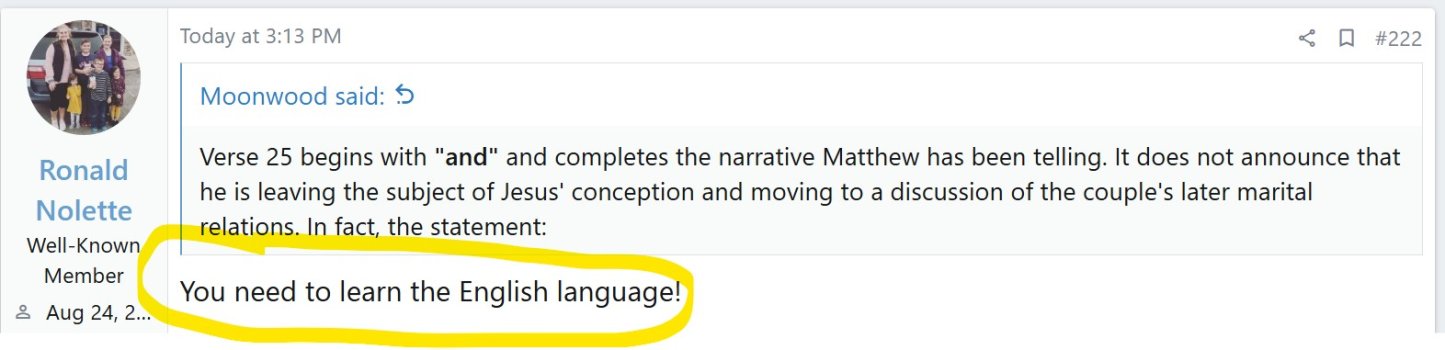
You can’t understand Scripture because you can’t seem to understanbd that it is NOT written in 21st century English . .
Failed again!I guess you can’t read very well because I already told you that she was nowhere near the Temple at the time of the Anunciation.
Temple virgins were only stayed until they reached the age of puberty (around 12-14 years).


They can’t get everything right . . .A lot of modern scholars also think Jesus of Nazareth is nothing but a myth.
You mean – like the Protoevangelium??We still credit it to the person who dictates it. You don't have to be the one to physically put pen to paper to be the one who wrote it. VERY different from the Proto.
It DOES when you’ve been shown that it’s wrong . . .Just as repeating that it's wrong doesn't make it wrong.
And YOU are a LIAR . . .I never ever - not once - said that the text of the Protoevangelium makes that claim.
Why do you have to make stuff up?
WOW – this is like talking to a wall . . .I know you said that. But we only need saving, we only need redemption, if we've sinned. A perfect person doesn't need redemption or saving. Mary was supposedly perfect, so she didn't need saving.
“Kecharitomene”, (not charitŏō) is the word used for Mary in the Angel’s greeting.From Strong's concordance on that word:
Nowhere does it mean that Mary was sinless. Nowhere.
- to make graceful
- charming, lovely, agreeable
- to persue with grace, compass with favour
- to honour with blessings
I don't even know wgat "Romanism" is - so WHY would I support it??Cuz you love to niot pick at the slightest derivation of words I use, ehile you redefine words at will to support Romanism.
Last time. You are trying to pose a question we do not even know if Mary thought! That is you trying to force Mary to bend to what you think she should have thought! The bible doesn't say, so I won't and you shouldn't in ypour arrogance either! Have your last bit of foolishness. We are done here.If Mary's expectation was that She would eventually conceive through ordinary marital relations with Joseph, why does Luke present Her virginity as the difficulty and divine intervention as the solution?
Your response is:
"She wasn't active so she wasn't sure how, and Gabriel told her."
But that's exactly what needs to be demonstrated, not assumed.
Gabriel did not say:
"You will conceive immediately."
Nor did he say:
"You will conceive before you come together with Joseph."
He simply says:
"You will conceive and bear a Son."
Good! For I cannot accept perpetual virginity based on Scripture. I accept[t the Luke passage as written and will not tryt o guess what was in Marys' mind that was not written down.But that is not the question I asked.
I am not asking you to accept perpetual virginity.
I am asking you to explain your interpretation of Luke 1:34-37.
The moment you propose an interpretation, you also bear the responsibility of explaining how the details of the text fit that interpretation.
They can’t get everything right . . .
You mean – like the Protoevangelium??
Your double-standards are hilarious . . .
It DOES when you’ve been shown that it’s wrong . . .
And YOU are a LIAR . . .
From YOUR post #710:
“WHAT THE PROTO TELLS US IS that these tales were believed by some people at that time. Obviously. What it doesn't tell us is if those stories are TRUE. Since we KNOW the Proto has some things wrong, there really isn't good reason to trust it's reliability.
Care to admit you LIED?
WOW – this is like talking to a wall . . .
As I’ve stated ad nauseam – Mary WAS redeemed AND saved at CONCEPTION.
This was made possible by Jesus’s sacrifice ono the cross.
HIS sacrifice is an ETERNAL one (Rev. 5:6–12, Rev. 13:8, Rom. 8:34, Heb. 7:25, 1 John 2).
“Kecharitomene”, (not charitŏō) is the word used for Mary in the Angel’s greeting.
Scholarly PROTESTANT Evidence:
Greek Grammar of the New Testament - (Blass and DeBrunner)
"… kecharitomene is completely, perfectly, enduringly endowed with grace."
A Matter of Quantity - François Rossier University of Dayton
There is no question of a "secondary" reality, one that would have touched her only ulteriorly. Rather, it pertains to the very identity of Mary. Moreover, the appellation κεχαριτωμένη, in all of Scripture, is reserved to Mary, as if it were her special mark. In fact, some have tried to see in the parallel with Gideon, a demonstration that the κεχαριτωμένη would refer only to a grace that is to come, one to follow immediately. For Gideon is called "valiant warrior" at a time when he is not yet such; therefore κεχαριτωμένη would signify a grace that is not present before the angel's greeting. However, as contrasted with what concerns Gideon, the angel does not apply to Mary a noun bracketed with an adjective, but a perfect participle, a verbal form that refers to a past that is prolonged in the present. Therefore, it is before the angel's greeting, before the Incarnation, that Mary is κεχαριτωμένη.
(Kecharitomene (Lk. 1:28) in the Light of Gen. 18:16-33:)
Greek Grammar - (H. W. Smyth, [Harvard University Press, 1968], p. 108-109, sec 1852:b.)
Kecharitomene denotes continuance of a completed action.
You do! You are just playing your silly little games again. Romansim is the collective teachings of the Roman Catholic church! Now you definitely know so stop pretending to be ignorant.I don't even know wgat "Romanism" is - so WHY would I support it??
Think asbout it . . .
Dinsingenuous? Maybe for a grade in school.I was in another Christian discussion group where all a guy did was run everything directly through AI and then cut and pasted it. That's disingenuous and is bad-faith posting.
Nobody here is talking TO AI Bots.We are here to talk to PEOPLE. Not AI bots.
And YOU made this statement in 21st century English.We all know that "until" *can* mean something other than "the point at which a certain action began (or stopped). As in: "He didn't drive the car until he started it up." Obviously that implies that he drove the car after starting it up.
NO more “CLEAR” than the examples I presented.Verse 18 and then verse 25 are bookends. BEFORE they came together in marital consummation, Mary got pregnant. And they remained celibate UNTIL Jesus was born. The implication is clear - that they had always planned on consummating the marriage, and waited until Jesus was born to do so, and then they did.
Said the ignorant anti-Catholic . . .You do! You are just playing your silly little games again. Romansim is the collective teachings of the Roman Catholic church! Now you definitely know so stop pretending to be ignorant.
Dinsingenuous? Maybe for a grade in school.
But we're MOT debating for grades here.
If you're so against someone using an online source 0 then YOU shouldn't use them, either . . .
Nobody here is talking TO AI Bots.
Howver - even YOU have used AI sources in your responses, whether you know it or not . . .
And YOU made this statement in 21st century English.
In a Jewish culture THOUSANDS of years ago – “Until” had a much broader meaning,
I’ve given you SEVERAL examples of this – and YOU respond with a 21st century English mentality . . .
NO more “CLEAR” than the examples I presented.
Good grief . . .
Did I hurt yoir feelings?You suck at pretending to know what I know! I know when the various books were written from B.C. to A.D. But thanks for failing again !
I guess I hurt your feelings again . . .YOu suck again at trying to tell me what I know. Failed again! I wonder why I use so many cites from Koine Greek and Hebrew if I thought the bible was 21st Century. Now you are grasping at straws and being childish.
No "failure" here.Failed again!
Did the Jewish Temple Have a Class of Virgin Women?
No — there was no formal, organized “department” of consecrated virgins serving in the Jerusalem Temple, though some women did perform specific volunteer tasks there.
According to mainstream Jewish sources, women were generally kept away from the most sacred areas of the Temple because of ritual purity laws, including the disqualification caused by menstruationsheilot.com. The actual priestly and Levitical service was the domain of men
Jewish Theological Seminary.
Some passages in the Mishnah and Midrash mention “virgins” in connection with Temple work — for example, Mishna Shekalim 8:5–6 records that eighty‑two virgins wove the Temple’s great veil
Some Christian traditions have claimed a “Temple virgin” order, sometimes linking it to the Virgin Mary’s early lifeTaylor Marshall. However, Jewish historians and scholars note that there is no credible evidence in the Hebrew Bible, Mishnah, Talmud, or other Jewish sources for such an organized group
In summary:
- No formal “virgin class” existed in the Temple.
- Women did serve in certain supportive, non‑sacrificial roles, often in volunteer capacity.
- References to “virgins” in sources like Mishna Shekalim describe specific tasks, not a standing institution
Ancient Temple Traditions | Sheilot
Ancient Temple Traditions | Beis ha-Mikdash - SHEILOT.COM offers the first and most extensive ask-the-rabbi service online, providing answers to your Jewish questions from a caring, international team of scholars and educators. Explore a wide range of topics about Jewish heritage and submit your...sheilot.com
nswered by Rabbi Ephraim Nisenbaum
Question
Did women serve in the work in the Holy Temple? If so, in what capacity?
Answer
The actual service in the Temple was generally done by the male kohanim and Levites. Women were involved in the building of the Temple, with sewing, weaving, embroidering, and other such crafts and skills. When a woman would bring a sacrifice, she also played a part in bringing it to the Temple.
History proves the fable found in the protoevangelium merely a false myth. NO women lived in the temple nor were young girls taken into the temple. Temple Service (except for laundry) was done by the kohani9m and not women.
Even in modern English, 'UNTIL' can have different meaning depending on the context of the sentence.It ALSO very much could, and still can, mean what I said it does. For example, Genesis 21:26 - "Abimelech said, “I do not know who has done this thing; you did not tell me, and I have not heard of it until today.”" Quite clearly, Abimelech isn't saying that he STILL hasn't heard of it. Rather, he's saying that up til today, he hadn't heard of it, but now he has. The "until" delineates a specific point in time when something was NOT, and then now IS.
And that's not exactly a 21st century mentality.
You're only "indignant" because you were proven WRONG.If you come on here pretending to be a thinking person but all you're doing is cutting and pasting AI, yeah, that's being disingenuous.

Judges 13:3 has nothing to do with this story about Mary. The wording is similar but they're different stories.
I actually am starting to think you're AI because just for fun I used AI to address my own post, and yours looks strikingly similar to this - including the formatting.
Yeah these timeline markers are significant, though of course you try to explain them away.
From Strong's Concordance:
- to come together
- to assemble
- of conjugal cohabitation
- to go (depart) or come with one, to accompany one
So in the context of marriage, yeah, conjugal cohabitation. Marital sex.
Even in modern English, 'UNTIL' can have different meaning depending on the context of the sentence.
"Don't touch the wet paint until it dries."
Drying is the condition for touching, not proof that you actually go over and touch it the second it dries.
I've been participating on forums like this for over a decade, and long before AI existed, I always took time before submitting a post to organize my formatting, refine my word choices, double-check grammar, and make sure everything I wanted to say was clear and accurate. Anyone who cares about presenting a clean, well-articulated post knows how time-consuming that is. When AI came along, it simply shaved off some of that editing time—taking the arguments I've already written and cleaning them up, which I always double-check afterward so nothing I mean is changed or made inaccurate. That's literally what editing tools are for. And since AI became common on discussion boards, I've noticed a predictable pattern: whenever someone spots clean formatting and uses "AI" as an excuse to brush off an argument instead of answering it, it's just a poor dodge.
Look at what you actually did instead of refuting a single word of my explanation of erusin and nissuin: you simply said "these timeline markers are significant, though of course you try to explain them away." That isn't an argument when I just showed you from Jewish marriage law why Joseph had to bring Mary into his home (nissuin, Matthew 1:20, 24) to protect Her and the child from the public charge of adultery (Deuteronomy 22:23–24), regardless of consummation.
Even your own Strong's Concordance quote proves my point, not yours: "conjugal cohabitation" literally means living together as husband and wife in the same household (co-habitare), which is the exact nissuin stage I just described. If synerchomai in verse 18 already meant sexual intercourse, Matthew wouldn't have switched to the actual Greek verb for sexual relations (ginōskō, "he knew her not") seven verses later in Matthew 1:25.
Meanwhile, look at everything you just skipped completely:
Whenever you’re ready to actually engage the Greek grammar of heōs in Matthew 1:25 and the historical and biblical witnesses in Point 3 instead of critiquing how I edit my posts, I’m right here.
- My entire grammatical breakdown of heōs ("until") in Matthew 1:25 (2 Samuel 6:23, Matthew 28:20, Psalm 110:1, Calvin, Keener, Koester, and Allison).
- Every single point in Point 3—Augustine’s On Holy Virginity 4.4, Luther, Calvin, and Zwingli, Jeremiah 16:2, Luke 2:36–37, 1 Corinthians 7, and why a marriage set apart for the Incarnation has zero "normal" benchmark.
- And brushing off Judges 13:3 with "different stories" still misses how a counterexample works: it disproves your universal rule that a sudden angelic visit plus "You will conceive and bear a son" automatically implies "soon."


