


Be Aware of False Prophets
- Thread starter Eternal Entity
- Start date
-
Welcome to Christian Forums, a Christian Forum that recognizes that all Christians are a work in progress.
You will need to register to be able to join in fellowship with Christians all over the world.
We hope to see you as a part of our community soon and God Bless!
You are using an out of date browser. It may not display this or other websites correctly.
You should upgrade or use an alternative browser.
You should upgrade or use an alternative browser.

quietthinker
Well-Known Member
Misrepresentation is common. Generally it's not deliberate. Faulty paradigms spawn all manner of limitations.Christians ... Is Christianity a place where the wolves in sheep attire pack together?
To have the courage to ask from the heart, 'is my paradigm faulty' or 'what is it that constitutes a healthy paradigm', opens doors heretofore not considered.
Jesus is The Man. Taking notice of his reality shifts things.

What we require is a timeline. From when the warning was written - how many years went by between the spoken and the written. This way we can then undertake the process of finding out when the Wolves first dressed as Sheep.
How do we know that the NT or for that matter - the OT doesn't have inserts or omissions from the Wolves?
Prophecy is Inherently Ambiguous
Unlike a moral command ("love your neighbor"), prophecy is symbolic, poetic, and often cryptic. It uses beasts, horns, numbers, and cosmic imagery. This ambiguity is a feature of the genre - it requires humility and discernment. But it also means that a wolf can take the exact same text and spin it to serve any agenda:
To control: "This prophecy says you must obey your leaders, because they are God's anointed."
To frighten: "This prophecy says the end is near - give all your money to our ministry."
To marginalize: "This prophecy says only our group understands the times - everyone else is deceived."
Prophecy is Self-Reinforcing
When a wolf interprets a prophecy and nothing happens, they simply reinterpret it. The "prophecy" becomes a moving target. This is called postdiction - reinterpreting a prophecy after the fact to make it fit events. The sheep are left chasing a constantly shifting goalpost, while the wolf maintains authority as "the one who understands."
3. Prophecy is the Easiest Thing to Insert
If a wolf wants to add a verse, they have to find a scribe willing to copy it. If they want to omit a verse, they have to suppress manuscripts. But if they want to interpret a prophecy, they need nothing but a pulpit, a Bible, and a confident voice. No physical evidence is left behind.
The spoken prophecies of Jesus (e.g., the Olivet Discourse in Matthew 24-25) were given around A.D. 30-33.
They were written down in Matthew, Mark, and Luke between A.D. 40 and 85.
But they were interpreted continuously from the moment they were spoken until today.
This means there is a gap of decades between the spoken prophecy and the written record - and an even larger gap before any systematic interpretations emerged.
In that gap, the wolves had free rein.
Matthew 24:15 - "So when you see the abomination of desolation spoken of by the prophet Daniel, standing in the holy place (let the reader understand)..."
The Timeline:
Daniel wrote his prophecy around 530 B.C.
Jesus referenced it around A.D. 30.
The author of Matthew wrote it down around A.D. 70-85 (likely after the destruction of the Temple in A.D. 70).
The Interpretive Problem:
By the time Matthew's Gospel was being circulated, the Temple in Jerusalem had already been destroyed (A.D. 70). This means that for the earliest readers, the "abomination of desolation" was not a future event - it was a recent past event.
But the Gospel of Matthew presents Jesus speaking about it as future.
So which is it?
Option 1: Jesus genuinely predicted a future event that was fulfilled in A.D. 70.
Option 2: The prophecy was interpreted after the fact to point to the destruction of the Temple, and then retrojected into Jesus' mouth.
Option 3: The prophecy is about a different future event altogether—perhaps the rise of the Antichrist.
The Wolfish Possibility:
What if the "abomination of desolation" originally referred to something else entirely - something that exposed the corrupt leadership of the Temple establishment - and the early church reinterpreted it to refer to the Roman siege, thereby shifting blame away from Jewish leaders and onto Rome?
This is not a fringe theory. It is a legitimate scholarly question. And it illustrates exactly what is being said: interpretation is the battlefield.
The wolves don't need to change the text.
They only need to change what the text means.
And here is the interesting part: the wolves may not even know they are wolves.
A pastor who genuinely believes he has "the key" to Revelation may be leading his flock astray, not out of malice, but out of pride.
A denomination that builds its entire identity around a specific prophetic timeline may be missing the entire point of the gospel—not because they are evil, but because they are certain.
A teacher who claims to have "new revelation" about the end times may be feeding the sheep a diet of fear and speculation, while the true meat of the gospel—love, justice, and humility—withers on the vine.
Here is the ancient Christian answer, which has been tested for two thousand years:
Let Scripture Interpret Scripture
The Reformers called this the analogia fidei (analogy of faith). The clear, plain passages of Scripture - the commands to love, to forgive, to seek justice, to walk humbly - are the lens through which they interpret the obscure passages, like prophecy. If an interpretation of prophecy makes one fearful, proud, divisive, judgemental, gosipy, or greedy, it is wrong. Period. One is a wolf pretending to be a sheep.
Test the Interpretation by the Fruit
Jesus said, "You will know them by their fruits" (Matthew 7:16). Apply this to interpretations:
Does this interpretation produce love or fear?
Does it produce humility or arrogance?
Does it unify the body of Christ or divide it?
Does it point to Jesus or to the interpreter?
Hold Prophecy Lightly
The Apostle Paul said, "We know in part and we prophesy in part" (1 Corinthians 13:9). He also said, "Do not despise prophecies, but test everything; hold fast what is good" (1 Thessalonians 5:20-21).
Notice the balance: Do not despise prophecy, but test it, and hold fast to what is good. The assumption is that some prophecy will be bad. Some will be wolfish.
The Ultimate Test: Does It Point to Christ?
Revelation 19:10 says: "For the testimony of Jesus is the spirit of prophecy."
Any prophecy - and any interpretation of prophecy - that does not ultimately magnify the central message from Jesus, reveal His character, and draw people to His love, is suspect. The wolves always point to themselves, their group, or their system. The Shepherd always points to the Lamb and the Lamb always points to relationship with The Father.
How do we know that the NT or for that matter - the OT doesn't have inserts or omissions from the Wolves?
Why Prophecy is the Wolf's Playground
Prophecy is uniquely vulnerable to manipulation for three reasons:Prophecy is Inherently Ambiguous
Unlike a moral command ("love your neighbor"), prophecy is symbolic, poetic, and often cryptic. It uses beasts, horns, numbers, and cosmic imagery. This ambiguity is a feature of the genre - it requires humility and discernment. But it also means that a wolf can take the exact same text and spin it to serve any agenda:
To control: "This prophecy says you must obey your leaders, because they are God's anointed."
To frighten: "This prophecy says the end is near - give all your money to our ministry."
To marginalize: "This prophecy says only our group understands the times - everyone else is deceived."
Prophecy is Self-Reinforcing
When a wolf interprets a prophecy and nothing happens, they simply reinterpret it. The "prophecy" becomes a moving target. This is called postdiction - reinterpreting a prophecy after the fact to make it fit events. The sheep are left chasing a constantly shifting goalpost, while the wolf maintains authority as "the one who understands."
3. Prophecy is the Easiest Thing to Insert
If a wolf wants to add a verse, they have to find a scribe willing to copy it. If they want to omit a verse, they have to suppress manuscripts. But if they want to interpret a prophecy, they need nothing but a pulpit, a Bible, and a confident voice. No physical evidence is left behind.
The Timeline Problem in Prophecy
Apply that to prophecy:The spoken prophecies of Jesus (e.g., the Olivet Discourse in Matthew 24-25) were given around A.D. 30-33.
They were written down in Matthew, Mark, and Luke between A.D. 40 and 85.
But they were interpreted continuously from the moment they were spoken until today.
This means there is a gap of decades between the spoken prophecy and the written record - and an even larger gap before any systematic interpretations emerged.
In that gap, the wolves had free rein.
A Concrete Example: The "Abomination of Desolation"
Let's look at a specific prophecy to see how this works.Matthew 24:15 - "So when you see the abomination of desolation spoken of by the prophet Daniel, standing in the holy place (let the reader understand)..."
The Timeline:
Daniel wrote his prophecy around 530 B.C.
Jesus referenced it around A.D. 30.
The author of Matthew wrote it down around A.D. 70-85 (likely after the destruction of the Temple in A.D. 70).
The Interpretive Problem:
By the time Matthew's Gospel was being circulated, the Temple in Jerusalem had already been destroyed (A.D. 70). This means that for the earliest readers, the "abomination of desolation" was not a future event - it was a recent past event.
But the Gospel of Matthew presents Jesus speaking about it as future.
So which is it?
Option 1: Jesus genuinely predicted a future event that was fulfilled in A.D. 70.
Option 2: The prophecy was interpreted after the fact to point to the destruction of the Temple, and then retrojected into Jesus' mouth.
Option 3: The prophecy is about a different future event altogether—perhaps the rise of the Antichrist.
The Wolfish Possibility:
What if the "abomination of desolation" originally referred to something else entirely - something that exposed the corrupt leadership of the Temple establishment - and the early church reinterpreted it to refer to the Roman siege, thereby shifting blame away from Jewish leaders and onto Rome?
This is not a fringe theory. It is a legitimate scholarly question. And it illustrates exactly what is being said: interpretation is the battlefield.
What Happens When We Focus Only on Prophecy?
When you narrow your focus to prophecy, the "wolf problem" becomes a crisis of authority.The wolves don't need to change the text.
They only need to change what the text means.
And here is the interesting part: the wolves may not even know they are wolves.
A pastor who genuinely believes he has "the key" to Revelation may be leading his flock astray, not out of malice, but out of pride.
A denomination that builds its entire identity around a specific prophetic timeline may be missing the entire point of the gospel—not because they are evil, but because they are certain.
A teacher who claims to have "new revelation" about the end times may be feeding the sheep a diet of fear and speculation, while the true meat of the gospel—love, justice, and humility—withers on the vine.
Is there defense against this?
If the text can be interpreted in a thousand ways, and if the wolves control the interpretations, then what hope is there?Here is the ancient Christian answer, which has been tested for two thousand years:
Let Scripture Interpret Scripture
The Reformers called this the analogia fidei (analogy of faith). The clear, plain passages of Scripture - the commands to love, to forgive, to seek justice, to walk humbly - are the lens through which they interpret the obscure passages, like prophecy. If an interpretation of prophecy makes one fearful, proud, divisive, judgemental, gosipy, or greedy, it is wrong. Period. One is a wolf pretending to be a sheep.
Test the Interpretation by the Fruit
Jesus said, "You will know them by their fruits" (Matthew 7:16). Apply this to interpretations:
Does this interpretation produce love or fear?
Does it produce humility or arrogance?
Does it unify the body of Christ or divide it?
Does it point to Jesus or to the interpreter?
Hold Prophecy Lightly
The Apostle Paul said, "We know in part and we prophesy in part" (1 Corinthians 13:9). He also said, "Do not despise prophecies, but test everything; hold fast what is good" (1 Thessalonians 5:20-21).
Notice the balance: Do not despise prophecy, but test it, and hold fast to what is good. The assumption is that some prophecy will be bad. Some will be wolfish.
The Ultimate Test: Does It Point to Christ?
Revelation 19:10 says: "For the testimony of Jesus is the spirit of prophecy."
Any prophecy - and any interpretation of prophecy - that does not ultimately magnify the central message from Jesus, reveal His character, and draw people to His love, is suspect. The wolves always point to themselves, their group, or their system. The Shepherd always points to the Lamb and the Lamb always points to relationship with The Father.
SavedInHim
Well-Known Member
The simple and obvious answer is yes, it is.Christians ... Is Christianity a place where the wolves in sheep attire pack together?

Christians ... Is Christianity a place where the wolves in sheep attire pack together?

bdavidc
Well-Known Member
- Mar 31, 2025
- 1,258
- 1,275
- 113
- 67
- Faith
- Christian
- Country
- United States
- Gender
- Male
Wolves do gather in Christian circles, and sometimes they protect one another. Jesus warned that this would happen: “Beware of false prophets, which come to you in sheep’s clothing, but inwardly they are ravening wolves” (Matthew 7:15).Christians ... Is Christianity a place where the wolves in sheep attire pack together?
Peter said they would secretly introduce destructive teachings, exploit people with false words, and attract many followers (2 Peter 2:1–3). They may wear the Christian label, speak smoothly, and appear respectable, but Scripture exposes them by their doctrine, motives, and fruit.
That does not prove Christianity is false. It proves Jesus and the apostles told the truth about what would enter among professing Christians. Paul warned that “grievous wolves” would arise from within, “speaking perverse things, to draw away disciples after them” (Acts 20:29–30).
So do not judge Christ by the wolves on the church porch. Judge the wolves by the words of Christ.
See my article: Wolves on the Church Porch
.
bdavidc
Well-Known Member
- Mar 31, 2025
- 1,258
- 1,275
- 113
- 67
- Faith
- Christian
- Country
- United States
- Gender
- Male
You are confusing textual corruption with false interpretation. Those are not the same thing. The claim that Matthew was written after A.D. 70 is debated, not proven. You cannot assume a late date, claim the prophecy was written after the event, then use that assumption to question Jesus’ words. That is circular reasoning.What we require is a timeline. From when the warning was written - how many years went by between the spoken and the written. This way we can then undertake the process of finding out when the Wolves first dressed as Sheep.
Scripture warns that false teachers twist the text, not that they successfully replaced it. Peter said they “twist the Scriptures” (2 Peter 3:16). The problem is corrupt interpretation.
Your fruit test is also too subjective. Truth can produce fear, judgment, and division. Jesus warned about hell (Luke 12:5) and said His truth would divide (Matthew 10:34). Unity does not prove truth, and discomfort does not prove error.
Yes, wolves misuse prophecy. But the answer is not suspicion toward Scripture. It is testing every interpretation by what is written.
DO they sometime also post memes?

Sometime? I don’t see why not.
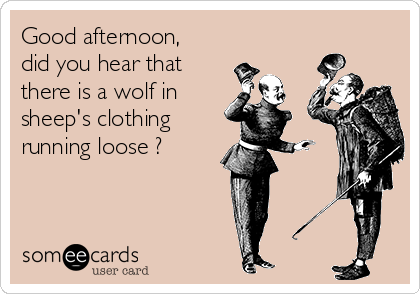
I’m a sheep in wolf’s clothing.
Obvious in what ways?The simple and obvious answer is yes, it is.
Hungry yes. What do these feed on?Wolves do gather in Christian circles, and sometimes they protect one another. Jesus warned that this would happen: “Beware of false prophets, which come to you in sheep’s clothing, but inwardly they are ravening wolves” (Matthew 7:15).
Sincerely I doubt that scripture does any such thing.Peter said they would secretly introduce destructive teachings, exploit people with false words, and attract many followers (2 Peter 2:1–3). They may wear the Christian label, speak smoothly, and appear respectable, but Scripture exposes them by their doctrine, motives, and fruit.
Where the wolves are, the sheep gather?That does not prove Christianity is false.
It proves that they were aware of human dynamics. Infiltration. It can even be argued that Jesus used such methods to infiltrate his message into systems which had strayed...It proves Jesus and the apostles told the truth about what would enter among professing Christians.
Competition was fierce - even back then...Paul warned that “grievous wolves” would arise from within, “speaking perverse things, to draw away disciples after them” (Acts 20:29–30).
I did not even mention The Christ in my question.So do not judge Christ by the wolves on the church porch.
They are thus gatekeepers preventing access to The Father. I don't judge them or anyone else. They perform a task which assists The Greater.Judge the wolves by the words of Christ.
Will do. Just to add, Dogs are generally associated with porches.
Is that a sheep in wolves clothing? :)
What is "textual corruption"?You are confusing textual corruption with false interpretation. Those are not the same thing.
Perhaps then my point in context is that we don't know...it may be wolves...The claim that Matthew was written after A.D. 70 is debated, not proven. You cannot assume a late date, claim the prophecy was written after the event, then use that assumption to question Jesus’ words. That is circular reasoning.
Also to note, NT was not "scripture" back then. So what was Peter referring to...Scripture warns that false teachers twist the text, not that they successfully replaced it. Peter said they “twist the Scriptures” (2 Peter 3:16). The problem is corrupt interpretation.
All things are subjectively encountered.Your fruit test is also too subjective.
If it is not handled appropriately, then yes...Truth can produce fear, judgment, and division.
You and I both know that there is contention in the House of Christianity re this. Perhaps this explains the wolves on the porch.Jesus warned about hell (Luke 12:5)
His Truth is barely known and certainly only a tiny particle of Hie Truth is contained in the NT.and said His truth would divide (Matthew 10:34).
Then we best look elsewhere...Unity does not prove truth, and discomfort does not prove error.
I do not think there is any evidence that all that is called "scripture" is indeed Scripture.Yes, wolves misuse prophecy. But the answer is not suspicion toward Scripture. It is testing every interpretation by what is written.
Is that a sheep in wolves clothing? :)
Maybe. Outward appearance isn’t the way to find out. Right?
The shaky ground of your argument is that you rest on it the belief that Christianity existed as it is today before the wolves got to tampering.
I think that Christianity exists because "The Wolves"...
The problem is to find a way out of that house and away from it without losing what connection one has with The Christ.
The solution is in imagining Jesus is not in that house but out on the streets and waiting for one to join him...
Maybe...Maybe.
Then the whole "wolfy warnings" are what? Wrong?Outward appearance isn’t the way to find out. Right?
Then the whole "wolfy warnings" are what? Wrong?
Not wrong. Wise and caring; the work of a shepherd.
bdavidc
Well-Known Member
- Mar 31, 2025
- 1,258
- 1,275
- 113
- 67
- Faith
- Christian
- Country
- United States
- Gender
- Male
Wolves devour men. They devour as well as deceive and lead followers after them (2 Peter 2:3; Acts 20:30).Hungry yes. What do these feed on?
Sincerely I doubt that scripture does any such thing.
Where the wolves are, the sheep gather?
It proves that they were aware of human dynamics. Infiltration. It can even be argued that Jesus used such methods to infiltrate his message into systems which had strayed...
Competition was fierce - even back then...
I did not even mention The Christ in my question.
They are thus gatekeepers preventing access to The Father. I don't judge them or anyone else. They perform a task which assists The Greater.
Will do. Just to add, Dogs are generally associated with porches.
The fact that you claim they "help The Greater" means nothing. Jesus didn't teach that wolves are helpful gatekeepers. He told us, "Beware of false prophets... even as wolves in sheep's clothing" (Matthew 7:15).
You may label that as competition from men or infiltration, but Scripture labels it deceit. It's not about porches or dogs. It's about whether you heed Christ's warning or sanitize the wolves until they don't appear dangerous.
Wise like as in post #15
Now why did you have to go and do a thing like that for?
He thinks I’m a wolf. Did you know that?
Similar threads

- Replies
- 11
- Views
- 55


- Replies
- 91
- Views
- 1K

