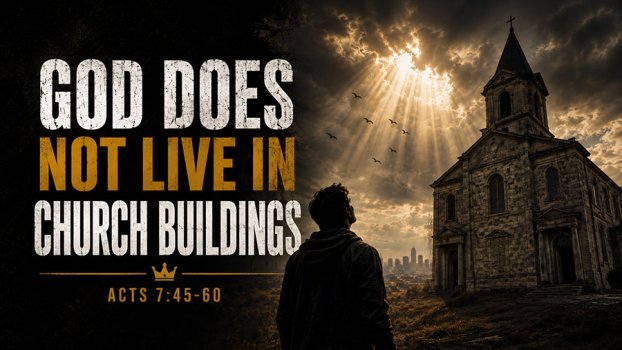
God Does Not Live in Your Church Building

  • Welcome to Christian Forums, a Christian Forum that recognizes that all Christians are a work in progress.

    You will need to register to be able to join in fellowship with Christians all over the world.

    We hope to see you as a part of our community soon and God Bless!

Does the New Testament teach that God now dwells in church buildings or in His born-again people?

  • God dwells in church buildings

  • God dwells in His people

  • Both equally

  • I need to study this more


Results are only viewable after voting.

bdavidc

Well-Known Member
Mar 31, 2025
1,186
1,193
113
67
Charlestown, IN
know-the-bible.com
Faith
Christian
Country
United States
Gender
Male
death-church.jpg

Acts 7:45-60 is not a soft passage. Stephen is standing before religious men who believe they are defending God, Moses, the temple, and the truth. But Stephen shows them from their own Scriptures that they are not defending God at all. They are resisting Him.

That is what makes this passage so powerful. Stephen does not stand there and give his opinion. He walks them through the history of Israel. He reminds them of Abraham, Joseph, Moses, the wilderness, the tabernacle, David, Solomon, and the temple. He shows them that their fathers had a long history of receiving truth from God, then resisting the very God who gave it.

Then Stephen brings the issue right to the temple. “Our fathers had the tabernacle of witness in the wilderness, as he had appointed, speaking unto Moses, that he should make it according to the fashion that he had seen.” ~Acts 7:44. The tabernacle was real. God commanded it. The temple was real. Solomon built it. Stephen was not denying that. He was not saying the temple had no place in Israel’s history.

But then he says, “Howbeit the most High dwelleth not in temples made with hands; as saith the prophet, Heaven is my throne, and earth is my footstool: what house will ye build me? saith the Lord: or what is the place of my rest? Hath not my hand made all these things?” ~Acts 7:48-50. That was the point they did not want to hear. God was never trapped in a building, controlled by a temple, or limited to a religious location.

The temple had become something God never meant it to be. They had taken a blessing and turned it into a hiding place. They thought because they had the temple, they were right with God. But Stephen showed them the truth. They had the building, but they were resisting the Holy Spirit.

That should make us stop and think. How many people today talk about “going to God’s house” as if God is locked inside a church building? How many people act one way inside a church service and another way the rest of the week? How many think worship is something that happens for an hour on Sunday, but not in the home, not at work, not in private, and not when no one is watching?

The New Testament does not teach that God now lives in church buildings. It teaches that God lives in His people. Paul said, “What? know ye not that your body is the temple of the Holy Ghost which is in you, which ye have of God?” ~1 Corinthians 6:19. He also said, “Know ye not that ye are the temple of God, and that the Spirit of God dwelleth in you?” ~1 Corinthians 3:16.

That is not a small thing. If you are born again, you do not meet God only when you walk into a church building. The Spirit of God dwells in you. That means your life belongs to Him everywhere. Not just in a service. Not just when people are watching. Not just when the Bible is open in front of you.

That also means you cannot hide behind religion. The men who killed Stephen were religious. They knew Scripture. They honored the temple. They claimed to defend Moses. But Stephen said, “Ye stiffnecked and uncircumcised in heart and ears, ye do always resist the Holy Ghost.” ~Acts 7:51. That is a terrifying statement. They had religion, but resisted God. They had Scripture, but rejected the Righteous One. They had the temple, but murdered Christ.

Stephen said, “Which of the prophets have not your fathers persecuted? and they have slain them which shewed before of the coming of the Just One; of whom ye have been now the betrayers and murderers.” ~Acts 7:52. This is where the passage gets serious. The issue was not a lack of religion. The issue was rebellion against God while hiding behind religion.

That same danger is alive today. A person can go to church, quote verses, defend traditions, follow popular teachers, and still resist the truth of Scripture. A person can defend a building, a ministry, a denomination, or a favorite preacher while ignoring what God actually said. That is why we must go back to the Bible instead of opinions, traditions, spiritual-sounding talk, or the words of a famous preacher.

Stephen stood on the Word of God, and it cost him his life. When they heard him, they were cut to the heart, but they did not repent. They gnashed on him with their teeth. They covered their ears. They cried out. They ran upon him. They cast him out of the city and stoned him.

But Stephen was not shaken. “But he, being full of the Holy Ghost, looked up stedfastly into heaven, and saw the glory of God, and Jesus standing on the right hand of God.” ~Acts 7:55. That is where death looks different for the believer. Stephen was not pretending the stones did not hurt. Stoning was brutal. It was violent. It was painful. His body was being broken by men who hated the truth he preached.

But death did not steal his hope. Death did not change the truth. Death did not make Christ less real. Stephen saw what mattered most. He saw the glory of God and Jesus standing at the right hand of God. Then he said, “Lord Jesus, receive my spirit.” ~Acts 7:59. That is not the cry of a man who thinks death wins. That is the faith of a man who knows where he is going.

For the born again believer, death is real, but it is not final. Grief is real, but it is not hopeless. Pain is real, but it does not get the last word. Paul said, “We are confident, I say, and willing rather to be absent from the body, and to be present with the Lord.” ~2 Corinthians 5:8. He also said, “For to me to live is Christ, and to die is gain.” ~Philippians 1:21.

That is not religious talk. That is biblical truth. If Christ is your life, death cannot rob you of Christ. If you are in Christ, death is not the end of your story. If you are born again, your body may fall asleep, but your spirit is with the Lord. Acts 7 says Stephen “fell asleep.” ~Acts 7:60. That does not mean death is imaginary. It means death has been changed for the believer. The body sleeps, but the believer is not lost. Christ receives His own.

But this passage should also warn us. If death terrifies you so badly that it shakes everything you claim to believe, you need to examine what you have really been following. Have you been following the truth of Scripture, or just men’s opinions? Have you been trusting Christ, or trusting religion? Have you been resting in the gospel, or resting in a church building, a teacher, a tradition, or a feeling?

The Bible says, “Examine yourselves, whether ye be in the faith; prove your own selves.” ~2 Corinthians 13:5. That is not a game. Stephen could face death because he knew Christ. He was full of the Holy Spirit. He was not clinging to a building, religious approval, or the praise of men. He saw Jesus.

And even while they were killing him, he prayed, “Lord, lay not this sin to their charge.” ~Acts 7:60. That is not natural. That is the work of God in a man. The same Spirit who caused Stephen to stand boldly also caused him to die mercifully. He told the truth without fear, and he prayed for his murderers without bitterness.

That is what real faith looks like. Not church-building religion. Not Sunday-only worship. Not empty talk. Real faith is a life indwelt by the Spirit of God.

So ask yourself honestly. Are you following Christ according to Scripture, or are you following religion with Bible words attached to it? And when death comes, will you be clinging to a building, a preacher, and an opinion, or will you be able to say with Stephen, “Lord Jesus, receive my spirit”?
 
  • Loveit!
Reactions: TLHKAJ and Nancy

The Barbarian

Active Member
Sep 13, 2009
759
204
43
Texas
Faith
Christian
Country
United States
Gender
Male
On Good Friday, the veil outside the Holy of Holies split from top to bottom. This was God, announcing that He was not limited to the Temple, but as Jesus said,
Luke 17:21 Neither shall they say, Lo here! or, lo there! for, behold, the kingdom of God is within you.
 

MatthewG

Well-Known Member
Apr 21, 2021
19,472
5,919
113
35
Alabama
Faith
Christian
Country
United States
Gender
Male
God actually showed up in the Temple as smoke.

God Appeared in the Temple as Smoke — The Manifest Presence

When Solomon dedicated the Temple, something happened that stunned the priests:

“The house was filled with a cloud… for the glory of the LORD filled the house of God.” — 2 Chronicles 5:13–14
And again:

“The priests could not stand to minister because of the cloud: for the glory of the LORD had filled the house of the LORD.” — 1 Kings 8:10–11
This wasn’t symbolic. This wasn’t metaphor. This wasn’t imagination.

God literally manifested Himself as a thick, overwhelming cloud of glory — smoke filling the Temple.

This was the same presence that:

  • led Israel by cloud and fire
  • descended on Sinai
  • filled the Tabernacle
  • appeared in the Most Holy Place
The Hebrew word is “kavod” — weight, heaviness, glory.

God’s presence was so real, so heavy, so overwhelming that the priests physically could not stand.
 

TrevorHL

Active Member
Jul 17, 2024
647
190
43
82
New South Wales / Lake Macquarie
Faith
Christian
Country
Australia
Gender
Male
Greetings bdavidc,
So ask yourself honestly. Are you following Christ according to Scripture, or are you following religion with Bible words attached to it? And when death comes, will you be clinging to a building, a preacher, and an opinion, or will you be able to say with Stephen, “Lord Jesus, receive my spirit”?
What you state is reasonable enough, but the time of Stephen shortly after the crucifixion and resurrection of Jesus with a present day place of fellowship and worship is not very strong or valid. I consider whatever means we have to gather in fellowship, a shared home, a hired hall or our own hall, we are counseled by the writer of the Hebrews letter near when the Temple was to be destroyed:
Hebrews 10:23–25 (AV): 23 Let us hold fast the profession of our faith without wavering; (for he is faithful that promised;) 24 And let us consider one another to provoke unto love and to good works: 25 Not forsaking the assembling of ourselves together, as the manner of some is; but exhorting one another: and so much the more, as ye see the day approaching.

We need the weekly remembrance of the sacrifice of Christ and we benefit from other meetings such as a mid-week Bible Class.

In comparison, at the time when the Book of Hebrews was written it was time to forsake both the Temple and Jerusalem and Stephen to some extent prepared the way for this great change.

Kind regards
Trevor
 

Grailhunter

Well-Known Member
Jun 19, 2019
14,547
6,252
113
69
FARMINGTON
Faith
Christian
Country
United States
Gender
Male
View attachment 85526

Acts 7:45-60 is not a soft passage. Stephen is standing before religious men who believe they are defending God, Moses, the temple, and the truth. But Stephen shows them from their own Scriptures that they are not defending God at all. They are resisting Him.

That is what makes this passage so powerful. Stephen does not stand there and give his opinion. He walks them through the history of Israel. He reminds them of Abraham, Joseph, Moses, the wilderness, the tabernacle, David, Solomon, and the temple. He shows them that their fathers had a long history of receiving truth from God, then resisting the very God who gave it.

Then Stephen brings the issue right to the temple. “Our fathers had the tabernacle of witness in the wilderness, as he had appointed, speaking unto Moses, that he should make it according to the fashion that he had seen.” ~Acts 7:44. The tabernacle was real. God commanded it. The temple was real. Solomon built it. Stephen was not denying that. He was not saying the temple had no place in Israel’s history.

But then he says, “Howbeit the most High dwelleth not in temples made with hands; as saith the prophet, Heaven is my throne, and earth is my footstool: what house will ye build me? saith the Lord: or what is the place of my rest? Hath not my hand made all these things?” ~Acts 7:48-50. That was the point they did not want to hear. God was never trapped in a building, controlled by a temple, or limited to a religious location.

The temple had become something God never meant it to be. They had taken a blessing and turned it into a hiding place. They thought because they had the temple, they were right with God. But Stephen showed them the truth. They had the building, but they were resisting the Holy Spirit.

That should make us stop and think. How many people today talk about “going to God’s house” as if God is locked inside a church building? How many people act one way inside a church service and another way the rest of the week? How many think worship is something that happens for an hour on Sunday, but not in the home, not at work, not in private, and not when no one is watching?

The New Testament does not teach that God now lives in church buildings. It teaches that God lives in His people. Paul said, “What? know ye not that your body is the temple of the Holy Ghost which is in you, which ye have of God?” ~1 Corinthians 6:19. He also said, “Know ye not that ye are the temple of God, and that the Spirit of God dwelleth in you?” ~1 Corinthians 3:16.

That is not a small thing. If you are born again, you do not meet God only when you walk into a church building. The Spirit of God dwells in you. That means your life belongs to Him everywhere. Not just in a service. Not just when people are watching. Not just when the Bible is open in front of you.

That also means you cannot hide behind religion. The men who killed Stephen were religious. They knew Scripture. They honored the temple. They claimed to defend Moses. But Stephen said, “Ye stiffnecked and uncircumcised in heart and ears, ye do always resist the Holy Ghost.” ~Acts 7:51. That is a terrifying statement. They had religion, but resisted God. They had Scripture, but rejected the Righteous One. They had the temple, but murdered Christ.

Stephen said, “Which of the prophets have not your fathers persecuted? and they have slain them which shewed before of the coming of the Just One; of whom ye have been now the betrayers and murderers.” ~Acts 7:52. This is where the passage gets serious. The issue was not a lack of religion. The issue was rebellion against God while hiding behind religion.

That same danger is alive today. A person can go to church, quote verses, defend traditions, follow popular teachers, and still resist the truth of Scripture. A person can defend a building, a ministry, a denomination, or a favorite preacher while ignoring what God actually said. That is why we must go back to the Bible instead of opinions, traditions, spiritual-sounding talk, or the words of a famous preacher.

Stephen stood on the Word of God, and it cost him his life. When they heard him, they were cut to the heart, but they did not repent. They gnashed on him with their teeth. They covered their ears. They cried out. They ran upon him. They cast him out of the city and stoned him.

But Stephen was not shaken. “But he, being full of the Holy Ghost, looked up stedfastly into heaven, and saw the glory of God, and Jesus standing on the right hand of God.” ~Acts 7:55. That is where death looks different for the believer. Stephen was not pretending the stones did not hurt. Stoning was brutal. It was violent. It was painful. His body was being broken by men who hated the truth he preached.

But death did not steal his hope. Death did not change the truth. Death did not make Christ less real. Stephen saw what mattered most. He saw the glory of God and Jesus standing at the right hand of God. Then he said, “Lord Jesus, receive my spirit.” ~Acts 7:59. That is not the cry of a man who thinks death wins. That is the faith of a man who knows where he is going.

For the born again believer, death is real, but it is not final. Grief is real, but it is not hopeless. Pain is real, but it does not get the last word. Paul said, “We are confident, I say, and willing rather to be absent from the body, and to be present with the Lord.” ~2 Corinthians 5:8. He also said, “For to me to live is Christ, and to die is gain.” ~Philippians 1:21.

That is not religious talk. That is biblical truth. If Christ is your life, death cannot rob you of Christ. If you are in Christ, death is not the end of your story. If you are born again, your body may fall asleep, but your spirit is with the Lord. Acts 7 says Stephen “fell asleep.” ~Acts 7:60. That does not mean death is imaginary. It means death has been changed for the believer. The body sleeps, but the believer is not lost. Christ receives His own.

But this passage should also warn us. If death terrifies you so badly that it shakes everything you claim to believe, you need to examine what you have really been following. Have you been following the truth of Scripture, or just men’s opinions? Have you been trusting Christ, or trusting religion? Have you been resting in the gospel, or resting in a church building, a teacher, a tradition, or a feeling?

The Bible says, “Examine yourselves, whether ye be in the faith; prove your own selves.” ~2 Corinthians 13:5. That is not a game. Stephen could face death because he knew Christ. He was full of the Holy Spirit. He was not clinging to a building, religious approval, or the praise of men. He saw Jesus.

And even while they were killing him, he prayed, “Lord, lay not this sin to their charge.” ~Acts 7:60. That is not natural. That is the work of God in a man. The same Spirit who caused Stephen to stand boldly also caused him to die mercifully. He told the truth without fear, and he prayed for his murderers without bitterness.

That is what real faith looks like. Not church-building religion. Not Sunday-only worship. Not empty talk. Real faith is a life indwelt by the Spirit of God.

So ask yourself honestly. Are you following Christ according to Scripture, or are you following religion with Bible words attached to it? And when death comes, will you be clinging to a building, a preacher, and an opinion, or will you be able to say with Stephen, “Lord Jesus, receive my spirit”?

I agree that the Trinity does not live in churches. But your reference to Stephen is misleading. At that point they were still in the Old Covenant. Yahweh planned for the Temple and the Holy of Holies. And He was present in the Holy of Holies. But still "live in" is the wrong term. God in Heaven but His presents was communicated in the Holy of Holies.

But when Yeshua passed on the cross the veil in the Temple was torn in two. From that moment on Yahweh was not separated from humanity. The Trinity does not live in churches but that does not mean They are not present during church services. Further when Christians gather in homes for biblical study and worship They are present there to.
 

bdavidc

Well-Known Member
Mar 31, 2025
1,186
1,193
113
67
Charlestown, IN
know-the-bible.com
Faith
Christian
Country
United States
Gender
Male
Greetings bdavidc,

What you state is reasonable enough, but the time of Stephen shortly after the crucifixion and resurrection of Jesus with a present day place of fellowship and worship is not very strong or valid. I consider whatever means we have to gather in fellowship, a shared home, a hired hall or our own hall, we are counseled by the writer of the Hebrews letter near when the Temple was to be destroyed:
Hebrews 10:23–25 (AV): 23 Let us hold fast the profession of our faith without wavering; (for he is faithful that promised;) 24 And let us consider one another to provoke unto love and to good works: 25 Not forsaking the assembling of ourselves together, as the manner of some is; but exhorting one another: and so much the more, as ye see the day approaching.

We need the weekly remembrance of the sacrifice of Christ and we benefit from other meetings such as a mid-week Bible Class.

In comparison, at the time when the Book of Hebrews was written it was time to forsake both the Temple and Jerusalem and Stephen to some extent prepared the way for this great change.

Kind regards
Trevor
Trevor, you are answering an argument I did not make.

I never said believers should forsake assembling together. Hebrews 10:23–25 is Scripture, and I fully affirm it. Christians are not called to be isolated. We are to exhort one another, provoke one another unto love and good works, and not forsake the assembling of ourselves together.

But Hebrews 10 does not prove that faith is to be centered on a building, a hall, a preacher, or religious routine. The passage commands fellowship and exhortation. It does not command trust in a physical place.

Stephen’s point in Acts 7 was not that fellowship is wrong. His point was that God cannot be boxed into man-made religious structures. He said plainly:

“Howbeit the most High dwelleth not in temples made with hands; as saith the prophet” ~Acts 7:48.

That is exactly the issue. The Jews had the temple, the priesthood, the sacrifices, and the outward religious system, yet many of them rejected the very Christ to whom all of it pointed. That is why Stephen said:

“Ye stiffnecked and uncircumcised in heart and ears, ye do always resist the Holy Ghost” ~Acts 7:51.

So the warning still stands. A person can have meetings, buildings, Bible classes, religious structure, and regular observance, and still miss Christ Himself.

Yes, believers should gather. Acts 2:42 says, “And they continued stedfastly in the apostles’ doctrine and fellowship, and in breaking of bread, and in prayers.” Amen. But notice what they continued in: doctrine, fellowship, breaking of bread, and prayers. Not confidence in a building. Not confidence in religious tradition. Not confidence in a preacher.

Jesus told the woman at the well:

“The hour cometh, when ye shall neither in this mountain, nor yet at Jerusalem, worship the Father” ~John 4:21.

And again:

“God is a Spirit: and they that worship him must worship him in spirit and in truth” ~John 4:24.

That is the point. True worship is not bound to Jerusalem, the temple, a hired hall, a church building, or any religious location. True worship is in spirit and in truth, according to Christ.

So yes, assemble with believers. Yes, remember the Lord’s death. Yes, continue in doctrine, fellowship, breaking of bread, and prayers. But do not confuse the means of fellowship with the ground of faith.

When death came for Stephen, he did not cry out for the temple. He did not cling to a religious system. He said:

“Lord Jesus, receive my spirit” ~Acts 7:59.

That is where every man’s confidence must be. Not in the place where he gathered, but in the Lord Jesus Christ Himself.
 
  • Loveit!
Reactions: TLHKAJ

TrevorHL

Active Member
Jul 17, 2024
647
190
43
82
New South Wales / Lake Macquarie
Faith
Christian
Country
Australia
Gender
Male
Greetings again bdavidc,
I never said believers should forsake assembling together. Hebrews 10:23–25 is Scripture, and I fully affirm it. Christians are not called to be isolated. We are to exhort one another, provoke one another unto love and good works, and not forsake the assembling of ourselves together.
Fair enough but when I read the title and the posts the impression was to some extent negative. I read your latest post before and after our weekly meeting. I appreciated the fellowship, the exhortation, the memorials, the worship and hymns, the conversation after the meeting including with the speaker on his subject of Revelation 15 including the Song of Moses in Exodus 15, even a brief mention of the fulfillment of the Yahweh Name.

As a result of your thread I was conscious of our hall today and all its facilities including three stages of our library, new books, reference books and lending library and adequate rooms for Sunday School classes and equipment. I have attended this hall with much satisfaction for over 45 years. In our region 5 meetings have their own hall and 3 have hired halls. When I was in Sydney, I attended and was a member of three meetings, the first and last had their own excellent halls, but the second was a hired Masonic Hall, which often was permeated by the stench of stagnant alcohol after the events of Saturday Night.

Kind regards
Trevor
 
  • Like
Reactions: Stumpmaster

Stumpmaster

Well-Known Member
Apr 5, 2009
2,773
1,805
113
71
Hamilton, New Zealand
Faith
Christian
Country
New Zealand
Gender
Male
View attachment 85526

Acts 7:45-60 is not a soft passage. Stephen is standing before religious men who believe they are defending God, Moses, the temple, and the truth. But Stephen shows them from their own Scriptures that they are not defending God at all. They are resisting Him.

That is what makes this passage so powerful. Stephen does not stand there and give his opinion. He walks them through the history of Israel. He reminds them of Abraham, Joseph, Moses, the wilderness, the tabernacle, David, Solomon, and the temple. He shows them that their fathers had a long history of receiving truth from God, then resisting the very God who gave it.

Then Stephen brings the issue right to the temple. “Our fathers had the tabernacle of witness in the wilderness, as he had appointed, speaking unto Moses, that he should make it according to the fashion that he had seen.” ~Acts 7:44. The tabernacle was real. God commanded it. The temple was real. Solomon built it. Stephen was not denying that. He was not saying the temple had no place in Israel’s history.

But then he says, “Howbeit the most High dwelleth not in temples made with hands; as saith the prophet, Heaven is my throne, and earth is my footstool: what house will ye build me? saith the Lord: or what is the place of my rest? Hath not my hand made all these things?” ~Acts 7:48-50. That was the point they did not want to hear. God was never trapped in a building, controlled by a temple, or limited to a religious location.

The temple had become something God never meant it to be. They had taken a blessing and turned it into a hiding place. They thought because they had the temple, they were right with God. But Stephen showed them the truth. They had the building, but they were resisting the Holy Spirit.

That should make us stop and think. How many people today talk about “going to God’s house” as if God is locked inside a church building? How many people act one way inside a church service and another way the rest of the week? How many think worship is something that happens for an hour on Sunday, but not in the home, not at work, not in private, and not when no one is watching?

The New Testament does not teach that God now lives in church buildings. It teaches that God lives in His people. Paul said, “What? know ye not that your body is the temple of the Holy Ghost which is in you, which ye have of God?” ~1 Corinthians 6:19. He also said, “Know ye not that ye are the temple of God, and that the Spirit of God dwelleth in you?” ~1 Corinthians 3:16.

That is not a small thing. If you are born again, you do not meet God only when you walk into a church building. The Spirit of God dwells in you. That means your life belongs to Him everywhere. Not just in a service. Not just when people are watching. Not just when the Bible is open in front of you.

That also means you cannot hide behind religion. The men who killed Stephen were religious. They knew Scripture. They honored the temple. They claimed to defend Moses. But Stephen said, “Ye stiffnecked and uncircumcised in heart and ears, ye do always resist the Holy Ghost.” ~Acts 7:51. That is a terrifying statement. They had religion, but resisted God. They had Scripture, but rejected the Righteous One. They had the temple, but murdered Christ.

Stephen said, “Which of the prophets have not your fathers persecuted? and they have slain them which shewed before of the coming of the Just One; of whom ye have been now the betrayers and murderers.” ~Acts 7:52. This is where the passage gets serious. The issue was not a lack of religion. The issue was rebellion against God while hiding behind religion.

That same danger is alive today. A person can go to church, quote verses, defend traditions, follow popular teachers, and still resist the truth of Scripture. A person can defend a building, a ministry, a denomination, or a favorite preacher while ignoring what God actually said. That is why we must go back to the Bible instead of opinions, traditions, spiritual-sounding talk, or the words of a famous preacher.

Stephen stood on the Word of God, and it cost him his life. When they heard him, they were cut to the heart, but they did not repent. They gnashed on him with their teeth. They covered their ears. They cried out. They ran upon him. They cast him out of the city and stoned him.

But Stephen was not shaken. “But he, being full of the Holy Ghost, looked up stedfastly into heaven, and saw the glory of God, and Jesus standing on the right hand of God.” ~Acts 7:55. That is where death looks different for the believer. Stephen was not pretending the stones did not hurt. Stoning was brutal. It was violent. It was painful. His body was being broken by men who hated the truth he preached.

But death did not steal his hope. Death did not change the truth. Death did not make Christ less real. Stephen saw what mattered most. He saw the glory of God and Jesus standing at the right hand of God. Then he said, “Lord Jesus, receive my spirit.” ~Acts 7:59. That is not the cry of a man who thinks death wins. That is the faith of a man who knows where he is going.

For the born again believer, death is real, but it is not final. Grief is real, but it is not hopeless. Pain is real, but it does not get the last word. Paul said, “We are confident, I say, and willing rather to be absent from the body, and to be present with the Lord.” ~2 Corinthians 5:8. He also said, “For to me to live is Christ, and to die is gain.” ~Philippians 1:21.

That is not religious talk. That is biblical truth. If Christ is your life, death cannot rob you of Christ. If you are in Christ, death is not the end of your story. If you are born again, your body may fall asleep, but your spirit is with the Lord. Acts 7 says Stephen “fell asleep.” ~Acts 7:60. That does not mean death is imaginary. It means death has been changed for the believer. The body sleeps, but the believer is not lost. Christ receives His own.

But this passage should also warn us. If death terrifies you so badly that it shakes everything you claim to believe, you need to examine what you have really been following. Have you been following the truth of Scripture, or just men’s opinions? Have you been trusting Christ, or trusting religion? Have you been resting in the gospel, or resting in a church building, a teacher, a tradition, or a feeling?

The Bible says, “Examine yourselves, whether ye be in the faith; prove your own selves.” ~2 Corinthians 13:5. That is not a game. Stephen could face death because he knew Christ. He was full of the Holy Spirit. He was not clinging to a building, religious approval, or the praise of men. He saw Jesus.

And even while they were killing him, he prayed, “Lord, lay not this sin to their charge.” ~Acts 7:60. That is not natural. That is the work of God in a man. The same Spirit who caused Stephen to stand boldly also caused him to die mercifully. He told the truth without fear, and he prayed for his murderers without bitterness.

That is what real faith looks like. Not church-building religion. Not Sunday-only worship. Not empty talk. Real faith is a life indwelt by the Spirit of God.

So ask yourself honestly. Are you following Christ according to Scripture, or are you following religion with Bible words attached to it? And when death comes, will you be clinging to a building, a preacher, and an opinion, or will you be able to say with Stephen, “Lord Jesus, receive my spirit”?
Stars and lampstands in Revelation are the first symbols Jesus Himself interprets for John on Patmos. They establish the entire interpretive framework for the book.

In Revelation 1,
the stars are the church’s messengers and the lampstands are the churches themselves. Christ holds the stars in His right hand and walks among the lampstands, showing His authority over church leaders and His presence among His people. The imagery roots Revelation in real congregations, frames the book as light‑bearing witness under persecution, and reveals that judgment begins with Christ evaluating His own church.
 

bdavidc

Well-Known Member
Mar 31, 2025
1,186
1,193
113
67
Charlestown, IN
know-the-bible.com
Faith
Christian
Country
United States
Gender
Male
Stars and lampstands in Revelation are the first symbols Jesus Himself interprets for John on Patmos. They establish the entire interpretive framework for the book.

In Revelation 1,
the stars are the church’s messengers and the lampstands are the churches themselves. Christ holds the stars in His right hand and walks among the lampstands, showing His authority over church leaders and His presence among His people. The imagery roots Revelation in real congregations, frames the book as light‑bearing witness under persecution, and reveals that judgment begins with Christ evaluating His own church.
I agree that Revelation 1:20 is important because Jesus does not leave those symbols to guesswork. He says plainly, “The seven stars are the angels of the seven churches: and the seven candlesticks which thou sawest are the seven churches.” That matters. When Scripture interprets a symbol, we do not need to run somewhere else and invent a meaning.

But I would be careful saying that establishes the entire interpretive framework for the whole book, unless we mean that Scripture itself must govern the interpretation. Revelation has symbols, but the symbols are not open season for imagination. Some are interpreted in the text. Some are drawn from the Old Testament. Some are explained by the context. The safest rule is still to let God’s Word explain God’s Word.

And yes, the lampstands being churches fits the point I was making from Acts 7. God is not locked inside a religious building, but Christ is very much present among His people. Revelation 1 shows Christ walking in the midst of the lampstands. That is not dead religion. That is the risen Lord examining His churches.

That should sober us up. Jesus said to the church at Ephesus, “repent, and do the first works; or else I will come unto thee quickly, and will remove thy candlestick out of his place” ~Revelation 2:5. So having a lampstand did not mean they were safe no matter what. Christ judged them by His Word. That lines up with Stephen’s rebuke in Acts 7. The Jews had the temple, the history, the Scriptures, and the outward religion, but Stephen still said, “ye do always resist the Holy Ghost” ~Acts 7:51.

So whether we are talking about the temple in Acts 7 or the lampstands in Revelation, the warning is the same. Religious identity does not protect anyone from the judgment of Christ. A church can have a name, a history, a building, leaders, and outward activity, and still be under the searching eyes of the Lord Jesus.

That is why the issue is not whether we can defend our religious system. The issue is whether we are hearing and obeying Christ according to Scripture.
 
  • Like
Reactions: TLHKAJ

bdavidc

Well-Known Member
Mar 31, 2025
1,186
1,193
113
67
Charlestown, IN
know-the-bible.com
Faith
Christian
Country
United States
Gender
Male
Greetings again bdavidc,

Fair enough but when I read the title and the posts the impression was to some extent negative. I read your latest post before and after our weekly meeting. I appreciated the fellowship, the exhortation, the memorials, the worship and hymns, the conversation after the meeting including with the speaker on his subject of Revelation 15 including the Song of Moses in Exodus 15, even a brief mention of the fulfillment of the Yahweh Name.

As a result of your thread I was conscious of our hall today and all its facilities including three stages of our library, new books, reference books and lending library and adequate rooms for Sunday School classes and equipment. I have attended this hall with much satisfaction for over 45 years. In our region 5 meetings have their own hall and 3 have hired halls. When I was in Sydney, I attended and was a member of three meetings, the first and last had their own excellent halls, but the second was a hired Masonic Hall, which often was permeated by the stench of stagnant alcohol after the events of Saturday Night.

Kind regards
Trevor
I understand what you are saying, and I am not against a hall, a meeting place, a library, rooms, books, hymns, fellowship, or the practical things that help believers gather together. If God has provided those things and they are being used in a way that serves the saints and points people back to His Word, then praise God for that. My concern was never with believers having a place to meet.

The issue I was addressing is when the building becomes the identity, the mission, or the center of the work. That is where Scripture gives us a needed warning. Stephen said, “Howbeit the most High dwelleth not in temples made with hands” ~Acts 7:48. Paul said the same thing in Acts 17:24, “God that made the world and all things therein, seeing that he is Lord of heaven and earth, dwelleth not in temples made with hands.”

So yes, Hebrews 10:23–25 matters. We should assemble. We should exhort one another. We should provoke one another unto love and good works. I am not pushing isolation or a lone ranger version of Christianity. That would be wrong. But the assembling of believers is not made spiritual because the building is nice, permanent, old, useful, or filled with resources. It is spiritual when Christ is honored, the Word is preached, the saints are edified, and the gospel is kept clear.

A hall can be a blessing. A hired room can be a blessing. A home can be a blessing. Even a rough place can be used by God. The building is just a tool. The danger comes when the tool starts being treated like the work itself. The church is not bricks, rooms, libraries, stages, or property. The church is the people of God, and the mission has never changed.
 
  • Like
Reactions: TLHKAJ