


- Mar 31, 2025
- 1,669
- 1,871
- 113
- 67
- Faith
- Christian
- Country
- United States
- Gender
- Male
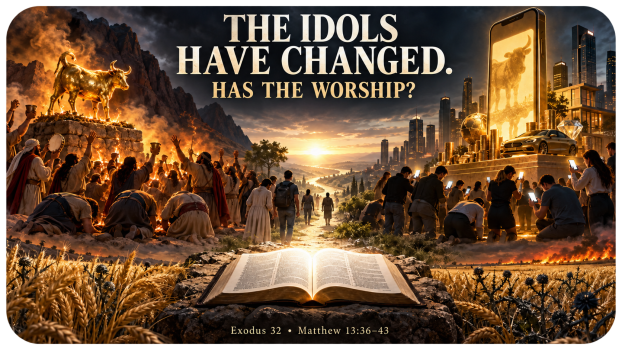
The people had an altar. They brought offerings. They gathered for a celebration that Aaron called “a feast to the LORD.” But God looked at what they were doing and said, “They have corrupted themselves” (Exodus 32:7).
That ought to stop us. People can put God’s name on something He condemns. They can celebrate it, support it, and convince one another that it honors Him. None of that changes what God has said.
Exodus 32 shows how quickly people can abandon God’s commands while keeping the appearance of worship. Matthew 13:36–43 shows where rebellion finally leads. Together, these passages confront us with something we cannot afford to brush aside: God takes sin seriously, and His patience will not postpone judgment forever.
The trouble at Sinai began when Moses delayed coming down from the mountain. The people did not know what had happened to him, so they demanded gods to lead them. God had already delivered them from Egypt and brought them through the sea. They had heard His commandments and promised to obey. Yet when waiting became uncomfortable, they reached for something they could see.
We face that same temptation. We pray, wait, and wonder why God has not acted. Then we begin making excuses for stepping outside His Word. But uncertainty about what God is doing never gives us permission to disregard what God has said.
Aaron collected their gold and fashioned a calf. Then they credited it with bringing them out of Egypt. They gave something they had made the honor belonging to the God who had delivered them. Psalm 106:21 states the problem plainly: “They forgat God their saviour.”
They still had religious activity. What they had abandoned was obedience to the God they claimed to honor.
That danger reaches into our lives today. We can construct an idea of God that approves of what we want, overlooks the sins we defend, and never challenges the way we live. We can welcome His promises while explaining away His warnings. We can say, “My God would never judge someone for that,” even when His Word says otherwise.
When we do that, we are allowing our preferences to tell us who God is. The golden calf warns us where that leads.
Aaron also shows what happens when a leader gives in to the crowd. He should have restrained the people. Instead, he helped them rebel, then tried to escape responsibility: “I cast it into the fire, and this calf came out” (Exodus 32:24). But Scripture had already told us that he deliberately fashioned it.
We do something similar whenever we explain our sin without confessing it. We describe the pressure, blame other people, and talk about how difficult things became. Those circumstances may be real, but repentance requires us to acknowledge what we chose. First John 1:9 says, “If we confess our sins, he is faithful and just to forgive us our sins, and to cleanse us from all unrighteousness.”
God’s response at Sinai makes the seriousness impossible to miss. Moses destroyed the calf, the tablets were broken, and about three thousand people died under a specific judgment commanded in that setting. This gives Christians no permission to use violence against unbelievers. It does show that rebellion against God is no small matter. Their celebration ended in grief because they treated His commands as something they could set aside.
Jesus carries that warning forward in the parable of the wheat and the tares. He explains that “the field is the world,” the good seed represents the sons of the kingdom, and the tares represent the sons of the wicked one. They grow alongside one another until the harvest, which He identifies as “the end of the age” (Matthew 13:38–39).
Their present coexistence will not continue forever. Jesus says His angels will gather “those who practice lawlessness” and cast them into “the furnace of fire,” where there will be “wailing and gnashing of teeth” (Matthew 13:41–42).
Those are the words of Jesus. We have no right to soften them until they lose their meaning. The Savior who welcomes sinners also warns them of judgment. We need to hear everything He says.
At Sinai, a religious celebration could not hide rebellion from God. At the harvest, no outward profession will prevent Christ from judging rightly. He makes that especially clear in Matthew 7:21: “Not every one that saith unto me, Lord, Lord, shall enter into the kingdom of heaven; but he that doeth the will of my Father which is in heaven.”
Some will point to impressive religious works. Yet Jesus will say, “I never knew you: depart from me, ye that work iniquity” (Matthew 7:23). Calling Him Lord while defending a life of disobedience is a deadly deception.
This does not mean we earn salvation by becoming good enough. Ephesians 2:8–9 says we are saved by grace through faith, “not of works, lest any man should boast.” The next verse says we are created in Christ Jesus “unto good works.” The grace that saves us also teaches us to deny “ungodliness and worldly lusts” and live “soberly, righteously, and godly, in this present world” (Titus 2:12).
Believers still stumble and need forgiveness. But there is a serious difference between confessing sin and defending it. We cannot honestly seek freedom from something while insisting on our right to keep it.
So how should we live now? We must bring our beliefs, our worship, and our conduct under God’s Word. Where Scripture exposes sin, we must repent. Where it corrects our thinking, we must listen. That reaches into our homes, our private habits, our speech, our honesty, our treatment of others, and what we choose to pursue. James 1:22 says, “Be ye doers of the word, and not hearers only, deceiving your own selves.”
We must also stop treating delay as approval. The people at Sinai grew impatient while Moses was away. In Jesus’ parable, the harvest comes at the appointed end. God’s patience gives us time to repent. Romans 2:4 asks whether we understand “that the goodness of God leadeth thee to repentance.” Continuing in sin because judgment has not yet come is an abuse of His kindness.
There is mercy for those who turn to Him. Moses pleaded for Israel, but he could only say, “Perhaps I can make atonement for your sin” (Exodus 32:30). Jesus accomplished what Moses could not. He “offered one sacrifice for sins for ever” (Hebrews 10:12). Our hope rests in Him, and His sacrifice shows us both the depth of God’s mercy and the terrible seriousness of our sin.
Exodus 32 asks whether we will obey the God who has spoken. Matthew 13 tells us that a final separation is coming. We will not be able to hide in the crowd, point to our religious activity, or explain away what Christ has said.
Jesus also promises that “the righteous will shine forth as the sun in the kingdom of their Father” (Matthew 13:43). There is a glorious future for His people. But we must not claim His promise while refusing His call to repentance.
If God’s Word is exposing something you have been excusing, take it seriously today. Confess it. Turn from it. Seek the Lord and obey what He has said. “To day if ye will hear his voice, harden not your hearts” (Hebrews 3:15).
More information on this subject:
Come Out from Among Them


