Unlocking Ezekiel 28

  • Welcome to Christian Forums, a Christian Forum that recognizes that all Christians are a work in progress.

    You will need to register to be able to join in fellowship with Christians all over the world.

    We hope to see you as a part of our community soon and God Bless!

Hiddenthings

Well-Known Member
May 19, 2025
3,777
415
83
Leeton NSW
Faith
Christian
Country
Australia
"Thou wast perfect in thy ways from the day that thou wast created, till iniquity was found in thee" (Ezek. 28:15).

Wick, some have argued that this verse cannot refer to the literal king of Tyre because he was not "perfect." However, the Hebrew word used here, tamim, translated as "perfect," also carries the meanings of complete, whole, or blameless.

For example, Noah is described as “a just man and perfect” in Genesis 6:9, using the same Hebrew word—tamim—yet there is no suggestion that Noah was anything other than a human being. So, the use of tamim in Ezekiel 28 does not require the subject to be angelic; it can refer to moral integrity or blamelessness in a general human sense.

I believe we can both agree that all of Ezekiel 28 is addressing the King of Tyre. Therefore, the burden of proof lies with those who believe it refers to the devil or Satan—they must demonstrate how the symbols fit within the actual context of the chapter.
 
  • Like
Reactions: Wick Stick

Wick Stick

Well-Known Member
Sep 21, 2023
2,424
1,486
113
46
Phoenix
Faith
Christian
Country
United States
@Wick Stick, if possible, could you include supporting scriptures in your comments? I’ve noticed several claims about your view of the devil, but no references to back them up. Even if you don’t have direct evidence, it’s helpful to clarify when something is just your opinion.
If there's something in particular for which you'd like to know the source, just say so and I'll attempt to give it.

However, I dislike providing proof-texts of the book-chapter-verse variety. I think doctrines should be based on a preponderance of Scripture; not single verses. Should you ask, the answer is likely going to be of the form "these several chapters of John develop this doctrine" or "this can be seen by doing a study of every usage of this Greek word" or "the thesis of the book of Obadiah is..."
 

Hiddenthings

Well-Known Member
May 19, 2025
3,777
415
83
Leeton NSW
Faith
Christian
Country
Australia
If there's something in particular for which you'd like to know the source, just say so and I'll attempt to give it.

However, I dislike providing proof-texts of the book-chapter-verse variety. I think doctrines should be based on a preponderance of Scripture; not single verses. Should you ask, the answer is likely going to be of the form "these several chapters of John develop this doctrine" or "this can be seen by doing a study of every usage of this Greek word" or "the thesis of the book of Obadiah is..."
If you continue to share opinions without evidence, you will lose my interest as everything, we are doing here is Scripturally based.

I'll give you an example.

You claim that your fallen angel is driven by a desire for wealth, yet the context of the chapter clearly refers to a king whose obsession with wealth led to his corruption.

I can prove this conclusively not only from Ezekiel but from passages all of the Scripture.

1 Timothy 6:9, But those who desire to be rich fall into temptation and a snare, and into many foolish and harmful lusts which drown men in destruction and perdition.”

Speaking to humans of course.

Job was rich and his adversary also envied at his riches.

Provide a passage in the Bible which teaches you a fallen angel desires material wealth?

If you cannot simply say so and we can move on.
 

Wick Stick

Well-Known Member
Sep 21, 2023
2,424
1,486
113
46
Phoenix
Faith
Christian
Country
United States
You are moving away from Ezekiel 28.

Evidence for this both camps belief?

I can't stress this enough Wick...either say it's a personal belief or provide support.
You yourself said that angels travel between heaven and earth. Didn't you bring up the "ministering spirits" in Heb 1? We could talk of Jacob's ladder, or Gabriel's announcing the births of Jesus and John. I think you already believe in this sort of angel.

I'm less sure we agree on terrestrial angels. I spoke in brief about the metaphor of "heavens and earth" being the rulers and people, and you appeared to agree. Certainly that's what's going on in Ezekiel 28 - the Prince of Tyre was one such ruler, but greed led to his fall and ultimately his destruction.

Maybe the break in communications is that we haven't talked about stars being angels? The Hebrew word translated "host" is Tsaba, and it doesn't put a difference between stars and angels. The Bible declares them to be for "signs and seasons." In antiquity, people relied on those "messages" received by looking at the stars. It's nothing so crass as modern astrology, but they relied on them the way we use calendars and clocks. Those "heavenly angels" do not fall. A star coming anywhere near our solar system would destroy earth.

Or possibly, you just want to limit the word angel to speaking about one of these? But the Bible has all of them.
 

Hiddenthings

Well-Known Member
May 19, 2025
3,777
415
83
Leeton NSW
Faith
Christian
Country
Australia
You yourself said that angels travel between heaven and earth. Didn't you bring up the "ministering spirits" in Heb 1? We could talk of Jacob's ladder, or Gabriel's announcing the births of Jesus and John. I think you already believe in this sort of angel.
Only one type of divine being.
I'm less sure we agree on terrestrial angels. I spoke in brief about the metaphor of "heavens and earth" being the rulers and people, and you appeared to agree. Certainly that's what's going on in Ezekiel 28 - the Prince of Tyre was one such ruler, but greed led to his fall and ultimately his destruction.
If you don't have any evidence, we need, accept this and push forward. Still a lot to get through in Ezekiel 28.
 

Wick Stick

Well-Known Member
Sep 21, 2023
2,424
1,486
113
46
Phoenix
Faith
Christian
Country
United States
Provide a passage in the Bible which teaches you a fallen angel desires material wealth?

If you cannot simply say so and we can move on.
Uh... this one? Ezekiel 28?

We agree the Prince of Tyre is a man. But he's also a metaphorical angel, because he's a Prince.

Or how about Annas and Caiaphas in the New Testament? Certainly they were rulers of the Jewish people. Certainly they turned the temple into a house of merchandise. And when the New Testament prophesies that the stars will fall from heaven (Matt 24, Mark 13), it's likely talking about them, or at least their successors.
 

David in NJ

Well-Known Member
Jul 20, 2021
16,393
8,947
113
50
Denville
Faith
Christian
Country
United States
Gender
Male
You have already made you mind up David so pray all your like.
TEN revelations of Truth that convinced me:
a.) Noah
b.) Joseph
c.) Daniel
d.) Job
e.) Matthew chapter 24
f.) 1 Thessalonians
g.) 2 Thessalonians
h.) Hebrews
i.) 1 Corinthinthians
j.) 1 John
 

Wick Stick

Well-Known Member
Sep 21, 2023
2,424
1,486
113
46
Phoenix
Faith
Christian
Country
United States
No, we have already agreed on the context.

I'm asking for evidence where the context is NOT a human king but your fallen angel.
All kings are angels. The Hebrew words for the two are basically identical for a reason.

But if you want an example of one of the other types of angel sinning... that's not in the Bible.

The closest you'll get is Jude 1. By combining "angels who kept not their first estate" and "wandering stars" and a reference to Enoch, which talks about supernatural angels sinning (the bit I quoted earlier), that idea exists there.

But the overall thesis of Jude is "watch out for the bad men who are creeping in." Comparing those bad men to angelic characters in a well-known story does not make them supernatural; they're still men. Likewise, knowing and referencing Enoch doesn't necessarily make Enoch a reliable source (or a literal one).
 

Hiddenthings

Well-Known Member
May 19, 2025
3,777
415
83
Leeton NSW
Faith
Christian
Country
Australia
@Wick Stick

Let's begin to deal with the symbology and the Language of God. He communicates in way's many do not grasp as we shall see.

Let’s set the context!

Tyre held a uniquely privileged position in its relationship with Israel. The close friendship between David and Hiram (2 Samuel 5:11; 1 Kings 5:1, 6–7, 10), and the alliance between Hiram and Solomon—in which Hiram supplied materials for the temple (1 Kings 5:12, 17–18)—reflects a history of cooperation and favor. In Ezekiel 28:13–18, symbolic language drawn from Israelite worship illustrates the depth of this connection, implying that Tyre shared in divine blessing due to its association with Israel.

For example:

“Every precious stone was your covering” (Ezek. 28:13, ESV)
“You walked among the stones of fire” (Ezek. 28:14, ESV)

These are allusions to the stones in the high priest’s breastpiece (Exodus 39:10–14), which represented the twelve tribes of Israel. Called “stones of fire” due to their brilliance under the Shekinah glory, they symbolize divine favor. The king of Tyre "walking among them" symbolically portrays his participation in the blessings and favor extended to Israel, especially in connection with the temple.

This aligns with Genesis 12:3 (ESV): “I will bless those who bless you, and him who dishonors you I will curse…”

Just as Potiphar’s household was blessed because of Joseph: “The LORD blessed the Egyptian's house for Joseph’s sake; the blessing of the LORD was on all that he had, in house and field” (Genesis 39:5, ESV), so too was Tyre “covered” through its alliance with Israel.

“You were an anointed guardian cherub. I placed you; you were on the holy mountain of God” (Ezekiel 28:14, ESV)

This echoes the cherubim over the mercy seat (Exodus 37:7–9; 25:19–20). Though the translation is debated, the imagery may suggest that Tyre, as a great power, had the opportunity to “cover” or support Israel—perhaps even economically and diplomatically. However, Tyre misused this role, and its pride led to judgment (cf. Ezek. 28:4–5).

“You were on the holy mountain of God” (Ezekiel 28:14, ESV)

This “holy mountain” refers not to heaven, as some argue, but to Mount Zion—the earthly site of God’s future temple:

“It shall come to pass in the latter days that the mountain of the house of the LORD shall be established… and all the nations shall flow to it” (Isaiah 2:2–3, ESV)

“These I will bring to my holy mountain, and make them joyful in my house of prayer” (Isaiah 56:7, ESV)
“For on my holy mountain… there all the house of Israel, all of them, shall serve me in the land” (Ezekiel 20:40, ESV)

“By the multitude of your iniquities, in the unrighteousness of your trade you profaned your sanctuaries” (Ezekiel 28:18, ESV)

This may imply that Tyre developed forms of worship modeled after Israel’s. Given Hiram’s admiration for David and Solomon (1 Kings 5:1–12), the king of Tyre would have been familiar with Israel’s God. Alternatively, this could mean Tyre’s "sanctuaries" were figuratively within Israel’s sphere of spiritual influence—privileged by proximity yet ultimately corrupted by pride.

When Nebuchadnezzar invaded Jerusalem in 586 B.C., Tyre arrogantly proclaimed:

“Aha, the gate of the peoples is broken; it has swung open to me. I shall be replenished, now that she is laid waste” (Ezekiel 26:2, ESV)

In doing so, Tyre violated the covenantal principle of Genesis 12:3, and thus invited judgment upon itself.

“I brought fire out from your midst; it consumed you, and I turned you to ashes on the earth” (Ezekiel 28:18, ESV)

Just as Nadab and Abihu were consumed by fire for profaning the sacred (Leviticus 10:2, ESV), Tyre too was judged. Like Sodom and Gomorrah, it would be reduced to ashes for failing to distinguish between the holy and the profane (Genesis 19:24–25, ESV).

In summary:

Ezekiel 28 is not speaking of a fallen angel, but of a historical king—one who, through pride and misuse of a privileged relationship with God’s people, fell from divine favor and was judged accordingly.

At some point, we also need to explore how the children of Israel would have understood these symbols and their significance, as well as the deeper lessons God was teaching them through His judgments on Tyre and its king.

 

Hiddenthings

Well-Known Member
May 19, 2025
3,777
415
83
Leeton NSW
Faith
Christian
Country
Australia
All kings are angels. The Hebrew words for the two are basically identical for a reason.

But if you want an example of one of the other types of angel sinning... that's not in the Bible.

The closest you'll get is Jude 1. By combining "angels who kept not their first estate" and "wandering stars" and a reference to Enoch, which talks about supernatural angels sinning (the bit I quoted earlier), that idea exists there.
We can deal with this another time as the context is clearly speaking about humans. Let's stay with Ezekiel and work through the evidence at hand.
 

Hiddenthings

Well-Known Member
May 19, 2025
3,777
415
83
Leeton NSW
Faith
Christian
Country
Australia
I think I agree...

Stars are heavenly but I wouldn't call them divine.
Kings and captains certainly aren't divine.
So only one of the 3 types of angels is divine
The Lord Jesus only defines and speaks to one type of angelic being and the OT portrays the same. The consistency cannot be ignored.
 

soberxp

Well-Known Member
Mar 6, 2025
2,631
907
113
43
Xi'an
m.youtube.com
Faith
Christian
Country
China
Gender
Male
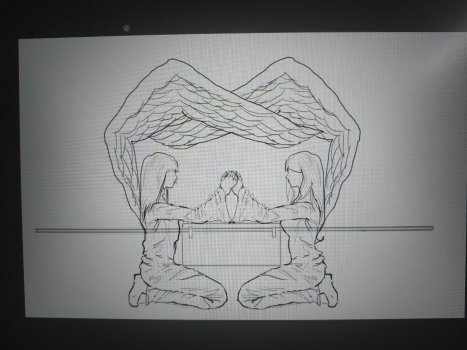
You must first understand the meaning of the cherubim before you can understand the whole meaning of Ezekiel.

444.jpg

If the two cherubim atop the Ark represent Adam and Eve—male and female—embodying sacred matrimony, then Ezekiel's allegorical use of the cherubim in this passage becomes profoundly clear.

Of course, if you can't understand it, then you should at least understand that any of the Ten Commandments begins with the breed of Adam and Eve. It all begins with their breed, which is perhaps too secular, with the other words is love of God, the love of love, the love of parents, and so on...
 
Last edited:

Hiddenthings

Well-Known Member
May 19, 2025
3,777
415
83
Leeton NSW
Faith
Christian
Country
Australia
@Wick Stick

I had a conversation with another member who unsuccessfully tried to argue that the "prince" in Ezekiel 28:2 is not the same individual as the "king" in the lament. It’s a misguided attempt to disconnect the lament from its proper context and force the passage into supporting a fallen angel narrative an approach that ultimately distorts and misuses the text.

I'll place this short study on the Hebrew word nāgîd which also highlights the unique relationship the King/Prince of Tyre had with God and Israel.

The Hebrew term נָגִיד (nāgîd), often translated as “prince”, is more accurately understood in many pre-exilic contexts as a “divine designee”—a royal figure appointed by God. Though the typical English rendering may be misleading, its usage in the Hebrew Bible suggests a title closely tied to divine appointment and early kingship.

In pre-exilic texts, nāgîd is used exclusively of kings, such as Saul, David, Solomon, Jeroboam I, and Jehu—all figures involved in the establishment or continuation of dynasties. It is therefore best understood as a primary royal title, rather than a general term for a prince or official. For example, in 2 Kings 20:5, the term is used of Hezekiah, though it does not appear in the parallel passage in Isaiah 38:5. If original, its use here may reflect a retrospective application of terminology from the Davidic period.

Curiously, the use of nāgîd in Ezekiel 28:2 for the king of Tyre stands out, as the term is otherwise confined to Israelite kings in pre-exilic usage.

In post-exilic texts, the scope of nāgîd broadens significantly, referring to a range of high-ranking figures—priestly officials (e.g., 1 Chr. 9:11; Neh. 11:11), military leaders (e.g., 1 Chr. 9:20; 2 Chr. 32:21), and other administrative roles. This broader usage continued into later Hebrew.

In earlier texts, nāgîd is most often associated with divine appointment, using verbs like צִוָּה (tsivvah, "command") or מָשַׁח (mashach, "anoint"), indicating that God himself designated individuals for this role (e.g., 1 Sam. 10:1; 13:14; 2 Sam. 6:21; 7:8; 1 Kgs. 14:7).

Though some scholars (e.g., Mettinger and Lipiński) have proposed that nāgîd originally meant “crown prince,” this theory is weakly supported:
  • 1 Kgs 1:35, where David appoints Solomon as nāgîd, is unique in having a human make the designation.
  • 2 Chr. 11:22 may reflect a later, expanded use of nāgîd in the post-exilic period, not its original meaning.
  • The suggested etymology linking nāgîd to the root נגד (n-g-d, “to declare” or “announce”) is linguistically problematic. As noted, the derivation would require a Hiphil form, and the argument leans on a questionable wordplay rather than true etymology.
Thus, Fritz’s conclusion that “the original meaning of nāgîd is difficult to determine” is probably the most realistic stance.

Nevertheless, several key features of the term stand out:
  1. It is mostly limited to Israel’s first monarchs.
  2. Its use is typically tied to divine appointment, with God as the subject of the verb nearly every time.
  3. It appears infrequently in poetic literature, suggesting it was more of a functional or official title than a literary or metaphorical one.
Importantly, nāgîd emphasizes the relationship between God and the king. This theologically loaded meaning made it inappropriate as a title for God Himself—He is the King, but not a “divine designee,” since He is not appointed by anyone.
 

Wick Stick

Well-Known Member
Sep 21, 2023
2,424
1,486
113
46
Phoenix
Faith
Christian
Country
United States
Let's begin to deal with the symbology and the Language of God. He communicates in way's many do not grasp as we shall see.

Let’s set the context!

Tyre held a uniquely privileged position in its relationship with Israel. The close friendship between David and Hiram (2 Samuel 5:11; 1 Kings 5:1, 6–7, 10), and the alliance between Hiram and Solomon—in which Hiram supplied materials for the temple (1 Kings 5:12, 17–18)—reflects a history of cooperation and favor. In Ezekiel 28:13–18, symbolic language drawn from Israelite worship illustrates the depth of this connection, implying that Tyre shared in divine blessing due to its association with Israel.

For example:

“Every precious stone was your covering” (Ezek. 28:13, ESV)
“You walked among the stones of fire” (Ezek. 28:14, ESV)

These are allusions to the stones in the high priest’s breastpiece (Exodus 39:10–14), which represented the twelve tribes of Israel. Called “stones of fire” due to their brilliance under the Shekinah glory, they symbolize divine favor. The king of Tyre "walking among them" symbolically portrays his participation in the blessings and favor extended to Israel, especially in connection with the temple.

This aligns with Genesis 12:3 (ESV): “I will bless those who bless you, and him who dishonors you I will curse…”

Just as Potiphar’s household was blessed because of Joseph: “The LORD blessed the Egyptian's house for Joseph’s sake; the blessing of the LORD was on all that he had, in house and field” (Genesis 39:5, ESV), so too was Tyre “covered” through its alliance with Israel.
Agreed.
“You were an anointed guardian cherub. I placed you; you were on the holy mountain of God” (Ezekiel 28:14, ESV)

This echoes the cherubim over the mercy seat (Exodus 37:7–9; 25:19–20). Though the translation is debated, the imagery may suggest that Tyre, as a great power, had the opportunity to “cover” or support Israel—perhaps even economically and diplomatically. However, Tyre misused this role, and its pride led to judgment (cf. Ezek. 28:4–5).
I think you missed on this bit.

I find the "guardian cherub" of v.14 to be a callback to the story in Genesis 3, where God stationed a cherub with a flaming sword at the entrance of Eden, to prevent Adam and Eve from returning to the Garden. That doesn't come out of the blue, as the verse immediately preceding puts the Garden of Eden in the immediate context:

13 Thou hast been in Eden the garden of God
“You were on the holy mountain of God” (Ezekiel 28:14, ESV)

This “holy mountain” refers not to heaven, as some argue, but to Mount Zion—the earthly site of God’s future temple:

“It shall come to pass in the latter days that the mountain of the house of the LORD shall be established… and all the nations shall flow to it” (Isaiah 2:2–3, ESV)

“These I will bring to my holy mountain, and make them joyful in my house of prayer” (Isaiah 56:7, ESV)
“For on my holy mountain… there all the house of Israel, all of them, shall serve me in the land” (Ezekiel 20:40, ESV)
I would suggest the holy mountain here is not Mt. Zion, but rather Mt. Hermon.

The king of Tyre did not visit Jerusalem. He sent craftsmen. He exported wood. He never saw Solomon's Temple. This is an argument from silence - if he had visited, the event would have been notable enough to be recorded.

He definitely visited Mt. Hermon. Not only does it lie within Tyre's territory, it's the single most important strategical site within it. There was a fortress there. It was also the seat of two different cults. My source in this paragraph is archaeology rather than the Bible.

And yes, Hermon is a holy mountain, both for ancient Israelites, Canaanites, and even modern Christians. Scholars think it was the site of Jesus' transfiguration.
“By the multitude of your iniquities, in the unrighteousness of your trade you profaned your sanctuaries” (Ezekiel 28:18, ESV)

This may imply that Tyre developed forms of worship modeled after Israel’s. Given Hiram’s admiration for David and Solomon (1 Kings 5:1–12), the king of Tyre would have been familiar with Israel’s God. Alternatively, this could mean Tyre’s "sanctuaries" were figuratively within Israel’s sphere of spiritual influence—privileged by proximity yet ultimately corrupted by pride.
You have it backwards - the Israelites were within the Phoenician's sphere of influence.

Before Israel ever existed, Phoenicia was the world's first sea-faring power. They invented navigation that didn't require staying within sight of the shore, and leveraged that to make themselves literally wealthy. They invented Phonetic language. They colonized the islands of the Mediterranean, the coast of North Africa (Carthage), and even sailed across the Atlantic. Artifacts of their civilization have been found alongside Native American relics in North America.

All of that would have been the case around the time of David, Moses, and Abraham. But by the time of the time of the writing of Ezekiel, they were in decline. The Hittite empire was encroaching from the north, Pharoah had ridden north and exacted tribute from most of the Canaanite city-states, and the Assyrians were pushing into the Beqaa.

These 2 paragraphs are based on reconstructed history and archaeology; not the Bible.

One thing we can say from the Bible - the temple was full of engravings of cherubim, and the cherub is the symbol of the king of Tyre.
When Nebuchadnezzar invaded Jerusalem in 586 B.C., Tyre arrogantly proclaimed:

“Aha, the gate of the peoples is broken; it has swung open to me. I shall be replenished, now that she is laid waste” (Ezekiel 26:2, ESV)

In doing so, Tyre violated the covenantal principle of Genesis 12:3, and thus invited judgment upon itself.

“I brought fire out from your midst; it consumed you, and I turned you to ashes on the earth” (Ezekiel 28:18, ESV)

Just as Nadab and Abihu were consumed by fire for profaning the sacred (Leviticus 10:2, ESV), Tyre too was judged. Like Sodom and Gomorrah, it would be reduced to ashes for failing to distinguish between the holy and the profane (Genesis 19:24–25, ESV).
Agreed.
In summary:

Ezekiel 28 is not speaking of a fallen angel, but of a historical king—one who, through pride and misuse of a privileged relationship with God’s people, fell from divine favor and was judged accordingly.
Yes, mostly. All kings are angels of a sort. Not divine angels, but angels nonetheless.
At some point, we also need to explore how the children of Israel would have understood these symbols and their significance, as well as the deeper lessons God was teaching them through His judgments on Tyre and its king.

I look forward to your next post.