amigo de christo
Well-Known Member
Adhereing to a creed , but do they follow Christ .Could you clarify who you’re referring to here? If you mean Orthodox and Catholic Christians, the primary doctrinal disagreement between them centers on the Filioque clause in the Nicene Creed. However, both Orthodox and Catholics strictly adhere to the Creed, which encapsulates the fundamental dogmas of the faith. Every Catholic and Orthodox believer is expected to accept the Creed as a unified statement of core beliefs, leaving no room for disagreement on these essentials within their respective traditions.
With Protestants, however, the situation is different. I once spoke with two Protestants from the same church, and one expressed a belief that contradicted the other’s. When I pointed out the inconsistency, they shrugged it off, saying, “Oh, that’s normal! That’s his personal faith, and this is mine. I don’t criticize his, and he doesn’t criticize mine.”
From this experience, I concluded that there are as many versions of Protestant faith as there are Protestants—each with their own unique, personal interpretation. To me, this is absurd. Truth is objective; it cannot be subjective, varying from person to person. This lack of a unified foundation makes meaningful dialogue with Protestants challenging, as they often lack a common doctrinal core.
There’s also a common myth that Protestants know the Bible well. In my experience, this is often an illusion. Many Protestants memorize a handful of verses to use in debates but rarely engage with the full scope of Scripture. Some may read the Bible but struggle to understand it deeply or study it systematically. As a result, each Protestant tends to develop their own personal, unique take on the Bible, shaped by individual interpretation rather than a shared framework.
You don’t have to look far for an example. In the thread “Should you help the wicked and love those who hate the Lord? Because of this, wrath has gone out against you from the Lord,” response #194 highlights a case where a single phrase was pulled out of context from just one verse. Not from the entire Bible, not from a single Gospel, not even from a whole chapter—but from one verse!
This is why the frequent quoting of Scripture by Protestants can create the impression that they know the Bible well. In reality, many don’t truly understand it or see the bigger picture. As a result, there are as many interpretations of the Bible as there are Protestants, and behind these interpretations can be anything—sometimes even the most blatant nonsense that pops into someone’s head.
Many can quoate a creed , just as i once could quoate the gospel .
However if that same person turns and contradicts THE ONE WHO saved us
by praticing wicked things , as i once could , THEN its naught but lip service .
Ecumenicism is now the snare that at the end of days has brought us unto its interfaith .
And it will grave every last one who partakes of its cup of love which has led them to The lie .
Did you know right now we have a very high number in christendom
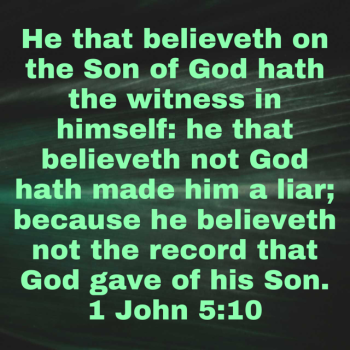
which claim to BELEIVE the gospel and yet DO NOT BELEIVE the gospel .
How so you might be thinking .
THE gospel is very clear that ONE MUST BELEIVE IN the ressurection of CHRIST and confess HIM to BE SAVED .
And many have indeed cliamed this , ONLY TO TURN around and prove they DO NOT .
HOW so , THEY make claim all other religoins serve the same GOD we do
and are all headed to GOD differently . MEANING what , THEY DO NOT BELEIVE ONE MUST BELIEVE TO BE SAV ED
and it has made their faith VOID as they now beleive IN UNBELEIF . pretty scary huh
And yet this generation believes in THIS UNBELIEF , they see it as the LOVE OF GOD . pretty terrifying for them my friend .
WE cannot claim to BELEIVE and yet preach UNBELEIF or we never really TRULY DO BELEIVE .
Cant have it both ways . That is known only as THEY HAVE DECIEVED themselves .