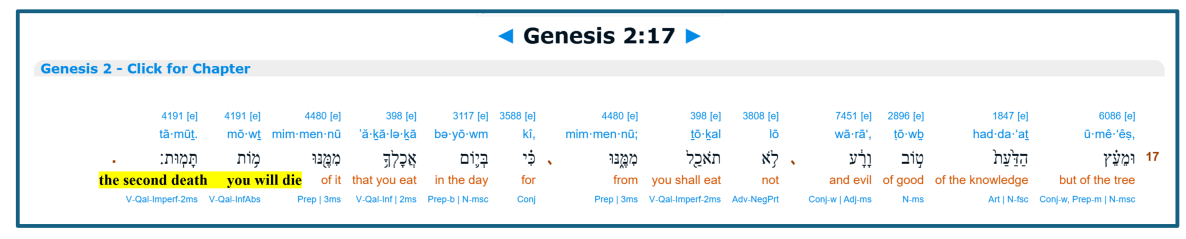
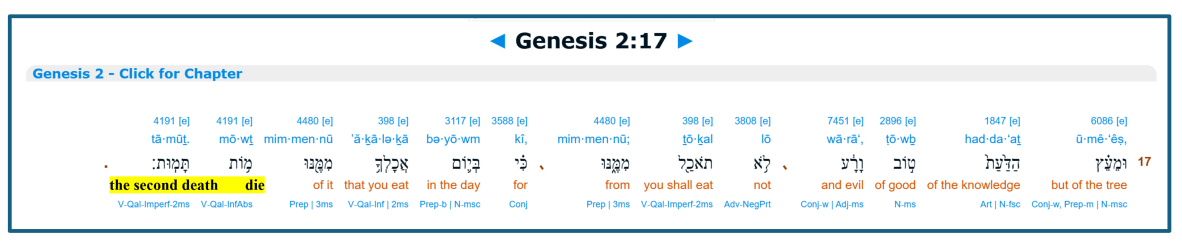
The phrase 'surely die' shows up dozens upon dozens of times in the Old Testament. One of the most famous examples is in Genesis 2:17:
What does surely die mean? There are many interpretations to choose from:
Looking at the original Hebrew, we find that the word 'surely' is not even there:
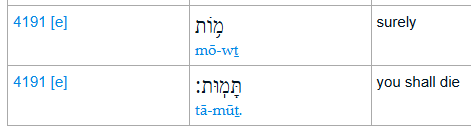
It is the Strong's number 4191 'muth' occurring twice in a row:
It is often transliterated as 'dying you shall die'. Variants of the phrase “dying you shall die” occur 49 times in the Old Testament. This is not very helpful as the phrase 'dying you shall die' is awkward and confusing and could mean all kinds of things. Therefore, it is best to use Exegesis to determine the proper meaning. In other words, we will let Scripture interpret Scripture and look at the phrase in question in other verses to see how it is used. Let us now examine our first verse:
Now, if we insert one of the common interpretations, we have:
Does that make sense? Not at all. Let's try another:
It just gets worse. As we can see none of the common interpretations work. We can do this over and over again:
Nope, that does not work either. Again:
As we can see, no matter what interpretation we use, they all fail the most basic tests of Exegesis. So why do Christians use them to interpret Genesis 2:17? We have a huge problem here. This comment sums it up best:
Finally, to interpret Genesis 2:17 as announcing natural consequences instead of a juridical penalty ignores the overwhelming biblical evidence of how authors used the phrase in question throughout the Old Testament. As such, the natural consequences interpretation seems to establish human arbiters as higher authorities than the text to determine its truthfulness and relevance. Scripture no longer interprets Scripture. How the pastor handles texts like Genesis 2:17 remains vital to maintaining a ministry faithful to the authority of Scripture and that properly disciples the church members in their walk with God.
The above comes from a very well done study that can be found here:

Genesis 2:17 But of the tree of the knowledge of good and evil, thou shalt not eat of it: for in the day that thou eatest thereof thou shalt surely die.
What does surely die mean? There are many interpretations to choose from:
- Spiritual death (whatever that means)
- Separation from God
- Begin the aging process and slowly die
- Death is certain... 'eventually'
- Other?
Looking at the original Hebrew, we find that the word 'surely' is not even there:
It is the Strong's number 4191 'muth' occurring twice in a row:
It is often transliterated as 'dying you shall die'. Variants of the phrase “dying you shall die” occur 49 times in the Old Testament. This is not very helpful as the phrase 'dying you shall die' is awkward and confusing and could mean all kinds of things. Therefore, it is best to use Exegesis to determine the proper meaning. In other words, we will let Scripture interpret Scripture and look at the phrase in question in other verses to see how it is used. Let us now examine our first verse:
Genesis 20:7 Now therefore restore the man his wife; for he is a prophet, and he shall pray for thee, and thou shalt live: and if thou restore her not, know thou that thou shalt surely die, thou, and all that are thine.
Now, if we insert one of the common interpretations, we have:
Genesis 20:7 Now therefore restore the man his wife; for he is a prophet, and he shall pray for thee, and thou shalt live: and if thou restore her not, know thou that thou shaltsurely[spiritually] die, thou, and all that are thine.
Does that make sense? Not at all. Let's try another:
Genesis 20:7 Now therefore restore the man his wife; for he is a prophet, and he shall pray for thee, and thou shalt live: and if thou restore her not, know thou that thou shaltsurely[begin the aging process and eventually] die, thou, and all that are thine.
It just gets worse. As we can see none of the common interpretations work. We can do this over and over again:
1 Samuel 22:16 And the king said, Thou shaltsurely[eventually grow old and] die, Ahimelech, thou, and all thy father’s house.
Nope, that does not work either. Again:
1 Kings 2:37 For it shall be, that on the day thou goest out, and passest over the brook Kidron, thou shalt know for certain that thou shaltsurely die[become spiritually dead]: thy blood shall be upon thine own head.
As we can see, no matter what interpretation we use, they all fail the most basic tests of Exegesis. So why do Christians use them to interpret Genesis 2:17? We have a huge problem here. This comment sums it up best:
Finally, to interpret Genesis 2:17 as announcing natural consequences instead of a juridical penalty ignores the overwhelming biblical evidence of how authors used the phrase in question throughout the Old Testament. As such, the natural consequences interpretation seems to establish human arbiters as higher authorities than the text to determine its truthfulness and relevance. Scripture no longer interprets Scripture. How the pastor handles texts like Genesis 2:17 remains vital to maintaining a ministry faithful to the authority of Scripture and that properly disciples the church members in their walk with God.
The above comes from a very well done study that can be found here:
Dying You Shall Die: The meaning of Genesis 2:17
When I was a district pastor, one of the more interesting elements in my work was fielding questions about a word or phrase from the original biblical languages. Like first year Hebrew students, members have unparalleled access to Internet and software resources that enable them to know enough...
www.ministrymagazine.org