What Does 'Surely Die' Mean?

  • Welcome to Christian Forums, a Christian Forum that recognizes that all Christians are a work in progress.

    You will need to register to be able to join in fellowship with Christians all over the world.

    We hope to see you as a part of our community soon and God Bless!

Exegesis

Member
Jun 22, 2025
417
92
28
62
Salt Lake
Faith
Christian
Country
United States
Gender
Male
The phrase 'surely die' shows up dozens upon dozens of times in the Old Testament. One of the most famous examples is in Genesis 2:17:

Genesis 2:17 But of the tree of the knowledge of good and evil, thou shalt not eat of it: for in the day that thou eatest thereof thou shalt surely die.

What does surely die mean? There are many interpretations to choose from:
  • Spiritual death (whatever that means)
  • Separation from God
  • Begin the aging process and slowly die
  • Death is certain... 'eventually'
  • Other?
So how do we know which is the correct interpretation? What if there is another interpretation that is not even taught? These are important questions which will be addressed in this post. If Christians are teaching the wrong interpretation, that would throw Biblical doctrine into turmoil and chaos. Such a foundational teaching should not be filled with error. We need to get this right the first time.

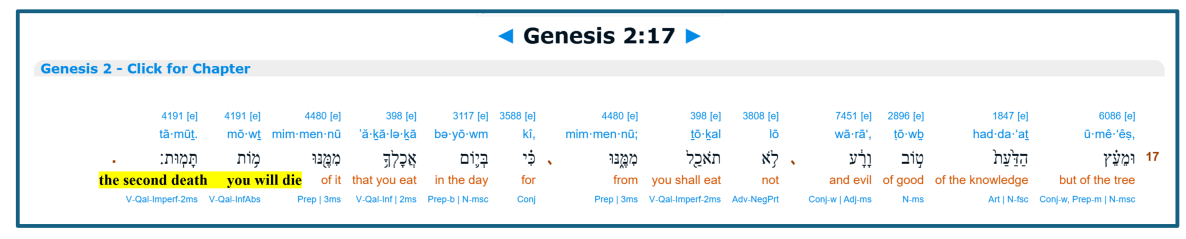
Looking at the original Hebrew, we find that the word 'surely' is not even there:
1762011302932.png


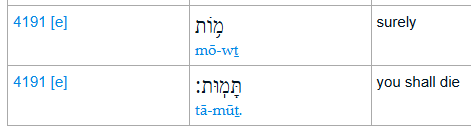
It is the Strong's number 4191 'muth' occurring twice in a row:


It is often transliterated as 'dying you shall die'. Variants of the phrase “dying you shall die” occur 49 times in the Old Testament. This is not very helpful as the phrase 'dying you shall die' is awkward and confusing and could mean all kinds of things. Therefore, it is best to use Exegesis to determine the proper meaning. In other words, we will let Scripture interpret Scripture and look at the phrase in question in other verses to see how it is used. Let us now examine our first verse:

Genesis 20:7 Now therefore restore the man his wife; for he is a prophet, and he shall pray for thee, and thou shalt live: and if thou restore her not, know thou that thou shalt surely die, thou, and all that are thine.

Now, if we insert one of the common interpretations, we have:

Genesis 20:7 Now therefore restore the man his wife; for he is a prophet, and he shall pray for thee, and thou shalt live: and if thou restore her not, know thou that thou shalt surely [spiritually] die, thou, and all that are thine.

Does that make sense? Not at all. Let's try another:

Genesis 20:7 Now therefore restore the man his wife; for he is a prophet, and he shall pray for thee, and thou shalt live: and if thou restore her not, know thou that thou shalt surely [begin the aging process and eventually] die, thou, and all that are thine.

It just gets worse. As we can see none of the common interpretations work. We can do this over and over again:

1 Samuel 22:16 And the king said, Thou shalt surely [eventually grow old and] die, Ahimelech, thou, and all thy father’s house.

Nope, that does not work either. Again:

1 Kings 2:37 For it shall be, that on the day thou goest out, and passest over the brook Kidron, thou shalt know for certain that thou shalt surely die [become spiritually dead]: thy blood shall be upon thine own head.

As we can see, no matter what interpretation we use, they all fail the most basic tests of Exegesis. So why do Christians use them to interpret Genesis 2:17? We have a huge problem here. This comment sums it up best:

Finally, to interpret Genesis 2:17 as announcing natural consequences instead of a juridical penalty ignores the overwhelming biblical evidence of how authors used the phrase in question throughout the Old Testament. As such, the natural consequences interpretation seems to establish human arbiters as higher authorities than the text to determine its truthfulness and relevance. Scripture no longer interprets Scripture. How the pastor handles texts like Genesis 2:17 remains vital to maintaining a ministry faithful to the authority of Scripture and that properly disciples the church members in their walk with God.

The above comes from a very well done study that can be found here:

 
  • Love
Reactions: Brakelite

Jay Ross

Well-Known Member
Jun 20, 2011
9,365
3,484
113
QLD
Faith
Christian
Country
Australia
Gender
Male
Hello,

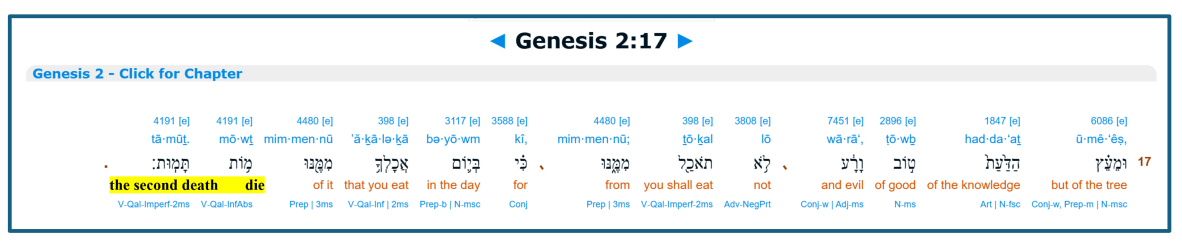
Simply speaking Genesis 2:17 tells us that if we sin against God's statutes then in the distant future, some 7,000 plus years after this requirement/law was written, those who sin against God will die the second death. In other words, we become a candidate to die the second death in the lake of fire at the time of the Final judgement if we do not humble ourselves and repent of turning away from God.

This is how I envisage the interlinear of Genesis 2:17 should read: -

1762028627522.pngShalom
 

Attachments

  • 1762028492068.png
    1762028492068.png
    74.1 KB · Views: 1
  • Like
Reactions: LoveYeshua

ScottA

Well-Known Member
Feb 24, 2011
15,580
6,968
113
www.FinishingTheMystery.com
Faith
Christian
Country
United States
The phrase 'surely die' shows up dozens upon dozens of times in the Old Testament. One of the most famous examples is in Genesis 2:17:


What does surely die mean? There are many interpretations to choose from:
  • Spiritual death (whatever that means)
  • Separation from God
  • Begin the aging process and slowly die
  • Death is certain... 'eventually'
  • Other?
So how do we know which is the correct interpretation? What if there is another interpretation that is not even taught? These are important questions which will be addressed in this post. If Christians are teaching the wrong interpretation, that would throw Biblical doctrine into turmoil and chaos. Such a foundational teaching should not be filled with error. We need to get this right the first time.

Looking at the original Hebrew, we find that the word 'surely' is not even there:

View attachment 72863


It is the Strong's number 4191 'muth' occurring twice in a row:


It is often transliterated as 'dying you shall die'. Variants of the phrase “dying you shall die” occur 49 times in the Old Testament. This is not very helpful as the phrase 'dying you shall die' is awkward and confusing and could mean all kinds of things. Therefore, it is best to use Exegesis to determine the proper meaning. In other words, we will let Scripture interpret Scripture and look at the phrase in question in other verses to see how it is used. Let us now examine our first verse:


Now, if we insert one of the common interpretations, we have:


Does that make sense? Not at all. Let's try another:


It just gets worse. As we can see none of the common interpretations work. We can do this over and over again:


Nope, that does not work either. Again:


As we can see, no matter what interpretation we use, they all fail the most basic tests of Exegesis. So why do Christians use them to interpret Genesis 2:17? We have a huge problem here. This comment sums it up best:

Finally, to interpret Genesis 2:17 as announcing natural consequences instead of a juridical penalty ignores the overwhelming biblical evidence of how authors used the phrase in question throughout the Old Testament. As such, the natural consequences interpretation seems to establish human arbiters as higher authorities than the text to determine its truthfulness and relevance. Scripture no longer interprets Scripture. How the pastor handles texts like Genesis 2:17 remains vital to maintaining a ministry faithful to the authority of Scripture and that properly disciples the church members in their walk with God.

The above comes from a very well done study that can be found here:

"Surely" and "die" is actually a repeat of the same word.

As such, in the simplest of terms, if God repeats himself, I take that to mean 'you will "totally" die.' In other words, in every way.
 

TrevorHL

Active Member
Jul 17, 2024
617
174
43
82
New South Wales / Lake Macquarie
Faith
Christian
Country
Australia
Gender
Male
Greetings Exegesis,
What does surely die mean? There are many interpretations to choose from:
  • Death is certain... 'eventually'
I suggest that after Adam sinned, the sentence of his eventual death is clearly taught, and also that in the meantime leading up to his death he would be subject to a life of trouble and difficulty, clearly indicating that his death would be future. And this is the first death, not the second death. He was to return to the dust after the present period of his mortal life:

Genesis 3:17-19 (KJV): 17 And unto Adam he said, Because thou hast hearkened unto the voice of thy wife, and hast eaten of the tree, of which I commanded thee, saying, Thou shalt not eat of it: cursed is the ground for thy sake; in sorrow shalt thou eat of it all the days of thy life; 18 Thorns also and thistles shall it bring forth to thee; and thou shalt eat the herb of the field; 19 In the sweat of thy face shalt thou eat bread, till thou return unto the ground; for out of it wast thou taken: for dust thou art, and unto dust shalt thou return.
No immortal souls here.

Also the following shows that Adam was excluded from the garden so that he would not eat of the tree of life and as a result live for ever - no immortal souls here:
Genesis 3:22-24 (KJV): 22 And the LORD God said, Behold, the man is become as one of us, to know good and evil: and now, lest he put forth his hand, and take also of the tree of life, and eat, and live for ever: 23 Therefore the LORD God sent him forth from the garden of Eden, to till the ground from whence he was taken. 24 So he drove out the man; and he placed at the east of the garden of Eden Cherubims, and a flaming sword which turned every way, to keep the way of the tree of life.

Kind regards
Trevor
 
Last edited:

Exegesis

Member
Jun 22, 2025
417
92
28
62
Salt Lake
Faith
Christian
Country
United States
Gender
Male
Hello,

Simply speaking Genesis 2:17 tells us that if we sin against God's statutes then in the distant future, some 7,000 plus years after this requirement/law was written, those who sin against God will die the second death. In other words, we become a candidate to die the second death in the lake of fire at the time of the Final judgement if we do not humble ourselves and repent of turning away from God.

This is how I envisage the interlinear of Genesis 2:17 should read: -

View attachment 72885Shalom

Thanks @Jay Ross . We are almost in complete agreement. Like you showed, the best interpretation is that 'dying you shall die' is referring to the Second Death. In other words it should read something like 'after dying the first death, you will die the second death'. The words 'die die' can also be interpreted as 'twice dead'.

What is so shocking about this, is that the concept of Hell, the Lake of Fire, and the Second Death were there all along in the Old Testament/Tanakh/Pentateuch/Torah. They are not exclusively Christian teachings. There is a lot of catching up to with all of the false teachings out there.

Unfortunately, where you and I differ is the timing. Genesis 2:17 makes it clear that anyone who partakes of the Forbidden Fruit will die both deaths within a twenty-four hour period:

Genesis 2:17 But of the tree of the knowledge of good and evil, thou shalt not eat of it: for in the day that thou eatest thereof thou shalt surely die.

This is another 'non-negotiable' part of the verse that is consistent with the rest of the context of the creation account. Some try and change the word 'day' into something non-literal like a thousand years or in your case it's 'seven thousand plus' years. This is altering the text to fit a pre-conceived narrative which is something the Bible itself teaches against.

We can apply the same rules of hermeneutics, exegesis, etc. using your interpretation and right away we see it fails:

1 Kings 2:37 For it shall be, that on the day [seven thousand plus years] thou goest out, and passest over the brook Kidron, thou shalt know for certain that thou shalt surely die: thy blood shall be upon thine own head.

The bottom line is that both 'day' and 'surely die' are literal. They both happened on the very day the man and woman partook.
 

Exegesis

Member
Jun 22, 2025
417
92
28
62
Salt Lake
Faith
Christian
Country
United States
Gender
Male
"Surely" and "die" is actually a repeat of the same word.

Yep, twice dead.

As such, in the simplest of terms, if God repeats himself, I take that to mean 'you will "totally" die.' In other words, in every way.

And that is precisely what happened. The man and woman experienced both the first death as well as the second death within a twenty-four hour period exactly as God said.
 

Exegesis

Member
Jun 22, 2025
417
92
28
62
Salt Lake
Faith
Christian
Country
United States
Gender
Male
Greetings Exegesis,

Hi @TrevorHL . Let's see what you got.

I suggest that after Adam sinned, the sentence of his eventual death is clearly taught,

Your interpretation is often the 'traditional' way of understanding Genesis 2:17. However, is it 'clearly taught' or are you subliminally adding something to the verses that really isn't there?

...and also that in the meantime leading up to his death he would be subject to a life of trouble and difficulty, clearly indicating that his death would be future.

Who's death are we talking about here? In other words, are you absolutely sure that Genesis 1, 2 and 3 are always referring to the same person? If we go verse by verse, without altering the text, something shocking occurs. There is more than one Adam being created. Do you know what I am referring to? In fact, there is another woman created. And no, I'm not referring to Lilith or some Gnostic heresy teachings or whatever. I am referring to what is written in all Bibles.

Before we go too much further, we will have to go over some of these concepts. To be clear, the man and woman that ate of the Forbidden Fruit *died twice* on that very day. There is no getting around this unless we call God a liar as the Athiests do who claim the Serpent told the truth here:

Genesis 3:4 And the serpent said unto the woman, Ye shall not surely die:

God did not lie. The Serpent did. Thus, we need to resolve an age old problem. Why does God create plants and animals *after* man in Genesis 2?

I invite you to watch this video that shows what happens when we do not alter the Word of God:


Exegesis

Member
Jun 22, 2025
417
92
28
62
Salt Lake
Faith
Christian
Country
United States
Gender
Male
To do this topic justice, we would have to go verse by verse beginning with Genesis 1:1 which would take a long time. So, to get folks up to speed we can quickly summarize a few points here and there to jump start things. It's more about 'deprogramming' what has been falsely taught for so long. For some, they may never be able to break from their conditioning.

Take the famous rib verses for example. Who did God create from Adam's rib? Practically everyone on the planet will answer 'Eve'. Seems like a no brainer. This is where the concept of 'question everything' applies. And so a question arises. Where in the Bible does it state God created Eve from a rib? Let us examine the verse:

Genesis 2:22 And the rib, which the LORD God had taken from man, made he a woman, and brought her unto the man.

Does the verse state that God made Eve? No, it does not. Keep going:

Genesis 2:23 And Adam said, This is now bone of my bones, and flesh of my flesh: she shall be called Woman, because she was taken out of Man.

Again, does the Bible teach that Eve was made from the rib? As you can see, that name is simply not there. It is falsely assumed. In fact, the name Eve does not show up until Genesis 3:20 which is much later in the creation account. Nowhere is Eve mentioned before Genesis 3:20. Go look. You will not find it.

So, who did God create from Adam's rib? God created Ishshah...

Strong's Hebrew 802: ishshah


The bottom line is that Ishshah and Eve are not the same person. They are two distinct individuals. That is why they are named differently. Basically, Ishshah and Eve were named based on how they were created or how they were 'born' so to speak. This is a common theme in the Bible. Jacob - The heel grabber. Ichabod - The glory has departed, etc.

Ishshah was taken out of Ish:


Thus, her name reflects how she was created. Adam did not name his wife twice. That is an absurd notion, yet no one questions it!

Eve was created by a different process, thus her name reflects said process. It is just that simple.
 

Exegesis

Member
Jun 22, 2025
417
92
28
62
Salt Lake
Faith
Christian
Country
United States
Gender
Male
Go back to Genesis 2:4 and ask yourself if you are altering the Word of God in real time:

Genesis 2:4 These are the generations of the heavens and of the earth when they were created, in the day that the LORD God made the earth and the heavens,

So, did you change the word 'day' in your mind as you read the passage? In other words, did you interpret that word as a literal twenty-four hour period, or did you change it to something else like:
  • Back in the day
  • Six days of creation
  • Days (plural)
Why did you alter it? Someone told you to alter it, that's why! And you went along with it, never questioning. You should know better than to take away and add to the Book:

Revelation 22:18-19 For I testify unto every man that heareth the words of the prophecy of this book, If any man shall add unto these things, God shall add unto him the plagues that are written in this book: And if any man shall take away from the words of the book of this prophecy, God shall take away his part out of the book of life, and out of the holy city, and from the things which are written in this book.

That is a very stern warning, yet most Christians couldn't care less. If Christians would have simply believed their Bible, they would have been blessed with the incredible truth that they have been purposely blinded from their whole life. How about we simply believe Genesis 2:4 and see what happens?

Genesis 2:4 These are the generations of the heavens and of the earth when they were created, in the day that the LORD God made the earth and the heavens,

The above verse is the beginning of a 'recap' of Genesis 1. Its main purpose is to add crucial information to the creation account that was missing. If we take the word 'day' as a literal, twenty-four hour period, we discover that Genesis 2:4 is starting us off on the Third Day when the Heavens and Earth were finished and ready for its first form of life to appear.

Note that the verse does not state that anything else was created or even exists at this point. In other words:
  • No plants
  • No animals
  • No people
We know this to be true because the very next verse confirms this:

Genesis 2:5 Neither wild plants nor grains were growing on the earth. For the LORD God had not yet sent rain to water the earth, and there were no people to cultivate the soil.

Again:
  • No plants
  • No animals
  • No people
So, what was the first form of life that God created on the Third Day before anything else?

Genesis 2:7 And the LORD God formed man of the dust of the ground, and breathed into his nostrils the breath of life; and man became a living soul.

God formed man on the Third Day. Can your brain process this? Take your time.

As mentioned previously, the false teachings that the Church has promoted for thousands of years is something that has to be 'un brainwashed' from the minds of gullible Christians. Most will never be able to accept what is clearly written in their Bibles.
 

Jay Ross

Well-Known Member
Jun 20, 2011
9,365
3,484
113
QLD
Faith
Christian
Country
Australia
Gender
Male
Thanks @Jay Ross . We are almost in complete agreement. Like you showed, the best interpretation is that 'dying you shall die' is referring to the Second Death. In other words it should read something like 'after dying the first death, you will die the second death'. The words 'die die' can also be interpreted as 'twice dead'.

No, we are not in agreement.

Genesis 2:15-17: - 15 Then the Lord God took the man and put him in the garden of Eden to tend and keep it. 16 And the Lord God commanded the man, saying, "Of every tree of the garden you may freely eat; 17 but of the tree of the knowledge of good and evil you shall not eat, for in the day that you eat of it you shall die the second death."​

When we sin, we turn away from God, but God's grace is that before we physically die, we are encouraged to humble ourselves and to repent of our sin of turning away from God. This is covered in Ezekiel 18.

The only time that the second death comes into play as a punishment is when everybody who has physically died is raised from the grave to stand before Christ and to be judged and if their name in not found written in the Book of Life, at that point in time, they will be dispatched into the Lake of Fire.

Those who are alive at that time, after they have been given new bodies, they too will be judged according to whether or not their name appears in the Book of Life, and if their name is not found in the Book of Life, then they too will be dispatched into the Lake of Fire.

What you are suggesting is very different.
 

Exegesis

Member
Jun 22, 2025
417
92
28
62
Salt Lake
Faith
Christian
Country
United States
Gender
Male
No, we are not in agreement.

Genesis 2:15-17: - 15 Then the Lord God took the man and put him in the garden of Eden to tend and keep it. 16 And the Lord God commanded the man, saying, "Of every tree of the garden you may freely eat; 17 but of the tree of the knowledge of good and evil you shall not eat, for in the day that you eat of it you shall die the second death."​

We are definitely in agreement with what you wrote so far, however I believe day means day. So let us break it down, verse by verse:

Genesis 3:6 And when the woman saw that the tree was good for food, and that it was pleasant to the eyes, and a tree to be desired to make one wise, she took of the fruit thereof, and did eat, and gave also unto her husband with her; and he did eat.

Ok, so what happened next? The man and woman died the first death within a twenty-four hour period. How do we know this? Because God said so. Is God a liar as the Atheists claim? No. They are really, really dead.

Of course, there is still the second death that has yet to happen. Thus, the man and woman are now currently in what would be called Sheol, the Underworld, Gehenna, or Hell in the New Testament. Does that make sense? If someone is considered twice dead, they are not saved, correct? In other words, there is no Salvation for them. The couple disobeyed, therefore they went to the grave and to the place that ultimately leads to the Lake of Fire. At this point, they have 'returned to the dust'. Remember, we must believe what God said in Genesis 2:17.

Note that is is all Bible Typology. It is looking forward to the rest of the Bible, especially Revelation. It is a foreshadowing of what happens to *all* the unsaved. The story thus far is also a prophecy. This means that the resurrection of damnation is next.

This brings us to the next verse:

Genesis 3:7 And the eyes of them both were opened, and they knew that they were naked; and they sewed fig leaves together, and made themselves aprons.

And there we have it. The man and woman are now resurrected. Their eyes are physically/literally open, when before they were 'asleep' or dead in the dust of the ground. We sleep with our eyes closed. Get it? They have just experienced Sheol and now they 'know' that they are no longer clothed with a Tabernacle body. They are in a state of panic, because again this is a picture of the resurrection of damnation.

What happens after the resurrection of damnation? Judgment day. The first to be judged is the Serpent:

Genesis 3:14 And the LORD God said unto the serpent, Because thou hast done this, thou art cursed above all cattle, and above every beast of the field; upon thy belly shalt thou go, and dust shalt thou eat all the days of thy life:

The Serpent is judged. The sentence is handed. Punishment is administered.

Next is the woman:

Genesis 3:16 Unto the woman he said, I will greatly multiply thy sorrow and thy conception; in sorrow thou shalt bring forth children; and thy desire shall be to thy husband, and he shall rule over thee.

The woman is judged. The sentence is handed. Punishment is administered.

Next is the man:

Genesis 3:17 And unto Adam he said, Because thou hast hearkened unto the voice of thy wife, and hast eaten of the tree, of which I commanded thee, saying, Thou shalt not eat of it: cursed is the ground for thy sake; in sorrow shalt thou eat of it all the days of thy life;

The man is judged. The sentence is handed. Punishment is administered. Again, this is all a picture of Judgment Day.

After all is said and done, they must now 'pass through the fire':

Genesis 3:24 So he drove out the man; and he placed at the east of the garden of Eden Cherubims, and a flaming sword which turned every way, to keep the way of the tree of life.

There is much more to the story here, but that is a very simple interpretation.

When we sin, we turn away from God, but God's grace is that before we physically die, we are encouraged to humble ourselves and to repent of our sin of turning away from God. This is covered in Ezekiel 18.

Yes, we all know the basics.

The only time that the second death comes into play as a punishment is when everybody who has physically died is raised from the grave to stand before Christ and to be judged and if their name in not found written in the Book of Life, at that point in time, they will be dispatched into the Lake of Fire.

Yes, and that is what I just showed you. Genesis 3 details this process. There is an incredible amount of information about the Lake of Fire, and what happens to those thrown in, right there in the verses. It's all about what happens to the unsaved. It is absolutely astonishing that the average person does not see this yet.

Those who are alive at that time, after they have been given new bodies, they too will be judged according to whether or not their name appears in the Book of Life, and if their name is not found in the Book of Life, then they too will be dispatched into the Lake of Fire.

Really? The unsaved are given new bodies before being thrown into the Lake of Fire?!?!? Do you realize what you are saying here?

Lol @Jay Ross . You are so close to agreeing with me.

Yes, the First Adam along with Ishshah, are given new bodies before being thrown out of the Heavenly Garden:

Genesis 3:21 Unto Adam also and to his wife did the LORD God make coats of skins, and clothed them.

God clothed them with the skin and flesh we have now:

Job 10:11 Thou hast clothed me with skin and flesh, and hast fenced me with bones and sinews.

Do you understand? The couple were 'naked' because they had no body yet. They were then 'clothed' with an earthly tabernacle, just as Job and other verses teach.

And now that Ishshah has a new body, i.e., she has just been recreated, she has to be named.

Genesis 3:20 And Adam called his wife’s name Eve; because she was the mother of all living.

As I already mentioned, any time God creates someone, or a child is born, they must be named, usually by the way they came into the world. Eve was named after the way she was created. I just described the process in some detail. Eve was not created from a rib. Eve was created by being 'clothed' after being dead and then resurrected. Adam went through the same thing but his name stayed the same.

What you are suggesting is very different.

I appreciate your comments thus far. Good stuff for sure.
 

dak

Well-Known Member
Feb 9, 2013
1,457
188
63
Messianica
sites.google.com
Faith
Other Faith
Country
United States
Gender
Male
The phrase 'surely die' shows up dozens upon dozens of times in the Old Testament. One of the most famous examples is in Genesis 2:17:


What does surely die mean? There are many interpretations to choose from:
  • Spiritual death (whatever that means)
  • Separation from God
  • Begin the aging process and slowly die
  • Death is certain... 'eventually'
  • Other?
So how do we know which is the correct interpretation? What if there is another interpretation that is not even taught? These are important questions which will be addressed in this post. If Christians are teaching the wrong interpretation, that would throw Biblical doctrine into turmoil and chaos. Such a foundational teaching should not be filled with error. We need to get this right the first time.

Looking at the original Hebrew, we find that the word 'surely' is not even there:

View attachment 72863


It is the Strong's number 4191 'muth' occurring twice in a row:


It is often transliterated as 'dying you shall die'. Variants of the phrase “dying you shall die” occur 49 times in the Old Testament. This is not very helpful as the phrase 'dying you shall die' is awkward and confusing and could mean all kinds of things. Therefore, it is best to use Exegesis to determine the proper meaning. In other words, we will let Scripture interpret Scripture and look at the phrase in question in other verses to see how it is used. Let us now examine our first verse:


Now, if we insert one of the common interpretations, we have:


Does that make sense? Not at all. Let's try another:


It just gets worse. As we can see none of the common interpretations work. We can do this over and over again:


Nope, that does not work either. Again:


As we can see, no matter what interpretation we use, they all fail the most basic tests of Exegesis. So why do Christians use them to interpret Genesis 2:17? We have a huge problem here. This comment sums it up best:

Finally, to interpret Genesis 2:17 as announcing natural consequences instead of a juridical penalty ignores the overwhelming biblical evidence of how authors used the phrase in question throughout the Old Testament. As such, the natural consequences interpretation seems to establish human arbiters as higher authorities than the text to determine its truthfulness and relevance. Scripture no longer interprets Scripture. How the pastor handles texts like Genesis 2:17 remains vital to maintaining a ministry faithful to the authority of Scripture and that properly disciples the church members in their walk with God.

The above comes from a very well done study that can be found here:


I read "a death you shall die".

Matthew 15:4 KJV
4 For God commanded, saying, Honour thy father and mother: and, He that curseth father or mother, let him die the death. [Exodus 21:17]

Exodus 21:17 WLC (consonants only)
ומקלל אביו ואמו מות יומת׃ ס

Exodus 21:17
17 The one cursing his father and/or his mother, a death he shall die.

The death of the adam, (not Adam because he is not yet given that name in the Hebrew text), cannot be a physical death. When the adam is resurrected into the image of Elohim, (Gen 1:26-28), that is when he is named Adam, and from thereon he Lives, (930 years, Gen 5:1-5). In Genesis 4 we have the genealogy of Kain: how many of them are said to have lived? None, therefore they are cursed because their names are written in the Torah forever and yet they are never said to have lived. Genesis 5 is therefore the commencement of "the book of life of the Lamb slain from the foundation of the world", (Rev 13:8).
 
  • Like
Reactions: Exegesis

Soyeong

Active Member
Jan 29, 2024
619
140
43
43
Hudson
Faith
Christian
Country
United States
The phrase 'surely die' shows up dozens upon dozens of times in the Old Testament. One of the most famous examples is in Genesis 2:17:


What does surely die mean? There are many interpretations to choose from:
  • Spiritual death (whatever that means)
  • Separation from God
  • Begin the aging process and slowly die
  • Death is certain... 'eventually'
  • Other?
So how do we know which is the correct interpretation? What if there is another interpretation that is not even taught? These are important questions which will be addressed in this post. If Christians are teaching the wrong interpretation, that would throw Biblical doctrine into turmoil and chaos. Such a foundational teaching should not be filled with error. We need to get this right the first time.

Looking at the original Hebrew, we find that the word 'surely' is not even there:

View attachment 72863


It is the Strong's number 4191 'muth' occurring twice in a row:


It is often transliterated as 'dying you shall die'. Variants of the phrase “dying you shall die” occur 49 times in the Old Testament. This is not very helpful as the phrase 'dying you shall die' is awkward and confusing and could mean all kinds of things. Therefore, it is best to use Exegesis to determine the proper meaning. In other words, we will let Scripture interpret Scripture and look at the phrase in question in other verses to see how it is used. Let us now examine our first verse:


Now, if we insert one of the common interpretations, we have:


Does that make sense? Not at all. Let's try another:


It just gets worse. As we can see none of the common interpretations work. We can do this over and over again:


Nope, that does not work either. Again:


As we can see, no matter what interpretation we use, they all fail the most basic tests of Exegesis. So why do Christians use them to interpret Genesis 2:17? We have a huge problem here. This comment sums it up best:

Finally, to interpret Genesis 2:17 as announcing natural consequences instead of a juridical penalty ignores the overwhelming biblical evidence of how authors used the phrase in question throughout the Old Testament. As such, the natural consequences interpretation seems to establish human arbiters as higher authorities than the text to determine its truthfulness and relevance. Scripture no longer interprets Scripture. How the pastor handles texts like Genesis 2:17 remains vital to maintaining a ministry faithful to the authority of Scripture and that properly disciples the church members in their walk with God.

The above comes from a very well done study that can be found here:

Hebrew repeats words in order to add emphasis. Before Adam and Eve had eaten from either tree, they were at a crossroads between eternal life and mortality where eating from the Tree of Life would have caused them to have eternal life while eating from the Tree of Knowledge caused them to become mortal. In Deuteronomy 30:15-20, they were at the same crossroads where Moses offered them a choice between live and a blessing for obedient to the Torah or death and a curse for disobedience. We we desire to do something that God has commanded against or vice versa, then we have a choice between whether we are going to learn on our own understanding of morality by doing what is right in our own eyes or whether we are going to trust in God with all of our heart to correctly divide between right and wrong by obeying the Torah in all of our ways and He will make our way straight (Proverbs 3:1-7), which again is the choice between the Tree of Knowledge and the Tree of Life (Proverbs 3:18).
 
  • Like
Reactions: David in NJ

Jay Ross

Well-Known Member
Jun 20, 2011
9,365
3,484
113
QLD
Faith
Christian
Country
Australia
Gender
Male
I would recommend that people take the time to actually meditate upon Genesis 2:17 and consider the breath of its outcomes' timespan and whether or not it is still applicable to us today?
 

TrevorHL

Active Member
Jul 17, 2024
617
174
43
82
New South Wales / Lake Macquarie
Faith
Christian
Country
Australia
Gender
Male
Greetings again Exegesis,
Your interpretation is often the 'traditional' way of understanding Genesis 2:17. However, is it 'clearly taught' or are you subliminally adding something to the verses that really isn't there?
I consider that it is clearly taught.
Who's death are we talking about here? In other words, are you absolutely sure that Genesis 1, 2 and 3 are always referring to the same person? If we go verse by verse, without altering the text, something shocking occurs. There is more than one Adam being created. Do you know what I am referring to?
First time I have heard that theory. I read Genesis 1-3 as speaking about the first man created, usually called Adam. You seem to be "subliminally adding something to the verses that really isn't there".
To be clear, the man and woman that ate of the Forbidden Fruit *died twice* on that very day. There is no getting around this unless we call God a liar
I understand the phrase "in the day" to mean initially in the sense "when", but also I do not know Hebrew well enough to expound "dying you shall die". as if it is a process of decay commencing immediately after the sentence of death described as "returning to dust" is pronounced. In other words Adam became mortal, subject to death on that very day that he sinned.
Genesis 3:4 And the serpent said unto the woman, Ye shall not surely die: God did not lie. The Serpent did.
God's teaching is simple and clear. Death would be the outcome of this particular sin. Those who teach immortal souls have adopted the serpent's lie.

You have not commented on the rest of my post, especially Genesis 3:19, that as a result of his sin, he would return to the dust. Also the following passages are not speaking about the second death:

Romans 5:12 (KJV): Wherefore, as by one man sin entered into the world, and death by sin; and so death passed upon all men, for that all have sinned:

Romans 6:22–23 (KJV): 22 But now being made free from sin, and become servants to God, ye have your fruit unto holiness, and the end everlasting life. 23 For the wages of sin is death; but the gift of God is eternal life through Jesus Christ our Lord.


Kind regards
Trevor
 

Aunty Jane

Well-Known Member
Sep 16, 2021
8,936
5,047
113
Sydney
Faith
Christian
Country
Australia
Gender
Female
First time I have heard that theory. I read Genesis 1-3 as speaking about the first man created, usually called Adam. You seem to be "subliminally adding something to the verses that really isn't there".
Wow! How many versions of one story can you get? "Subliminally adding" is a very good way to describe what is happening.
God's teaching is simple and clear. Death would be the outcome of this particular sin. Those who teach immortal souls have adopted the serpent's lie.
Yes...."you surely will not die" was the devil's lie....

If the Bible is one story, with one author, who inspired many 'secretaries' to record God's dealings with the human race from the beginning, then there has to be a narrative that is logical, cohesive and can tell that one story while encompassing all that the Bible teaches without contradiction.
Romans 5:12 (KJV): Wherefore, as by one man sin entered into the world, and death by sin; and so death passed upon all men, for that all have sinned:

Romans 6:22–23 (KJV): 22 But now being made free from sin, and become servants to God, ye have your fruit unto holiness, and the end everlasting life. 23 For the wages of sin is death; but the gift of God is eternal life through Jesus Christ our Lord.
If Adam and his wife were not the first humans, where were these other humans, untainted by the sin that he introduced into the world.
Jesus came to rescue (redeem) Adam's children, so what happened to those other people? They weren't in the garden because Adam and Eve didn't have children until after they sinned. What was the purpose of the garden of Eden?

The suggestion that Adam and his wife were not the first humans is not substantiated in the Bible, like a lot of other things. When people try to add things to fill what they assume are blank spaces in the narrative, those suggestions simply muddy the waters and make the rest of the Bible incomprehensible.

Nothing makes sense.
 
  • Like
Reactions: TrevorHL

Exegesis

Member
Jun 22, 2025
417
92
28
62
Salt Lake
Faith
Christian
Country
United States
Gender
Male
I read "a death you shall die".

Matthew 15:4 KJV
4 For God commanded, saying, Honour thy father and mother: and, He that curseth father or mother, let him die the death. [Exodus 21:17]

Exodus 21:17 WLC (consonants only)
ומקלל אביו ואמו מות יומת׃ ס

Wow @dak . You found something I have not noticed before. First of all, we have this translation:

Matthew 15:4 (English Standard Version) For God commanded, ‘Honor your father and your mother,’ and, ‘Whoever reviles father or mother must surely die.’

The same phrase' surely die' is there. And when I look at the Greek, it appears that the word for 'death' is there twice?

2288. thanatos

5053. teleutaó

Just like you said. Die (once) the death (twice). So basically, we have the same 'die die' theme going on. I think we can all agree that this is not something that happens to the righteous.

Exodus 21:17
17 The one cursing his father and/or his mother, a death he shall die.

Yep, it's the 'twice dead' theme again.

The death of the adam, (not Adam because he is not yet given that name in the Hebrew text), cannot be a physical death.

This aligns with what I see happening in the sense that the man and Ishshah did not have physical bodies yet like we have now. They were spirit and soul only, thus they were 'naked'. The death they experienced is something that I will expand on at a future time, depending on how much folks here can comprehend the profoundness of what is taking place. Basically, we are looking at a sort of 'fallen angel' situation here. The dynamics are a bit different than what the average person understands.

When the adam is resurrected into the image of Elohim, (Gen 1:26-28), that is when he is named Adam, and from thereon he Lives, (930 years, Gen 5:1-5).

The above comment is stunning to me. You may be the first person I have come across that actually understands this. This is a big breakthrough since I always get banned for trying to show folks this concept. There is a spirit at work that does not want people to know what is really going down in those verses.

That reminds me...

If anyone reading this thread finds it interesting and useful, you better screenshot it or make a copy before it disappears like my last thread did when I tried to expose some evil that is taking place. There is a reason why some folks have thousands of posts under their name and yet they and said posts are still here. The reason is that they have never said anything the Devil has to worry about.

In Genesis 4 we have the genealogy of Kain: how many of them are said to have lived? None, therefore they are cursed because their names are written in the Torah forever and yet they are never said to have lived. Genesis 5 is therefore the commencement of "the book of life of the Lamb slain from the foundation of the world", (Rev 13:8).

Interesting. I view the birth of Seth as the continuation of a special genealogy that leads to Jesus:

Genesis 4:25 And Adam knew his wife again; and she bare a son, and called his name Seth: For God, said she, hath appointed me another seed instead of Abel, whom Cain slew.

In other words, many children were being born at the time, but only Seth could replace the special genetics that Abel had. The phrase 'another seed' is a prophecy of Abraham's Seed.
 
  • Like
Reactions: dak

MatthewG

Well-Known Member
Apr 21, 2021
18,973
5,787
113
35
Alabama
Faith
Christian
Country
United States
Gender
Male
@Exegesis

Jesus also experienced this same spiritual death when God left him for a moment on the cross.


He paid the price for it as well.