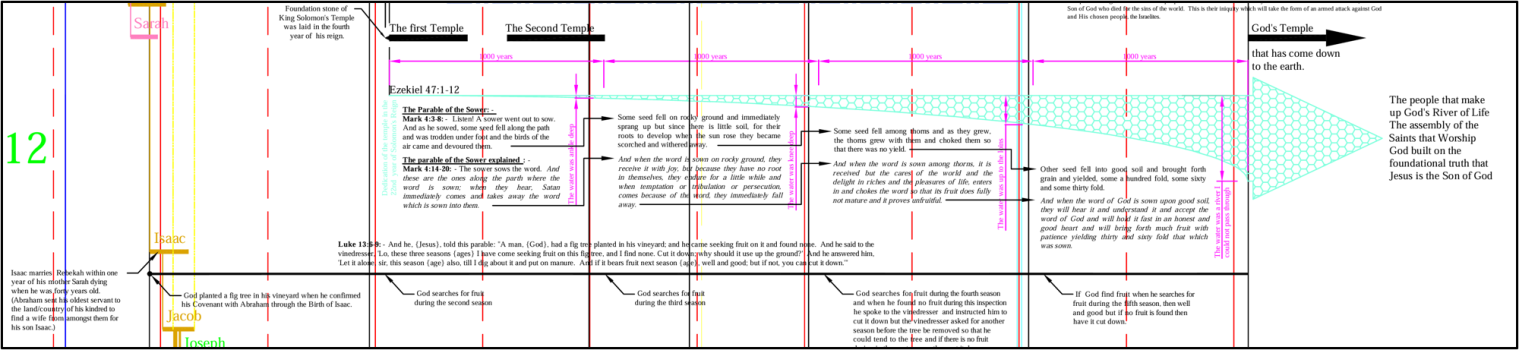
A few days ago I read this post from Scott and decided to spend some time thinking about why God would present three different "yields" in the three Synoptic Gospels. The more I have considered it, the more convinced I have become that there is much more beneath the surface than we often realize.
Although I have spent considerable time studying this topic, I still feel as though I have only begun to scratch the surface. As we all know, God does nothing without perfect purpose. Every word, every detail, and every number has meaning. Our task is to prayerfully discover what He wants us to see rather than assume those details are incidental.
With that in mind, here is one thought that has come to mind so far. It is certainly not presented as a final conclusion, but rather as an observation worth considering and testing against the rest of Scripture. There may be a real purpose behind the fact that Jesus gives the harvest in two opposite threefold orders, while Luke records only the hundredfold result.
In Matthew, the yield is presented in descending order: one hundredfold, sixtyfold, and thirtyfold. In Mark, it is ascending: thirtyfold, sixtyfold, and one hundredfold. Luke simply records that the good soil produced one hundredfold.
Since Matthew strongly emphasizes Israel, Mark presents Christ as the active Servant and carries the gospel naturally into the Gentile world, and Luke presents Jesus as the Son of Man and Savior of all humanity, perhaps these different arrangements contain a secondary prophetic pattern.
Matthew’s descending order may reflect the course of Jewish fruitfulness after the cross. The earliest Church was Jewish. The apostles were filled with the Holy Spirit, preached first to their own people, and saw thousands of Jews accept Jesus as Messiah. This was an extraordinary beginning—something resembling a hundredfold harvest.
Yet over the following centuries, the Jewish presence within the Church steadily declined. As the Church became increasingly Gentile, Jewish believers were gradually separated from, absorbed into, or even rejected by the developing Gentile institution. Israel’s visible fruitfulness within the Church therefore moved downward rather than continuing the powerful harvest of the apostolic period:
one hundredfold, sixtyfold, thirtyfold.
Mark gives the reverse order: thirtyfold, sixtyfold, one hundredfold.
If Mark’s presentation carries a particular significance for the Gentile mission, this ascending order may reflect the increasing reception of the gospel among the nations. The Gentile work began more modestly, but it expanded throughout the Roman world and continued spreading across nations and centuries during the times of the Gentiles.
The movement would therefore be:
Matthew: Jewish fruitfulness begins greatly and then diminishes.
Mark: Gentile fruitfulness begins more modestly and then expands.
Luke may then complete the picture. He does not give a descending or ascending sequence. He simply records the seed producing one hundredfold.
Luke repeatedly presents Jesus as the Son of Man and emphasizes that salvation is offered not merely to Israel or to one particular Gentile nation, but to all humanity. His Gospel includes Samaritans, foreigners, the poor, sinners, women, and others frequently overlooked by society. His genealogy also traces Jesus beyond Abraham back to Adam, connecting Him with the entire human family.
Luke’s single hundredfold harvest may therefore represent the full possibility of the Word of God in mankind. Jew and Gentile are no longer being viewed as two competing groups. Every human being who receives the Word with an honest and good heart, keeps it, and patiently obeys it can bear the fruit God intended.
The three Gospel presentations may therefore suggest a broader movement:
Matthew: the gospel’s powerful Jewish beginning, followed by declining Jewish participation.
Mark: the expanding Gentile reception of the gospel throughout the centuries.
Luke: the universal reach and full fruitfulness of the Word among all mankind.
This would fit the movement of the gospel after the cross—from Jerusalem, to Judea and Samaria, and finally to the uttermost parts of the earth.
This interpretation is not directly explained by Jesus, so it should be presented as a possible secondary pattern rather than a fixed doctrine. The primary meaning remains that good soil produces abundant fruit in differing measures. Nevertheless, the reversal between Matthew and Mark, together with Luke’s single hundredfold yield, may invite us to consider whether God arranged the accounts to reflect the movement from Israel, through the Gentile age, and ultimately to the universal offer of salvation to all humanity.
One final thought...
As this study has continued to develop, it has become increasingly apparent that there may be a fascinating relationship emerging between these two themes. What began as a simple observation about the threefold fruit in the Gospels is now leading into what appears to be a much broader biblical pattern.
In particular, there seems to be a strong connection between the threefold fruit metaphor and the threefold structure of the
666 in Revelation. At this stage, I am simply following the patterns wherever they lead, without forcing conclusions. But the more these passages are examined together, the more intriguing the parallels become. Whether these connections ultimately prove significant remains to be seen, but they are certainly worthy of careful and prayerful investigation.