Some a hundredfold, some sixty, some thirty

  • Welcome to Christian Forums, a Christian Forum that recognizes that all Christians are a work in progress.

    You will need to register to be able to join in fellowship with Christians all over the world.

    We hope to see you as a part of our community soon and God Bless!

in His rest

New Member
Jul 25, 2026
15
16
3
65
st charles
Faith
Christian
Country
United States
Gender
Male
I am not going to continue going back and forth with you until you can acknowledge that God alone is sovereign over His own word. Which you have rejected now in two different threads. In the other thread you justified Paul for writing by the Holy Spirit--well here it's me whether like it or believe it or not. But none of it make any sense to you until you acknowledge God do whatever He wants with whatever text He wants, and with whomever He wants.

The problem resides in you.
ScottA…you have a problem of moving away from context. You are reading your own interpretation into many passages. The problem resides in you!
 
  • Like
Reactions: Anchorite

ScottA

Well-Known Member
Feb 24, 2011
16,084
7,164
113
www.FinishingTheMystery.com
Faith
Christian
Country
United States
I’m sorry friend, but you completely dodged my request.
That surprises you?

On the contrary, I addressed the issue in spite of your request. I explained that the foundation, while true at that level, is not the finished work of God. Why should I not bring us up to speed regarding those things that were to be fulfilled during these present times, rather than mull over the field as if it were just planted?

Tell me then, what is it that you would like to hear, and like to be so doing?
 

ScottA

Well-Known Member
Feb 24, 2011
16,084
7,164
113
www.FinishingTheMystery.com
Faith
Christian
Country
United States
Friend….how is the words written in the Bible as You say natural? You are using the word “natural“ as in “carnal”. That’s totally different from the way I used the word.
Your use and reference to the parable of the sower is natural, because you stopped at the math or numbers of the planting phase, as if we all just fade into the sunset spreading that seed--as if the words meant nothing more. While my point was that everything Jesus did that we should participate in was and is more importantly about the harvest--which the parable addresses. But what about the sum of the equation Jesus presented? I presented the opportunity to press on, to see and go beyond the planting, and consider the Sower actually being at hand. And the response has been like the Scribes and the Pharisees who shut up the kingdom of heaven and hindered those who were entering in.
 

ScottA

Well-Known Member
Feb 24, 2011
16,084
7,164
113
www.FinishingTheMystery.com
Faith
Christian
Country
United States
ScottA…you have a problem of moving away from context. You are reading your own interpretation into many passages. The problem resides in you!
Not my own--I have told you that already.

But tell me, Is there no biblical exception to what you have accuse me of? What would have to be, for it to be biblically correct for a person to make declarations as I have?

Hint: bdavidc said it--but rejected it, resorting rather to continued accusations.
 

Justified

Well-Known Member
Mar 11, 2025
535
312
63
Canada
Faith
Christian
Country
Canada
There are many lessons to be learned from Jesus' parable of the sower in Matthew chapter 13. And it is easy to see and understand Jesus speaking of different percentages of profit unto the kingdom that come from His words falling on good soil. But hearing and seeing--did you notice that those percentages chronologically--diminish and become smaller and smaller?

Which He did repeatedly saying: "He who has ears to hear, let him hear!" Three or more times in the gospels, and then again seven times in the book of Revelation. Only in the book of Revelation He actually says, what to hear: "He who has an ear, let him hear what the Spirit says to the churches.
It seems that you’re reading too much into the numbers. As has been pointed out, the order of the numbers and which numbers are included changes. That alone shows that you’re reading too much into the numbers.

The parable simply means that some people are more fruitful than others. And that is what we see throughout history, even in the Bible. We’re told that some have been given more faith than others, some have been given more talents than others, we are all given different gifts, and we all struggle to varying degrees with different trials and temptations.
 

CTK

Well-Known Member
Aug 13, 2024
1,631
358
83
73
Albuquerque
Faith
Christian
Country
United States
It seems that you’re reading too much into the numbers. As has been pointed out, the order of the numbers and which numbers are included changes. That alone shows that you’re reading too much into the numbers.

The parable simply means that some people are more fruitful than others. And that is what we see throughout history, even in the Bible. We’re told that some have been given more faith than others, some have been given more talents than others, we are all given different gifts, and we all struggle to varying degrees with different trials and temptations.

A few days ago I read this post from Scott and decided to spend some time thinking about why God would present three different "yields" in the three Synoptic Gospels. The more I have considered it, the more convinced I have become that there is much more beneath the surface than we often realize.

Although I have spent considerable time studying this topic, I still feel as though I have only begun to scratch the surface. As we all know, God does nothing without perfect purpose. Every word, every detail, and every number has meaning. Our task is to prayerfully discover what He wants us to see rather than assume those details are incidental.

With that in mind, here is one thought that has come to mind so far. It is certainly not presented as a final conclusion, but rather as an observation worth considering and testing against the rest of Scripture. There may be a real purpose behind the fact that Jesus gives the harvest in two opposite threefold orders, while Luke records only the hundredfold result.

In Matthew, the yield is presented in descending order: one hundredfold, sixtyfold, and thirtyfold. In Mark, it is ascending: thirtyfold, sixtyfold, and one hundredfold. Luke simply records that the good soil produced one hundredfold.

Since Matthew strongly emphasizes Israel, Mark presents Christ as the active Servant and carries the gospel naturally into the Gentile world, and Luke presents Jesus as the Son of Man and Savior of all humanity, perhaps these different arrangements contain a secondary prophetic pattern.

Matthew’s descending order may reflect the course of Jewish fruitfulness after the cross. The earliest Church was Jewish. The apostles were filled with the Holy Spirit, preached first to their own people, and saw thousands of Jews accept Jesus as Messiah. This was an extraordinary beginning—something resembling a hundredfold harvest.

Yet over the following centuries, the Jewish presence within the Church steadily declined. As the Church became increasingly Gentile, Jewish believers were gradually separated from, absorbed into, or even rejected by the developing Gentile institution. Israel’s visible fruitfulness within the Church therefore moved downward rather than continuing the powerful harvest of the apostolic period: one hundredfold, sixtyfold, thirtyfold.


Mark gives the reverse order: thirtyfold, sixtyfold, one hundredfold.


If Mark’s presentation carries a particular significance for the Gentile mission, this ascending order may reflect the increasing reception of the gospel among the nations. The Gentile work began more modestly, but it expanded throughout the Roman world and continued spreading across nations and centuries during the times of the Gentiles.

The movement would therefore be:

Matthew: Jewish fruitfulness begins greatly and then diminishes.​
Mark: Gentile fruitfulness begins more modestly and then expands.​
Luke may then complete the picture. He does not give a descending or ascending sequence. He simply records the seed producing one hundredfold.​

Luke repeatedly presents Jesus as the Son of Man and emphasizes that salvation is offered not merely to Israel or to one particular Gentile nation, but to all humanity. His Gospel includes Samaritans, foreigners, the poor, sinners, women, and others frequently overlooked by society. His genealogy also traces Jesus beyond Abraham back to Adam, connecting Him with the entire human family.

Luke’s single hundredfold harvest may therefore represent the full possibility of the Word of God in mankind. Jew and Gentile are no longer being viewed as two competing groups. Every human being who receives the Word with an honest and good heart, keeps it, and patiently obeys it can bear the fruit God intended.

The three Gospel presentations may therefore suggest a broader movement:

Matthew: the gospel’s powerful Jewish beginning, followed by declining Jewish participation.​
Mark: the expanding Gentile reception of the gospel throughout the centuries.​
Luke: the universal reach and full fruitfulness of the Word among all mankind.​

This would fit the movement of the gospel after the cross—from Jerusalem, to Judea and Samaria, and finally to the uttermost parts of the earth.

This interpretation is not directly explained by Jesus, so it should be presented as a possible secondary pattern rather than a fixed doctrine. The primary meaning remains that good soil produces abundant fruit in differing measures. Nevertheless, the reversal between Matthew and Mark, together with Luke’s single hundredfold yield, may invite us to consider whether God arranged the accounts to reflect the movement from Israel, through the Gentile age, and ultimately to the universal offer of salvation to all humanity.

One final thought...

As this study has continued to develop, it has become increasingly apparent that there may be a fascinating relationship emerging between these two themes. What began as a simple observation about the threefold fruit in the Gospels is now leading into what appears to be a much broader biblical pattern.

In particular, there seems to be a strong connection between the threefold fruit metaphor and the threefold structure of the 666 in Revelation. At this stage, I am simply following the patterns wherever they lead, without forcing conclusions. But the more these passages are examined together, the more intriguing the parallels become. Whether these connections ultimately prove significant remains to be seen, but they are certainly worthy of careful and prayerful investigation.

 
  • Like
Reactions: ScottA

ScottA

Well-Known Member
Feb 24, 2011
16,084
7,164
113
www.FinishingTheMystery.com
Faith
Christian
Country
United States
It seems that you’re reading too much into the numbers. As has been pointed out, the order of the numbers and which numbers are included changes. That alone shows that you’re reading too much into the numbers.

The parable simply means that some people are more fruitful than others. And that is what we see throughout history, even in the Bible. We’re told that some have been given more faith than others, some have been given more talents than others, we are all given different gifts, and we all struggle to varying degrees with different trials and temptations.
keep reading, you too have missed the point.
 

ScottA

Well-Known Member
Feb 24, 2011
16,084
7,164
113
www.FinishingTheMystery.com
Faith
Christian
Country
United States
A few days ago I read this post from Scott and decided to spend some time thinking about why God would present three different "yields" in the three Synoptic Gospels. The more I have considered it, the more convinced I have become that there is much more beneath the surface than we often realize.

Although I have spent considerable time studying this topic, I still feel as though I have only begun to scratch the surface. As we all know, God does nothing without perfect purpose. Every word, every detail, and every number has meaning. Our task is to prayerfully discover what He wants us to see rather than assume those details are incidental.

With that in mind, here is one thought that has come to mind so far. It is certainly not presented as a final conclusion, but rather as an observation worth considering and testing against the rest of Scripture. There may be a real purpose behind the fact that Jesus gives the harvest in two opposite threefold orders, while Luke records only the hundredfold result.

In Matthew, the yield is presented in descending order: one hundredfold, sixtyfold, and thirtyfold. In Mark, it is ascending: thirtyfold, sixtyfold, and one hundredfold. Luke simply records that the good soil produced one hundredfold.

Since Matthew strongly emphasizes Israel, Mark presents Christ as the active Servant and carries the gospel naturally into the Gentile world, and Luke presents Jesus as the Son of Man and Savior of all humanity, perhaps these different arrangements contain a secondary prophetic pattern.

Matthew’s descending order may reflect the course of Jewish fruitfulness after the cross. The earliest Church was Jewish. The apostles were filled with the Holy Spirit, preached first to their own people, and saw thousands of Jews accept Jesus as Messiah. This was an extraordinary beginning—something resembling a hundredfold harvest.

Yet over the following centuries, the Jewish presence within the Church steadily declined. As the Church became increasingly Gentile, Jewish believers were gradually separated from, absorbed into, or even rejected by the developing Gentile institution. Israel’s visible fruitfulness within the Church therefore moved downward rather than continuing the powerful harvest of the apostolic period: one hundredfold, sixtyfold, thirtyfold.


Mark gives the reverse order: thirtyfold, sixtyfold, one hundredfold.


If Mark’s presentation carries a particular significance for the Gentile mission, this ascending order may reflect the increasing reception of the gospel among the nations. The Gentile work began more modestly, but it expanded throughout the Roman world and continued spreading across nations and centuries during the times of the Gentiles.

The movement would therefore be:

Matthew: Jewish fruitfulness begins greatly and then diminishes.​
Mark: Gentile fruitfulness begins more modestly and then expands.​
Luke may then complete the picture. He does not give a descending or ascending sequence. He simply records the seed producing one hundredfold.​

Luke repeatedly presents Jesus as the Son of Man and emphasizes that salvation is offered not merely to Israel or to one particular Gentile nation, but to all humanity. His Gospel includes Samaritans, foreigners, the poor, sinners, women, and others frequently overlooked by society. His genealogy also traces Jesus beyond Abraham back to Adam, connecting Him with the entire human family.

Luke’s single hundredfold harvest may therefore represent the full possibility of the Word of God in mankind. Jew and Gentile are no longer being viewed as two competing groups. Every human being who receives the Word with an honest and good heart, keeps it, and patiently obeys it can bear the fruit God intended.

The three Gospel presentations may therefore suggest a broader movement:

Matthew: the gospel’s powerful Jewish beginning, followed by declining Jewish participation.​
Mark: the expanding Gentile reception of the gospel throughout the centuries.​
Luke: the universal reach and full fruitfulness of the Word among all mankind.​

This would fit the movement of the gospel after the cross—from Jerusalem, to Judea and Samaria, and finally to the uttermost parts of the earth.

This interpretation is not directly explained by Jesus, so it should be presented as a possible secondary pattern rather than a fixed doctrine. The primary meaning remains that good soil produces abundant fruit in differing measures. Nevertheless, the reversal between Matthew and Mark, together with Luke’s single hundredfold yield, may invite us to consider whether God arranged the accounts to reflect the movement from Israel, through the Gentile age, and ultimately to the universal offer of salvation to all humanity.

One final thought...

As this study has continued to develop, it has become increasingly apparent that there may be a fascinating relationship emerging between these two themes. What began as a simple observation about the threefold fruit in the Gospels is now leading into what appears to be a much broader biblical pattern.

In particular, there seems to be a strong connection between the threefold fruit metaphor and the threefold structure of the 666 in Revelation. At this stage, I am simply following the patterns wherever they lead, without forcing conclusions. But the more these passages are examined together, the more intriguing the parallels become. Whether these connections ultimately prove significant remains to be seen, but they are certainly worthy of careful and prayerful investigation.

Thank you--good work!

I would contrast the parable of the sower with regards to the three (or four) different gospel accounts in this way:
  • Matthew's account depicting the "falling away" as it has been said, "it is always darkest just before the day dawn." "And because lawlessness will abound, the love of many will grow cold. Ultimately, the failure the teachings of men and the flesh over time.
  • Mark's account depicting God's word not returning void, but every promise being fulfilled in spirit, yet unseen to this world.
  • Luke's account depicting the over all scope of the salvation plan since Adam, and unto the end of the age.
  • And John's non-depiction representing the unseen, unnamed Holy Spirit, and the innumerable host of heaven following the harvest.
"We will all stand before the judgement seat of God" (Romans 14:10), "Some to everlasting life, Some to shame and everlasting contempt" (Daniel 12:2).
 
  • Like
Reactions: CTK

Jay Ross

Well-Known Member
Jun 20, 2011
9,527
3,557
113
QLD
Faith
Christian
Country
Australia
Gender
Male
Hello,

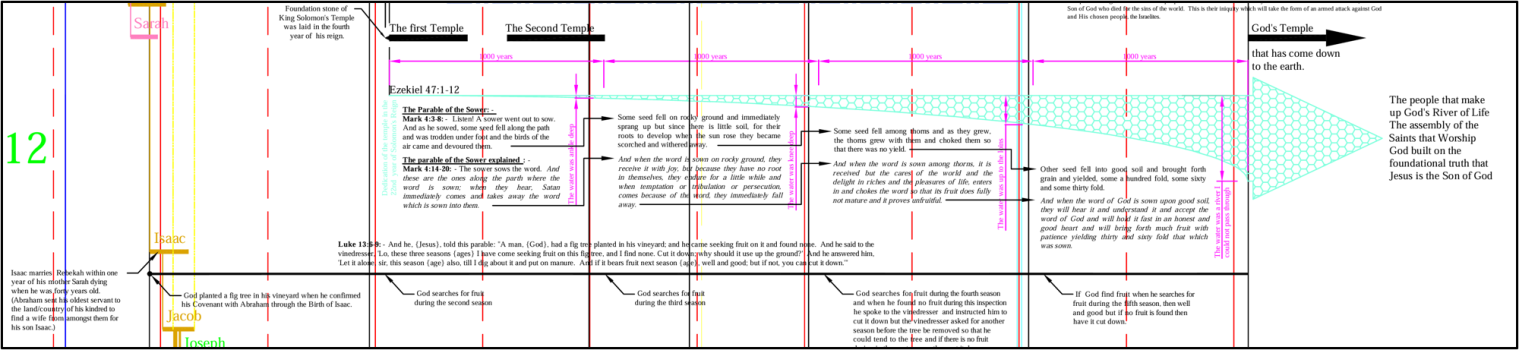
Here is diagram of God's purposes from the time of Isaac's birth up to when The Final Judgement is completed and the Saints enter into eternity.
1785400905794.png

This image has been snipped from a much larger diagram. The reason I snipped this from the original diagram was to show the relationship between the Parables of the Sower, and the River of Life prophecy found in Ezekile 47:1-12, and the parable found in Luke 13:6-9 of the Man who had planted a Fig tree in His garden.

The diagram shows how different part of the Scripture are linked.

Shalom
 

in His rest

New Member
Jul 25, 2026
15
16
3
65
st charles
Faith
Christian
Country
United States
Gender
Male
That surprises you?

On the contrary, I addressed the issue in spite of your request. I explained that the foundation, while true at that level, is not the finished work of God. Why should I not bring us up to speed regarding those things that were to be fulfilled during these present times, rather than mull over the field as if it were just planted?

Tell me then, what is it that you would like to hear, and like to be so doing?
Friend.....you are like a wild flower! Just growing where it is not wanted. You fruitless commentary is as such. It has no root and is not germane to the converstation at had.
 
  • Like
Reactions: Anchorite

in His rest

New Member
Jul 25, 2026
15
16
3
65
st charles
Faith
Christian
Country
United States
Gender
Male
Your use and reference to the parable of the sower is natural, because you stopped at the math or numbers of the planting phase, as if we all just fade into the sunset spreading that seed--as if the words meant nothing more. While my point was that everything Jesus did that we should participate in was and is more importantly about the harvest--which the parable addresses. But what about the sum of the equation Jesus presented? I presented the opportunity to press on, to see and go beyond the planting, and consider the Sower actually being at hand. And the response has been like the Scribes and the Pharisees who shut up the kingdom of heaven and hindered those who were entering in.
ScottA, my friend!

Paul said 1 Cor 9:22.....To the weak I became weak, that I might win the weak. I have become all things to all people, that by all means I might save some

Right now brother you are not all things to all people. IF you where as such, you would be humble in heart and listen to the the brothers on the board who have told you its not as you say. You need to step back brother.
 

in His rest

New Member
Jul 25, 2026
15
16
3
65
st charles
Faith
Christian
Country
United States
Gender
Male
Not my own--I have told you that already.

But tell me, Is there no biblical exception to what you have accuse me of? What would have to be, for it to be biblically correct for a person to make declarations as I have?

Hint: bdavidc said it--but rejected it, resorting rather to continued accusations.
Dear friend....you have become as a clanging cymbal....a loud, empty and annoying noise. You use a lot of words but dont really say anything foundational. Come on dear brother! You act as if you are better than the rest of us while trying to speak lofty. You need to learn to be a simple man.
 
  • Like
Reactions: Anchorite

Anchorite

Well-Known Member
May 1, 2026
720
677
93
68
Peoria
Faith
Christian
Country
United States
Gender
Male
A few days ago I read this post from Scott and decided to spend some time thinking about why God would present three different "yields" in the three Synoptic Gospels. The more I have considered it, the more convinced I have become that there is much more beneath the surface than we often realize.

Although I have spent considerable time studying this topic, I still feel as though I have only begun to scratch the surface. As we all know, God does nothing without perfect purpose. Every word, every detail, and every number has meaning. Our task is to prayerfully discover what He wants us to see rather than assume those details are incidental.

With that in mind, here is one thought that has come to mind so far. It is certainly not presented as a final conclusion, but rather as an observation worth considering and testing against the rest of Scripture. There may be a real purpose behind the fact that Jesus gives the harvest in two opposite threefold orders, while Luke records only the hundredfold result.

In Matthew, the yield is presented in descending order: one hundredfold, sixtyfold, and thirtyfold. In Mark, it is ascending: thirtyfold, sixtyfold, and one hundredfold. Luke simply records that the good soil produced one hundredfold.

Since Matthew strongly emphasizes Israel, Mark presents Christ as the active Servant and carries the gospel naturally into the Gentile world, and Luke presents Jesus as the Son of Man and Savior of all humanity, perhaps these different arrangements contain a secondary prophetic pattern.

Matthew’s descending order may reflect the course of Jewish fruitfulness after the cross. The earliest Church was Jewish. The apostles were filled with the Holy Spirit, preached first to their own people, and saw thousands of Jews accept Jesus as Messiah. This was an extraordinary beginning—something resembling a hundredfold harvest.

Yet over the following centuries, the Jewish presence within the Church steadily declined. As the Church became increasingly Gentile, Jewish believers were gradually separated from, absorbed into, or even rejected by the developing Gentile institution. Israel’s visible fruitfulness within the Church therefore moved downward rather than continuing the powerful harvest of the apostolic period: one hundredfold, sixtyfold, thirtyfold.


Mark gives the reverse order: thirtyfold, sixtyfold, one hundredfold.


If Mark’s presentation carries a particular significance for the Gentile mission, this ascending order may reflect the increasing reception of the gospel among the nations. The Gentile work began more modestly, but it expanded throughout the Roman world and continued spreading across nations and centuries during the times of the Gentiles.

The movement would therefore be:

Matthew: Jewish fruitfulness begins greatly and then diminishes.​
Mark: Gentile fruitfulness begins more modestly and then expands.​
Luke may then complete the picture. He does not give a descending or ascending sequence. He simply records the seed producing one hundredfold.​

Luke repeatedly presents Jesus as the Son of Man and emphasizes that salvation is offered not merely to Israel or to one particular Gentile nation, but to all humanity. His Gospel includes Samaritans, foreigners, the poor, sinners, women, and others frequently overlooked by society. His genealogy also traces Jesus beyond Abraham back to Adam, connecting Him with the entire human family.

Luke’s single hundredfold harvest may therefore represent the full possibility of the Word of God in mankind. Jew and Gentile are no longer being viewed as two competing groups. Every human being who receives the Word with an honest and good heart, keeps it, and patiently obeys it can bear the fruit God intended.

The three Gospel presentations may therefore suggest a broader movement:

Matthew: the gospel’s powerful Jewish beginning, followed by declining Jewish participation.​
Mark: the expanding Gentile reception of the gospel throughout the centuries.​
Luke: the universal reach and full fruitfulness of the Word among all mankind.​

This would fit the movement of the gospel after the cross—from Jerusalem, to Judea and Samaria, and finally to the uttermost parts of the earth.

This interpretation is not directly explained by Jesus, so it should be presented as a possible secondary pattern rather than a fixed doctrine. The primary meaning remains that good soil produces abundant fruit in differing measures. Nevertheless, the reversal between Matthew and Mark, together with Luke’s single hundredfold yield, may invite us to consider whether God arranged the accounts to reflect the movement from Israel, through the Gentile age, and ultimately to the universal offer of salvation to all humanity.

One final thought...

As this study has continued to develop, it has become increasingly apparent that there may be a fascinating relationship emerging between these two themes. What began as a simple observation about the threefold fruit in the Gospels is now leading into what appears to be a much broader biblical pattern.

In particular, there seems to be a strong connection between the threefold fruit metaphor and the threefold structure of the 666 in Revelation. At this stage, I am simply following the patterns wherever they lead, without forcing conclusions. But the more these passages are examined together, the more intriguing the parallels become. Whether these connections ultimately prove significant remains to be seen, but they are certainly worthy of careful and prayerful investigation.
You still assume that the “thirty fold, sixty fold, one hundredfold” is chronological, but the scriptures say a crop, not successive crops throughout an expanse of time.


Matthew 13:8

Still other seed fell on good soil and produced a crop—a hundredfold, sixtyfold, or thirtyfold.


Scripture does not say “thirty fold, then sixty fold, and later one hundredfold”.

The different yields occur at one harvest in one moment of time.


Mark 4:20

And these are they which are sown on good ground, such as hear the Word and receive it and bring forth fruit: some thirtyfold, some sixty, and some a hundred.

So in Mark the different yields are produced by “such as hear the Word and receive it”, thus different individuals produce different yields.
 

bdavidc

Well-Known Member
Mar 31, 2025
1,311
1,414
113
67
Charlestown, IN
know-the-bible.com
Faith
Christian
Country
United States
Gender
Male
I am not going to continue going back and forth with you until you can acknowledge that God alone is sovereign over His own word. Which you have rejected now in two different threads. In the other thread you justified Paul for writing by the Holy Spirit--well here it's me whether like it or believe it or not. But none of it will make any sense to you until you acknowledge God does whatever He wants with whatever text He wants, and with whomever He wants.

The problem resides in you.
God is sovereign over His Word. You are not. Paul wrote by the Holy Spirit as an apostle of Jesus Christ. Your claim that “here it’s me whether you like it or believe it or not” does not place your interpretation in the same category as inspired Scripture. That is an enormous claim, and Scripture does not tell believers to accept such claims merely because someone makes them.

“Beloved, believe not every spirit, but try the spirits whether they are of God” (1 John 4:1). “Let the prophets speak two or three, and let the other judge” (1 Corinthians 14:29). Your words must be tested by Scripture just like anyone else’s.

God can use His Word however He chooses, but that does not mean you may remove a passage from its context and then claim God personally authorized your interpretation. You still have not shown from the parable itself that your conclusion is what Jesus taught.

Saying “the problem resides in you” does not answer the objection. It simply shifts attention away from the text. I acknowledge God’s sovereignty completely. What I reject is your attempt to use God’s sovereignty to place your own interpretation beyond biblical examination.
 
  • Love
Reactions: Anchorite

bdavidc

Well-Known Member
Mar 31, 2025
1,311
1,414
113
67
Charlestown, IN
know-the-bible.com
Faith
Christian
Country
United States
Gender
Male
IKR! I’ve even told him as Such…..I even pointed out his actions Are called Eisegesis.
Exactly. The issue is not whether someone can find an interesting pattern in the wording. The issue is whether that pattern is actually taught by the text.

When Matthew, Mark, and Luke record the fruitfulness differently, the proposed chronological meaning falls apart. Calling attention to that is not rejecting Scripture. It is refusing to add a meaning Jesus never gave.

That is eisegesis: reading an idea into the passage rather than drawing the meaning from the passage.
 
  • Love
Reactions: Anchorite

CTK

Well-Known Member
Aug 13, 2024
1,631
358
83
73
Albuquerque
Faith
Christian
Country
United States
You still assume that the “thirty fold, sixty fold, one hundredfold” is chronological, but the scriptures say a crop, not successive crops throughout an expanse of time.


Matthew 13:8

Still other seed fell on good soil and produced a crop—a hundredfold, sixtyfold, or thirtyfold.


Scripture does not say “thirty fold, then sixty fold, and later one hundredfold”.

The different yields occur at one harvest in one moment of time.


Mark 4:20

And these are they which are sown on good ground, such as hear the Word and receive it and bring forth fruit: some thirtyfold, some sixty, and some a hundred.

So in Mark the different yields are produced by “such as hear the Word and receive it”, thus different individuals produce different yields.

It is true that the parable speaks of one crop and does not directly say, “first thirtyfold, then sixtyfold, and finally one hundredfold.” However, that does not mean time has no place in the picture. In fact, the nature of seed and fruit strongly suggests that the parable is not limited to one fixed point in time.

Jesus was not speaking only about one small group of people living at one moment in history. The seed represents the Word of God, which would continue to be preached after the cross and throughout the world until the final harvest. Those who hear and receive that Word would live in different generations, among different peoples, and across many centuries.

For that reason, the crop may be gathered as one final harvest even though its fruit develops over a long period of time. A farmer may speak of one harvest, but the growth leading to that harvest takes place throughout an entire season. In the same way, the thirtyfold, sixtyfold, and hundredfold yields may all belong to one great harvest while reflecting fruit produced during different periods of history.

There is also something important within the image of fruit itself. Fruit is not merely a one-time product. It contains seed within itself, and that seed is capable of producing additional fruit. One seed produces a plant, the plant produces fruit, and the fruit carries more seed that can be planted again. The result is continuing multiplication rather than one isolated act of production.

This is especially fitting as a picture of how the Word of God spreads. A person receives the Word, it changes that person’s life, and the fruit of that changed life becomes visible to others. The believer also carries the seed of the Word to other people through testimony, teaching, conduct, and personal influence. Those people may then receive the Word and bear fruit of their own. Therefore, the fruit continues to reproduce through time.

The fruit is expressed in at least two connected ways. First, it is displayed before the world through the transformed life of the person who received the Word. Second, it produces further growth as that person shares the Word with others. The fruit is therefore both the evidence of what the seed has already accomplished and the means by which still more seed is carried into the world.

Mark clearly shows that different people produce different amounts of fruit:

“Such as hear the Word, and receive it, and bring forth fruit: some thirtyfold, some sixty, and some a hundred.”

That is certainly part of the meaning. Some individuals respond to the Word more fruitfully than others. However, this personal application does not rule out a larger historical pattern. Those individuals live within particular generations, nations, and periods of redemptive history. Personal fruitfulness and historical development can exist together.

The difference between Matthew and Mark is therefore especially interesting.

Matthew gives the yields in descending order: one hundredfold, sixtyfold, thirtyfold.

Mark gives them in ascending order: thirtyfold, sixtyfold, one hundredfold.

That reversal may be significant. One order moves downward, while the other moves upward. A descending order naturally suggests decline, while an ascending order suggests growth and expansion. Movement in either direction implies development, and development necessarily involves time. This does not by itself prove exactly what the two orders represent, but it gives us a strong reason not to view the numbers as a completely static list.

Matthew’s descending order may point to the declining response of Israel to the gospel. The Word first produced remarkable fruit among the Jewish people through Jesus, the apostles, and the earliest believers. Yet over time, the nation as a whole increasingly rejected the Messiah, and the Jewish presence within the growing Church diminished.

Mark’s ascending order may point to the spread of the gospel among the Gentiles. What began with a relatively small number of non-Jewish believers continued to multiply as the Word was carried from one nation and generation to another throughout the time of the Gentiles.

This interpretation does not require three separate harvests. It allows for one seed, one gospel, and one final harvest while recognizing that the fruit develops, reproduces, and multiplies across history. Each new fruit contains seed capable of producing still more fruit, creating an unfolding process that continues until the appointed harvest.

Therefore, the thirtyfold, sixtyfold, and hundredfold yields should not necessarily be viewed as a frozen picture of three individuals standing together at one moment. Since the parable applies to all who would hear the Word throughout the gospel age, and since fruit naturally carries seed that produces further fruit, the imagery itself strongly points toward an ongoing process.

When this continuing multiplication is considered alongside the opposite descending and ascending orders preserved in Matthew and Mark, it becomes reasonable to ask whether the yields reveal not only different levels of individual fruitfulness, but also two larger movements through history—one declining and the other increasing.
 

ScottA

Well-Known Member
Feb 24, 2011
16,084
7,164
113
www.FinishingTheMystery.com
Faith
Christian
Country
United States
Hello,

Here is diagram of God's purposes from the time of Isaac's birth up to when The Final Judgement is completed and the Saints enter into eternity.
View attachment 87501

This image has been snipped from a much larger diagram. The reason I snipped this from the original diagram was to show the relationship between the Parables of the Sower, and the River of Life prophecy found in Ezekile 47:1-12, and the parable found in Luke 13:6-9 of the Man who had planted a Fig tree in His garden.

The diagram shows how different part of the Scripture are linked.

Shalom
Thanks, I'm not much found of timelines, but links in scripture are always good to consider.
 

ScottA

Well-Known Member
Feb 24, 2011
16,084
7,164
113
www.FinishingTheMystery.com
Faith
Christian
Country
United States
ScottA, my friend!

Paul said 1 Cor 9:22.....To the weak I became weak, that I might win the weak. I have become all things to all people, that by all means I might save some

Right now brother you are not all things to all people. IF you where as such, you would be humble in heart and listen to the the brothers on the board who have told you its not as you say. You need to step back brother.
I know that is the perspective of you and others, but it is because you do not understand.

Paul was all things to all people, because he brought the opening message to many nations. Do you not see the correlation? But that is not where we are now, and you have not perceived that the wrap up is different than the beginning. Why should I--or anyone for that matter--do what was correct for the beginning of the times of the gentiles...when these are not those times, but the time of the end?

Meanwhile, wake up, you have [fallen] into the pattern of those we were asleep at the end of the times of Israel (when their Messiah had come to gather them). And your attitude is not unlike theirs also. "Every tree that does not bear good fruit is cut down and thrown into the fire."
 

ScottA

Well-Known Member
Feb 24, 2011
16,084
7,164
113
www.FinishingTheMystery.com
Faith
Christian
Country
United States
Dear friend....you have become as a clanging cymbal....a loud, empty and annoying noise. You use a lot of words but dont really say anything foundational. Come on dear brother! You act as if you are better than the rest of us while trying to speak lofty. You need to learn to be a simple man.
Answer the question.