@David in NJ said:
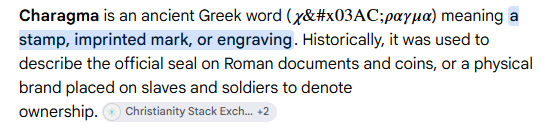
The word “mark” is translated from the Greek charagma (Strong’s Greek concordance reference #5480) as “a scratch or etching, ie stamp (as a badge of servitude), or sculptured figure (statue): graven image.” In the Roman context charagma was the imperial stamp that was placed on official documents. It was also a “badge of servitude” etched, inscribed or branded on slaves to designate ownership. Soldiers often branded themselves with the name of their favorite general and religious cult devotees placed tattoos of their favorite gods as symbolic of their devotion and allegiance.[29]
___
This brings me back to how in the OT, when a slave was to be set free, they could choose to stay with their master and serve him the rest of their life. So their master would bore a hole through their ear (a mark) signifying lifelong servanthood.
@David in NJ - I couldn't quote your post for some reason this is for you too.

Do you both agree that the revelation given in this book was communicated in signs? John says so himself — Rev 1:1 says Jesus
ἐσήμανεν it, "signified" it, made it known by sign. So I'll assume we're agreed there.
If that's so, then I don't think either of you believes a literal steel blade protrudes from Jesus' mouth in 19:15. The word there is
ῥομφαία — a large Thracian broadsword, a real physical weapon, the same word the LXX uses for Goliath's sword. It isn't a "spiritual sword" word. It's as literal a sword as Greek has. And yet 19:21 says the nations were slain with the sword proceeding out of his mouth. Nobody reads that as dental cutlery. Everyone reads it as his word, his verdict, his spoken judgment.
That's not an isolated case. Consider what else the book asks us to take as sign:
- Jesus is a Lamb with seven horns and seven eyes (5:6). The central figure of the entire book is a symbol.
- The seven stars are explicitly decoded as the angels of the churches, the lampstands as the churches (1:20). The book interprets itself.
- The dragon is explicitly identified as "that old serpent, called the Devil and Satan" (12:9).
- The angel tells John outright that the waters are peoples, multitudes, nations, and tongues (17:15), that the seven heads are seven mountains, and that the woman is a city (17:9, 18).
- The great city is called Sodom and Egypt — and the text supplies its own reading key: πνευματικῶς, "figuratively" (11:8).
- A chain binds a spirit being (20:1). What links would hold a spirit?
- A woman clothed with the sun, standing on the moon, crowned with twelve stars (12:1).
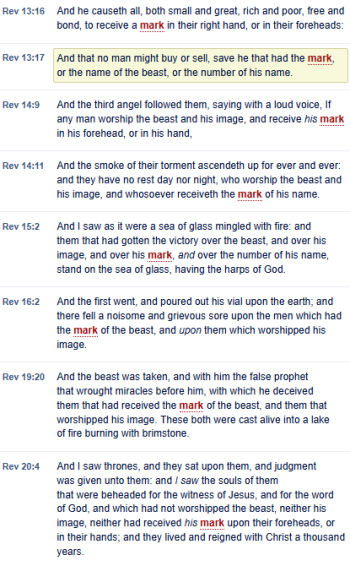
So the book announces itself as sign, decodes its own images as sign, and hands us a Lamb, a dragon, a woman, a city, and a mouth-sword. Then we arrive at chapter 13 — and suddenly the beast is granted to be symbolic, but his mark is a physical object applied to skin?
The mark's counterpart is right there in the same book: God's servants are sealed on their foreheads (7:3), the 144,000 have the Father's name written on their foreheads (14:1), and his servants shall see his face and his name shall be on their foreheads (22:4). If that seal is a badge of ownership and allegiance rather than ink, why is the beast's mark ink?
And the hand-and-forehead pairing isn't arbitrary. It comes straight out of Deuteronomy: "thou shalt bind them for a sign upon thine hand, and they shall be as frontlets between thine eyes" (6:8; cf. 11:18, Ex 13:9, 16). Israel was never handed a literal object to fix to her skull. Hand and forehead are the standard biblical shorthand for
what you do and
what you think — deed and allegiance. The beast is counterfeiting the Shema.