Active Voice
Grammatical voice indicates whether the subject is the performer of the action of the verb (active voice), or the subject is the recipient of the action (passive voice). If the subject of the sentence is executing the action, then the verb is referred to as being in the active voice.
For example: "Jesus was baptizing the people" (paraphrase of John 3:22; 4:1,2). "Jesus" is the subject of the sentence and is the one that is performing the action of the verb; therefore the verb is said to be in the "Active Voice".
Passive Voice
Grammatical voice indicates whether the subject is the performer of the action of the verb (active voice), or the subject is the recipient of the action (passive voice). If the subject of the sentence is being acted upon, then the verb is referred to as being in the passive voice.
For example: "Jesus ... was baptized by John in the Jordan" (Mark 1:9). "Jesus" is the subject of the sentence, but in this case He is being acted upon (i.e. He is the recipient of the action), therefore the verb is said to be in the "Passive Voice".
Middle Voice
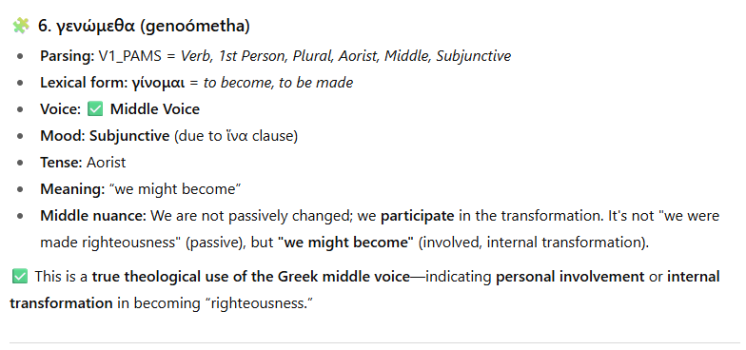
The Greek middle voice shows the subject acting in his own interest or on his own behalf, or participating in the results of the verbal action. In overly simplistic terms, sometimes the middle form of the verb could be translated as "the performer of the action actually acting upon himself" (reflexive action).
For example: "I am washing myself." "I" is the subject of the sentence (performing the action of the verb) and yet "I" am also receiving the action of the verb. This is said to be in the "Middle Voice". Many instances in the Greek are not this obvious and cannot be translated this literally.
Grammatical voice indicates whether the subject is the performer of the action of the verb (active voice), or the subject is the recipient of the action (passive voice). If the subject of the sentence is executing the action, then the verb is referred to as being in the active voice.
For example: "Jesus was baptizing the people" (paraphrase of John 3:22; 4:1,2). "Jesus" is the subject of the sentence and is the one that is performing the action of the verb; therefore the verb is said to be in the "Active Voice".
Passive Voice
Grammatical voice indicates whether the subject is the performer of the action of the verb (active voice), or the subject is the recipient of the action (passive voice). If the subject of the sentence is being acted upon, then the verb is referred to as being in the passive voice.
For example: "Jesus ... was baptized by John in the Jordan" (Mark 1:9). "Jesus" is the subject of the sentence, but in this case He is being acted upon (i.e. He is the recipient of the action), therefore the verb is said to be in the "Passive Voice".
Middle Voice
The Greek middle voice shows the subject acting in his own interest or on his own behalf, or participating in the results of the verbal action. In overly simplistic terms, sometimes the middle form of the verb could be translated as "the performer of the action actually acting upon himself" (reflexive action).
For example: "I am washing myself." "I" is the subject of the sentence (performing the action of the verb) and yet "I" am also receiving the action of the verb. This is said to be in the "Middle Voice". Many instances in the Greek are not this obvious and cannot be translated this literally.