Daniel 10:13
The prince of the kingdom of Persia withstood me twenty-one days, but Michael, one of the chief princes, came to help me, for I was left there with the kings of Persia
It took the angel 21 days to influence the political realm in order to align the Persian empire’s policies with Yahweh’s purpose, something Daniel had been fervently praying for. At the start of this period, Daniel had turned to God in mourning, fasting, and prayer for the restoration of his people (v2–3). Although Daniel's prayers were heard immediately, he was unaware of the angelic activity taking place behind the scenes during this time.
To accomplish God's will, political circumstances had to be adjusted so that the Persian ruler would choose to act in a specific way of his own volition. That same year, King Cyrus issued a decree permitting the Jewish exiles to return, a moment that fulfilled God’s sovereign intention. This event demonstrates the truth of Daniel 4:17,32: “God rules in the kingdom of men.” The Elohim (mighty ones or angels) silently influence leaders and events to fulfill God's plan.
The term “prince” (Hebrew: sar) means a leader or commander, and in this context refers to Cyrus (v.1), who was moved by circumstances to issue the decree recorded in Ezra 1. Ezra explains that “Yahweh stirred up the spirit of Cyrus” (Ezra 1:1). Though Cyrus may not have realized it, his actions fulfilled the will of the Sovereign of heaven, guided by divinely orchestrated political developments.
The Hebrew word translated “withstand” (amad) appears in 2 Chronicles 26:18, describing how Azariah and fellow priests opposed King Uzziah when he attempted to enter the temple to offer incense unlawfully. Similarly, angels act invisibly to shape human government. An angel blocked Balaam’s path to prevent him from opposing God's purpose (Numbers 22:32, though a different Hebrew word is used there), showing how divine influence shapes both personal and national events.
Such turning points in history may seem to unfold through natural means, but they often require time and coordination. This behind-the-scenes work is part of the angels’ ministering role on behalf of the saints (Hebrews 1:14).
Talons, the very idea that Christians believe Heaven is in disarray and that God has lost control of His own servants is deeply irreverent and is mockery toward God. It reveals that many, like Matthias have no understanding of the God of Israel and the Lord Jesus Christ.
Sar Yawan/Yavan, (the Prince of Greece), is the Prince of the power of the air, (Eph 2:2), and the spirit of the world, (1Cor 2:12).
Daniel 8:5 KJV
5 And as I was considering, behold, an he goat came from the west
on the face of the whole earth,
and touched not the ground: and the goat had a notable horn between his eyes.
The he-goat from the west is flying over the face of the whole land/earth, in the air, not touching the ground, and that one is the king/prince of Yavan, (Greece).
Daniel 8:19-21 KJV
19 And he said, Behold, I will make thee know what shall be in the last end of the indignation: for at the time appointed the end shall be.
20 The ram which thou sawest having two horns are the kings of Media and Persia.
21 And
the rough goat is the king of Grecia: [Yavan] and the great horn that is between his eyes is the first king.
Ephesians 2:1-3 KJV
1 And you hath he quickened, who were dead in trespasses and sins;
2
Wherein in time past ye walked according to the course of this world, according to the prince of the power of the air, the spirit that now worketh in the children of disobedience:
3 Among whom also we all had our conversation in times past in the lusts of our flesh, fulfilling the desires of the flesh and of the mind; and were by nature the children of wrath, even as others.
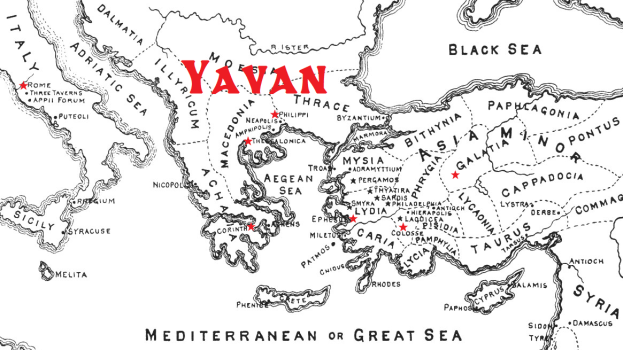
With the exception of Rome, all of Paul's congregations are in the territory of Yavan, (see Luke 11:24-26).
Sar Yavan, the Prince of the power of the air, is not a human being, (see Eph 6:12).




