@rvmb
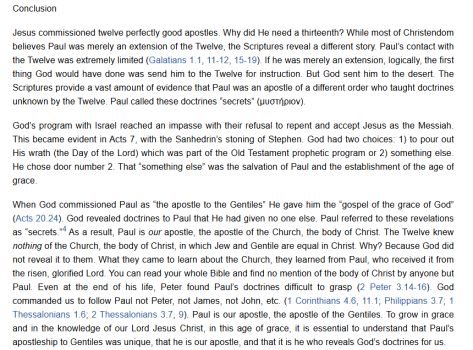
There are several serious problems in that text. Some are small, but many go against what Jesus and His first disciples clearly taught. Let’s walk through it in a simple way and correct it with Scripture.
First, the idea that Jesus made “twelve perfectly good apostles” and then needed a different kind of thirteenth is misleading.
Jesus chose twelve for a reason, tied to the twelve tribes of Israel:
- Matthew 19:28 (ASV)
“ye also shall sit upon twelve thrones, judging the twelve tribes of Israel.”
After Judas fell, the apostles did not wait for Paul. They replaced Judas with Matthias in Acts 1, restoring the number to twelve. This shows the group was meant to remain twelve, not become thirteen of a different kind.
Second, the claim that Paul had little contact with the apostles and therefore taught something separate is used in a wrong way.
Yes, Paul says he did not learn from men (Galatians 1), but later he
did meet and confirm unity with them:
- Acts 15 shows the apostles and elders coming together in agreement
- Galatians 2:9 shows James, Peter, and John giving Paul fellowship
So Paul was not independent in doctrine. He was examined and recognized.
Third, the idea that God’s plan with Israel “failed” in Acts 7 is not true.
The rejection of prophets was already known long before:
- Isaiah 53 speaks of the Messiah being rejected
- Psalm 118 22 says the stone would be rejected
And Jesus Himself foretold it:
- Matthew 21:42
“The stone which the builders rejected…”
So Acts 7 is not a surprise or a change of plan. It is part of what was already foretold.
Fourth, the claim that the “age of grace” began with Paul is not supported by Jesus.
Jesus already preached grace, repentance, and salvation before Paul ever appears:
- Luke 24:47
“repentance and remission of sins should be preached… unto all the nations”
- John 10:16
“other sheep I have, which are not of this fold”
Jesus Himself already included the nations. This did not begin with Paul.
Fifth, the idea that Paul received doctrines unknown to the Twelve is exaggerated and misleading.
What Paul calls “mystery” does not mean a brand-new message different from Jesus. It means something
hidden before, now revealed more clearly.
But the core message was already there:
- Love, obedience, salvation, and inclusion of Gentiles were already taught by Jesus
- Peter also understood Gentiles were accepted:
Acts 10:34–35
“God is no respecter of persons… in every nation…”
This came directly by revelation to Peter, not from Paul.
Sixth, the claim that the Twelve knew nothing about the Church is false.
Jesus Himself spoke of it:
- Matthew 16:18
“I will build my church”
And the disciples were part of it from the beginning in Acts 2. The Church did not start with Paul.
Seventh, the claim that only Paul speaks of the “body” idea is misleading.
Even if the exact phrase “body of Christ” is used by Paul, the
idea of unity is already taught by Jesus:
- John 17:21
“that they may all be one”
The teaching is the same, even if the wording is different.
Eighth, saying God commands us to follow Paul instead of Peter, James, or John is a serious distortion.
Paul himself said:
- 1 Corinthians 11:1
“Be ye imitators of me, even as I also am of Christ.”
He points back to Christ, not to himself as a separate authority.
And Peter warns about misunderstanding Paul:
- 2 Peter 3:16
“which the ignorant… wrest, as they do also the other scriptures”
Peter does not say Paul teaches a different doctrine. He warns people not to twist his words.
Ninth, the idea that we must build our faith mainly on Paul instead of Jesus is directly against Jesus’ own words:
- John 12:48
“the word that I spake, the same shall judge him in the last day”
- Matthew 7:24
“every one that heareth these words of mine, and doeth them…”
Jesus never told us to shift our foundation to another man.
Paul was truly called by God and sent to the Gentiles just like Peter was also called to go to the gentiles (Acts 15:7). But he did not bring a new or separate message. He continued what Jesus had already begun. The foundation remains Jesus and His words. The apostles were united, not divided into different systems.
The error in that text is that it separates Paul from Jesus and the Twelve, when Scripture shows they all serve the same truth, with Jesus as the head.