Divine nature cannot sin or die!
If we are talking about people and the wicked fallen heavenly hosts, then this claim is untrue.
Welcome to Christian Forums, a Christian Forum that recognizes that all Christians are a work in progress.
You will need to register to be able to join in fellowship with Christians all over the world.
We hope to see you as a part of our community soon and God Bless!
Divine nature cannot sin or die!

Remains true until proven otherwise, and so far, no one has presented even the slightest argument to challenge it.If we are talking about people and the wicked fallen heavenly hosts, then this claim is untrue.
Remains true until proven otherwise, and so far, no one has presented even the slightest argument to challenge it.

Christadelphians often quote Romans 8:3 and Hebrews 2:14 when considering this subject. I would be interested in your exposition of these verses. One question that arises is: Why is there no mention of the Devil in Romans 7 and 8 when Paul deals with the struggle against sin?a thread on the Christadelphian belief and teaching about the devil and Satan, using a Christadelphian source.

Greetings Matthias,
Christadelphians often quote Romans 8:3 and Hebrews 2:14 when considering this subject. I would be interested in your exposition of these verses. One question that arises is: Why is there no mention of the Devil in Romans 7 and 8 when Paul deals with the struggle against sin?
Kind regards
Trevor

I meant to say "..God's nature ' and not God's human nature of course in my last post. God does not have a human nature.Peter & Christ both teach the Saints and Angels will share divine nature.
by which he has granted to us his precious and very great promises, so that through them you may become partakers of the divine nature, having escaped from the corruption that is in the world because of sinful desire. 2 Peter 1:4
Divine nature cannot sin or die!
Heavenly Host have Divine Nature and therefore impossible to sin! This idea is based on incorrect interpration of two passages in Scripture.It depends on whether or not we consider a heavenly host entity, i.e. and angel, has a divine nature or not?
God (singular) alone has immortality - all created beings are reliant on God for Life including Christ and the angels.I meant to say "..God's nature ' and not God's human nature of course in my last post. God does not have a human nature.
So having partaken and still feeding off the divinity or the nature of God as a believer, we also cannot die either, today or tomorrow?
Heavenly Host have Divine Nature and therefore impossible to sin! This idea is based on incorrect interpration of two passages in Scripture.
My personal assessment is that Romans 7 and 8 cover the subject thoroughly and this lines up with my own understanding and experience. I am not sure of when and how you would consider that the Devil is participating in your personal life.Paul needs to mention the devil in every passage where he speaks about the struggle against sin?
That seems to be a mix-up of ideas. No, I consider that we are tempted by our own lusts James 1:14.it was suggested to me by a Christadelphian in another thread ... that paganism (not a personal being) is what (not who) tempts us.
Do you think Jesus (Hebrews 4:15) was tempted by paganism?


Divine nature cannot sin - God's nature!
Daniel Chapter 10 is showing you how the Divine Angels work in the Kingdoms of Men. Daniel had witnessed powerful rulers rise and fall such as Nebuchadnezzar, Evil-Merodach, Neriglissar, Labashi-Marduk, Nabonidus, and his co-regent son, the indulgent Belshazzar.
Aside from Revelation 12—which is highly symbolic and often misapplied—where else in the Bible are we given a clear account of heavenly rebel angels? Is there a backstory that provides all the details Christians commonly attribute to this creature today?
Peter draws upon examples from Israel's history to illustrate how seductive and destructive internal corrupting influences can be. Peter makes it clear that these internal threats are often far more difficult to resist than external trials or persecution. This chapter closely parallels the Epistle of Jude, as Peter foresaw the very conditions that Jude later witnessed unfolding.
I understand that the Elohim of Psalm 82:6 are the unjust Judges and the Judges appointed by Moses were addressed as Elohim in Exodus 21:6 because they represented God and acted on his behalf. But the Judges mentioned by the Psalmist were unjust and ready to be judged as was the Sanhedrin of Jesus' day.Here God (the supreme Elohim) is judging a council of wicked divine beings. They are not called messengers (mal'akh), so there's no mistaking them for humans, but elohim.
This thread is proving extremely challenging for those seeking evidence for such a being, especially in the absence of supporting texts.“But who was the devil who thus busied himself to subvert Jesus from the path of obedience? The answer is, it is impossible to say positively who he was. As in the case of Job’s Satan, we can only be positive as to who he was not. Various probabilities are suggested by the circumstances of the temptation according to the phase in which they are contemplated. Some think the devil in the case was Christ’s own inclinations but this is untenable in view of the statement that ‘When the devil had ended all the temptation, he departed from him for a season’ (Luke IV 13.).”
(Robert Roberts, Christendom Astray From The Bible, p. 144)
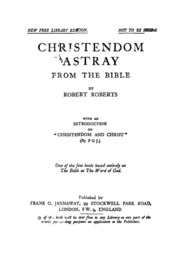
Christendom Astray From The Bible : Robert Roberts : Free Download, Borrow, and Streaming : Internet Archive
Book Source: Digital Library of India Item 2015.506999dc.contributor.author: Robert Robertsdc.coverage.spatial: londondc.date.accessioned:...archive.org
Roberts is a key figure in Christadelphian history. (See below.) He isn’t sure who the devil was in the temptation of the Messiah but he is certain that the devil was an external person. In other words, the temptation of Jesus was from without, not from within; Jesus wasn’t talking to himself in the wilderness.
Robert Roberts (Christadelphian) - Wikipedia
en.wikipedia.org
Fair statement...This thread is proving extremely challenging for those seeking evidence for such a being, especially in the absence of supporting texts.
The challenge lies in the terminology, as there are so many different descriptors for sin and evil.Fair statement...
I'm torn between the evil, the sin, the devil possessed by a human being and an external being. And then when demonic beings or spirits get into the act, it really becomes a very difficult subject to discuss, as there is evidence they are external beings. And then the devil and demons are different entities aren't they? One external and the other at least internal to all fallen human beings because of Adam.
The concept and personage or entity call the satan or the devil seems either to be a permanent external tester and accuser of anyone's relationship with God and yet the satan could also be a built-in tester within all of us, in all fallen men to reveal our relationship with God at any time. Peter once was accused by Jesus of having a devil within him as his faith was weak at that time. There was no external invisible entity or fallen angel attacking his senses, mind and heart at that time, it was all Peter doing it. And anyway how can a non-omnipresent fallen angel be everywhere with everyone at one time? Some with say 'he' delegated these accusatory duties to his army of demons around the world.The challenge lies in the terminology, as there are so many different descriptors for sin and evil.
The more you examine this belief, the clearer it becomes that it’s impossible for immortals, those possessing the divine nature to sin.There was no external invisible entity or fallen angel attacking his senses, mind and heart at that time, it was all Peter doing it. And anyway how can a non-omnipresent fallen angel be everywhere with everyone at one time? Some with say 'he' delegated these accusatory duties to his army of demons around the world.
That is not an acceptable answer. I believe God allows this accusatory evil force to come to life whenever he wishes, within each and every one of us. And this also included the human being we call Jesus, our savior.