

Who really created the Son of God?

  • Welcome to Christian Forums, a Christian Forum that recognizes that all Christians are a work in progress.

    You will need to register to be able to join in fellowship with Christians all over the world.

    We hope to see you as a part of our community soon and God Bless!

Status
Not open for further replies.

JustMe

Well-Known Member
May 6, 2025
1,172
1,333
113
US
Faith
Christian
Country
United States
Gender
Male
No. Scripture isn't flawed. It's inspired by God. What's flawed is your understanding of it.


Jesus Christ is God manifested in the flesh.

And without controversy great is the mystery of godliness:
God was manifested in the flesh,
Justified in the Spirit,
Seen by angels,
Preached among the Gentiles,
Believed on in the world,
Received up in glory. 1 Timothy 3:16


Sorry that you don't understand plain and clear words of scripture.


Jesus Christ is LORD; YHWH
JLB, I would like to leave you with more on the history of 1 Timothy 3:16 as @dak already pointed to, in his post. Keep it for future reference. I generated this years ago and improved upon it a bit. I really hope you can understand it, even after a few reads.

Thanks

-----------------------------------------------------

1 Timothy 3:16​

This verse is set as a creed as a hymn in poetic language.

The controversy centers around the use of the word ‘God’ or ‘who’ or ‘which, or ‘He.’ Now the message of the verse really does not alter by using any of the choices, although some will take the opportunity if the word is ‘God’ as the more acceptable word, as proof that Yeshua, the Son of God is also God the Son. And fail to realize the point of the verse is about Yahshua's’ life of godliness, shown in segments.

If God is used it surely does NOT mean God the Son is revealed in the flesh. It can mean that since God was in his Son, then his Father who is God was revealed through his Son, who was born human person. And if one of the other three choice of words was the best fit, then it would clearly reveal Yeshua the human being as part of the theme of godliness. And thus indicating his natural and yet unique method of creation.

Now from the start it must be said that the use of the word 'God' was a later insertion into the verse.

The majority of modern critical editions of the Greek New Testament, such as the Nestle-Aland and United Bible Societies' texts, favor the reading "He who was manifested in the flesh" or "Who was manifested in the flesh" based on the earliest extant manuscripts, including Codex Sinaiticus, Codex Alexandrinus, and others.

“God was manifested in flesh” is what we still have in the Textus Receptus but they who follow the Westcott & Hort / Nestle text do not have it.

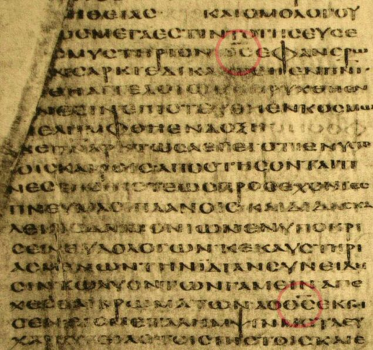
In An Historical Account of Two Notable Corruptions of Scripture (posthumously published in 1754), Isaac Newton argues that a small change to early Greek versions of this verse effectively changed "which" (referring to godliness) was changed to "God". This change increases textual support for trinitarianism, a doctrine to which Newton did not subscribe. There is evidence that the original Greek read 'ος' but was modified by the addition of a strikethrough to become 'θς' (see the excerpt from the Codex Sinaiticus, above). 'θς' was then assumed to be a contraction of 'θεος.' The biblical scholar Metzger explains, "no uncial (in the first hand) earlier than the eighth or ninth century (Ψ) supports θεος; all ancient versions presuppose ὃς or ὃ; and no patristic writer prior to the last third of the fourth century testifies to the reading of θεος."[24] In other words, Bible manuscripts closest to the original said 'who' and not 'God' in verse 16.

[ Source for paragraph above : First Epistle to Timothy - Wikipedia ]

The difference between these two readings has nothing to do with anyone wanting to "weaken the relationship between Father and Son"; it is simply a statement of fact consistent with the textual philosophy of the particular version being used. More specifically:

  1. If we accept that earlier manuscripts are more likely to have the original text, then we essentially arrive at the UBS5/NA28 text. In 1 Tim 3:16 this gives "he/who" uniformly for all early MSS
  2. If we accept the much later Byzantine text, then we essentially arrive at the Robinson-Pierpoint text (quite different from the TR but similar to the majority text). In 1 Tim 3:16 this gives "God".
The evidence from a number of Greek texts and textual authorities clearly indicates that the word “God” (theos in the Greek) was not originally in this verse. The King James Version was translated from the Stephens Greek text; and the Stephens Greek text does have in this verse the word theos, from which “God” was accurately translated. However, in Jesus Christ Is Not God, page 33, Dr. Victor Paul Wierwille reveals that in all the critical Greek texts other than Stephens, the masculine relative pronoun hos appears, instead of the word theos. These critical texts are documented in a note at the bottom of page 543 in The Interlinear KJV Parallel New Testament in Greek and English by George Ricker Berry. As noted in place of theos, these texts all have hos, meaning “who.”
The Companion Bible adds the understanding that it’s probable that an earlier reading was the neuter pronoun ho (which), to agree with mustērion, the Greek word translated “mystery,” which is also neuter. This agrees with the Syriac Version and all the Latin Versions….[1]

1 Timothy 3:16 in Codex Alexandrinus​

Reproduced below is the text of 1 Timothy 3:16–4:3 from Codex A, as presented in the photographic facsimile volume published by the British Museum in 1879. Of particular interest here is the reading in 3:16, where it may be seen that the manuscript reads ΘC "God was manifested in the flesh," employing the usual abbreviation ΘC for ΘEOC, with a stroke over the letters to indicate an abbreviation. However, textual critics believe that the ink in the center of the Θ and the stroke above were added by a corrector in modern times. Reasons for this belief are the color of the ink, and the fact that a "dot" has been placed in the Θ instead of a line. Tregelles writes, "The ink in which this has been done in A is sufficiently modern and black to declare its recent application" (An Account of the Printed Text of the Greek New Testament, London, 1854). Without these marks, the manuscript originally read ΟC "He who was manifested in the flesh." In the photograph below the ΘC in 3:16 is circled. Further down, in verse 4:3, there is another ΘC circled for comparison. Click on the circled areas for a larger view.[2]

1764726227729.png


1764726250363.png

[1] (Way, 2021)
[2] (1 Timothy 3:16 in Codex Alexandrinus)
 
Last edited:
  • Love
Reactions: dak

dak

Well-Known Member
Feb 9, 2013
1,457
188
63
Messianica
sites.google.com
Faith
Other Faith
Country
United States
Gender
Male
JLB, I would like to leave you with more on the history of 1 Timothy 3:16 as @dak already pointed to, in his post. Keep it for future reference. I generated this years ago and improved upon it a bit. I really hope you can understand it, even after a few reads.

Thanks

-----------------------------------------------------

1 Timothy 3:16​

This verse is set as a creed as a hymn in poetic language.

The controversy centers around the use of the word ‘God’ or ‘who’ or ‘which, or ‘He.’ Now the message of the verse really does not alter by using any of the choices, although some will take the opportunity if the word is ‘God’ as the more acceptable word, as proof that Yeshua, the Son of God is also God the Son. And fail to realize the point of the verse is about Yahshua's’ life of godliness, shown in segments.

If God is used it surely does NOT mean God the Son is revealed in the flesh. It can mean that since God was in his Son, then his Father who is God was revealed through his Son, who was born human person. And if one of the other three choice of words was the best fit, then it would clearly reveal Yeshua the human being as part of the theme of godliness. And thus indicating his natural and yet unique method of creation.

Now from the start it must be said that the use of the word 'God' was a later insertion into the verse.

The majority of modern critical editions of the Greek New Testament, such as the Nestle-Aland and United Bible Societies' texts, favor the reading "He who was manifested in the flesh" or "Who was manifested in the flesh" based on the earliest extant manuscripts, including Codex Sinaiticus, Codex Alexandrinus, and others.

“God was manifested in flesh” is what we still have in the Textus Receptus but they who follow the Westcott & Hort / Nestle text do not have it.

In An Historical Account of Two Notable Corruptions of Scripture (posthumously published in 1754), Isaac Newton argues that a small change to early Greek versions of this verse effectively changed "which" (referring to godliness) was changed to "God". This change increases textual support for trinitarianism, a doctrine to which Newton did not subscribe. There is evidence that the original Greek read 'ος' but was modified by the addition of a strikethrough to become 'θς' (see the excerpt from the Codex Sinaiticus, above). 'θς' was then assumed to be a contraction of 'θεος.' The biblical scholar Metzger explains, "no uncial (in the first hand) earlier than the eighth or ninth century (Ψ) supports θεος; all ancient versions presuppose ὃς or ὃ; and no patristic writer prior to the last third of the fourth century testifies to the reading of θεος."[24] In other words, Bible manuscripts closest to the original said 'who' and not 'God' in verse 16.

[ Source for paragraph above : First Epistle to Timothy - Wikipedia ]

The difference between these two readings has nothing to do with anyone wanting to "weaken the relationship between Father and Son"; it is simply a statement of fact consistent with the textual philosophy of the particular version being used. More specifically:

  1. If we accept that earlier manuscripts are more likely to have the original text, then we essentially arrive at the UBS5/NA28 text. In 1 Tim 3:16 this gives "he/who" uniformly for all early MSS
  2. If we accept the much later Byzantine text, then we essentially arrive at the Robinson-Pierpoint text (quite different from the TR but similar to the majority text). In 1 Tim 3:16 this gives "God".
The evidence from a number of Greek texts and textual authorities clearly indicates that the word “God” (theos in the Greek) was not originally in this verse. The King James Version was translated from the Stephens Greek text; and the Stephens Greek text does have in this verse the word theos, from which “God” was accurately translated. However, in Jesus Christ Is Not God, page 33, Dr. Victor Paul Wierwille reveals that in all the critical Greek texts other than Stephens, the masculine relative pronoun hos appears, instead of the word theos. These critical texts are documented in a note at the bottom of page 543 in The Interlinear KJV Parallel New Testament in Greek and English by George Ricker Berry. As noted in place of theos, these texts all have hos, meaning “who.”
The Companion Bible adds the understanding that it’s probable that an earlier reading was the neuter pronoun ho (which), to agree with mustērion, the Greek word translated “mystery,” which is also neuter. This agrees with the Syriac Version and all the Latin Versions….[1]

1 Timothy 3:16 in Codex Alexandrinus​

Reproduced below is the text of 1 Timothy 3:16–4:3 from Codex A, as presented in the photographic facsimile volume published by the British Museum in 1879. Of particular interest here is the reading in 3:16, where it may be seen that the manuscript reads ΘC "God was manifested in the flesh," employing the usual abbreviation ΘC for ΘEOC, with a stroke over the letters to indicate an abbreviation. However, textual critics believe that the ink in the center of the Θ and the stroke above were added by a corrector in modern times. Reasons for this belief are the color of the ink, and the fact that a "dot" has been placed in the Θ instead of a line. Tregelles writes, "The ink in which this has been done in A is sufficiently modern and black to declare its recent application" (An Account of the Printed Text of the Greek New Testament, London, 1854). Without these marks, the manuscript originally read ΟC "He who was manifested in the flesh." In the photograph below the ΘC in 3:16 is circled. Further down, in verse 4:3, there is another ΘC circled for comparison. Click on the circled areas for a larger view.[2]

View attachment 74828


View attachment 74829

[1] (Way, 2021)
[2] (1 Timothy 3:16 in Codex Alexandrinus)

Well said, well done!
WINNER!
 
  • Like
Reactions: JustMe

HealthyShape

Well-Known Member
Aug 29, 2025
1,827
673
113
Northeast
Faith
Christian
Country
United States
If you check a Concordance you will find that many people besides God are legitimately worshipped in scripture.
It is clearly forbidden. Many people in the Bible did many wrong things.

You don’t ignore any scripture. I don’t ignore any scripture. I understand every passage of scripture from a Hebraic perspective; you don’t.
Whatever the "Hebraic perspective" is supposed to mean, it is irrelevant. Christian perspective is relevant.

It means that Jesus is the Messiah, Son of the living God.
Come on, you should know it means much more. Saying "I am Christ" is not blasphemy worth of death. Study what "coming on the clouds of heaven" signifies in ancient Hebrew culture, if you really do not know. It refers to Yahweh.
 
  • Like
Reactions: David Lamb

HealthyShape

Well-Known Member
Aug 29, 2025
1,827
673
113
Northeast
Faith
Christian
Country
United States
So why do many still want to make/force Yeshua the man to be God is beyond me.
Because both the apostles and Jesus identified Him with God. What is so "beyond you" about it? It is said even explicitly on several places:

No one has ever seen God, but the one and only Son, who is himself God and is in closest relationship with the Father, has made him known.
J 1:18

"...awaiting the blessed hope and the appearing of the glory of our great God and Savior, Jesus Christ."
Titus 2:13

But unto the Son he saith, Thy throne, O God, is for ever and ever: a sceptre of righteousness is the sceptre of thy kingdom.
Hebrews 1:8

Or implicitly:
Jesus said to her, “I am the resurrection and the life.
J 11:25

No one has ever gone into heaven except the one who came from heaven - Son of Man.
J 3:13

Jesus replied. “But I say to all of you: From now on you will see the Son of Man sitting at the right hand of the Mighty One and coming on the clouds of heaven.”
Then the high priest tore his clothes and said, “He has spoken blasphemy! Why do we need any more witnesses? Look, now you have heard the blasphemy. What do you think?”
“He is worthy of death,” they answered.

Mt 26:64-66
 
Last edited:

Matthias

Well-Known Member
May 3, 2022
32,124
24,090
113
Kentucky
Faith
Other Faith
Country
United States
Gender
Male
It is clearly forbidden. Many people in the Bible did many wrong things.

I Chronicles 29:20 is a classic instance. The people did nothing wrong.

Whatever the "Hebraic perspective" is supposed to mean, it is irrelevant. Christian perspective is relevant.

You probably also don’t know what “Hellenic perspective” means. Basic Church history - the Christian perspective of the earliest Christians - Jewish monotheists - is Hebraic.

Come on, you should know it means much more.

It’s the whole point of the NT. Jesus of Nazareth is the Son of Man that the prophet Daniel - himself a Jewish monotheist - saw in his vision.

Saying "I am Christ" is not blasphemy worth of death.

That’s right.

Study what "coming on the clouds of heaven" signifies in ancient Hebrew culture, if you really do not know. It refers to Yahweh.

There is only one Yahweh. When you miss that elementary fact, you change the entire story.

As for ancient Hebrew culture, that’s part of the “Hebraic perspective” underpinning of my position against yours.
 

HealthyShape

Well-Known Member
Aug 29, 2025
1,827
673
113
Northeast
Faith
Christian
Country
United States
I Chronicles 29:20 is a classic instance. The people did nothing wrong.
The verse does not say that people worshiped David, explicitly. If you want to read it that way, then they were clearly wrong, because it is clearly forbidden to worship anyone else than Yahweh. Period.

There is only one Yahweh. When you miss that elementary fact, you change the entire story.
It would certainly change your entire story. Like many things do. Who is the angel of Yahweh in so many OT texts?
 
  • Like
Reactions: David Lamb

Matthias

Well-Known Member
May 3, 2022
32,124
24,090
113
Kentucky
Faith
Other Faith
Country
United States
Gender
Male
The verse does not say that people worshiped David, explicitly. If you want to read it that way, then they were clearly wrong, because it is clearly forbidden and even angels reject worship.

The verse clearly says that the people worshipped both David and Yahweh. The people weren’t wrong. You’re weak on ancient Jewish culture.


It would certainly change your entire story. Like many things do.
 

HealthyShape

Well-Known Member
Aug 29, 2025
1,827
673
113
Northeast
Faith
Christian
Country
United States
The verse clearly says that the people worshipped both David and Yahweh. The people weren’t wrong.
Then David said to the whole assembly, “Praise the LORD your God.” So they all praised the LORD, the God of their fathers; they bowed down, prostrating themselves before the LORD and the king.
NIV

The text says "Praise the Yahweh, your God". So they all praised Yahweh, the God of their fathers. They bowed down both before Yahweh and the king. Bowing before a king is/was not automatically worshiping him.

You’re weak on ancient Jewish culture.
It seems you are weak both on ancient Jewish culture and Christianity. Do not ignore my question - who was the angel of Yahweh in so many OT texts?
 

Matthias

Well-Known Member
May 3, 2022
32,124
24,090
113
Kentucky
Faith
Other Faith
Country
United States
Gender
Male
Then David said to the whole assembly, “Praise the LORD your God.” So they all praised the LORD, the God of their fathers; they bowed down, prostrating themselves before the LORD and the king.
NIV

The text says "Praise the Yahweh, your God". So they all praised Yahweh, the God of their fathers. They bowed down both before Yahweh and the king. Bowing before the king is not automatically worshiping him.

Consult any standard Hebrew Lexicon for shachah and any standard Greek Lexicon for proskuneo.

See also translations which render the words as “worship”.

It seems you are weak both on ancient Jewish culture and Christianity.

I taught both at the college level.
 

HealthyShape

Well-Known Member
Aug 29, 2025
1,827
673
113
Northeast
Faith
Christian
Country
United States
Consult any standard Hebrew Lexicon for shachah and any standard Greek Lexicon for proskuneo.

See also translations which render the words as “worship”.
If you want it read in that way, it does not change the fact that it is forbidden:

"For you shall worship no other god, for the LORD, whose name is Jealous, is a jealous God."
Exodus 34:14

"You shall worship the Lord your God and him only shall you serve."
Matthew 4:10

At this I fell at his feet to worship him. But he said to me, “Don’t do that! I am a fellow servant with you and with your brothers and sisters who hold to the testimony of Jesus. Worship God!
Rev 19:10

I taught both at the college level.
You already said that many times. It does not automatically mean you are good or honest in these things. Your bias towards modern Judaism can blind you regarding things that do not fit.

Who was the angel of Yahweh? For the third time. Hard question?
 
  • Like
Reactions: David Lamb

Matthias

Well-Known Member
May 3, 2022
32,124
24,090
113
Kentucky
Faith
Other Faith
Country
United States
Gender
Male
If you want it read in that way, it does not change the fact that it is forbidden:

"For you shall worship no other god, for the LORD, whose name is Jealous, is a jealous God."
Exodus 34:14

"You shall worship the Lord your God and him only shall you serve."
Matthew 4:10

At this I fell at his feet to worship him. But he said to me, “Don’t do that! I am a fellow servant with you and with your brothers and sisters who hold to the testimony of Jesus. Worship God!
Rev 19:10

“Worship” has a much broader range in the culture than you’re aware of.

You already said that many times. It does not automatically mean you are good or honest in these things.

Anyone with my educational background could confirm for you that what I’ve said about “worship” is correct. In addition to Lexicons, you should consult Commentaries.
 

HealthyShape

Well-Known Member
Aug 29, 2025
1,827
673
113
Northeast
Faith
Christian
Country
United States
“Worship” has a much broader range in the culture than you’re aware of.


Anyone with my educational background could confirm for you that what I’ve said about “worship” is correct. In addition to Lexicons, you should consult Commentaries.
Why did the angel forbid John to worship him? Who was the angel of YHWH? Who was the Son of Man in Daniel?
 
  • Like
Reactions: David Lamb

Matthias

Well-Known Member
May 3, 2022
32,124
24,090
113
Kentucky
Faith
Other Faith
Country
United States
Gender
Male

HealthyShape

Well-Known Member
Aug 29, 2025
1,827
673
113
Northeast
Faith
Christian
Country
United States
Do not dwell on what people in Israel did or did not do. Focus on the commandments: what is permitted and what is forbidden.

Are you allowed to worship anyone else than Yahweh, God?
 
  • Like
Reactions: David Lamb

JustMe

Well-Known Member
May 6, 2025
1,172
1,333
113
US
Faith
Christian
Country
United States
Gender
Male
Well said, well done!
WINNER!
Thank you. I have more commentaries on controversial scripture to give at the appropriate time...
 
  • Like
Reactions: dak

JustMe

Well-Known Member
May 6, 2025
1,172
1,333
113
US
Faith
Christian
Country
United States
Gender
Male
Because both the apostles and Jesus identified Him with God. What is so "beyond you" about it? It is said even explicitly on several places:

No one has ever seen God, but the one and only Son, who is himself God and is in closest relationship with the Father, has made him known.
J 1:18

"...awaiting the blessed hope and the appearing of the glory of our great God and Savior, Jesus Christ."
Titus 2:13

But unto the Son he saith, Thy throne, O God, is for ever and ever: a sceptre of righteousness is the sceptre of thy kingdom.
Hebrews 1:8

Or implicitly:
Jesus said to her, “I am the resurrection and the life.
J 11:25

No one has ever gone into heaven except the one who came from heaven - Son of Man.
J 3:13

Jesus replied. “But I say to all of you: From now on you will see the Son of Man sitting at the right hand of the Mighty One and coming on the clouds of heaven.”
Then the high priest tore his clothes and said, “He has spoken blasphemy! Why do we need any more witnesses? Look, now you have heard the blasphemy. What do you think?”
“He is worthy of death,” they answered.

Mt 26:64-66
Did you intentionally decide to highlight more contentious or suspected alterations of scripture as your primary evidence? I personally wouldn't if I were in your position. Credibility may be at stake. Would you like me to examine each one? You must be aware of what I'm referring to, I'm certain.
 

JLB

Well-Known Member
Mar 25, 2012
1,307
537
113
Spring Texas
Faith
Christian
Country
United States
Gender
Male
JLB, I would like to leave you with more on the history of 1 Timothy 3:16 as @dak already pointed to, in his post. Keep it for future reference. I generated this years ago and improved upon it a bit. I really hope you can understand it, even after a few reads.

Thanks

-----------------------------------------------------

1 Timothy 3:16​

This verse is set as a creed as a hymn in poetic language.

The controversy centers around the use of the word ‘God’ or ‘who’ or ‘which, or ‘He.’ Now the message of the verse really does not alter by using any of the choices, although some will take the opportunity if the word is ‘God’ as the more acceptable word, as proof that Yeshua, the Son of God is also God the Son. And fail to realize the point of the verse is about Yahshua's’ life of godliness, shown in segments.

If God is used it surely does NOT mean God the Son is revealed in the flesh. It can mean that since God was in his Son, then his Father who is God was revealed through his Son, who was born human person. And if one of the other three choice of words was the best fit, then it would clearly reveal Yeshua the human being as part of the theme of godliness. And thus indicating his natural and yet unique method of creation.

Now from the start it must be said that the use of the word 'God' was a later insertion into the verse.

The majority of modern critical editions of the Greek New Testament, such as the Nestle-Aland and United Bible Societies' texts, favor the reading "He who was manifested in the flesh" or "Who was manifested in the flesh" based on the earliest extant manuscripts, including Codex Sinaiticus, Codex Alexandrinus, and others.

“God was manifested in flesh” is what we still have in the Textus Receptus but they who follow the Westcott & Hort / Nestle text do not have it.

In An Historical Account of Two Notable Corruptions of Scripture (posthumously published in 1754), Isaac Newton argues that a small change to early Greek versions of this verse effectively changed "which" (referring to godliness) was changed to "God". This change increases textual support for trinitarianism, a doctrine to which Newton did not subscribe. There is evidence that the original Greek read 'ος' but was modified by the addition of a strikethrough to become 'θς' (see the excerpt from the Codex Sinaiticus, above). 'θς' was then assumed to be a contraction of 'θεος.' The biblical scholar Metzger explains, "no uncial (in the first hand) earlier than the eighth or ninth century (Ψ) supports θεος; all ancient versions presuppose ὃς or ὃ; and no patristic writer prior to the last third of the fourth century testifies to the reading of θεος."[24] In other words, Bible manuscripts closest to the original said 'who' and not 'God' in verse 16.

[ Source for paragraph above : First Epistle to Timothy - Wikipedia ]

The difference between these two readings has nothing to do with anyone wanting to "weaken the relationship between Father and Son"; it is simply a statement of fact consistent with the textual philosophy of the particular version being used. More specifically:

  1. If we accept that earlier manuscripts are more likely to have the original text, then we essentially arrive at the UBS5/NA28 text. In 1 Tim 3:16 this gives "he/who" uniformly for all early MSS
  2. If we accept the much later Byzantine text, then we essentially arrive at the Robinson-Pierpoint text (quite different from the TR but similar to the majority text). In 1 Tim 3:16 this gives "God".
The evidence from a number of Greek texts and textual authorities clearly indicates that the word “God” (theos in the Greek) was not originally in this verse. The King James Version was translated from the Stephens Greek text; and the Stephens Greek text does have in this verse the word theos, from which “God” was accurately translated. However, in Jesus Christ Is Not God, page 33, Dr. Victor Paul Wierwille reveals that in all the critical Greek texts other than Stephens, the masculine relative pronoun hos appears, instead of the word theos. These critical texts are documented in a note at the bottom of page 543 in The Interlinear KJV Parallel New Testament in Greek and English by George Ricker Berry. As noted in place of theos, these texts all have hos, meaning “who.”
The Companion Bible adds the understanding that it’s probable that an earlier reading was the neuter pronoun ho (which), to agree with mustērion, the Greek word translated “mystery,” which is also neuter. This agrees with the Syriac Version and all the Latin Versions….[1]

1 Timothy 3:16 in Codex Alexandrinus​

Reproduced below is the text of 1 Timothy 3:16–4:3 from Codex A, as presented in the photographic facsimile volume published by the British Museum in 1879. Of particular interest here is the reading in 3:16, where it may be seen that the manuscript reads ΘC "God was manifested in the flesh," employing the usual abbreviation ΘC for ΘEOC, with a stroke over the letters to indicate an abbreviation. However, textual critics believe that the ink in the center of the Θ and the stroke above were added by a corrector in modern times. Reasons for this belief are the color of the ink, and the fact that a "dot" has been placed in the Θ instead of a line. Tregelles writes, "The ink in which this has been done in A is sufficiently modern and black to declare its recent application" (An Account of the Printed Text of the Greek New Testament, London, 1854). Without these marks, the manuscript originally read ΟC "He who was manifested in the flesh." In the photograph below the ΘC in 3:16 is circled. Further down, in verse 4:3, there is another ΘC circled for comparison. Click on the circled areas for a larger view.[2]

View attachment 74828


View attachment 74829

[1] (Way, 2021)
[2] (1 Timothy 3:16 in Codex Alexandrinus)

Who do you believe Jesus Christ was before He became flesh?


God
Angel
Man
other
 
  • Like
Reactions: David Lamb

JustMe

Well-Known Member
May 6, 2025
1,172
1,333
113
US
Faith
Christian
Country
United States
Gender
Male
@HealthyShape ..a continuation of my brief previous post.

John 1:18​

There are some translations of the last 40 years or so that have suddenly taken liberties with the rendering of the Son in this subject verse. It is not new of this verse and is very deceptive and apparently a desperate attempt to force the Son to be also God. What a ridiculous idea.

The NIV and NASB represent theologians who believe that the original text read “ho monogenes theos” = “the unique, or only begotten God,” while the KJV is representative of theologians who believe that the original text was “ho monogenes huios” = “the only begotten Son.”

Here’s one example of it.

The Literal Standard Version (LSV) of recent years.

(LSV) No one has ever seen God; the only begotten God who is on the bosom of the Father—He has expounded Him.

Now does this make any sense at all. Do we find ‘God’ or another ‘God’ inside another we know as God, the Father?!

Another reason for favoring and keeping the “Son” over “God” is that the verse is about God being revealed by Jesus (John 1:17), because the verse started with the phrase, that no one had ever seen “God.” To call Jesus in that context “the only begotten God” (or the “unique God”) would set up an inherent contradiction. If you cannot see God, how could you see “the unique God?” The simple answer in the verse is that the Son is not God, and so while we cannot see God, we can see the only begotten Son who has made God known to us.[1]

It is difficult to conceive of what “only begotten God” would have meant in the Jewish culture. There is no use of the phrase anywhere else in the Bible. In contrast, the phrase “only begotten Son” is used three other times by John (John 3:16, 18; 1 John 4:9 – KJV). To a Jew, or Judahite, any reference to a “unique God” would have usually referred to the Father. Although the Jews of John’s day would have had a problem with “only begotten God,” Christians of the second century and beyond, with their increasingly paradoxical understanding of Christology and the nature of God, would have been much more easily able to accept such a doctrine.[2]

The reason that the text was likely changed from “Son” to “God” was to provide “extra evidence” for the existence of the Trinity. By the second century, an intense debate about whether or not Jesus was God raged in Alexandria, Egypt, the place where all the texts that read “God” originated. The stakes were high in these debates, and excommunication, banishment or worse could be the lot of the “loser.” Changing a text or two to in order to “help” in a debate was a tactic proven to have occurred. An examination of all the evidence shows that it is probable that “the only begotten son” is the original reading of John 1:18. [3]

Even if the original text reads “God” and not “Son,” that still does not prove the Trinity. The word “God” has a wider application in Hebrew, Aramaic and Greek than it does in English. It can be used of men who have divine authority (See John 10:33 and Heb. 1:8). There is no “Trinitarian Formula” in this verse that forces a Trinitarian interpretation.

The King James Version (KJV)

(KJV) No man hath seen God at any time; the only begotten Son, which is in the bosom of the Father, he hath declared him.

This KJV is much closer to the translation of its original conception.

Fortunately, there are only about 10 percent of the translations of this verse that are skewed and altered with a mean bias toward a religious-mythological Jesus.

The standing question is why do some force the Son of God to be a hybrid God-man when the overwhelming scriptural evidence says he is not, and infers it’s an impossibly?


[1] (John 1:18, 2025)
[2] (John 1:18, 2025)
[3] (John 1:18, 2025)
----------------------------------------------------------------------------------------------------------------------------------
HS: Can you also cite the version of scripture you use. As you can see it does make a huge difference at times in what you get, truth or deception.

If you continue to be deceptive in your posts as you've already shown, then the public will certainly know you have an agenda and possibly an axe to grind. The truth does sometimes hurt.
 

JustMe

Well-Known Member
May 6, 2025
1,172
1,333
113
US
Faith
Christian
Country
United States
Gender
Male
Who do you believe Jesus Christ was before He became flesh?


God
Angel
Man
other
If you are attempting to apply a manipulative tactic that potentially reveals your narcissistic behavior, to bait me and then label me, for your own shallow satisfaction, then that would be a sorry reason to continue to converse with me don't you think. You intentions are most probably are not above-board.

Anyway, to satisfy your curiosity with these elementary exchanges as is this one, scripture strongly suggests and infers the Son of God never existed until his creation and birth in Bethlehem as the son of man, of God, of his Father.

And I have a question for you. Who and what do you think the Son of God is today, with his Father in the heavenly realm. Still a human being of a transformed human immortal spirit, or something else.
 

JLB

Well-Known Member
Mar 25, 2012
1,307
537
113
Spring Texas
Faith
Christian
Country
United States
Gender
Male
If you are attempting to apply a manipulative tactic that potentially reveals your narcissistic behavior, to bait me and then label me, for your own shallow satisfaction, then that would be a sorry reason to continue to converse with me don't you think. You intentions are most probably are not above-board.

Anyway, to satisfy your curiosity with these elementary exchanges as is this one, scripture strongly suggests and infers the Son of God never existed until his creation and birth in Bethlehem as the son of man, of God, of his Father.

I asked a simple question.


Who do you believe Jesus Christ was before He became flesh?


God
Angel
Man
other


I will give my answer, and the scripture from which my answer comes from.


Jesus Christ before He became flesh was God; YHWH


And without controversy great is the mystery of godliness:
God was manifested in the flesh,
Justified in the Spirit,
Seen by angels,
Preached among the Gentiles,
Believed on in the world,
Received up in glory.


Ok, there’s my answer.


What’s your answer?
 
Status
Not open for further replies.